There are two broad ways for an interceptor missile to stop a target. One is to get close and burst. The other is to hit the target body itself. When the news mentions "hit-to-kill" or a "blast fragmentation warhead," it is naming one of these two.
How do they differ? And when did U.S. ballistic missile defense (BMD) start moving toward hitting? Public U.S. congressional reports and academic sources answer both questions.
The two ways at a glance
A 2024 defense primer from the Congressional Research Service (CRS) describes U.S. land- and sea-based interceptors in two groups. One group uses hit-to-kill, or direct impact. The other carries blast fragmentation warheads.
Hit-to-kill goes by several names. It is also called direct impact or kinetic energy interception. All of these names point to the same idea: destroying the target by the collision itself.
Blast fragmentation: get close, then burst
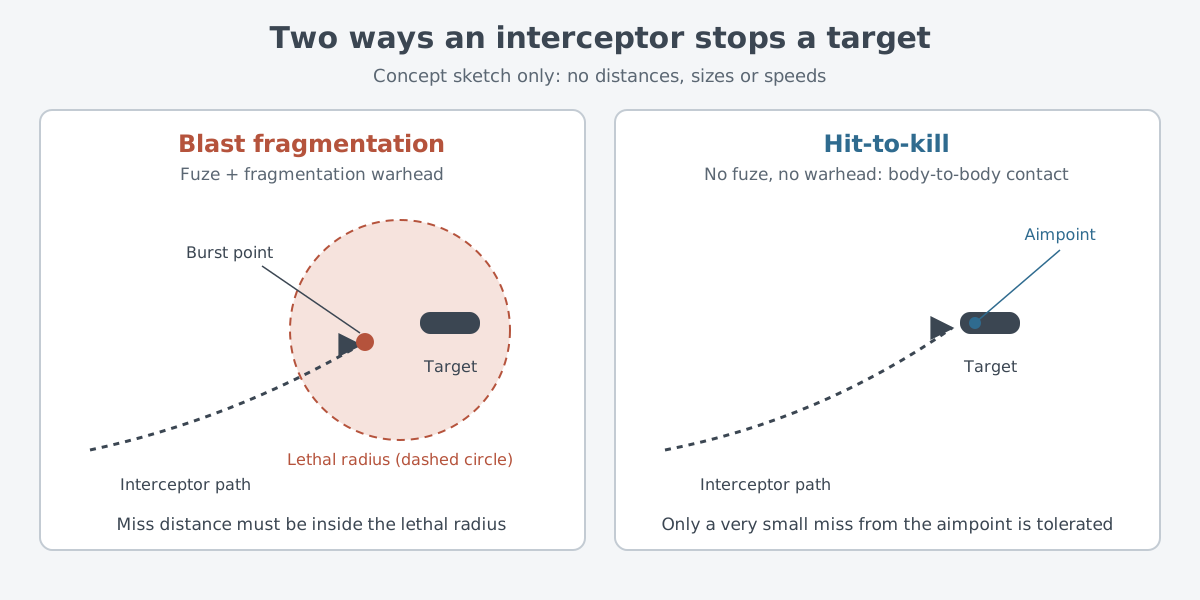
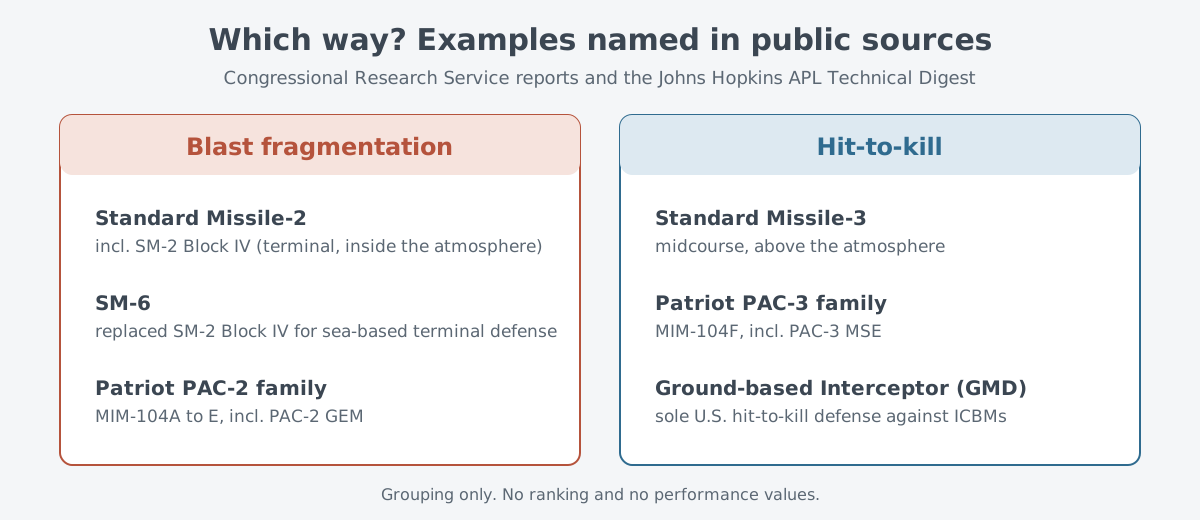
An interceptor is guided to shrink the final gap to its target, called the miss distance. Even so, a sizable gap can remain at the moment of closest approach. So the missile carries a fuze and a fragmentation warhead, and it bursts across that gap to break the target with fragments. The technical journal of the Johns Hopkins Applied Physics Laboratory (APL) names Standard Missile-2 and the Patriot PAC-2 variants as examples.
The fuze decides when to burst. A proximity fuze senses that it is near the target and fires on its own. Its principle and history have their own article: Proximity fuzes.
Hit-to-kill: body against body
Recent designs for missile defense above the atmosphere do away with both. They destroy the target through body-to-body contact while closing at high speed. The usual labels for them are "direct-hit" and "hit-to-kill."
With nothing exploding, where does the damage come from? The answer is the energy of motion, kinetic energy. In a physics textbook, kinetic energy is half the mass times the square of the speed. Because speed is squared, doubling the speed of the same object gives four times the kinetic energy.
Picture two bicycles colliding head-on. The faster they approach each other, the harder the impact. A real intercept differs in two ways: the speeds are far higher, and the strike has to land on one chosen aimpoint on the target body.
How much miss each way can tolerate
The biggest difference between the two is how much miss they can absorb. When the missile carries a blast fragmentation warhead, the last miss must fall inside the lethal radius of the warhead. In the words of the APL journal, the lethal radius makes up for some lack of guidance precision.
A hit-to-kill missile is different. Its strike has to land very close to one chosen aimpoint on the body of the target. Any larger miss costs it the ability to destroy. The SM-3 and the Patriot PAC-3 missiles belong to this group.
The direction of approach matters as well. For hit-to-kill, it is set for good body-to-body impact. For blast fragmentation, it is set so the fuze and warhead work well and more fragments reach the target. The eye at the front of the missile that finds the target is covered in Missile seekers.
How hit-to-kill began
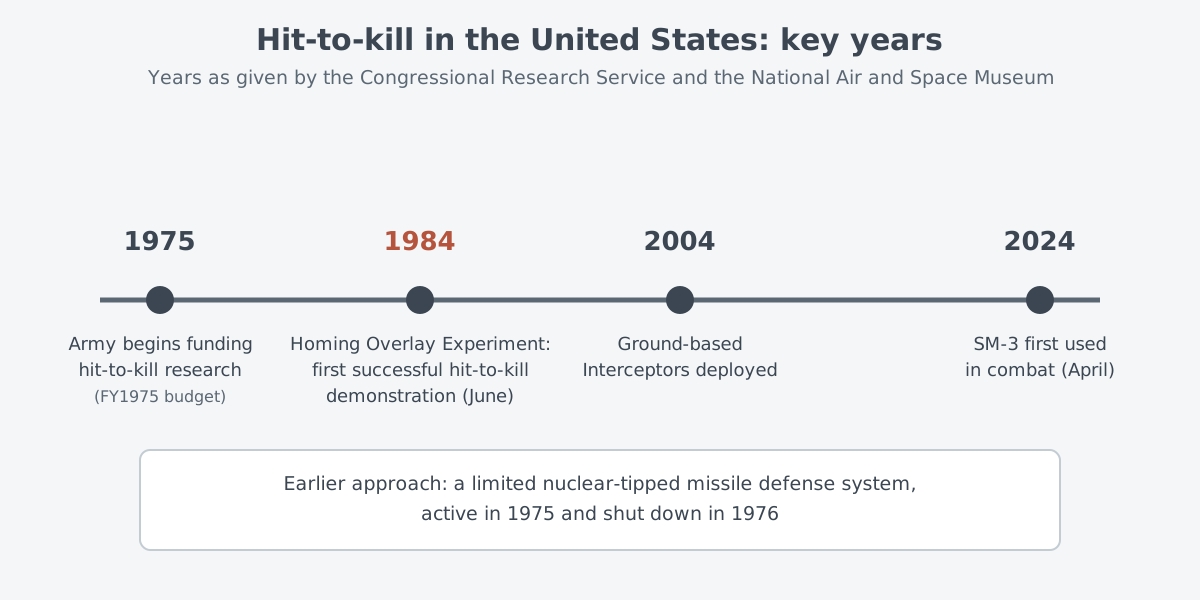
Before hit-to-kill, the United States took a different path. The CRS primer says the country fielded a limited missile defense system with nuclear warheads around the turn of the 1970s. It went into operation in 1975, then closed a year later, in 1976, because of worries about its cost and how well it worked.
Starting with the FY1975 budget, the Army funded research on kinetic energy interceptors, the hit-to-kill kind, as another option. This type of interceptor now leads U.S. missile defense.
According to the Smithsonian National Air and Space Museum, the first successful demonstration came in June 1984. The museum keeps a test vehicle built for an Army program called the Homing Overlay Experiment (HOE). The museum explains that after leaving its booster, the vehicle was meant to find and lock on to an incoming missile with its own sensors and then strike it. In June 1984, on the fourth and last test, a vehicle struck a dummy warhead, the first time hit-to-kill technology was shown to work.
The hit-to-kill vehicles in today's deployed U.S. interceptors are far smaller. Such a vehicle is also called a kinetic kill vehicle (KKV).
Which way today's interceptors use
Public sources show both ways still in use.
At sea, ships with the Aegis combat system carry the SM-3. It is built to meet ballistic missiles in the middle of their flight, outside the atmosphere, and it uses a hit-to-kill warhead. The SM-2 Block IV was meant for the final phase, inside the atmosphere, and carried a blast fragmentation warhead. The SM-6 has now taken its place.
The SM-6 also uses blast fragmentation. A CRS report quotes December 2023 testimony from the Missile Defense Agency (MDA). In it, MDA said the SM-6, which kills by blast fragmentation, was the one interceptor that could offer a limited defense against hypersonic missiles.
On land, the Patriot name covers both ways, and a description quoted by CRS splits the family in two. The MIM-104A to E group, including PAC-1 and PAC-2, uses blast fragmentation against aircraft and has a limited role against tactical ballistic missiles. The MIM-104F group, PAC-3 and PAC-3 MSE, is far smaller and was made for ballistic missiles. The PAC-3 MSE is described as a fast, hit-to-kill missile fired from the ground at air targets.
CRS calls GMD, short for Ground-based Midcourse Defense, the only U.S. hit-to-kill defense against intercontinental ballistic missiles (ICBMs). It is designed for a limited attack from North Korea or Iran. Its Ground-based Interceptors (GBI) have stood in Alaska and California since 2004.
At sea, the SM-3 saw its first combat use in April 2024. How these layers overlap by flight phase is covered in Layered missile defense.
Open problems
Hit-to-kill tolerates only a very small miss, so it places heavy demands on guidance precision. Blast fragmentation eases that demand through the lethal radius. Even so, recent designs for missile defense above the atmosphere chose hit-to-kill without a fuze or warhead.
Problems can remain even after a successful intercept. Writing about intercepts in the boost phase, while a missile is still climbing, the National Research Council (NRC) points to the "shortfall" problem. Even a successful intercept can send pieces such as engines and fuel tanks down onto friendly or neutral territory. A nuclear weapon could also come down whole and still armed.
Where this meets lasers
The same NRC chapter compares this with lasers. The boost phase is short, so there is little time to carry out the intercept. The NRC says this time limit weighs far more on kinetic systems than on laser-kill systems. The NRC adds that either kind needs very fast detection of the launch and a quick decision to engage, and it calls this a formidable operational challenge.
For what a laser weapon is and where its limits lie, continue with What is a laser weapon?.
What to read next
- Proximity fuzes: the device that decides when a blast fragmentation warhead bursts
- Layered missile defense: how interceptors divide the flight phases
- Surface-to-air missiles: the wider family that interceptors belong to
- What is a laser weapon?: another path, using light instead of a flying missile