Once or twice a week, with two or three targets on each day of attack. That was the forecast in a cable Washington sent to the U.S. embassy in Saigon on February 13, 1965. One year and eight months later, attack sorties over North Vietnam had reached 12,000 a month.
This bombing, started small and raised step by step, was Operation Rolling Thunder. It ran for more than three years, until November 1968, and opinion inside the U.S. government split sharply over what it achieved.
Why did officials conclude that the bombing fell short of its goals, even after it grew so large? Meeting notes and memos from the time, now declassified, answer in several different voices.
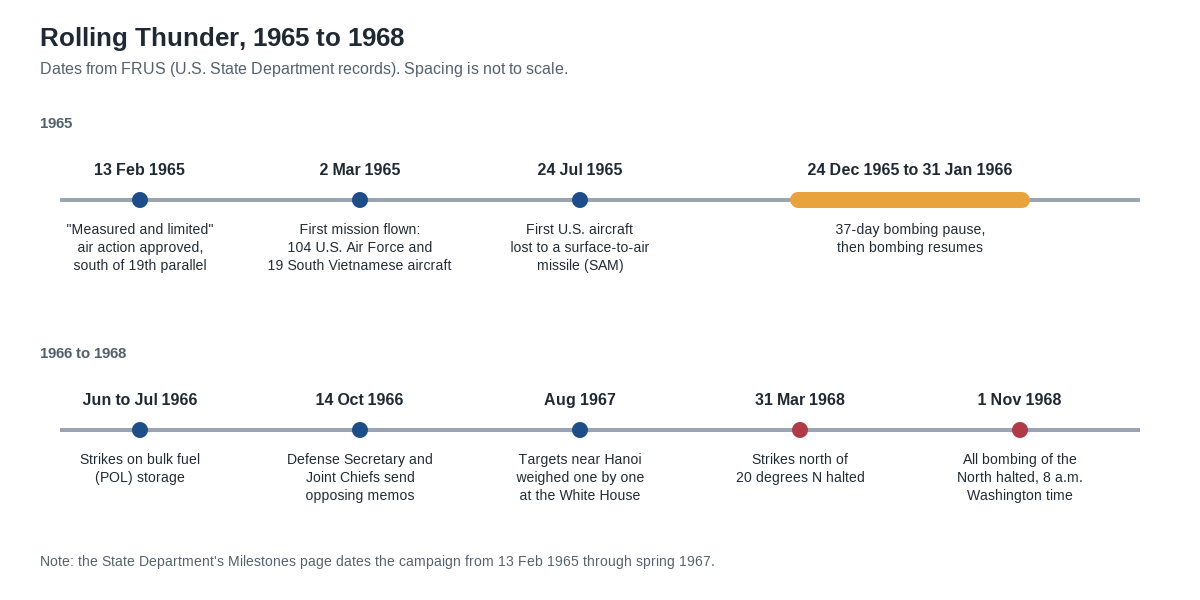
The first plan: south of the 19th parallel, until further notice
The background is the Gulf of Tonkin incident and the congressional resolution of summer 1964. The State Department's Office of the Historian explains that President Johnson and his advisers launched the campaign believing that heavier raids would wear Hanoi down over time.
The key line of the plan the President approved on February 13 was short. Together with the South Vietnamese government, the United States would take "measured and limited air action" against selected military targets in the North. The area was south of the 19th parallel. The time frame was "until further notice."
The plan set limits on the area but no end date. That open end is a useful key to the three years that followed.
The first mission and the first losses
The first Rolling Thunder mission actually flew on March 2. A force of 104 U.S. Air Force B-57s, F-100s and F-105s flew with 19 South Vietnamese Skyraiders. Their targets were the Quang Khe naval base and the Xom Bang ammunition depot, which lay just above the DMZ.
Anti-aircraft fire brought down six U.S. aircraft, and rescuers recovered five of the six pilots. Neither Washington nor Saigon announced the raid.
That is why sources give two different start dates. February 13 is the day the President approved the plan, and March 2 is the day the first mission took place.
On July 24 a new kind of loss came. A surface-to-air missile brought down a U.S. F-4. It was the first aircraft lost to the SAMs set up by Soviet technicians.
Two days later, at a White House meeting, the President himself asked about the SAM problem. Details of the bombing kept landing on the President's table after that.
Pause, then widen: the steps of 1966
On December 24, 1965, the bombing stopped. Thirty-seven days later, on January 31, 1966, the United States resumed bombing North Vietnam.
The next step was fuel. In early June 1966, Joint Chiefs chairman General Wheeler wrote in a cable that authority to strike the petroleum (POL) system had been almost within reach. Around the same time, British Prime Minister Wilson was briefed on the plan and told Johnson he would have to distance himself from that move. He added that he still backed Johnson's overall Vietnam policy.
Large fuel storage sites were struck in June and early July. A CIA appraisal of July 23 judged that roughly half of the targeted storage capacity that existed on June 28 had been lost.
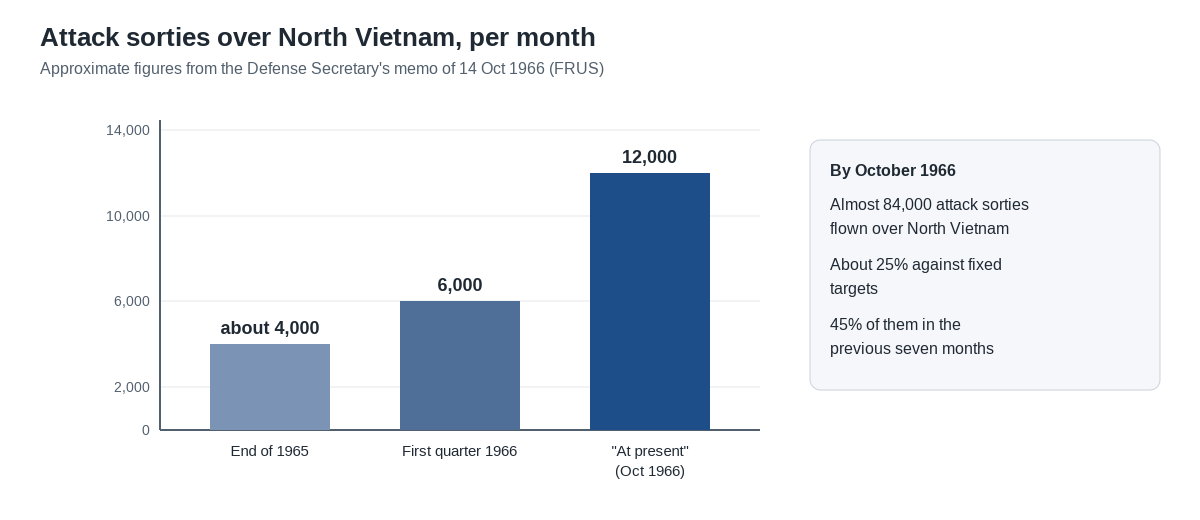
Sorties grew at the same pace. Defense Secretary McNamara's memo of October 14, 1966 tracks the rise. Attack sorties over the North were about 4,000 a month at the end of 1965 and 6,000 a month in the first quarter of 1966. When he wrote, they stood at 12,000 a month.
By then almost 84,000 attack sorties had been flown over North Vietnam, and about 25% of them had gone against fixed targets.
Two memos on the same day
On October 14, 1966, McNamara told the President in a memo that Rolling Thunder had neither cut infiltration into the South in any major way nor broken Hanoi's morale. He added that the intelligence agencies agreed on this. His advice was to "stabilize" the bombing: hold it at its current level instead of raising it further.
The Joint Chiefs of Staff sent a memo the same day that pointed the other way. They called it a "restricted" air campaign, yet said it had destroyed large amounts of military supplies and facilities and badly damaged transport routes. They also noted that North Vietnam had been forced to shift at least 300,000 people out of farming and industry into repair work. They did not agree with holding the bombing level steady, and they called the bombing one of the President's two trump cards.
Views inside the CIA were not uniform either. Carver, the agency's special assistant for Vietnamese affairs, wrote that he did not accept the hint that changes to the bombing plan could make no difference. In his judgment, closing the port of Haiphong while repeatedly cutting the railways running to China might have a large effect.
Why officials judged it fell short
McNamara's memo carried supporting papers in an appendix. The most specific was the conclusion of a summer study group at the Institute for Defense Analyses (IDA). North Vietnam did not make the supplies, and it was not the bottleneck that aid from China and the Soviet Union had to pass through. Hitting the North therefore did not shrink the flow heading south.
The study group gave more reasons. North Vietnam was very good at improvising when transport was cut. Its economy was simple, so the bombing reached only part of the population directly. Foreign economic aid was large compared with the damage done, and it was growing.
Two CIA reports pointed the same way. A March 1966 report said movement of people and goods inside North Vietnam had become harder and more costly, yet the flow to the South had actually grown. The July report said that despite strain on the economy, the North had mostly met its military needs, and its leaders' will to keep fighting had not weakened.
The two camps read the same results differently. One side saw a built-in limit to what bombing the North could do in this war. The other side blamed the limits placed on areas and targets.
This was not the first time the effect of bombing had divided opinion. The strategic bombing debate after World War II is an earlier example.
Targets on the White House table
The notes of a meeting on August 18, 1967 show how decisions on this bombing were made. General Wheeler spread out a map marked with 10 targets, and the President and his secretaries weighed the targets one at a time.
One depot target at the northern edge of Hanoi came with an estimate of 30 civilian casualties. McNamara pointed out that this was higher than the estimates of 5, 10 or 15 for other targets. Because the area was heavily populated, he advised against approving it that night.
Civilian harm was not the only weight. In 1966, some officials wanted to delay the fuel strikes because of talks with Britain and a Canadian diplomat's peace mission to Hanoi. McNamara also saw the bombing as a bargaining chip to get talks started. This bombing was a military operation and a tool of diplomacy at the same time.
1968: two halts
The direction changed after the Tet Offensive in early 1968. By 1 p.m. on March 31, Defense Secretary Clifford had sent the Joint Chiefs an order. It halted every strike on the North beyond 20 degrees north, effective at 7 p.m. that day. In a national address at 9 p.m. that same night, Johnson said he would not run for another term.
The final halt came in a speech at 8 p.m. on October 31. Bombing of North Vietnam would stop at 8 a.m. on November 1, Washington time, and four-party talks could open in Paris on November 6. Counted from the first mission, the campaign lasted about three years and eight months.
Sources do not agree on when it ended. The Office of the Historian's overview page says the operation continued through the spring of 1967, while the FRUS document volumes record the two halts of 1968. The timeline in The Vietnam War at a Glance follows the overview page.
Where this meets lasers
In the Rolling Thunder years, bombing was counted in sorties. North Vietnam's Thanh Hoa Bridge shows the limit of that approach. Over six years the United States dropped hundreds of bombs on the bridge and lost aircraft and pilots. The bridge finally fell in April 1972 to a small number of laser-guided bombs.
The Johns Hopkins Applied Physics Laboratory (APL) technical digest uses this scene as an example of weapons that home on a spot lit by a laser.
That shift from "more" to "more accurate" leads into the later era of precision-guided munitions (PGM). The bridge's own story is told in The Thanh Hoa Bridge, 1972.
Read next
- The Gulf of Tonkin Incident: What the Declassified Records Say: the event used to justify this bombing
- The Tet Offensive: When the Military Result and Public Opinion Split: what came just before the March 1968 change of course
- The Thanh Hoa Bridge, 1972: How Laser-Guided Bombs Changed Bombing: hundreds of bombs, then a few
- The Strategic Bombing Debate: Did Bombing Cities End the War?: an older argument about what bombing can do
- Operations Linebacker I and II (1972): Precision-Guided Weapons and the B-52: the two bombing campaigns of 1972 after Rolling Thunder