On 30 January 1968, South Vietnam was entering the Tet holiday. It is the most important holiday of the Vietnamese year, a time when families gather in their home villages. Both sides had announced truces for the holiday. During it, North Vietnamese and Viet Cong forces attacked most of South Vietnam's cities at once, including the capital, Saigon.
Within weeks the attackers had been pushed out of most of those cities. Yet two months later, on the night of 31 March, President Lyndon B. Johnson announced that he was stopping most of the bombing of North Vietnam and would not run for another term. Why did the result on the battlefield and the mood at home in the United States move in different directions?
This article follows those two months through two sets of records. One is the Foreign Relations of the United States (FRUS), a collection of diplomatic documents from the State Department's Office of the Historian. The other is the US National Archives (NARA). All of them are American records, so Hanoi's plans and losses appear only as US agencies described them.
Why the lunar new year
Ho Chi Minh and Hanoi's leaders wanted a decisive win to close out a long war that had frustrated commanders on both sides. If strikes on the big cities worked, they thought, Washington might be pushed into talks or even out of the war.
The FRUS editors, writing in 2002, list four aims for the offensive. The first two were a popular revolt against the Americans and Saigon's government, and insecurity across the South. The other two were pulling forces away from Khe Sanh and a better bargaining position for later peace talks.
The timing had its reasons too. Tet had long been a season of truce, and the movement of fighters was hidden among the crowds traveling to spend the holiday with relatives. The forces for the offensive had slipped into those areas during the weeks before.
The two sides announced different truces. Weeks ahead, the North and the Viet Cong had gone public with plans for a seven-day truce. The South Vietnamese government and its allies announced a 36-hour truce. Tet itself normally runs for four days.
Attacks on the cities all at once
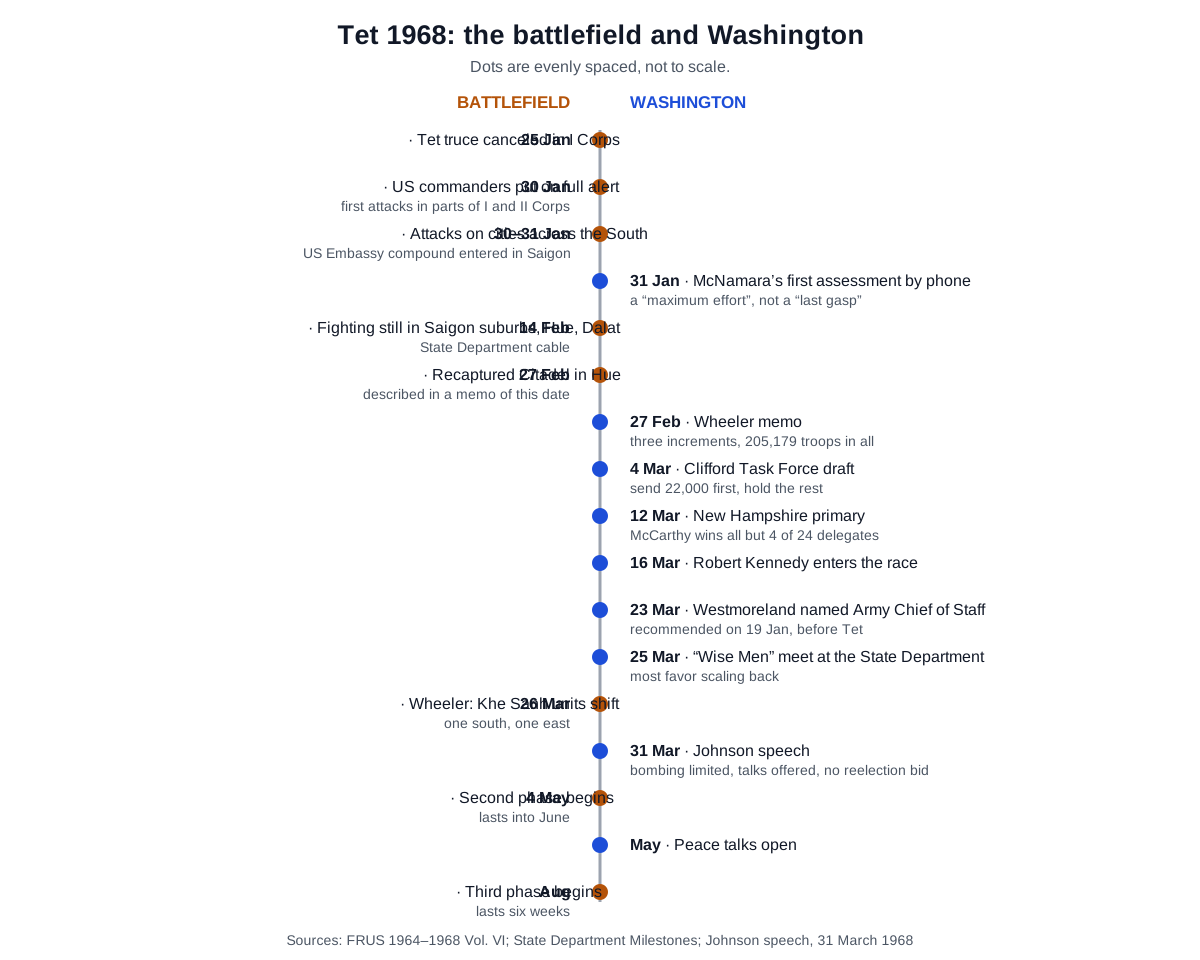
Attacks came first on 30 January in some areas of the I and II Corps zones. Over 30 and 31 January, Saigon, the six biggest cities and most province capitals, the main towns of each province, came under attack. The targets were mostly crowded areas and places with many US troops.
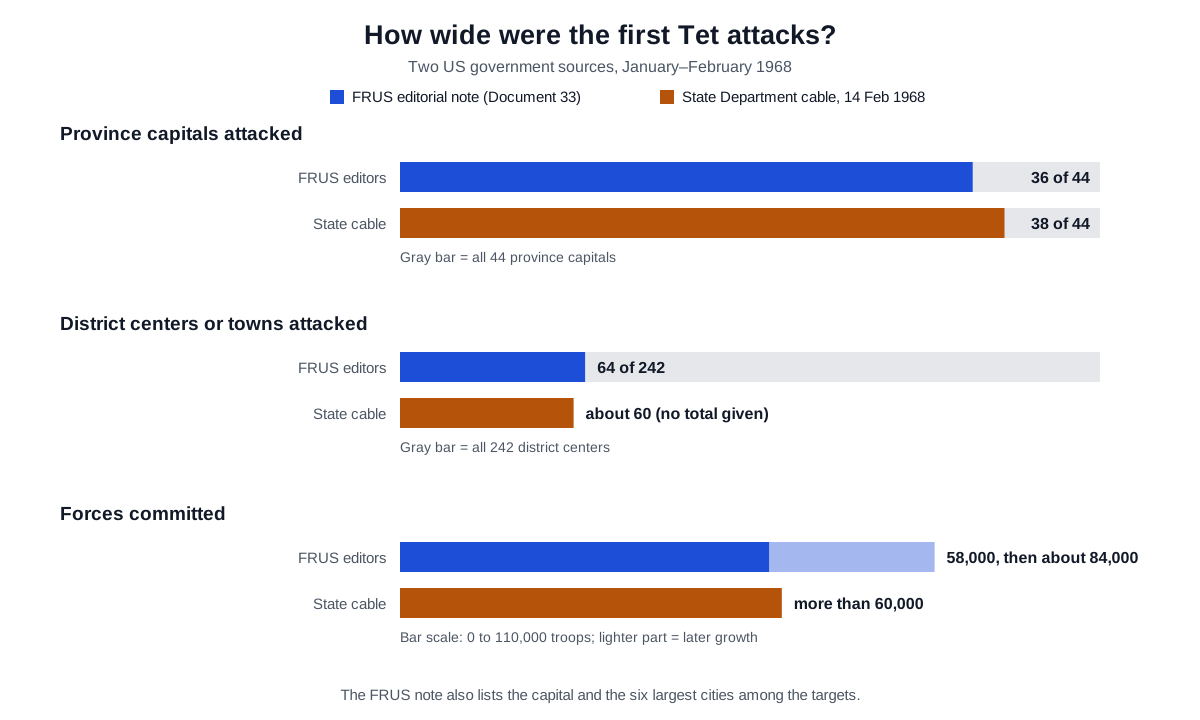
The numbers differ a little by source. The FRUS editorial note says 36 of 44 province capitals and 64 of 242 district centers were attacked. It puts the force at 58,000 at first, soon rising to about 84,000. A State Department cable sent to US posts abroad on 14 February counted 38 of 44 province capitals, about 60 district towns and more than 60,000 troops.
In Saigon, sapper teams made it into the grounds of the US Embassy, into the Presidential Palace and onto Tan Son Nhut airport. The fight at the embassy lasted more than six hours, and all 19 attackers who got in were killed or wounded. Hue, the old imperial capital, fell after an assault of only a few hours.
On the morning of 31 January, Secretary of Defense Robert S. McNamara gave the president his first assessment by phone. He did not see it as a last gasp but as a maximum effort that poured out everything the attackers had. Even after heavy losses, he expected them to remain a substantial force.
The uprising the offensive hoped for did not come. Communist cadres had been told that people would rise up and welcome them as liberators. No such response followed. In his 31 March speech, Johnson said none of the over 30 cities the attackers struck stayed in their hands, and that their casualties were very heavy.
Hue, Khe Sanh and three waves
In mid-February the fighting was still not over everywhere. On 14 February, fighting still continued on Saigon's outskirts, in Dalat and in part of Hue. A memo dated 27 February already describes a ceremony at Hue's Citadel after it was retaken, watched by many thousands of residents.
Wheeler's memo of 27 February says that US forces were carrying the brunt of the fighting at Hue. A month later, on 26 March, General Creighton Abrams told the president that the South Vietnamese 1st Division had cleared two thirds of the Citadel.
The division's losses survive differently in the records. The notes of the 26 March meeting say it lost two thirds of its strength. The record of the next day's National Security Council meeting says it took 10% casualties (30% in the rifle battalion) but kept fighting.
The people of the cities were in the middle of the fighting. Among the photographs NARA has published is a young widow at a mass funeral for Tet victims in Hue, holding a picture of her missing husband. Another shows old people and children who fled the fighting and reached the south shore of the river past a blown bridge.
The Khe Sanh combat base was another stage. On 8 February, General Walt, the Assistant Commandant of the Marine Corps, wrote to a White House adviser about Khe Sanh. He called it the northwest anchor of the whole Quang Tri–Thua Thien defense sector. He added that it sat where several natural routes into South Vietnam from Laos and North Vietnam met.
On 26 March, General Earle Wheeler, Chairman of the Joint Chiefs of Staff, said one North Vietnamese unit around Khe Sanh had pulled back south and another had moved east. What he said about Khe Sanh survives a little differently in two records. In the notes of that meeting, he said Khe Sanh had "served a useful purpose" by holding two enemy divisions around it. The record of the next day's National Security Council meeting has him saying the base seems to have suited North Vietnamese aims.
The offensive did not end with one wave. A second phase struck smaller cities and towns at once on 4 May and lasted into June, and a third phase opened in August and ran for six weeks. Over the following months, US and South Vietnamese troops won back the towns the attackers had seized, but with heavy military and civilian casualties.
Was there a warning
Did the United States not see an offensive this large coming? The FRUS editorial note says the US intelligence community gave some forewarning of the general offensive, though not full details. Intelligence drawn from reading enemy communications gave clear warning of attacks bigger than any seen before. Yet the evidence was not enough to predict the exact timing.
The warnings did lead to action. On 25 January the Tet truce was canceled in the I Corps area. On 30 January, just before the main attacks, General William C. Westmoreland, the US commander in Vietnam, put US commanders across South Vietnam on full alert.
Judgments differed. The final report to the President's Foreign Intelligence Advisory Board (PFIAB) was finished on 7 June and reached Johnson on 11 June. It found no basis for accusing the intelligence services of a major failure. It added a caveat: assessments produced in Washington lacked the sense of urgency felt in Saigon.
Others saw it differently. On 16 February, Director of Central Intelligence Richard Helms said intelligence before Tet had fallen short in predicting the exact time, wide scale and intensity of the urban attacks. An interim report from 8 April notes that most people who knew an attack was coming did not picture the enemy reaching its stated goals. Those goals appeared in its propaganda and in captured documents.
A memo by Henry Kissinger, released by the Nixon Library, says the shock of Tet came partly from failing to analyze the available intelligence accurately.
Even with warnings, the South Vietnamese army was in a weak position. When the attacks came, most South Vietnamese units had half of their men home on Tet leave.
Numbers on the battlefield, arithmetic in Washington
By 12 February, South Vietnam had lost more than 2,100 soldiers killed, with almost 8,000 wounded. US losses were about 1,000 dead and 5,000 wounded. Caught by surprise, with some troops on leave, the South Vietnamese army still took the heaviest part of the attack.
Views of the South Vietnamese army were not uniform. On 20 February, 97 of its battalions were rated effective and 58 ineffective. Wheeler wrote that there was some question whether it had the stamina for a long enemy offensive. On 27 March, Abrams reported that only 8 of 149 maneuver battalions had performed unsatisfactorily, while 30 had distinguished themselves.
Civilian suffering does not fit into a single number. Johnson said half a million people had become refugees because of the attacks and the fighting after them. In Cholon, a suburb of Saigon, South Vietnamese troops burned streets to flush out remaining Viet Cong fighters. An evaluation memo from the US Embassy side says the attackers sought out local leaders to kill or kidnap them.
Fighting by both sides placed a heavy burden on city residents.
For the US military, too, 1968 was a heavy year. In the Defense Department records NARA has published, 16,899 US deaths have 1968 as the year of death or incident. That is the most of any year, and more than the 11,363 and 11,780 of the years on either side. NARA notes that these are record counts for information, not official statistics.
Washington's arithmetic began with Wheeler's memo of 27 February. He had spent most of three days with commanders in the field. He reported that the offensive had not run its course and that the first attacks had nearly succeeded in about a dozen places. He also wrote that 1968 would be the pivotal year, and that the pacification program had stopped in many areas.
The memo also covers equipment and logistics. As US forces had to rush to more places, the number of helicopters on hand mattered more, with battlefield losses rising. Airlift inside the country was becoming more critical, logistics support in northern I Corps was marginal, and equipment loss rates were up.
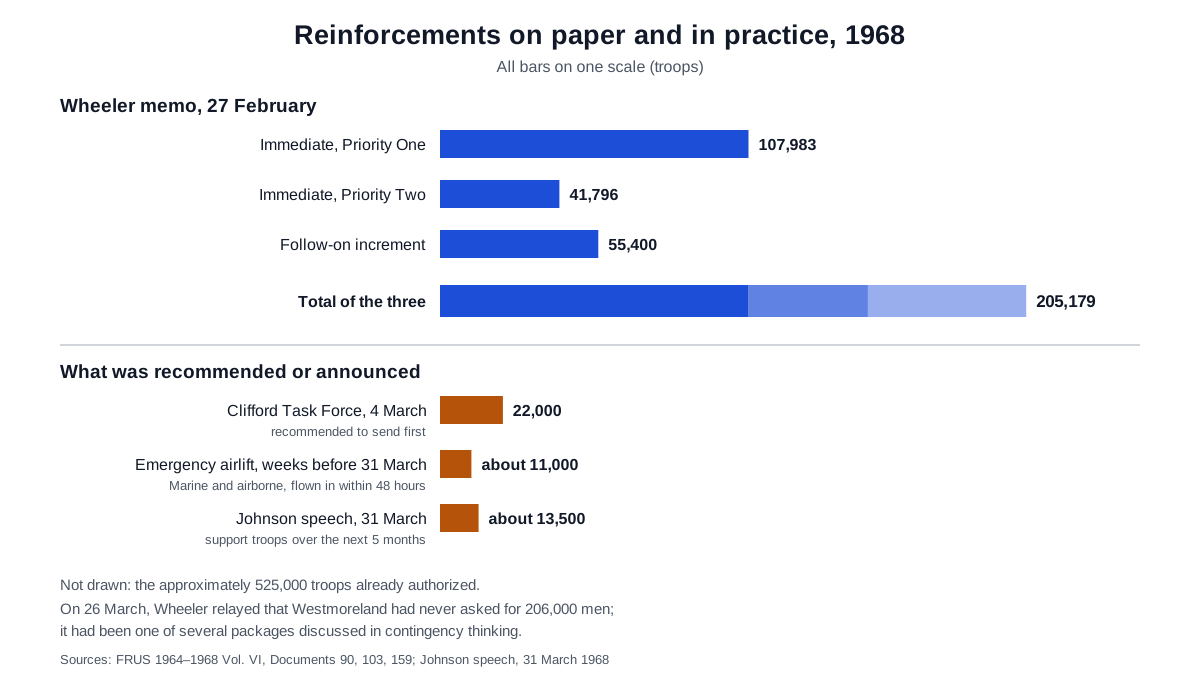
Moving troops was part of the same picture. The 31 March speech, covered below, mentions about 11,000 Marine and airborne troops flown in within 48 hours.
The memo ended with numbers. Split into three increments, the reinforcements Westmoreland wanted were 107,983 for Immediate Priority One, 41,796 for Immediate Priority Two and 55,400 for the follow-on, a total of 205,179.
A draft by the task force of Secretary of Defense Clark Clifford, dated 4 March, says Westmoreland had asked for 205,000 more troops on top of the 525,000 already authorized. Meeting that request in full would have meant calling up about 262,000 reservists.
The task force recommended sending 22,000 more at once and holding off on the rest. It saw no assurance that such a large addition would leave the military position any better a year later. On 26 March, Wheeler passed on a different account from Westmoreland. He had never asked for 206,000 men, he said; it was just one of several options weighed in contingency planning.
The shock to the American public was immense. The FRUS editors write that press reports stressed a strategic victory for the North Vietnamese and Viet Cong. In retrospect, they add, the attackers suffered a devastating tactical defeat, losing nearly 70% of their cadres in the South. Yet polls right afterward showed the public turning sharply against continuing the war effort.
The Office of the Historian's Milestones page describes the role of the press differently. In its account, vivid US media reporting made clear to the public that victory in Vietnam was nowhere near, and that weakened support at home for the administration. On the first morning, McNamara had already predicted that Americans would feel the enemy was much stronger than they had thought, and that in this sense the enemy would gain.
On 26 March, Wheeler said he saw no reason for the gloom in the US press. He also said the biggest setback had been in the United States, and that this was one of the enemy's goals.
In March, politics moved. In the New Hampshire Democratic primary on 12 March, Senator Eugene McCarthy lost only 4 of the 24 delegates. Four days later, on 16 March, Senator Robert Kennedy entered the race.
On 23 March, Westmoreland was told he would move to become Army Chief of Staff. McNamara had recommended that move on 19 January, before the offensive.
On the evening of 25 March, a group of senior figures known as the "Wise Men," including a former secretary of state and retired generals, met at the State Department. Clifford set out three paths: widen the war, keep muddling along as before, or shrink the US part by scaling down the bombing and ground fighting. When the meeting broke up at 11 p.m., most of the group leaned toward de-escalation.
The March 31 speech and the verdicts that remain
At 9 p.m. on 31 March, Johnson spoke to the nation on television from his office in the White House. He said he had ordered US aircraft and ships to stop attacking North Vietnam, with one exception. That was a zone just north of the DMZ, where enemy forces building up directly threatened allied forward positions.
The halt covered nearly 90% of the North's people and the larger part of its land. The Milestones page sums the step up as halting bombing above the 20th parallel and capping US troop numbers.
The troop numbers were far from 205,179. Johnson restated the force level of about 525,000 already authorized and said that some weeks earlier about 11,000 more Marine and airborne troops had been flown in within 48 hours. On the advice of the Joint Chiefs, he said, the United States would prepare to send about 13,500 support troops over the next 5 months. South Vietnam had decided to call up 135,000 more men.
Johnson named Ambassador Averell Harriman as his representative for talks. At the end of the speech he said he would neither seek nor accept his party's nomination for another term. Talks opened in May, but it took several more years for them to bear fruit. The next president, Richard Nixon, inherited the task of getting the United States out of Vietnam.
How should the offensive be judged? By the end of the offensive, both sides had suffered losses, and each side claimed it had won.
The State Department's Milestones summarizes the US and South Vietnamese response as having almost wiped out the forces of the National Liberation Front (NLF) and regained all the lost ground. The FRUS editors, cited earlier, write that the attackers lost nearly 70% of their cadres in the South. NARA presents the Tet Offensive as one of the biggest campaigns of the war and a turning point.
A NARA event notice for Erik B. Villard's book on September 1967 to October 1968 is more measured. By October 1968, it says, the allies were only a little better placed than at the end of 1967. Talks in Paris were stuck, and US public opinion had firmly turned against the war.
On the battlefield, the attackers could not hold the cities and lost many troops. But at home, the people watching that fighting came to see that victory was not near. Washington chose limits on bombing and an offer of talks over a large reinforcement. That is why this article reads Tet as an offensive where the military result and public opinion split.
What to read next
- The Vietnam War at a Glance: 1955 to 1975: the larger story before and after Tet.
- Ia Drang and Helicopter Airmobility: the 1965 battle where a division built to fight by helicopter first met the enemy.
- Military logistics: performance must be sustainable: why the supply and maintenance that worried Wheeler matter so much.
- Finding open sources: where to look for government reports, papers and standards: how to find and read government documents like the FRUS records used here.