In 1972 the United States gave the same name to a bombing campaign against North Vietnam twice. Linebacker began in May. Linebacker II followed on 18 December and lasted eleven days. Both reopened the bombing of the North that had stopped in 1968.
So how did they differ from Rolling Thunder, which had started seven years earlier? Lay the White House, State Department and Joint Chiefs records side by side, and the differences show up in three places. They are the aim of the bombing, the weapons used, and the way the bombing stopped.
What Rolling Thunder Left Behind
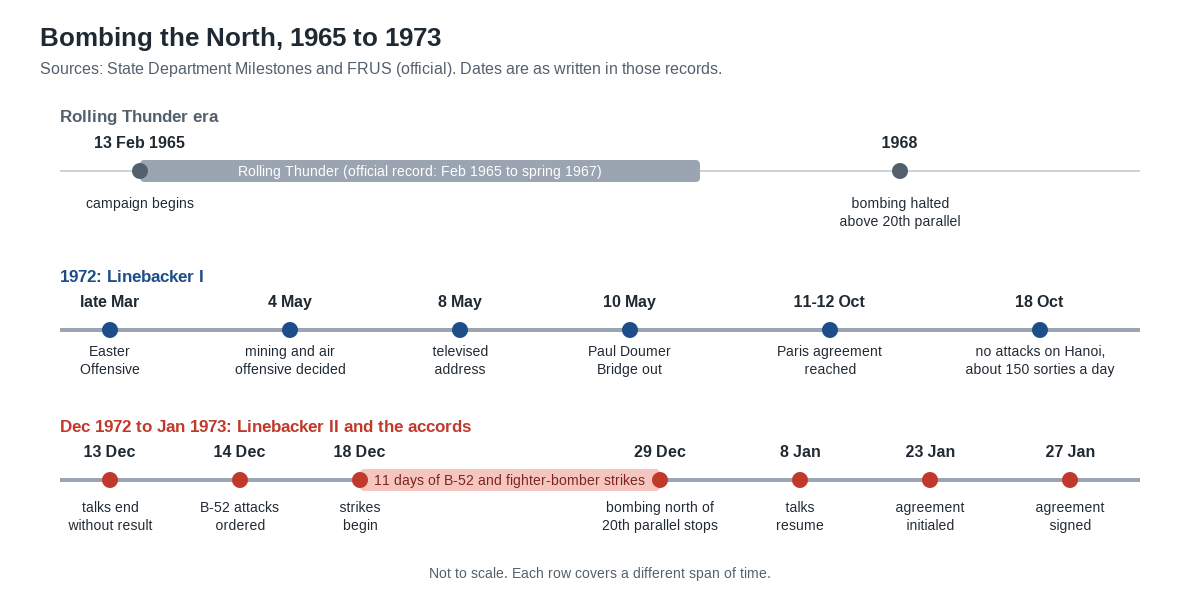
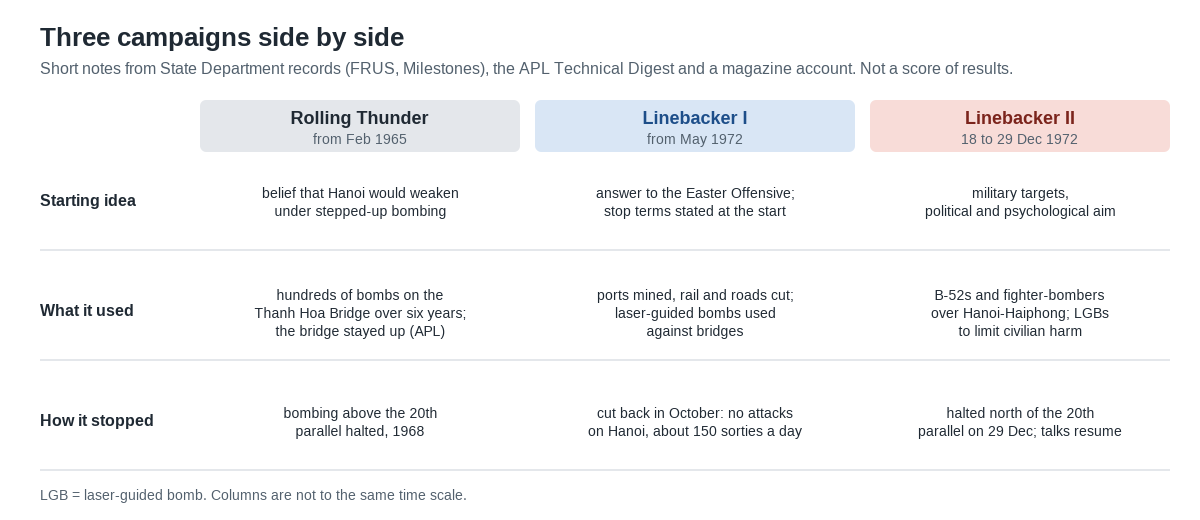
Rolling Thunder was a bombing campaign against North Vietnam that the president approved on 13 February 1965, with the first mission flown on 2 March. President Johnson and his advisers believed that heavier bombing would, in time, wear Hanoi down.
Sources differ on when it ended. The State Department's overview page says it continued through the spring of 1967. The FRUS document volumes record a partial halt on 31 March 1968 and a full halt on 1 November 1968.
More bombs did not mean a target would fall. The Johns Hopkins Applied Physics Laboratory (APL) Technical Digest gives the example of the Thanh Hoa Bridge. Over six years, hundreds of bombs were dropped on it, and the United States lost aircraft and pilots along the way. The bridge's longer story is in The Thanh Hoa Bridge, 1972.
In 1968, the year of the Tet Offensive, Johnson announced that bombing of North Vietnam above the 20th parallel would stop. Bombing deep in the North was closed off for a time.
Spring 1972: Back to the North
In late March 1972, North Vietnam launched a three-pronged offensive into South Vietnam. Americans call it the Easter Offensive. Nixon moved large air and naval forces to bases in Indochina and on Guam.
On 4 May, Nixon chose to lay mines in the North's harbors and to start a long air offensive against it. This was Operation Linebacker. Four days later, at 9 p.m. on 8 May, he announced the decision in a televised address.
The address was specific. Every entrance to North Vietnam's ports would be mined, and rail lines and all other transport would be cut as far as possible. Air and naval strikes on military targets in the North would go on. Foreign ships already in port were given three daylight periods to leave safely.
The same address named the conditions for stopping. The measures would end once all American prisoners of war were returned and an internationally supervised cease-fire began across Indochina. The campaign's terms for ending were made public on the day it was announced.
The Laser-Guided Bombs That Cut Bridges
The weapon that stands out in the 1972 bombing is the laser-guided bomb. Someone shines a laser designator at the target, and the bomb homes on the light reflected from that bright spot. Weapons that correct their own path in flight like this are grouped as precision-guided munitions (PGMs).
The Thanh Hoa Bridge fell to exactly this kind of weapon. It had stood through hundreds of bombs over six years, yet in April 1972 a small number of laser-guided bombs was enough. That was a little before the May decision to launch Linebacker.
After Linebacker began, the Paul Doumer Bridge in Hanoi went down. It was the main road and rail link between Hanoi and China. A memo Kissinger sent Nixon on 19 May lists it as "out as of May 10." According to Air & Space Forces Magazine, published by the Air & Space Forces Association, laser-guided bombs dropped one span of this bridge.
The same magazine gives figures for scale. Between February 1972 and February 1973, over 10,500 laser-guided bombs fell from Air Force aircraft. During Linebacker's first three months, precision-guided munitions took out over 100 bridges. These figures were not checked against official Air Force statistics, so they should be read as the magazine's account.
October: Talks Move Forward, Bombing Is Cut Back
The State Department's historians judge the period this way. Mining, Linebacker, heavy air attacks in the battle areas and stronger South Vietnamese defenses together halted the North Vietnamese offensive. The North Vietnamese Politburo then entered serious negotiations for the first time.
On 11–12 October, Kissinger and North Vietnam's Le Duc Tho reached a peace agreement. On 18 October, Kissinger, then in Paris, cabled Haig at the White House to keep the current bombing limits in place. That meant leaving Hanoi alone and holding attack sorties to about 150 a day.
Cutting the daily sorties from 200 to 150 was the president's decision. Nixon later wrote in his memoir that he had ruled out any bombing halt until the agreement was signed. He did not want to repeat Johnson's 1968 experience of trusting the mere prospect of a deal.
The agreement soon stalled. South Vietnam's President Thieu refused to accept it. In two more rounds of talks, Kissinger found no common ground that both Vietnamese sides would accept.
Eleven Days of B-52s
On 13 December, a meeting between Kissinger and Le Duc Tho ended without progress. On 14 December, Nixon ordered large B-52 attacks on the North Vietnamese heartland. This was Linebacker II, also called the "Christmas Bombing" in the United States.
The campaign was set in motion by an execute message from Joint Chiefs Chairman Moorer on 17 December. It called for three days of maximum effort against the Hanoi and Haiphong areas from about 1200Z (noon Greenwich time) on the 18th, with readiness to continue if directed. It also told commanders to take care to limit the risk of civilian casualties by using laser-guided bombs on designated targets, and to avoid harming ships of other countries.
Three days became eleven. B-52s and several kinds of fighter-bombers struck major military targets in the Hanoi-Haiphong area. The preface to the diplomatic records volume sums it up: the targets were military, but the aim was political and psychological. The goal was to bring North Vietnam back to the table before the newly elected, antiwar Congress met in January.
On 26 December, the North Vietnamese government said it would meet again in early January. After three more days of bombing, the United States said it would stop bombing north of the 20th parallel by 7 p.m. Washington time on 29 December. Expert-level talks were set for 2 January, and a private Kissinger–Le Duc Tho meeting for 8 January in Paris.
Same Day, Different Numbers
The B-52 loss figures differed even for a single day. On 20 December, National Security Council staffer Kennedy cabled Haig in Saigon that 4, and possibly 5, B-52s appeared to have been lost in about 100 sorties that day. The editors of the records volume added a different figure in a footnote. Citing a published study, it says surface-to-air missiles shot down 6 B-52s that day and damaged one more.
An expected figure survives as well. In a White House conversation that same day, Kissinger said Defense Secretary Laird's side had expected to lose 3 aircraft for every 100 sorties.
The campaign-wide totals appear in a 1997 Air & Space Forces Magazine article. By that account, Strategic Air Command B-52s flew 729 sorties out of 741 planned, delivering 15,000 tons of bombs. The Air Force lost 15 B-52s, a loss rate below 2%. The earlier report was a first count on the campaign's third day, while these totals were compiled after it ended.
The Paris Accords and Competing Readings
Talks resumed on 8 January 1973, and the agreement was initialed on 23 January and formally signed on 27 January. It let the United States leave the war and bring its prisoners home. Neither Vietnamese side kept to it, though, and the war went on. How it ended is in The Fall of Saigon.
What the bombing achieved reads differently even within the same agency's records. The State Department's historical summary holds that the measures, Linebacker among them, halted the North's spring offensive and led to real negotiations. The preface to the records volume, by contrast, says the agreement signed in January stayed very close in substance to the October text.
Negroponte, then one of Kissinger's aides, said at the time that the bombing was meant to force Hanoi to accept American concessions. One reading is that military pressure produced the agreement. Another is that the bombing served to close a deal that was already mostly settled. Both readings remain on the record.
Where It Meets Lasers
A laser-guided bomb only works if the light can reach the target and come back. The magazine's account of Linebacker II includes a passage saying poor weather greatly reduced the effectiveness of the tactical forces' precision-guided munitions. A weapon that cut bridges in spring had a harder time doing the same job under winter clouds.
How rain and cloud weaken laser light continues in the weather section of the laser-guided bomb article and in Light through air: absorption, scattering, turbulence, thermal blooming. The same question applies directly to today's laser weapons.
What to Read Next
- The Thanh Hoa Bridge, 1972: How Laser-Guided Bombs Changed Bombing: the change at one bridge just before Linebacker
- Laser-Guided Bombs: Following a Reflected Laser Spot: how a bomb follows light, and the limit set by weather
- Strategic Bombers: The Role of Big, Long-Range Aircraft: what the B-52 has done up to today
- The Vietnam War at a Glance: 1955 to 1975: the whole war in which both campaigns took place
- Operation Rolling Thunder (1965–1968): What More Than Three Years of Bombing the North Left Behind: the full story of the first bombing campaign against the North