A submarine is safest when it stays hidden under water. That means its missiles should be able to leave from under water too. It sounds simple, but in the 1950s the U.S. Navy had never done it. On July 20, 1960, off Cape Canaveral, Florida, a U.S. Navy submarine fired a missile from under water for the first time.
The submarine was George Washington (SSBN-598), and the missile was the Polaris A-1. What did the Navy have to solve before that day? The ship history kept by the Naval History and Heritage Command (NHHC) shows both the day itself and the work that led to it. How a missile is pushed up from under water is covered in detail in Cold launch: why some missiles pop out before igniting.
1955: a deterrent that could survive
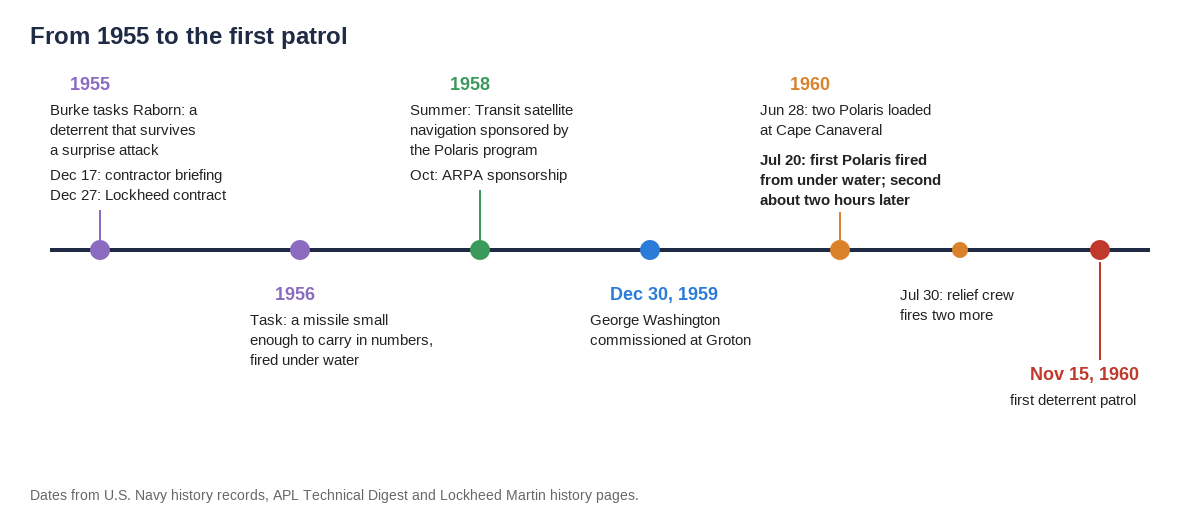
The story begins in 1955, as Cold War threats grew. That year, Chief of Naval Operations Admiral Arleigh Burke gave Rear Admiral William Raborn a job: build a nuclear deterrent able to ride out a surprise attack. There were three conditions: reliable, undetectable and fast.
On December 17 that year, Raborn called several aerospace companies to Washington to brief them on a new fleet ballistic missile program. It would study whether intercontinental ballistic missiles could be turned into weapons launched from submarines. On December 27, Lockheed became the Navy's strategic missile contractor.
The problem to solve
The task was heavy and specific. The Royal Air Force Museum describes the problem Lockheed and its subcontractors faced in 1956. They had to build a missile small enough for a submarine to carry several, and one that could be fired under water. At the time, simply keeping a rocket under control on land was hard enough.
Meeting that demand took breakthroughs in propulsion, in guidance and in launch technology. There was one more piece. A submarine hiding in the middle of the ocean had to know exactly where it was.
Where am I on the sea?
A ballistic missile flies a path worked out from the launch point to the target. If the starting point is wrong, the arrival point is wrong too. So for a nuclear-powered ballistic missile submarine to fire accurately, its fire control system needed an exact fix on the boat's own position.
As two researchers from the Johns Hopkins Applied Physics Laboratory (APL) later recalled, many worried about knowing a Polaris submarine's launch position at sea, ideally within a few hundred feet. Mapping the sea floor with active sonar did not suit a submarine that was meant to stay undetected. The answer was Transit, a satellite navigation system that worked out position from the Doppler shift of satellite signals. Submarines would be able to fix their position about once an hour anywhere on Earth.
Work on Transit was sponsored by the Polaris program in the summer of 1958, and the Advanced Research Projects Agency (ARPA) took over formal sponsorship that October. By the early 1960s it was built into the Fleet Ballistic Weapon System. The question of where a submarine missile starts from led straight into satellite navigation.
George Washington, the first of its class
George Washington was commissioned on December 30, 1959, at Groton, Connecticut. It was the first nuclear-powered ballistic missile submarine of its class.
On June 28 of the next year, the submarine went to Cape Canaveral, Florida, and loaded two Polaris missiles. What remained was to actually fire one from under water.
July 20, 1960
According to the NHHC ship history, George Washington was out on the Atlantic Missile Test Range on July 20, with Polaris program head Rear Adm. Raborn on board. That day the submarine successfully fired the first Polaris from a submerged submarine. The Brookings Institution places the launch about 30 miles (48 km) off Cape Canaveral and counts it as the first time the whole Polaris weapons system passed a full-scale test.
After the first launch, the commanding officer, Cmdr. James Osborn, sent President Dwight D. Eisenhower a short message: "Polaris from out of the deep to target. Perfect."
Lockheed's history article names Rear Adm. Raborn as the one who informed the President, so the accounts differ slightly.
About two hours later, a second Polaris went up. The ship history says it came down in an impact area some 1,100 miles downrange.
From under water to the sky
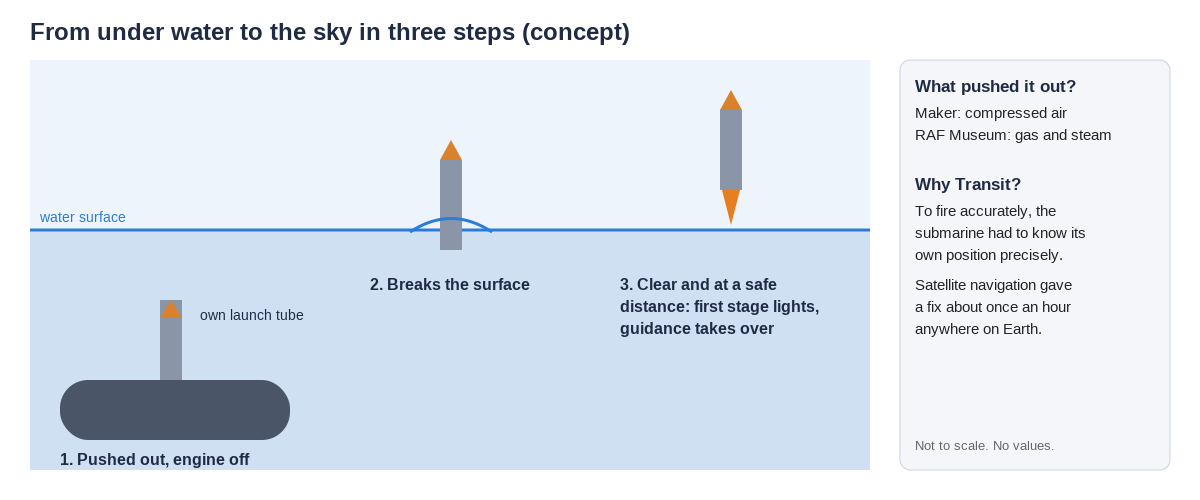
Sources word the underwater launch a little differently, but the outline is the same. Each Polaris sat in its own launch tube inside the submarine. Lockheed Martin says streams of compressed air pushed the missile out. The Royal Air Force Museum says gas and steam blew it up like a cork from a popgun.
Only then did the engine light. The first stage ignited after the missile had cleared the water and reached a safe distance from the submarine, and at that point its internal guidance system took over.
Afterward: July 30 and the first patrol
The tests did not stop at one day. George Washington returned to Cape Canaveral and took on its relief crew, and on July 30 that crew fired two more Polaris missiles from under water. The submarine ran with two crews taking turns.
Later, at Charleston, South Carolina, the submarine loaded its full set of 16 Polaris missiles. NHHC's Today in Naval History dates its departure on the first deterrent patrol to November 15 that year. The ship history says it stayed submerged for 66 days on that first voyage. That was less than four months after July 20.
What to read next
- Cold launch: why some missiles pop out before igniting: how an underwater launch works
- SLBMs: how a missile starts from under the sea: submarine-launched ballistic missiles after Polaris
- Inertial and satellite navigation: knowing where you are: two ways to know your position
- The Cold War Arms Race: From Bombers to Missiles to Satellites: the larger picture of the same era