The Vietnam Veterans Memorial bears 58,318 names, one for each American who lost their life in the war. The names run in the order of time. In a military death file that went to the U.S. National Archives (NARA) in 2008, the earliest date of death is June 8, 1956. That is nine years before the United States sent regular ground combat troops in 1965.
It is hard to say when the Vietnam War began. U.S. law counts the "Vietnam era" from November 1, 1955, for those who served in Vietnam. That is why this article starts in 1955. The end is April 30, 1975, the day North Vietnamese tanks pushed through the palace gate in Saigon.
This article follows the years from the French withdrawal in 1954 to Saigon in 1975 on a single timeline.
The sources are public records such as the State Department's Office of the Historian, the National Archives and the Australian War Memorial. Most of them come from the United States and its allies, so the North Vietnamese view is thinly covered.
Where France left off
The roots of the war lie in French colonial rule. France promised Vietnam autonomy by 1949, but in practice it gave only limited independence and kept control of defense and foreign policy. Earlier, in 1946, talks with France broke down, and war broke out in the north between Ho Chi Minh's Viet Minh and French troops.
The United States backed France in that war. President Eisenhower compared the region to a row of dominoes. If one country became communist, he argued, its neighbors in Southeast Asia would go the same way. Washington also needed French help to build the North Atlantic Treaty Organization (NATO) and to rebuild West Germany.
On May 7, 1954, the French garrison at Dien Bien Phu, in a valley near the border with Laos, fell after a four-month siege. France pulled out of the region, and the United States would stay in Vietnam for the next twenty years.
A country split at the 17th parallel
In mid-1954, French and Vietnamese delegates met in Geneva along with representatives of the United States and China. They reached two agreements. The first stopped the fighting and drew a temporary dividing line across Vietnam at the 17th parallel. The second said that neither North nor South would join outside alliances and that general elections would be held in 1956.
Washington never signed the second agreement. As French forces left, it set up a separate government in the South. In the words of the Office of the Historian, it "appointed" Ngo Dinh Diem to lead South Vietnam.
The elections never took place. The communists, with better organization and wider support in the countryside, looked likely to win, and when Diem refused to hold the vote the United States backed him.
This period still shows up as a date in U.S. law. Under Title 38 of the U.S. Code, the "Vietnam era" runs from November 1, 1955, to May 7, 1975, for veterans who served in Vietnam. For everyone else, it starts on August 5, 1964.
From advisers to ground troops
By 1959, the Viet Cong, the communist guerrillas of South Vietnam, and the Viet Minh had begun a large insurgency in the South. The Office of the Historian treats this as the opening of the Second Indochina War. The U.S. Army's first armed helicopters, along with fixed-wing planes, arrived in 1961 to back South Vietnamese forces. By 1963 there were 21,000 American military advisers in South Vietnam, about the size of a reinforced division.
The year 1963 brought political upheaval. Diem was overthrown and killed by some of his own generals. The State Department says the Kennedy Administration quietly approved the coup. Kennedy himself was killed by an assassin three weeks afterward.
In August 1964, two U.S. destroyers in the Gulf of Tonkin, the Maddox and the Turner Joy, were on station. Their crews reported being attacked by North Vietnamese patrol boats, first on August 2 and then on August 4.
On August 7, Congress passed the Tonkin Gulf Resolution. Only two senators voted against it, and the House passed it unanimously. The resolution became the legal basis on which the Johnson and Nixon administrations carried on the war.
Doubts later arose about the second attack. According to the National Archives, a 2002 report by the National Security Agency (NSA), made public in 2007, found that the first attack was real. It found that the second, on August 4, did not take place. Congress repealed the resolution in January 1971.
On February 13, 1965, Rolling Thunder, a bombing campaign against North Vietnam, began; it lasted until the spring of 1967. Johnson began sending regular ground combat units, and in March Marine combat units went to Da Nang. By the end of that year the United States had committed 200,000 troops.
The United States did not go alone. Australia joined with a team of 30 Army advisers who arrived in July and August 1962, and South Korea sent forces from September 1964 to March 1973.
A timeline, 1954–1975
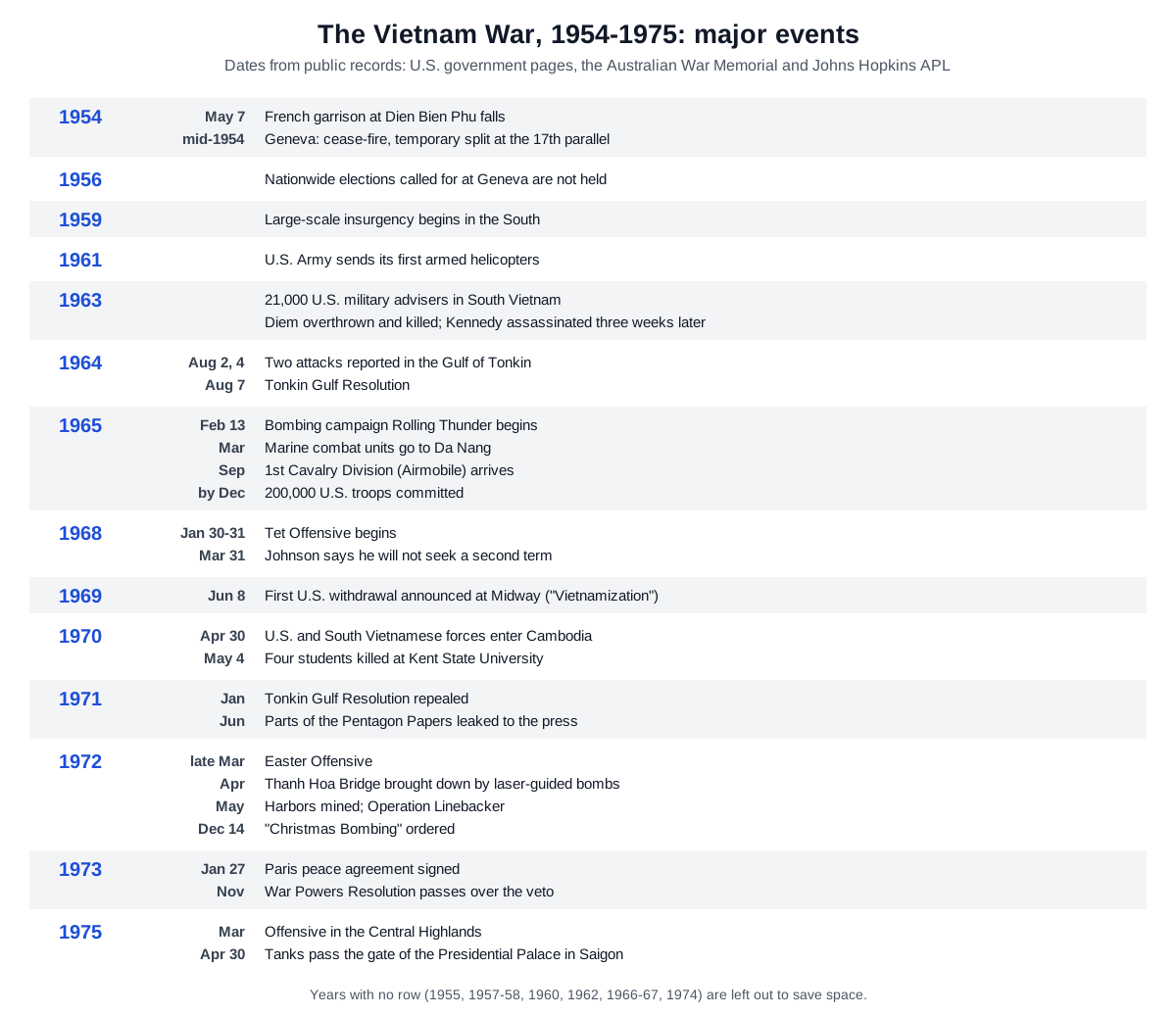
The gaps in the timeline are worth a look. Ten years passed between Dien Bien Phu and the Gulf of Tonkin. From the Gulf of Tonkin to 200,000 U.S. troops took little more than a year. After the Tet Offensive of 1968, the weight shifts toward talks and withdrawal.
Helicopters, bombing and laser-guided bombs
South Vietnam was good ground for helicopters. It had no long road network, and the roads it did have often came under attack. Jungle, mountains, swamps and a wide delta covered the land.
A history study by the U.S. Army Transportation Corps lists three advantages American ground units had: the ability to move quickly, firepower, and supply. It says the helicopter provided all three.
A division formed to test airmobility became the 1st Cavalry Division (Airmobile) on July 1, 1965, and it reached South Vietnam that September. Helicopters put troops in and took them out, rescued downed aviators, gave close air support with UH-1 and AH-1 gunships, flew reconnaissance and carried the wounded. By the same study's count, medical evacuation crews saved the lives of about 390,000 wounded Americans. How a helicopter lifts and steers is explained in Helicopter rotors: how coaxial helicopters fly without a tail rotor.
Bombing went on from the air: Rolling Thunder from 1965 to 1967, Linebacker in May 1972, and the so-called Christmas Bombing that December. Earlier, in April 1972, before Linebacker, there is a recorded case of bombs that steered themselves toward a bright spot lit by a laser.
A technical journal of the Johns Hopkins Applied Physics Laboratory (APL) gives the Thanh Hoa Bridge as an often-cited example. Over six years, the United States dropped hundreds of bombs on the bridge and lost aircraft and pilots. In April 1972 a small number of laser-guided bombs brought it down. Laser-guided bombs are one kind of precision-guided munition (PGM), and the story continues in Precision-guided bombs: what gets added to a plain bomb.
Tet and public opinion
At the end of January 1968, over Tet, the Vietnamese lunar new year, North Vietnamese forces and the Viet Cong struck many targets across South Vietnam at once. The first phase came on January 30 and 31, and attackers even broke through the outer wall of the U.S. Embassy in Saigon. A second phase began on May 4 and ran into June, and a third began in August and lasted six weeks.
The outcome reads differently depending on who is looking. By the end, both sides had suffered losses, and both sides claimed victory.
In military terms, U.S. and South Vietnamese forces nearly wiped out the South Vietnamese National Liberation Forces (NLF) and took back all the ground they had lost. Yet vivid news coverage showed the American public that victory was not close, and support for the Johnson Administration weakened. On March 31, 1968, Johnson announced that he would not run again.
The Australian War Memorial (AWM) sees it in a similar way. For the communists, Tet was a military defeat but a propaganda victory, and U.S. military planners began to ask whether a decisive victory could be won at all.
Vietnamization and the Paris agreement
Richard Nixon took office in January 1969. On June 8 that year he met Nguyen Van Thieu, president of South Vietnam, on Midway Island and announced the first withdrawal. From then on, the U.S. pullout never stopped. The plan to build up South Vietnam's forces as American troops left was called "Vietnamization."
The war also spread to a neighbor. On April 30, 1970, Nixon ordered U.S. and South Vietnamese forces into North Vietnamese base camps in Cambodia. The move set off fierce protests on American campuses, and on May 4 four students died at Kent State University.
In late March 1972, North Vietnam opened a three-pronged offensive, which Americans called the Easter Offensive. On May 4 Nixon chose to lay mines in the North's harbors and begin Operation Linebacker. When talks stalled, he ordered B-52 raids on December 14.
The peace agreement was signed in Paris on January 27, 1973. It let the United States leave the war and bring its prisoners of war home. Neither Vietnamese side kept to it, however, and the fighting went on. Australia formally ended its part in the war with a proclamation by the Governor-General on January 11, 1973.
The fall of Saigon and what remained
Nixon had promised Thieu more than once that the United States would answer a North Vietnamese violation with force. The Office of the Historian says those promises were not kept for a mix of reasons. Congress and the public did not want to go back into the war, money was tight, and the Watergate scandal weakened Nixon.
In March 1975, North Vietnamese forces opened a major offensive in the Central Highlands. When their tanks pushed through the palace gate in Saigon on April 30, the war was in effect over.
The war left a new rule in American politics. The War Powers Resolution of 1973 let the president send forces abroad but required a report to Congress within 48 hours. Congress then had 60 days to decide whether to allow it.
The House Office of History, Art and Archives traces it to wide discontent with the Vietnam War. It also points to public support for limiting a president's power to wage an undeclared war. Nixon vetoed the bill, and Congress overrode the veto in November 1973.
It left records too. The Pentagon Papers, an internal study that Defense Secretary Robert McNamara ordered in 1967, partly leaked to the press in June 1971. The National Archives later released the complete declassified report, about 7,000 pages in 48 boxes.
It also left marks on people's health. Agent Orange was a tactical herbicide that the U.S. military sprayed to clear trees and thick tropical foliage that gave the enemy cover. Millions of gallons of it and other herbicides were used. The Department of Veterans Affairs links certain cancers and other illnesses to exposure during service and offers health care and compensation to eligible veterans.
Numbers and dates that differ by source
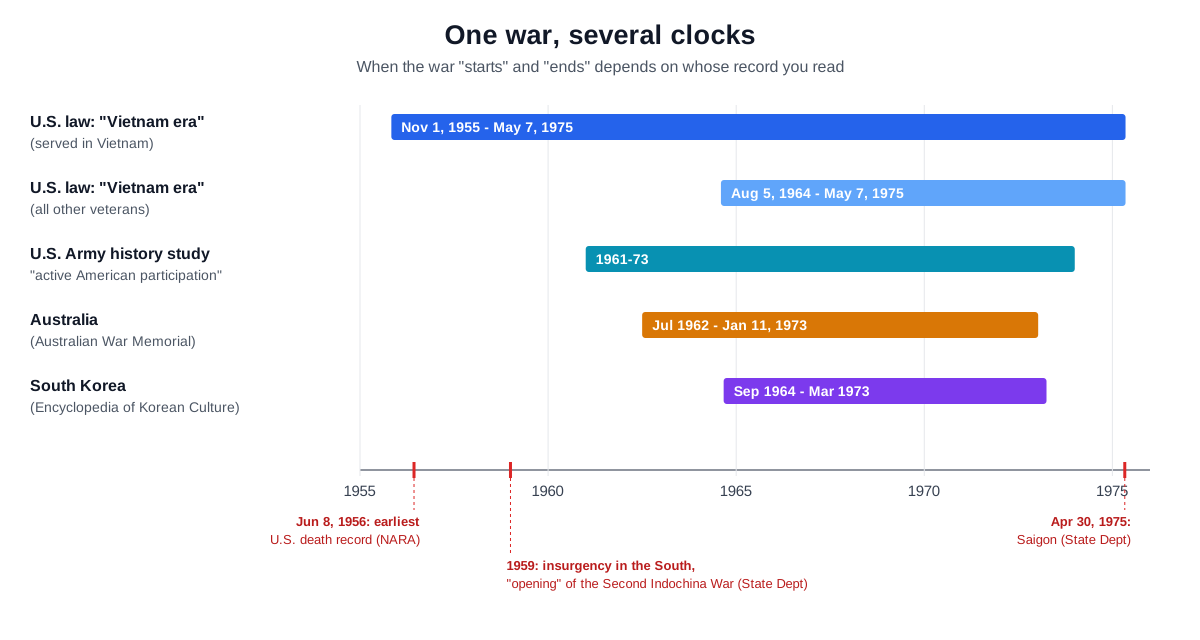
Even the start and end depend on the source. U.S. law uses two start dates, and the Army Transportation Corps study gives the period of active American participation as 1961–73. For Australia it is 1962–1973, and for South Korea 1964–1973.
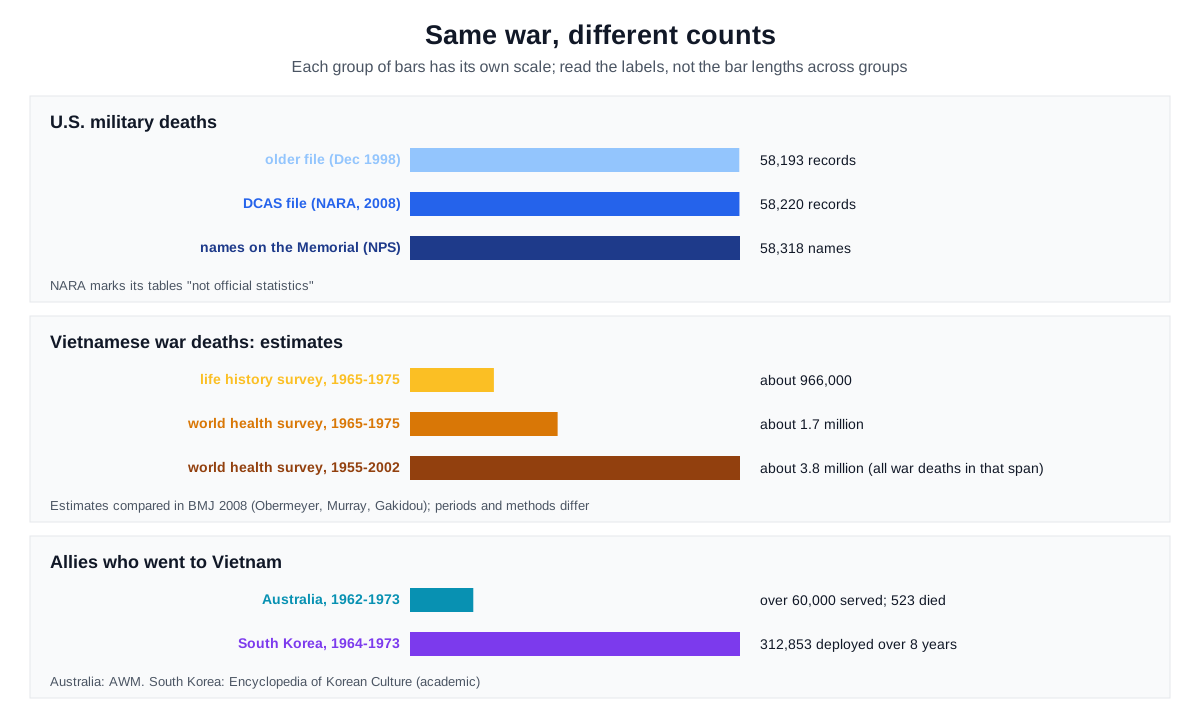
The U.S. military death toll is not a single number either. The Vietnam file of the Defense Casualty Analysis System (DCAS) at the National Archives holds 58,220 records as of April 29, 2008. An older file from December 1998 held 58,193.
The Archives labels these tables "not official statistics." The Memorial carries 58,318 names.
Vietnamese losses were far larger, but the estimates vary widely with method and period. A 2008 study in the medical journal BMJ used world health survey data to estimate about 3.8 million violent war deaths in Vietnam from 1955 to 2002. That figure covers all war deaths over those 47 years.
Across all 13 countries in the study, 1965–1974 was the decade with the most war deaths, 205,000 a year, mostly because of the Vietnam War. That 205,000 is the total for the 13 countries, not a figure for Vietnam alone.
For 1965–1975 alone, the world health survey estimate is about 1.7 million, while another analysis of Vietnam's life history survey arrived at 966,000. Its authors acknowledged that their figure is likely too low because rural areas with higher death rates were under-represented. Among the allies, over 60,000 Australians served, 523 died and almost 2,400 were wounded, and South Korea sent 312,853 personnel over eight years.
What to read next
- Precision-guided bombs: what gets added to a plain bomb: how the laser guidance that brought down the Thanh Hoa Bridge led on to satellite-navigation kits.
- Helicopter rotors: how coaxial helicopters fly without a tail rotor: how the helicopters that carried troops and the wounded in Vietnam stay in the air.
- A history of laser weapons: from chemical to electric lasers: how lasers went from marking targets to being aimed at targets as weapons.
- More in this series: "Dien Bien Phu," "The Gulf of Tonkin Incident," "Ia Drang and Helicopter Air Mobility," "The Tet Offensive," "The Ho Chi Minh Trail," "South Korean Forces in Vietnam" and "The Fall of Saigon, 1975."