A poplar tree stood in the southern corner of the Joint Security Area at Panmunjom, close to the Bridge of No Return. Over the years its branches grew thick enough to block the view between two UN Command guard posts. In August 1976, a work party pruning that tree was attacked, and two American officers died.
Three days later, US and South Korean troops went in and cut the tree down. Bombers flew overhead, and both armies had raised their alert levels. This article uses US diplomatic records and Korean sources to show how one tree turned into a crisis, and what changed afterward.
Guard posts mixed in one area
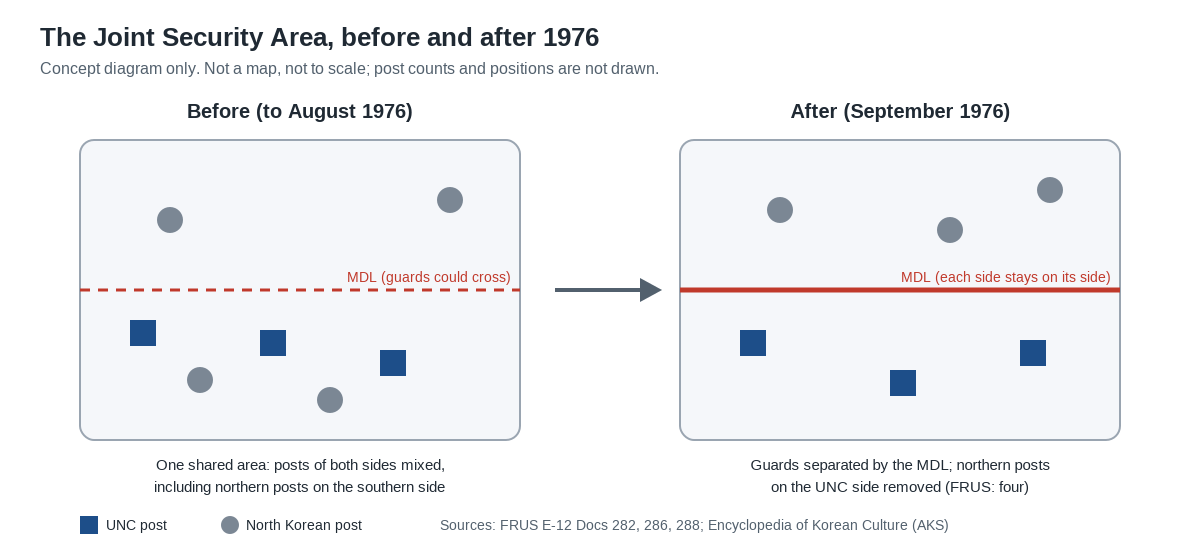
Panmunjom is where the armistice was signed in 1953, and it became the meeting place between the UN Command and the North Korean side. Until the summer of 1976, the Joint Security Area looked different from the one that came after. The Military Demarcation Line ran through it, yet guards from both sides could move across the whole area.
Guard posts were mixed as well, and the two sides' posts overlapped. North Korea had five posts on the southern part without coordinating with the UN Command. UN Command Post 3, where the incident happened, sat at the start of the northern route across the bridge known as the Bridge of No Return.
At a White House meeting on the day of the incident, Under Secretary of State Philip Habib described the whole zone as a joint area. Neither side could force the other, he added, but arguments were frequent.
The day of the pruning
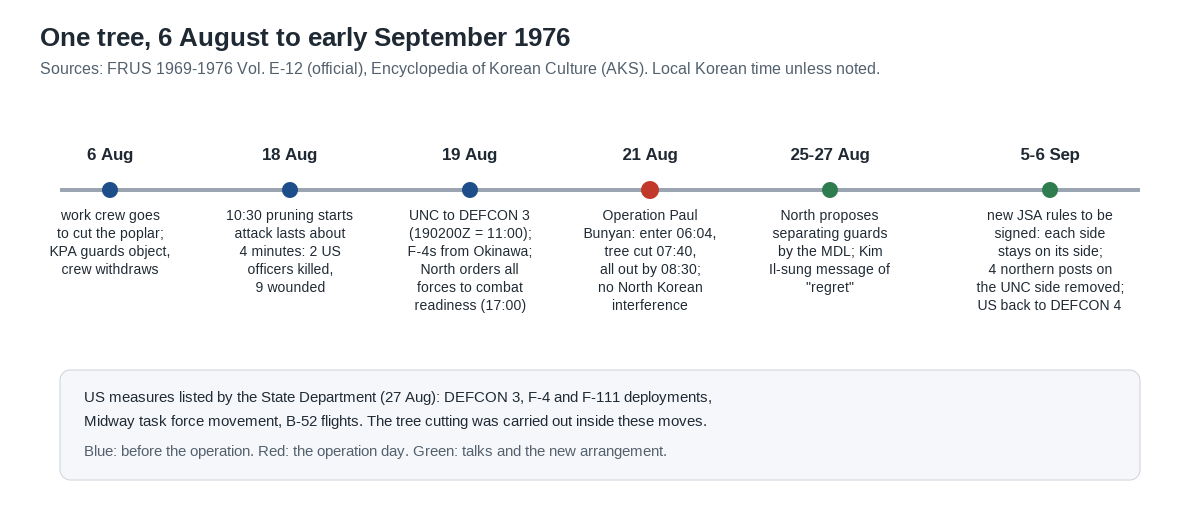
The poplar grew between UN Command Posts 3 and 5 and blocked the line of sight between them. On 6 August, six Korean laborers and four UN Command guards went to cut it down. A North Korean guard told them, in a threatening way, to leave the tree alone, and the crew withdrew.
At 10:30 on the morning of 18 August, a party of ten guards and five laborers returned, this time only to trim the branches. At the White House meeting that day, Chief of Naval Operations James Holloway passed on General Richard Stilwell's report. The first plan had been to fell the tree, but the North Koreans objected, so the work became pruning. Habib noted at the same meeting that accounts of the first exchange at the site did not fully agree.
A few minutes later, two North Korean officers and nine soldiers arrived by truck and warned that continuing the work would cause trouble. The attack began after the North Korean force grew to about thirty, and the fight lasted four minutes.
Captain Arthur G. Bonifas, the American in charge, and First Lieutenant Mark T. Barrett suffered severe head injuries and died while being evacuated. Nine others were wounded: one South Korean officer, four South Korean enlisted soldiers and four American enlisted soldiers.
A crisis that grew over three days
That afternoon in Washington, the Washington Special Actions Group (WSAG), a crisis meeting, convened. Secretary of State Henry Kissinger named the deaths of two American officers as the first problem. He said his impression was that the attack had been planned in advance. Holloway said alert levels could move from DEFCON 4 to DEFCON 3.
On 19 August, the State Department cabled Seoul, telling the embassy and General Stilwell to see President Park Chung-hee at once. The message proposed DEFCON 3 in South Korea right away and an extra F-4 squadron from Kadena Air Base on Okinawa. A B-52 bombing exercise, an F-111 squadron and a carrier task force in the Sea of Japan were also under review.
That day Stilwell met Defense Minister Suh Jyong-chul and then went on to the Blue House. DEFCON 3 was set to take effect at 02:00 UTC on 19 August, which was 11:00 in Korea.
Park called the incident "beyond human reason." He wanted a strong protest demanding an apology, reparations and a guarantee that it would not happen again. He also stressed, more than once, that the response should not involve the use of arms.
The North moved too. At 5 p.m. on the same day, an order in Kim Il-sung's name put all regular and reserve forces on combat readiness. Within two days, a tree in one corner had pushed the alert posture of two whole armies upward.
Cutting the tree on 21 August
On the morning of 19 August, the White House meeting agreed to seek the President's approval for a military action to cut the tree without a clash. Among the many options raised, Holloway even mentioned hitting the tree with a laser-guided bomb. That was the same kind of weapon used against the Thanh Hoa Bridge in Vietnam in 1972. The path chosen, however, was to send people in to cut it down.
Stilwell ordered the work, named Operation Paul Bunyan, for 21 August. It was built around troops from the US 2nd Infantry Division and the South Korean 1st Special Forces Brigade. They entered the area at about 06:04, engineers cut the poplar at about 7:40, and everyone was out by about 8:30.
This operation of a little over two hours sat inside a larger set of moves. A State Department cable of 27 August listed the steps taken right after the incident. They were DEFCON 3, F-4 and F-111 deployments, the movement of the Midway carrier task force and B-52 flights, and the tree cutting took place within them. North Korean troops in the area simply watched the cutting.
Regret and new rules
At US insistence, the dispute went to the Military Armistice Commission. At its first meeting, the North Korean side conveyed Kim Il-sung's "regret" over the incident. US documents describe this in different words. The 27 August cable called it an "apologetic message," while a 5 September White House memo judged it the nearest thing to a real apology North Korea would offer.
North Korea also proposed separating the guards of the two sides with the Military Demarcation Line between them. Habib read that statement aloud at a White House meeting on 25 August. For the next two weeks, the secretaries of the two delegations met to work out the details.
On 5 September, President Ford was told that a new agreement would almost certainly be signed the next morning. Soldiers of each side would stay on their own side of the line, even inside the Joint Security Area. Neither side would build anything on the other side that blocked sight or passage, and each would guarantee the safety of the other's personnel. The four North Korean posts on the UN Command side would be removed.
US forces would return to DEFCON 4, begin pulling back part of the two added fighter squadrons and send the Midway home after a port call at Busan. Monthly B-52 training flights would continue.
One incident, different readings
Why North Korea acted as it did is explained differently in different records. The 5 September White House memo saw a likely attempt to raise North Korea's standing at the summit of non-aligned countries being held in Colombo at the time. The Academy of Korean Studies' Encyclopedia of Korean Culture sees a push for US troop withdrawal as the main outside motive. It also points to economic hardship and internal politics.
The entry carries a note that it reflects the author's scholarly view and may differ from the Academy's official position. It is one reading among several, not a settled finding.
Seoul and Washington did not see things the same way either. Right after the incident, Park warned against overreacting. On 27 August, though, he complained to the US embassy that the United States had made concessions to Pyongyang. The State Department's reply said that further punishment by force, without a new provocation, would not be understood by Americans or by world opinion.
In South Korean government records, the event is listed as the "8·18 Axe Murder Incident." The National Archives of Korea chronology places it under 18 August 1976, alongside a record of a public rally condemning it.
What to read next
- Hill Battles and the Armistice: Two Years of Negotiation: how Panmunjom and the Military Armistice Commission came about
- The Outbreak of the Korean War: Dawn, June 25, 1950: the war before the armistice line
- The Thanh Hoa Bridge, 1972: How Laser-Guided Bombs Changed Bombing: where the laser-guided bomb named at the meeting had been used
- The January 21 Incident, 1968: The Blue House Raid and What Changed After It: another incident on the peninsula in the same era