On the night of August 4, 1964, the US Navy destroyer Turner Joy was in the Gulf of Tonkin. Together with carrier aircraft, it fired toward unidentified radar blips for two and a half hours. Three days later, Congress passed a resolution that left "all necessary measures" to the President. But were North Vietnamese boats really out on the water that night?
Two days earlier, on August 2, its patrol partner Maddox had clashed with North Vietnamese torpedo boats. The two events are usually grouped under one name, the "Gulf of Tonkin incident." The records, however, tell rather different stories about them. On November 30, 2005, the National Security Agency (NSA) began releasing formerly classified material on the incident, adding new evidence to the question of August 4.
This article takes the two dates one at a time. It sets the State Department's documentary series (FRUS) and historical notes beside the National Archives, a Navy ship history and the NSA releases. Where the records disagree, the disagreement is left in place.
The Gulf of Tonkin in the summer of 1964
After the First Indochina War ended, the Geneva Conference split Vietnam in two, north and south. Each half had its own regime, and elections were scheduled to reunite the country. In the South, the Diem government kept weakening until several of its generals overthrew it in 1963 and Diem was killed. The State Department's Office of the Historian says the Kennedy administration quietly approved of the coup.
By August 1964, the Johnson administration saw a larger US presence in Vietnam as the only answer. US forces started to support South Vietnamese raids along the coast of the North. To back those raids, the Navy kept two destroyers, Maddox and Turner Joy, in the gulf.
Two programs were running in the gulf at the same time. One was OPLAN 34A, in which South Vietnamese commandos struck the North Vietnamese coast. The other was the DESOTO patrol, in which US Navy destroyers collected intelligence.
How closely the two were tied depends on the record. Robert J. Hanyok, writing in Cryptologic Quarterly from the NSA's Center for Cryptologic History, sees the DESOTO mission as limited to gathering intelligence that 34A planners could use. The two programs were run by separate offices and were not known to coordinate plans, apart from warnings to the patrol to keep clear of 34A areas.
The National Archives account says instead that Maddox was eavesdropping electronically on North Vietnam to help South Vietnamese commando raids, a fact not public at the time.
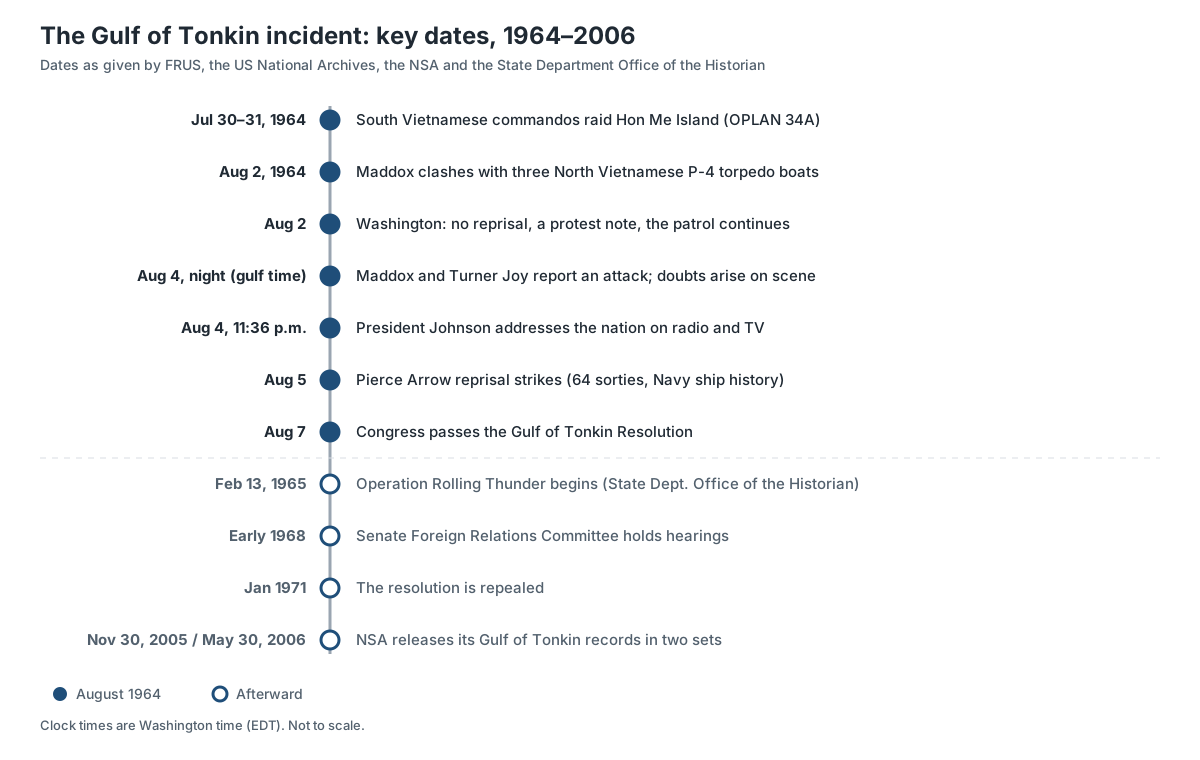
On the night of July 30–31, South Vietnamese commandos struck Hon Me Island, off the central coast of North Vietnam. Under orders to stay well out at sea at night, Maddox was away from the scene during the raid. Hanyok argues that the raids on these islands, Hon Me above all, combined with the nearby Maddox to set off the confrontation.
August 2: a clash that did happen
It was 3:40 a.m. on August 2 in Washington, 3:40 p.m. in Saigon. The first report came from Maddox. High-speed craft were approaching as if to make a torpedo attack. Twenty-seven minutes later, it reported that three North Vietnamese patrol craft were attacking and that it had opened fire.
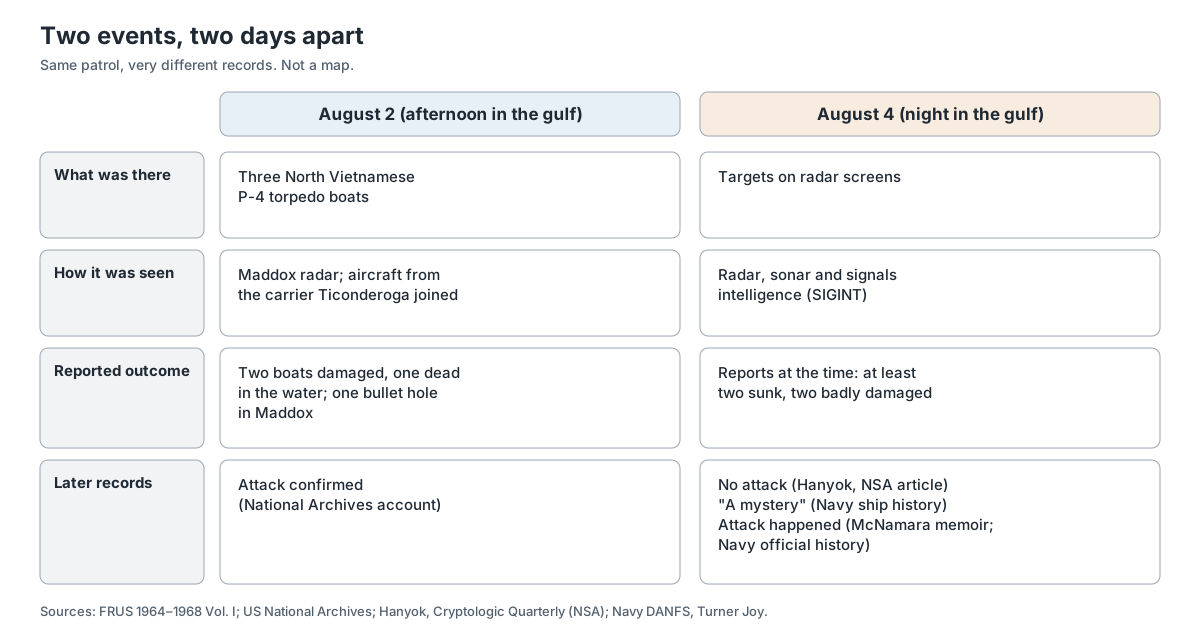
Maddox's radar had picked up three P-4 torpedo boats closing from the southwest. Aircraft from the carrier Ticonderoga joined the fight. Maddox and the aircraft damaged two of the boats, which withdrew northward, and a third was left motionless at sea. Maddox came through with nothing worse than a single bullet hole from a North Vietnamese machine gun.
Turner Joy also hurried toward Maddox. By the time it arrived, the remaining boat had fled. The two destroyers then kept patrolling the gulf together.
Why did the torpedo boats come out? According to the National Archives account, historians now suspect they set out to attack a South Vietnamese raid in progress and ran into Maddox. At a meeting in Washington that day, the participants judged that a shore commander or a shore station on the North Vietnamese coast had acted first. They decided not to retaliate.
They settled on two things instead. A protest note would go to North Vietnam, and the patrol would be ordered to continue.
August 4: a night seen through radar and sonar
Two days later, at 7:40 a.m. on August 4 in Washington, it was 7:40 in the evening in Saigon. Maddox reported that an attack by unidentified vessels appeared imminent. A report soon followed that its radar held two unknown surface contacts and three unknown aircraft.
Turner Joy reported sighting one, maybe two, torpedo wakes. Over the next two and a half hours, Turner Joy and aircraft from Ticonderoga fired at what they took to be hostile craft. Reports at the time claimed at least two boats sunk and another two badly damaged.
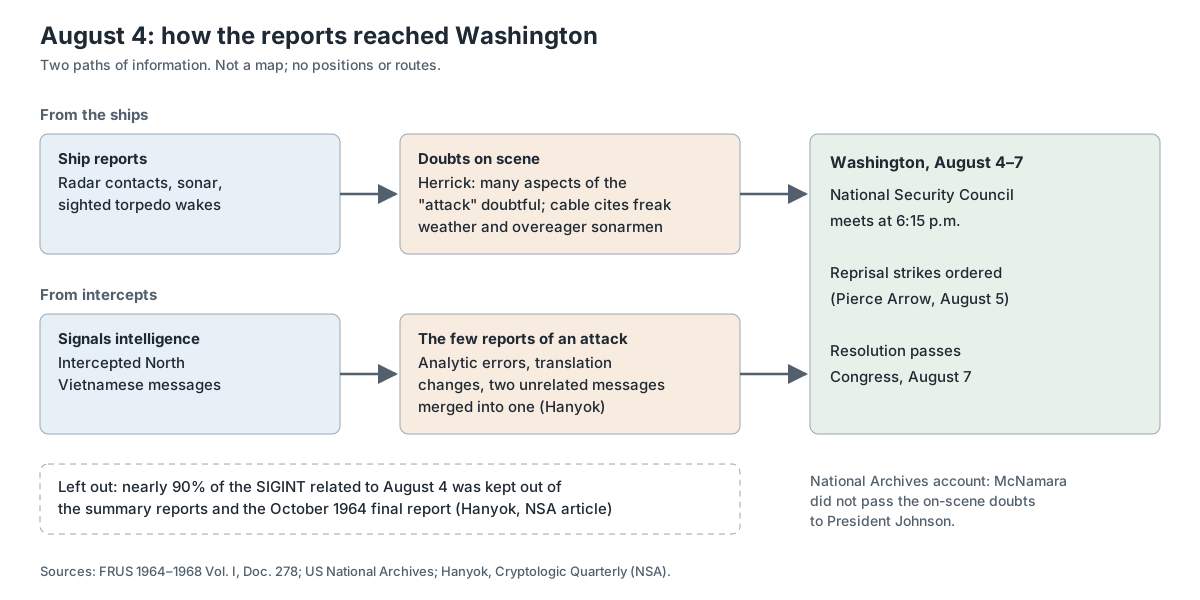
Confidence on the scene did not last. Captain John J. Herrick, aboard Maddox, commanded the destroyer division that Maddox belonged to and served as on-scene commander for the mission. He was not sure what had happened, and hours later he radioed Pacific Command that many aspects of the "attack" were doubtful.
As quoted in the National Archives account, the first report from the captain of Maddox was of being "under continuous torpedo attack." A later cable read: "freak weather effects on radar and overeager sonarmen may have accounted for many reports." Defense Secretary Robert McNamara, however, did not pass these doubts on to President Johnson.
The sonar record was not clean either. The sonar operator on Maddox saw a noise spike on his equipment but did not report it as a torpedo. Navy pilot James Stockdale, who was at the scene, saw nothing.
The Navy History and Heritage Command's ship history of Turner Joy (DANFS) says it remains a mystery whether North Vietnam attacked the two ships on the 4th. Bad weather and the strange radar conditions the Gulf of Tonkin is known for may have put echoes on Turner Joy's screen.
Washington's day: reprisal strikes and a resolution
At 6:15 p.m. on August 4, the National Security Council met in Washington. McNamara reported that North Vietnamese patrol boats had kept attacking the two destroyers in international waters. Director Rowan of the US Information Agency (USIA) asked whether they knew for certain that North Vietnam had really provoked the clash. He also asked whether they could pin down exactly what had happened.
McNamara replied that they would know for certain in the morning. For now, he said, only highly classified information confirmed the incident, and since it could not be used, they would rely on other reports still to come. When the President asked whether North Vietnam wanted a war by attacking US ships, CIA Director McCone said no. In his view, North Vietnam was reacting defensively to "our" attacks on its offshore islands.
The scope of the reprisal also came up at this meeting. The strikes were to hit two bases in the north of the country and two base complexes in the south, and a fifth target close to China was dropped. At 11:36 that night, President Johnson gave a radio and television address from the White House. The response, he said, would be "limited and fitting" for the present, and the United States still sought "no wider war."
On the next day, August 5, came the reprisal raid code-named Pierce Arrow. The carrier Constellation joined Ticonderoga, and aircraft from the two carriers flew 64 sorties.
Their targets were the bases from which the attacks had reportedly come and an oil storage depot that supported them. At the depot, 12 of the 14 oil storage tanks were set on fire. By early afternoon the strikes had hit several targets, including almost all of North Vietnam's naval installations.
On August 7, Congress passed a joint resolution (H.J. RES 1145). There was little debate. In the Senate, only two members, Wayne Morse and Ernest Gruening, voted against it, and the House passed it unanimously.
The heart of the resolution is short. Congress approved and supported the President's determination, as Commander in Chief, to take "all necessary measures." Those measures were "to repel any armed attack against the forces of the United States and to prevent further aggression." It would expire when the President judged that peace and security in the area were reasonably assured, and Congress could end it earlier by concurrent resolution.
The Office of the Historian explains that Congress backed it expecting the President to return and ask for support before widening the war.
What the declassified records said
On November 30, 2005, the NSA released its first set of formerly classified material on the Gulf of Tonkin incident. The final set followed on May 30, 2006. The releases include articles, chronologies, oral history interviews, memoranda, and reports and translations of signals intelligence (SIGINT), the intelligence drawn from intercepted communications. The NSA said it did not intend to prove or disprove any one set of conclusions.
Hanyok's article is among the documents posted on the NSA website. Articles in the journal are marked as the authors' opinions, which may not reflect the NSA's official views. The release date also differs between records. The National Archives account says that "a 2002 National Security Agency report made available in 2007" found the August 2 attack real and the August 4 attack nonexistent.
Hanyok starts from the fact that, until then, the NSA had officially held that the August 4 incident took place. From the newly found material he concludes that no attack happened that night. North Vietnam's navy was only salvaging two boats damaged on August 2.
How the SIGINT was used is a central part of the article. Most of the SIGINT related to August 4 was left out of the summary reports written after the event and the final report of October 1964. The part left out came to nearly 90% of all the SIGINT available. The few reports that suggested an attack contained serious analytic errors and unexplained changes in translation, and in one case two unrelated messages were merged into one.
He points to North Vietnamese traffic as well. On August 6, a North Vietnamese naval message summing up recent combat described fighting the "American warship" on August 2, but said nothing about the 4th. For Hanyok, this intercept leaves just one conclusion: nothing attacked the ships on the night of the 4th.
This does not mean that someone made up evidence. Hanyok writes that the mishandling of the SIGINT cannot fairly be called a conspiracy in which evidence was invented and every level colluded. Those involved were instead trying to support the Navy's claim that North Vietnam had deliberately attacked the DESOTO patrol.
Hanyok's article also records the opposing view. In 1968, McNamara told the Senate Foreign Relations Committee that the supporting signals intelligence was "unimpeachable," and in his memoir In Retrospect he still found the evidence convincing. The Navy's official history of the Vietnam War, by Marolda and Fitzgerald, said the evidence for the second attack was considered conclusive. That was especially true of the intelligence, which included a small amount of SIGINT.
Government records themselves use different words for whether the attack on Turner Joy took place. In the Office of the Historian's account there is a sentence about doubts that emerged later, and in the Navy ship history the word "mystery." What appears in the National Archives account is the conclusion that no attack happened.
What the resolution left behind
The Office of the Historian sees the incident and the resolution as the justification for further US escalation in Vietnam. By its account, Operation Rolling Thunder, the bombing of North Vietnam, started on February 13, 1965. Johnson also approved sending regular ground combat units, the first of many such deployments. At the peak of US involvement, more than half a million US personnel were stationed there.
The resolution served as the legal ground on which the Johnson administration, and later the Nixon administration, carried on the war. The Navy ship history describes it as the legal foundation for direct US involvement in the war in Indochina over the following eight and a half years.
The question went back to Congress. In early 1968, the Senate Foreign Relations Committee, chaired by Senator William Fulbright, opened hearings on the incident. In 1964, Fulbright had been the one who steered the resolution through the Senate.
According to the National Archives account, a Senate investigation showed that Maddox had been gathering intelligence in the gulf. That contradicted Johnson's denial that the Navy supported such missions. Once conflicting evidence came out, many people felt Congress had been misled, but by then it was too late. In January 1971 the resolution was repealed, as an effort to limit President Nixon's ability to keep the war going.
Looking back, every record says the August 2 clash took place. On August 4, the records split among "it did not happen," "doubts emerged later," "a mystery" and, in the Navy's official history and McNamara's account, "it happened." Following which report went to whom, and when, shows why the same night was recorded so differently.
What to read next
- "The Vietnam War at a Glance: 1955 to 1975": the whole war that followed the Gulf of Tonkin.
- "Ia Drang and Helicopter Air Mobility": the Vietnam War after ground troops arrived.
- Radar: measuring distance and motion with radio waves: background for the targets that appeared on screens on August 4.
- Sonar: why sound is used to see underwater: background for why the sonar reports became a point of dispute.
- Destroyers and frigates: why warships have different names: what kind of warships Maddox and Turner Joy were.
- Finding open sources: where to look for government reports, papers and standards: where to find public records such as FRUS.
- How to read laser weapon news: applying the habit of separating announcements from records to laser weapon news.