News reports about air strikes often list "aircraft, cruise missiles, and drones" side by side. A U.S. congressional report sorts Russian attacks into the same three groups. Yet two of the three look a lot alike. A cruise missile and a one-way attack drone both fly with no one on board, end in an explosion at the target and never come back.
So what separates them? This article puts the U.S. Department of Defense (DoD) definition of a UAV next to the categories of an international export-control regime. The answer depends on who draws the line. Categories and terms change often, so this article reflects the situation as of October 2026.
What a one-way attack drone is
The name seems to have no official definition. In a 2024 overview of drone categories, the Congressional Research Service (CRS) noted that DoD seems never to have issued a public definition of a one-way attack UAV. What CRS gives instead is how DoD uses the term: a UAV built for a single-use mission, with an explosive warhead built into the airframe.
On that account, these drones are also called loitering munitions, and they are meant to fly into a point target and detonate. CRS adds the phrase "much like a missile." Even the official summary starts by admitting the two are close.
"Single-use" is not always literal. Some may be recovered and reused by the operator in certain circumstances. Some can hold off an engagement so an operator can look over several possible targets and choose one, while others are preprogrammed to attack specific targets. The kind that waits for a person to choose is covered in Loitering munitions: between missile and drone.
One-way attack is one of several single-use missions a UAV can fly. It is a name for a mission, not for a shape. A UAV combined with ground control stations and data links makes up an unmanned aerial system (UAS). CRS describes one-way attack drones inside a document that sorts out the categories of these systems.
The word "drone" deserves a note too. In the U.S. military it is everyday slang for any uncrewed aircraft, just as the public uses it. It is also a label for certain types of military aircraft, such as target drones.
What a cruise missile is
The cruise missile definition is short. A 2005 CRS report quotes it as "a long-range, low-flying guided missile that can be launched from air, sea, and land."
The key words are "guided missile." The object is named from inside the missile family from the start. How a cruise missile flies and finds its way is covered in Cruise missiles: how they resemble aircraft.
This definition says nothing about whether anyone is on board or whether it is used only once. Another document fills that gap. The international export-control regime discussed below lists cruise missiles as a kind of unmanned air vehicle.
The DoD line: cruise missiles are not UAVs
Here is how DoD defines a UAV, as quoted in a 2012 CRS report.
- A powered aerial vehicle that does not carry a human operator.
- It uses aerodynamic forces to provide lift.
- It can fly autonomously or be piloted remotely.
- It can be expendable or recoverable.
- It may carry a payload, lethal or not.
The definition then names what it leaves out. Three groups are set aside: ballistic and semi-ballistic vehicles, cruise missiles, and artillery shells.
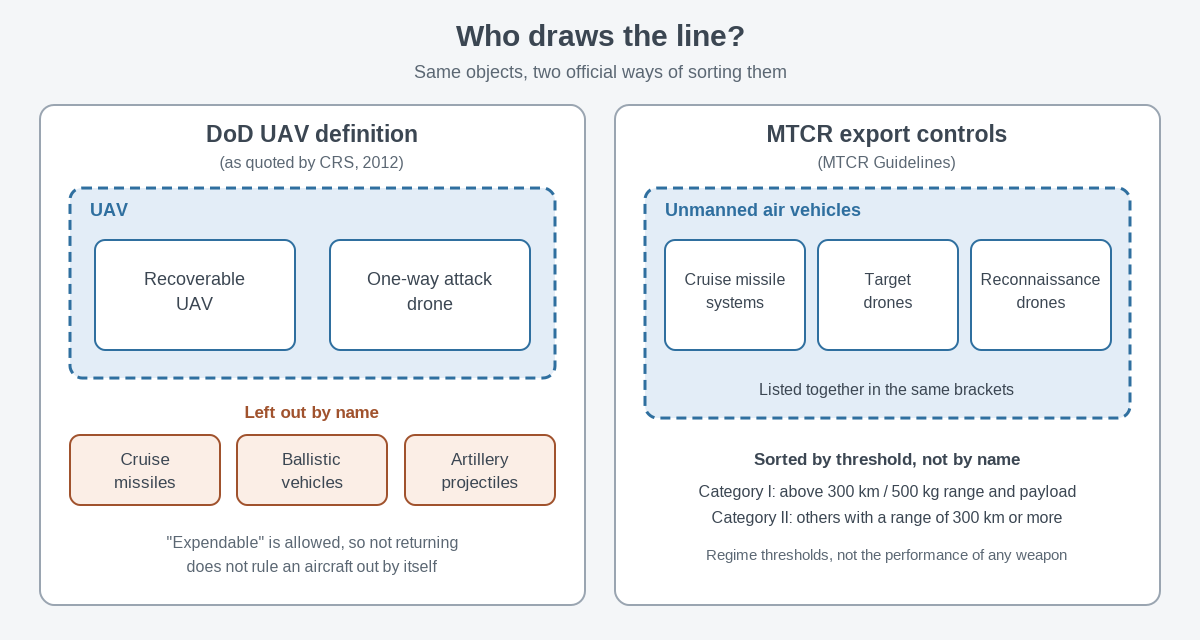
Two things stand out. First, "expendable" is allowed, so an aircraft that does not return is not ruled out for that reason alone. Second, cruise missiles are removed by name, not by any property, and the definition does not say why.
Think of a class register at school. A student who looks like everyone else is still not in the class if the name is missing from the register. The analogy only goes so far. A register lists names and nothing else, while the UAV definition first checks the five conditions and only then removes a few groups by name.
The export-control line: one basket
Seen from another side, the line moves. The Missile Technology Control Regime (MTCR) was set up on April 16, 1987, by the United States, Canada, France, Germany, Italy, Japan and the United Kingdom. Its aim is to slow the spread of ballistic and cruise missiles, rockets and unmanned air vehicles that can deliver weapons of mass destruction. It is an informal arrangement, not a treaty.
The MTCR Guidelines ask partner countries to exercise restraint in every transfer of a listed item and to weigh each case on its own. The greatest restraint applies to Category I items. Category I covers complete rocket systems and unmanned air vehicle systems that exceed a 300 km/500 kg range and payload threshold. Inside the brackets for those unmanned air vehicle systems sit cruise missile systems, target drones and reconnaissance drones.
Unmanned air vehicles outside Category I with a maximum range of 300 km or more fall into Category II. Cruise missile systems, target drones and reconnaissance drones are listed there as well. Partners still exercise restraint with Category II, but they have more flexibility.
In the MTCR, then, a cruise missile is one kind of unmanned air vehicle. In this basket the slots are set by how far and how much an item can carry, not by its name. The 300 km/500 kg figure is a threshold set by the regime, not a statement about any weapon's performance.
Where they overlap and where they part
Putting the two lines together shows that the difference does not come from a single feature of the object. The DoD definition takes cruise missiles out by name, while the MTCR places them in the same unmanned air vehicle slot as target and reconnaissance drones.
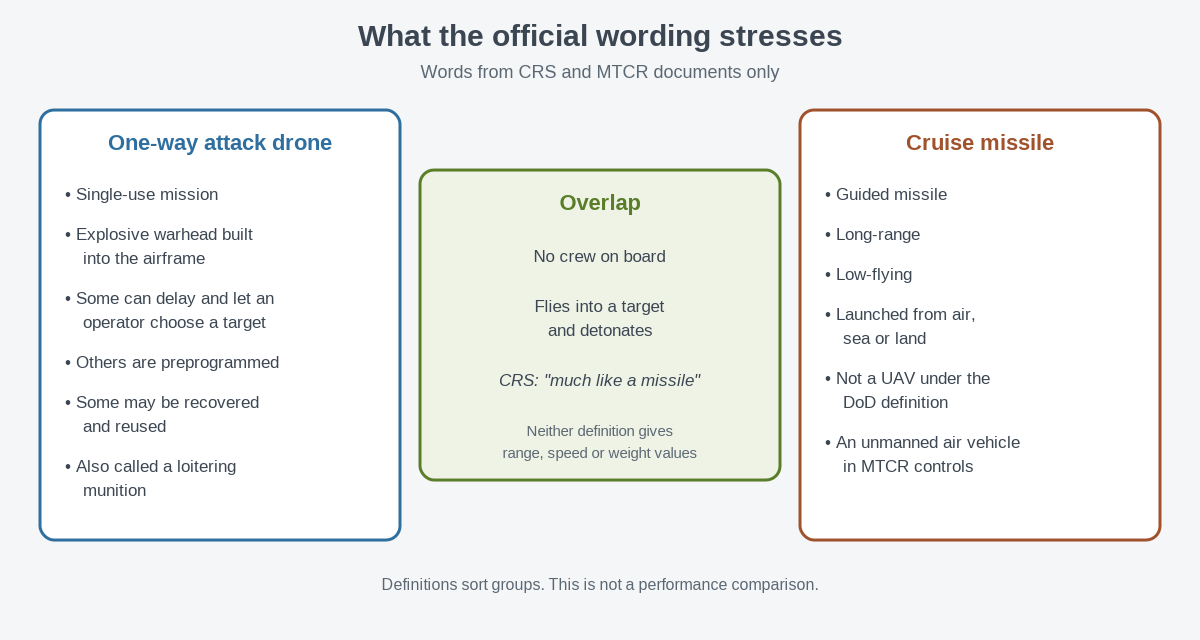
The overlap is clear. Neither carries a crew: one-way attack drones are classed as UAVs, and the MTCR puts cruise missiles among unmanned air vehicles. Both fly into a target and detonate, which is where CRS writes "much like a missile."
Where they part is in what each description stresses. The one-way attack drone description leans on the mission. It names a single-use mission, a built-in warhead, and several ways of reaching a target, from waiting for a person to choose to following a preset plan. The cruise missile definition leads with long range, low flight and launch from air, sea or land.
The words of a definition cannot tell you what a given weapon can do. A short definition is a tool for sorting groups, not a performance sheet. Whatever name a news story uses, it pays to check which system of terms the source document is using.
Names in official documents
How does the name show up in real documents? The U.S. Treasury issued a sanctions announcement on February 23, 2024. It named two partners: Russia and Iran's Ministry of Defense and Armed Forces Logistics (MODAFL). They had worked together to pay for and build one-way attack UAVs of Iranian design at a new plant in Russia, and the release also calls them "kamikaze drones."
A March 2025 CRS report on counter-drone systems turns to Iraq. There, U.S. forces have picked up pieces of Shahed series one-way attack drones of Iranian origin: the Shahed-101, 131 and 136. It adds that the Houthi group used similar drones against merchant ships in the Red Sea, and Russia used them to strike Ukrainian cities and energy facilities. How names split within this family is laid out in The Shahed series: same name, different drones.
The same report mentions another kind as well. Russia and Ukraine have reportedly armed first-person view (FPV) one-way attack drones with explosives and handed them to front-line units, adding to artillery shells and conventional missiles. FPV aircraft at the front and the Shahed series end up under the same "one-way attack" label in one document. The FPV side continues in FPV drones: flying through the drone's eyes.
The U.S. military has bought this kind of aircraft too. In the mid-2010s the U.S. Army bought a few small one-way attack drones for its special forces units, and CRS also calls them "loitering munitions."
Notice that the counter-drone report lists the two groups separately. It writes of Russian attacks by "aircraft, cruise missiles, and drones" and of Houthi "drone and cruise missile attacks," placing them side by side. Under the DoD definition, too, they sit in different slots.
Where this meets lasers
What an incoming object is classed as matters to the defender as well. The CRS counter-drone report lists several technologies DoD is pursuing against drones. They include new interceptors that may cost less, guns and electronic warfare, along with high-power microwave and directed energy systems.
A laser weapon is one branch of directed energy weapons (DEW). When a laser weapon story says a system "stops drones," checking which group those drones belong to makes the story much easier to read accurately. What the label "laser weapon" covers is explained in What is a laser weapon? Film versus reality, and why drone defense layers several devices is explained in Counter-drone systems: why one device is not enough.
What to read next
- Loitering munitions: between missile and drone: the kind that waits before diving, and the question of human control.
- Cruise missiles: how they resemble aircraft: how cruise missiles fly and find their way.
- The Shahed series: same name, different drones: reading the names of a family often reported as one-way attack UAVs.
- Counter-drone systems: why one device is not enough: how drone defense devices are layered.