In February 1945, more than 1,200 British and American bombers flew over the German city of Dresden and attacked it four times. These were the final months of the war in Europe. The raids are still counted among the most controversial Allied attacks of World War II.
How much did burning cities from the air help end the war? And was it worth the lives it cost? Since the war ended, neither question has settled on a single answer. This article follows what strategic bombing aimed at, how it turned into the bombing of cities, and where the first official audit and later verdicts part ways, using public records.
The idea that bombers could win wars
Strategic bombing goes after an enemy's ability to fight itself. In World War II, the Allied bombing of Germany was meant to destroy key industrial, transport and military targets and weaken Germany's ability to fight. The offensive against Nazi Germany was one of the longest and most intense strategic bombing campaigns of the war.
Behind it lay hopes that went back before the war. In the United States, many believed that long-range heavy bombers fighting a strategic bombing war could win it. A group of US Army officers known as the "Bomber Mafia" developed a strategy of precise daylight bombing against factories and military sites deep inside enemy territory.
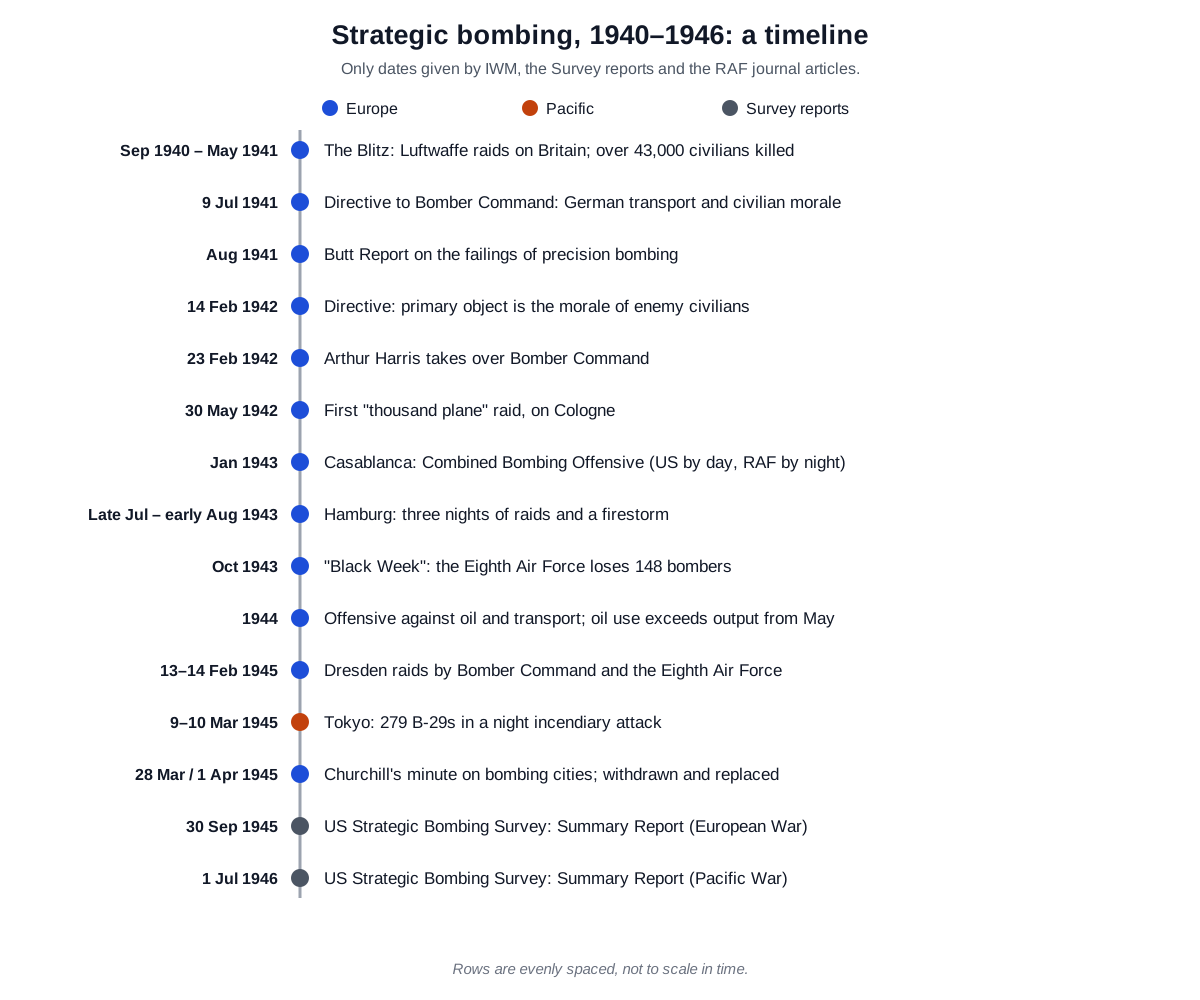
City bombing was not only an Allied practice. The German air force, the Luftwaffe, bombed Britain in a long series of raids from September 1940 to May 1941. This Blitz changed daily life across Britain and killed more than 43,000 British civilians.
From aiming at factories to aiming at cities
In 1939, RAF Bomber Command had 23 operational bomber squadrons with 280 aircraft, and at first it struck only strictly military targets. On early daylight raids, the bombers were easy targets for enemy fighters. On 18 December 1939, German fighters shot down 12 of 22 Wellington bombers on a raid against shipping off Wilhelmshaven.
After Germany invaded France in 1940, the RAF began bombing German industry at night, especially synthetic oil plants. In the dark, though, crews rarely managed to find a single factory or refinery. The plan to hit particular factories proved impossible to carry out.
The Butt Report of August 1941 is often named as the turning point. On this account, it exposed the failings of precision bombing and pushed the RAF toward targeting cities and civilian morale. An article by Peter Lee in Air Power Review, the journal of the RAF's Centre for Air and Space Power Studies, calls this reading somewhat crude. A directive of 9 July 1941, more than a month before the report, already called for disrupting German transport and breaking civilian morale, especially among industrial workers.
A directive of 14 February 1942 went a step further. It made the morale of the enemy civilian population, and in particular of industrial workers, the primary object of operations. Arthur Harris took over Bomber Command after that, on 23 February. Lee notes that the shift from factories to morale had already happened before Harris arrived.
That year, accepting that precision bombing was proving impossible, the British War Cabinet sanctioned "area bombing." This meant targeting whole cities to destroy both factories and the workers in them. It was judged necessary to defeat an enemy that seemed close to victory. Harris believed it could win the war, and he won much public support when he sent 1,000 bombers against Cologne on the night of 30 May 1942.
The Americans took a different road. At the Casablanca Conference in January 1943, Britain and the United States agreed on a Combined Bombing Offensive. The US Eighth Air Force would bomb precisely by day, and the RAF would area-bomb the same targets by night, in a "round the clock" offensive.
The price was high. In a single week of October 1943, known as "Black Week," the Eighth Air Force lost 148 bombers and about 1,500 aircrew. That was nearly 13% of the aircraft it sent to attack.
By 1944, the combined Allied bomber force began to overwhelm the Germans, and an offensive against Germany's fuel supplies succeeded. Harris kept up his city attacks all the while, still convinced they would prove decisive. In 1945, raids against oil and communications proved the most effective. Starved of fuel, the German military machine ground to a halt.
Hamburg, Dresden and Tokyo
Over three nights in late July and early August 1943, the RAF bombed Hamburg, and a firestorm swept the city. In the words of the US Strategic Bombing Survey's report, it was perhaps the most devastating single city attack of the war. About a third of the city's houses were destroyed, and German estimates put the dead at 60,000 to 100,000. No later city raid shook Germany the way Hamburg did.
RAF Bomber Command and the US Eighth Air Force both took part in the Dresden raids of 13–14 February 1945. Nearly 4,000 tons of bombs and incendiaries fell, and a firestorm destroyed the city. Imperial War Museums (IWM) gives the dead as up to 25,000. An Air Power Review article by Peter W Gray also cites an estimate of some 25,000 killed, and adds that the casualty figures have been debated, revised and contested.
Dresden comes up again and again. Gray suggests these raids have probably caused more heated debate than all the others put together. He himself argues that Dresden was a strategic target in its own right, and that its industry and transport links left Germany's seventh-largest city open to attack.
In the Pacific, the method of bombing changed sharply in March 1945. American B-29 bombers began attacking Japanese cities at night, carrying incendiaries instead of high-explosive bombs. An IWM curator explains that most Japanese houses were built of wood and bamboo, and that the commander, Curtis LeMay, knew firebombing would cause huge civilian losses. It was a controversial decision.
On the night of 9–10 March 1945, 279 B-29s firebombed Tokyo. IWM says 16 square miles of central Tokyo burned and nearly 100,000 people were killed. That is more than the estimated casualties of the atomic bomb on Hiroshima. The Survey recorded that 15 square miles of the most crowded parts of Tokyo burned to the ground, and that no later city attack was as destructive.
Attacks on Japanese cities went on after that. By the Survey's count, 66 urban areas were the targets of 104,000 tons of bombs, and about 40% of those cities' built-up land was destroyed. About 30% of Japan's whole urban population lost their homes, along with many belongings.
The first audit: the Strategic Bombing Survey
The audit began before the war was over. The Secretary of War created the United States Strategic Bombing Survey (USSBS) on 3 November 1944, on President Roosevelt's orders. It was planned with 300 civilians, 350 officers and 500 enlisted personnel. The European summary report is dated 30 September 1945, and the Pacific summary report 1 July 1946.
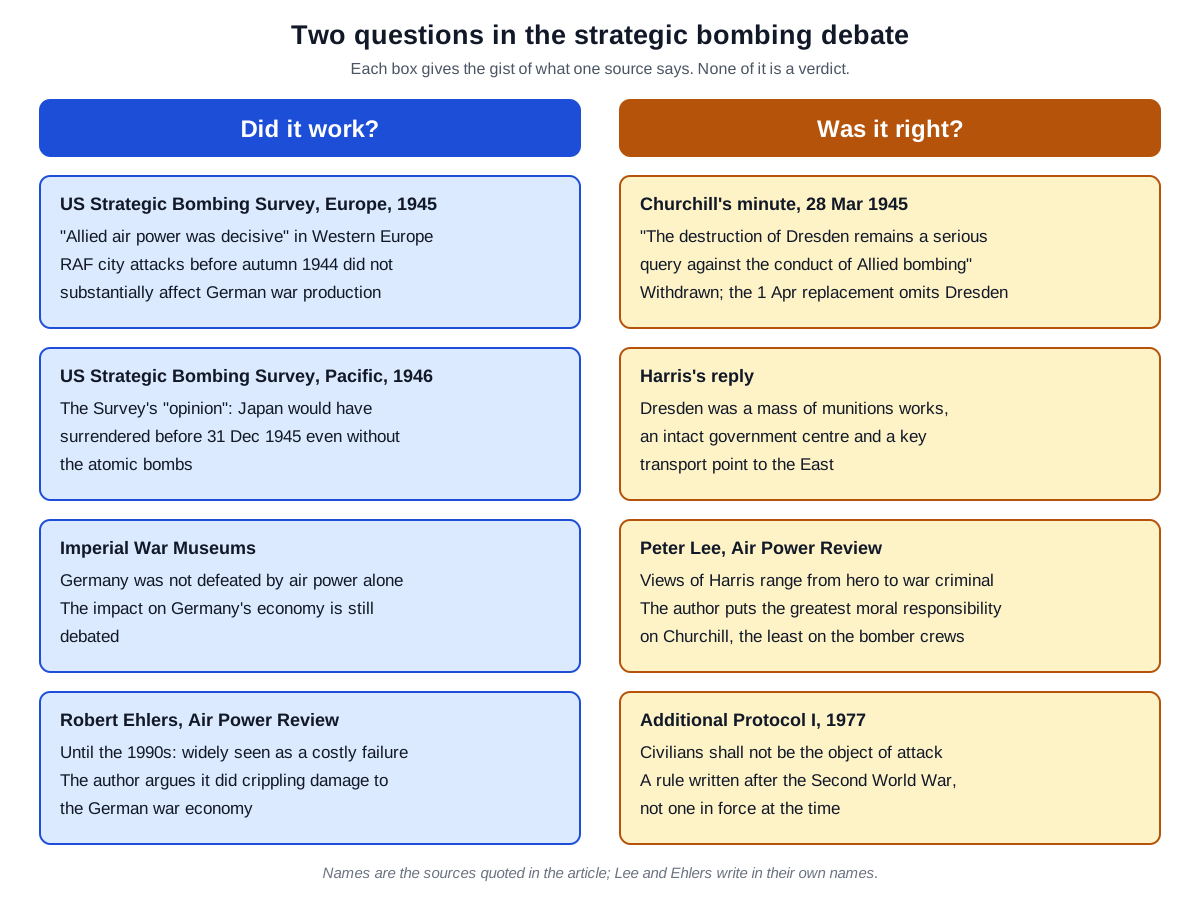
The European summary's conclusion is short and firm. Allied air power, it says, was decisive in the war in Western Europe. The summary says air power brought the economy behind the German armed forces to virtual collapse. It also adds a caveat: Allied ground forces overran the enemy before the full effects of that collapse reached the front lines.
Look at city attacks alone, and the picture changes. Until the autumn of 1944, RAF city attacks did not substantially affect the course of German war production, and German war production as a whole kept rising. Output in a bombed city fell for a while and then largely recovered within a few weeks. For the area raids from autumn 1944 on, the report says too many other forces were at work to measure their effect separately, but that they were significant.
The Survey put more weight on basic industries. From May 1944, German oil consumption exceeded production, and the Survey called the attack on transport the decisive blow that completely disorganized the German economy. The Germans themselves worried far more about attacks on oil, chemicals, steel, power and transport than about attacks on arms factories or city areas. At the same time, the speed and ingenuity with which Germany rebuilt and ran its key war industries went beyond what the Allies expected.
What about the people? The Survey found that German morale fell under air attack, and that above all people wanted the war to end. But in a police state there was a wide gap between discontent and open opposition, and by and large workers kept working.
The Pacific summary went further and offered an opinion. It said there was little point in tying Japan's surrender precisely to any one of its many causes. Yet it held that, even without the atomic bombs, command of the air over Japan could have applied enough pressure to bring unconditional surrender.
In the Survey's "opinion," Japan would certainly have surrendered before 31 December 1945, and most likely before 1 November 1945. That held, it said, even with no atomic bombs, no Soviet entry into the war and no planned invasion.
In the answers the Survey collected, 10% of people in December 1944 believed Japan could not win. That share rose to 19% in March 1945, 46% in June and 68% just before surrender. More than half of those who came to believe this named air raids other than the atomic bombs as the main reason.
An IWM curator tells it differently. The incendiary raids hit Japan hard, yet the war went on, and Allied planners believed an atomic bomb was the only way to secure an unconditional Japanese surrender. The decision to drop the atomic bombs is the subject of a separate article, "The Manhattan Project, Hiroshima and Nagasaki."
Later verdicts: the argument over results
The argument did not end with the reports. IWM says the bold claims made by the Bomber Mafia before the war never came true, and that Germany was not defeated by air power alone. It also says that, although the effect on Germany's economy is still debated, the Eighth Air Force clearly helped deal the Luftwaffe a blow it never recovered from.
For RAF Bomber Command, there have also been calls for a fresh look. In an Air Power Review article, Robert Ehlers writes that until the 1990s the near-universal view saw Bomber Command's offensive as a costly failure that swallowed resources better used elsewhere. Ehlers himself argues the opposite: that Bomber Command did crippling damage to the German war economy. He sees city attacks on their own as clearly not decisive, but as a source of serious difficulties for Germany.
One of his grounds is the resources tied down in defense. According to his article, anti-aircraft guns rose from 14% of total German war production in the first quarter of 1940 to 29% in the first quarter of 1943. On morale, he says German morale never broke, but the relentless bombing clearly lowered it.
Criticism also runs the other way. One view that IWM reports argues that the myth of winning the war in Europe by air power alone led to needless military and civilian deaths. The debate splits in two main places. How much did bombing shake Germany's ability to wage war, and can the human cost be justified?
Was it right? The argument over morality and blame
Apart from results, people also disagree about aiming at cities where civilians lived at all. In the weeks after the Dresden raids, public unease began to surface. On 28 March 1945, Winston Churchill sent a minute to General Ismay and the Chief of the Air Staff.
Gray's article quotes its key line. "It seems to me that the moment has come when the question of bombing German cities simply for the sake of increasing terror, though under other pretexts, should be reviewed."
The minute also said, "The destruction of Dresden remains a serious query against the conduct of Allied bombing." Harris replied that Dresden had been a mass of munitions works, an intact government centre and a key transport point to the east. The Chief of the Air Staff, Charles Portal, strongly backed Harris, and Churchill withdrew the minute. A less provocative replacement issued on 1 April made no mention of Dresden.
Views also split over who bears the blame. Lee writes that few military figures divide public, military and academic opinion the way Harris does. To some he is a hero of the vast struggle against Hitler's Reich, and to others a war criminal who escaped prosecution only because he was on the winning side. Lee himself argues that, for bombing after 27 January 1945 and Dresden in particular, Churchill bears the greatest moral responsibility and the bomber crews the least.
Some read Churchill's minute differently. Oliver Haller, whose view Lee's article also presents, sees it as rooted in a judgment that destroying industry needed for reconstruction or reparations made no economic or humanitarian sense.
The American side is not simple either. The Eighth Air Force's precision bombing doctrine aimed to avoid civilian casualties, but accuracy was low, collateral damage was unavoidable, and the Eighth often joined the RAF in area-bombing cities. IWM says that after the war the Americans managed to distance themselves from the public and political unease over bombing these cities. Bomber Command, by contrast, made a major contribution to the Allied victory and lost over 55,000 aircrew, yet remains mired in controversy to this day.
Reading the numbers
Even putting the cost into numbers is hard. German civilian deaths alone differ from source to source. The overview of the Survey's European summary estimates some 300,000 civilians killed, 780,000 wounded and 7,500,000 left homeless.
Later in the report, the Survey notes that official German statistics counted 250,253 killed by air attack from January 1943 to January 1945. It judges that too low and re-estimates at least 305,000 killed for the whole war. This figure includes not only German civilians but also foreigners and military personnel in the cities attacked. IWM puts the number of German civilians killed by Allied bombing at over half a million.
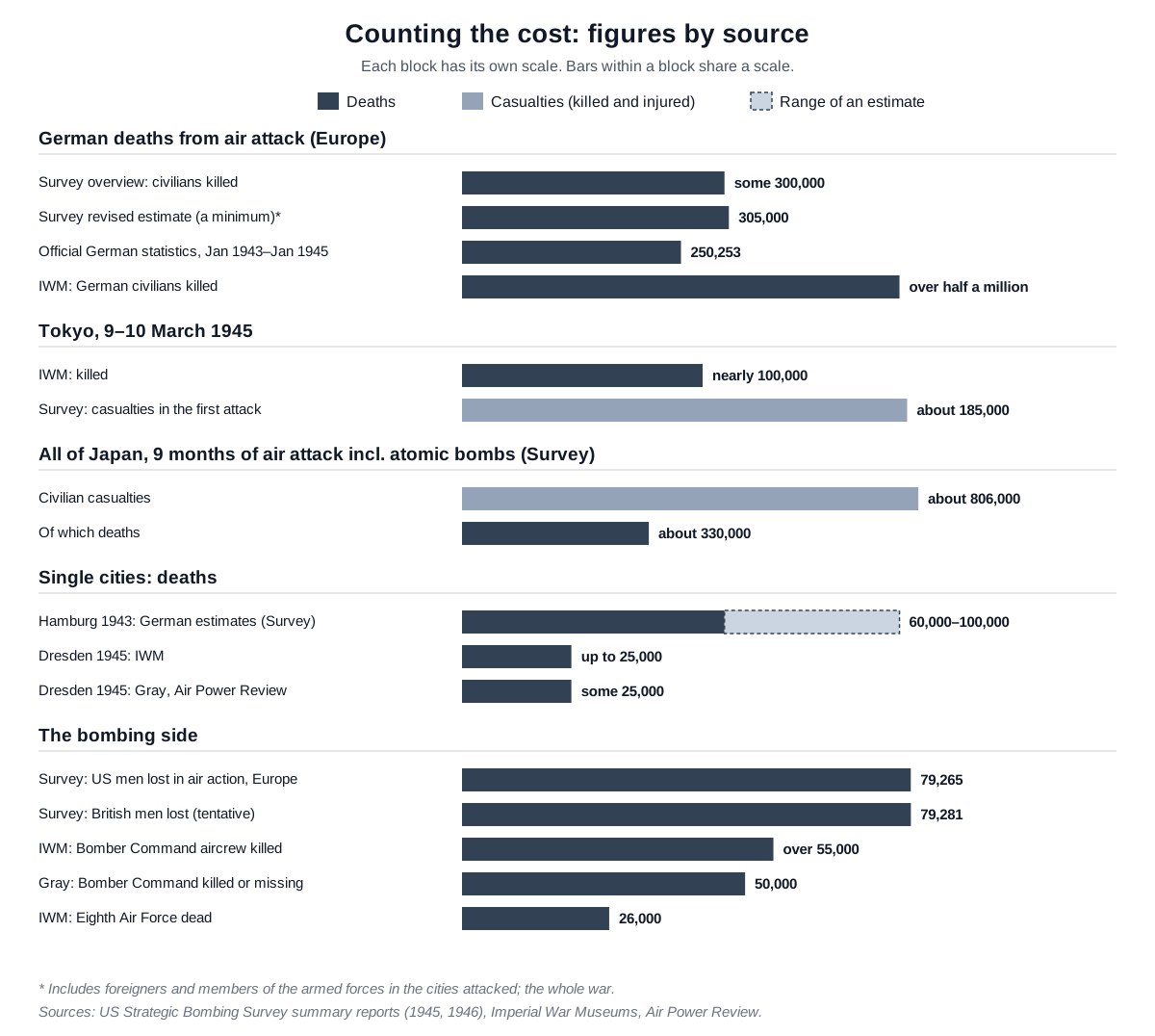
City figures differ too. For the Tokyo raid of 9–10 March, IWM's figure is nearly 100,000 killed, and the Survey's is about 185,000 casualties for the first attack. The Survey's figure counts the injured as well as the dead. Across all of Japan, nine months of air attack, including the atomic bombs, caused about 806,000 civilian casualties, of whom about 330,000 died.
The bombing side also paid heavily. By the Survey's count, the men lost in air action in Europe were 79,265 Americans and 79,281 British, and the British figures are tentative. Bomber Command's losses come to over 55,000 aircrew killed by IWM's count, and 50,000 killed or missing by Gray's. The Eighth Air Force's dead number 26,000 by IWM's count.
Even the weight of bombs depends on what is counted. Bombs dropped by Britain and the United States on German cities, factories and military targets come to more than 1.4 million tons by IWM's count. All bombs dropped by Allied air power in the European war come to almost 2,700,000 tons by the Survey's. Differing numbers do not make the loss any smaller: whichever source you read, hundreds of thousands of civilians lost their lives.
What it left
Some thirty years after the war, international law took up the question directly in Article 51 of Additional Protocol I to the Geneva Conventions, dated 8 June 1977. It forbids making civilians the target of attack, and it bans violence or threats whose main purpose is to spread terror among them. Any bombing also counts as indiscriminate if it lumps clearly separate military objectives in a city or similar civilian area together as one target. No such article existed during World War II.
Questions about precision remained too. The Survey wrote that the German experience shows how much careful selection of targets matters. How the problem of putting bombs where they are aimed later led to precision-guided munitions (PGM) is told in the article on precision-guided bombs.
Public records give no one-line answer to whether bombing cities ended the war. The Survey called air power decisive, yet it found that city attacks before autumn 1944 did not substantially affect production. Later researchers still reach different conclusions about both the results and the morality.
What to read next
- The Battle of Britain: An Air Defense Built on Radar and Control: the 1940 air battle over Britain that led into the Blitz.
- The Manhattan Project, Hiroshima and Nagasaki: a separate article on the atomic bombings this one only touches on.
- Precision-guided bombs: what gets added to a plain bomb: how the technology for putting bombs where they are aimed changed after World War II.
- Turning points in military technology: other technologies that changed the shape of war.
- A history of laser weapons: from chemical to electric lasers: the path taken by laser weapons, this site's main subject.