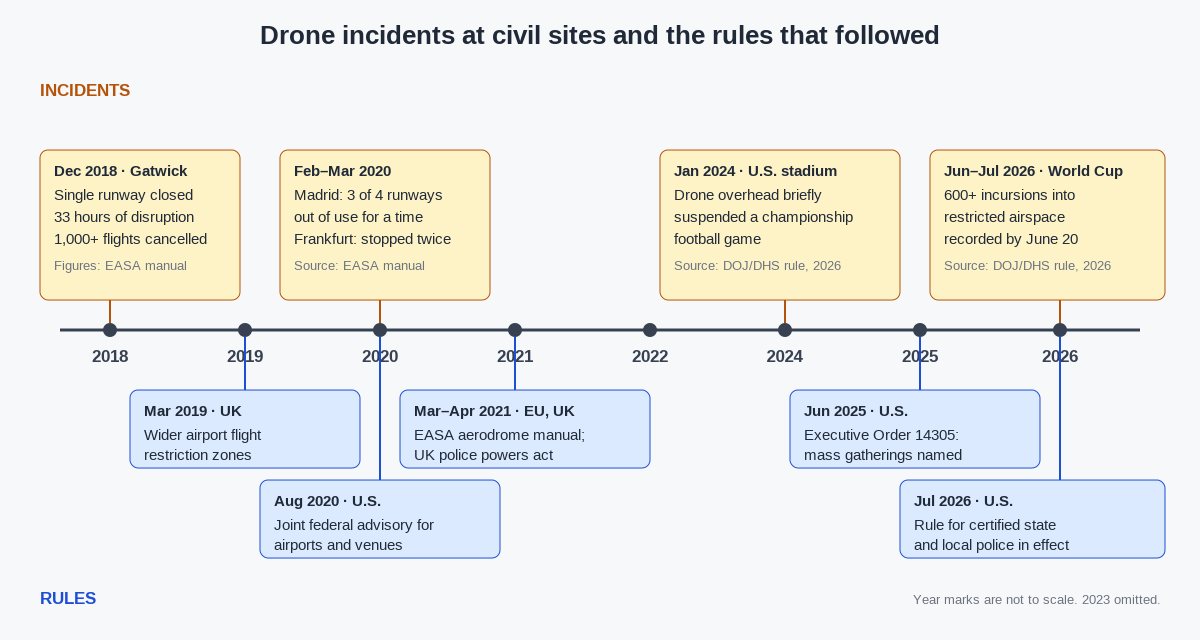
In December 2018, the single runway at London Gatwick Airport was closed during three days of drone reports. The sightings kept coming in. It was the run-up to Christmas, and tens of thousands of passengers were stranded. A large airport had stopped because of small machines said to be in the sky.
This article follows the rules that countries wrote afterward for civil sites: airports, stadiums and large events. It uses public documents from the UK, Europe, the United States and Korea. The questions are how flight restriction zones grew, what airport operators and police may do, and who is actually allowed to stop a drone.
The tools themselves are covered in "Counter-drone systems: why one device is not enough." This article reflects the situation as of October 2026.
Why airports are vulnerable to drones
The sky near an airport holds the paths that departing and arriving aircraft follow. Close to those very paths, unauthorized unmanned aerial systems (UAS), or drones, are reported often. The European Union Aviation Safety Agency (EASA) has an airport manual on this. It says most such drones are seen around the airport fence, inside it, or under the routes aircraft use to land and take off.
A collision between a crewed aircraft and a drone could be disastrous. So when a drone report comes in, the airport and its air traffic service are frequently forced to halt or limit use of the runway. A single report can turn straight into flight disruption.
Finding the drone is hard too. A small unmanned aircraft is far more difficult to identify, and its pilot is not easy to locate or track. The problem of telling a drone from a bird in the first place is covered in "Drone or bird: what sensors look at."
Gatwick 2018: three days that changed the rules
According to the EASA manual, 115 drone sightings were reported over Gatwick between December 19 and 21. The disruption went on for 33 hours. In that time more than 1,000 flights were cancelled and some 140,000 passengers were affected. The manual estimates the cost to the industry at up to EUR 64 million.
In its January 2019 response on drone policy, the UK government called the disruption a "stark example." In the government's view, it showed why more action was needed to keep drone use safe.
The problem did not stay in Britain. A paper on airport security notes that Heathrow had a similar, shorter disruption in January 2019. In the same month, Newark Airport in the United States closed for 90 minutes after a drone was spotted nearby.
On February 3, 2020, three of the four runways at Madrid Barajas were out of use for a time and 26 flights were re-routed. Frankfurt suspended runway operations twice within one month (February 8 and March 2).
The UK and Europe: wider zones and new guidance
Rules existed before Gatwick. From July 30, 2018, all drones in the UK were banned from flying above 400 ft and within 1 km of protected airport boundaries. After the incident, the government decided to widen that zone.
The wider zone has two layers. One is the aerodrome traffic zone around the airport, which the government document describes as roughly a circle with a 5 km radius. The other is a rectangle 5 km long and 1 km wide reaching out from each end of the runway.
The amendment order that came into force on March 13, 2019 calls these rectangles runway protection zones, and sets their width at 1.5 km for Heathrow only. Any small drone flight inside the zone needs permission.
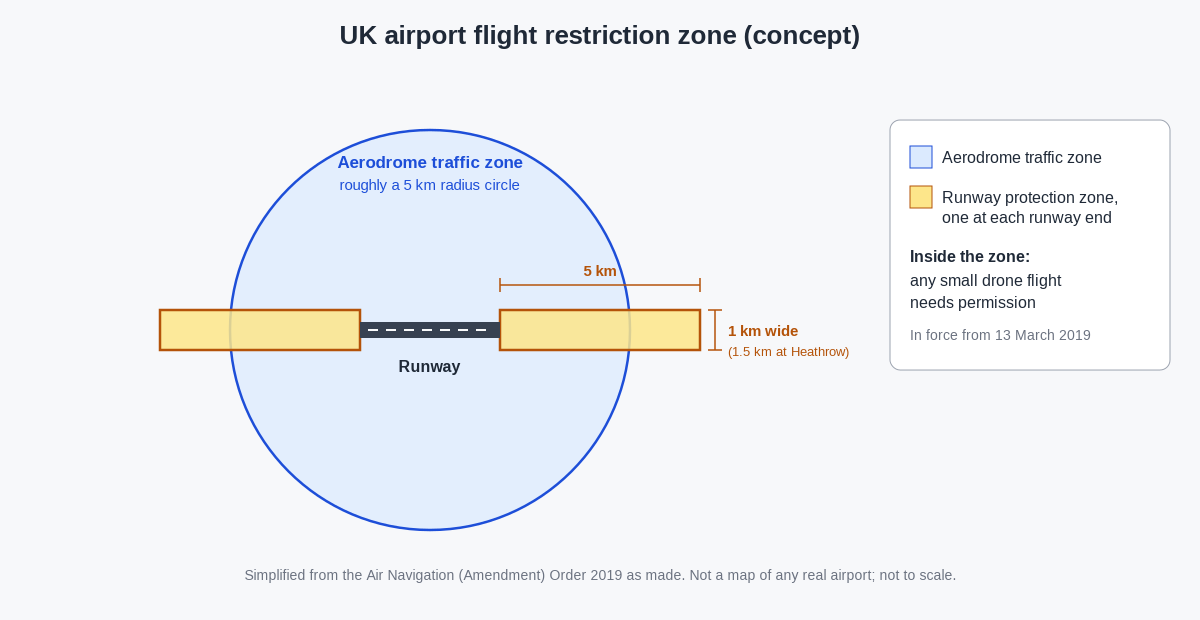
The government document admits a limit. A bigger zone would not prevent an incident that someone causes on purpose. The zone draws a line for people who want to follow the rules; it does not stop someone who means to cross it.
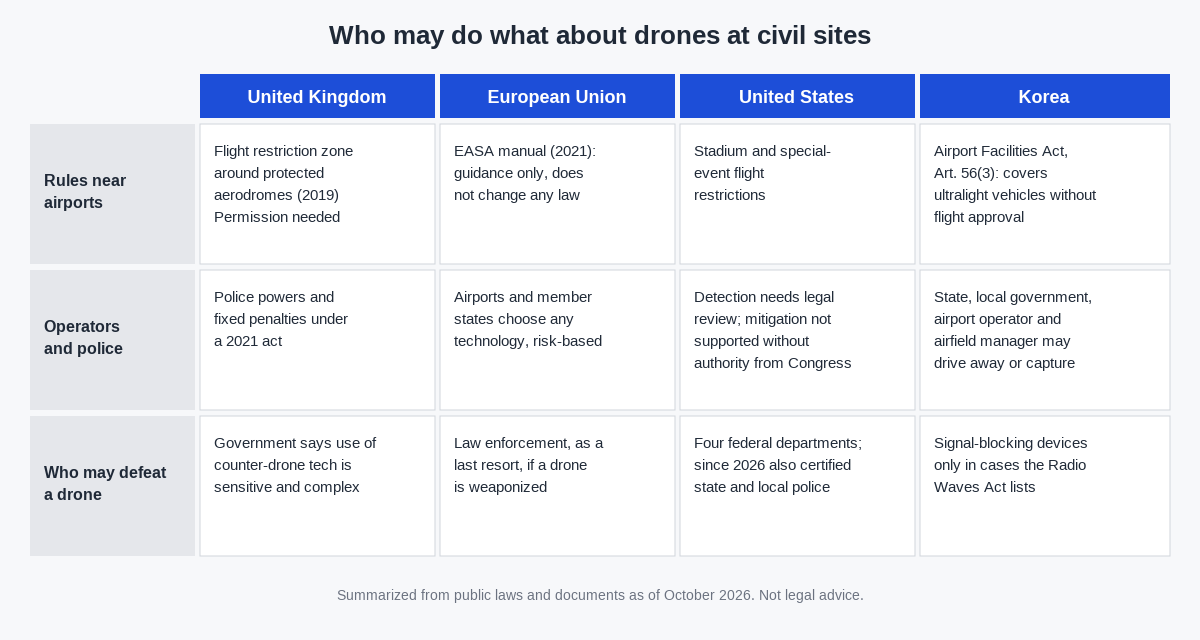
Enforcement powers came next. The Air Traffic Management and Unmanned Aircraft Act 2021, dated April 29, 2021, gave the police new powers over unmanned aircraft and set fixed penalties for some offenses. On counter-drone technology itself, the government was careful. The 2019 document records worries that the technology could be misused and says there are "significant sensitivities and complexities" in setting standards for it and authorizing its use.
At the European Union level, EASA published its manual on managing drone incidents at aerodromes on March 8, 2021. Only the first of its three parts is public; the others go only to those involved in managing incidents.
Part 1 is technology-neutral. It does not recommend any detection or counter-drone technology and leaves the choice, as a risk-based decision, to member states and the airports themselves. The manual is safety promotion material and does not change the status of any law.
One notable piece of Part 1 is its table of people who cause drone incidents.
| Group | The manual's description |
|---|---|
| Clueless | Do not know or understand the rules and restrictions |
| Careless | Know the rules but break them through fault or negligence |
| Reckless | Know the rules and deliberately ignore them for personal or professional gain |
| Activists and protesters | Use drones to disrupt airports and flight operations |
| Criminals and terrorists | Use drones to harm the safety and security of air travel |
The catch is that it is hard to tell which group is behind an incident while it is happening. The manual says identifying a drone is very challenging, and working out the pilot's motivation is even harder. If a drone is shown to be weaponized, the incident is treated as a security matter, and as a last resort law enforcement may need to neutralize the drone.
Stadiums and big events: cases from the United States
Airports are not the only concern. Stadiums and large events bring many people to one place. The opening section of U.S. Executive Order 14305, signed on June 6, 2025, states that mass gatherings are vulnerable to disruption and threats from unauthorized drone flights.
The numbers show it. In July 2026, the U.S. Department of Justice and Department of Homeland Security issued an interim final rule. Its background section cites testimony that the National Football League's (NFL) chief security officer gave Congress in December 2024.
In the 2017 season, drones entered the restricted airspace over NFL games without permission roughly a dozen times. The count rose to 2,537 in 2022 and 2,845 in 2023.
Games have actually stopped. On January 28, 2024, a drone over M&T Bank Stadium forced a brief suspension of the American Football Conference Championship game. Another flight over the same stadium took place during a playoff game on January 11, 2025. The same rule says these two cases led to federal felony charges.
The 2026 FIFA World Cup was scheduled from June 11 to July 19 across 11 U.S. host cities. Its matches were covered by the same flight limits that apply to stadiums and special events. The interim rule states that by June 20, DHS and the Federal Bureau of Investigation (FBI) had recorded drones entering restricted airspace near host-city venues more than 600 times.
Who may stop a drone: authority in the U.S. and Korea
That raises a question. May an airport or stadium operator stop a drone on its own? As of 2020, the U.S. answer was close to "no."
In August 2020, four agencies issued a joint advisory for non-federal public and private entities. They were the Federal Aviation Administration (FAA), the Department of Justice, the Federal Communications Commission (FCC) and the Department of Homeland Security.
According to the advisory, only four departments have permission from Congress for limited detection and mitigation: Defense, Energy, Justice and Homeland Security. This matters for owners and operators of stadiums, outdoor venues and airports, and for state and local police. Federal law can block, restrict or punish selling, owning or using such equipment. The FAA does not back mitigation systems in the hands of anyone without express authority from Congress.
Even detection is not automatic. Commercial service airport operators may need to add procedures for a drone detection system to their airport certification manuals.
Radio interference such as jamming is clearer still. U.S. law (47 U.S.C. 302a) bars most non-federal entities from making, importing, selling or using transmitters designed to block wireless communications.
The door to authority has opened in steps. A 2018 law, 6 U.S.C. 124n, gave the Departments of Justice and Homeland Security power to protect designated facilities and assets. The 2025 executive order asked for a recommendation on whether large airports and other sites should be added.
Then the SAFER SKIES Act, part of the National Defense Authorization Act for Fiscal Year 2026, extended similar authority to state, local, tribal and territorial law enforcement and correctional agencies. The condition is training and certification by the Department of Justice.
The interim rule, effective July 1, 2026, splits certification into two kinds. Detection and warning certification covers finding and tracking a drone and warning its operator, and does not include mitigation. Mitigation certification is a two-week residential course.
Anyone taking mitigation action must decide that a credible threat exists, and the action must be proportionate to the threat. The rule also bars using this authority against any aircraft with people on board. Nor may it be used solely to monitor or disrupt people exercising rights protected by the First Amendment.
Korea put a direct clause into its Airport Facilities Act. A proviso in Article 56(3) covers an ultralight vehicle that approaches or enters an airport or airfield without flight approval under the Aviation Safety Act. In that case, the national or local government, the airport operator, or whoever runs the airfield may take aviation safety measures. Examples are driving the vehicle away, bringing it down or capturing it.
Radio methods are bound separately. Article 29(3) of the Radio Waves Act allows signal-blocking devices only where public safety makes them unavoidable, in cases the law lists, and within the scope of that activity. One listed case is stopping violations under the Airport Facilities Act. Making, importing or selling a signal-blocking device requires approval from the Minister of Science and ICT.
Open problems
The first problem is whether equipment does what it claims. The 2020 joint advisory describes itself as informational only. It tells entities to check each system themselves, legally and technically, and not to rely only on what vendors say about legality or function.
The background to EASA's decision not to recommend technologies is similar. When the manual was written, many counter-drone technologies were still being developed, and some were far more mature and reliable than others.
The second is telling lawful flights apart. The UK government document says nearly all drone users fly with care and follow the rules. Yet detection systems pick up those lawful flights along with unlawful ones. So the 2020 joint advisory says further analysis is needed, before any response, to find out whether a flight really broke the rules.
The third is people and training. According to a July 2026 report by the Congressional Research Service (CRS), the U.S. national counter-drone training center had trained 61 officers from 46 agencies as of July 1. It had given priority to police in World Cup host cities. Having authority on paper is not the same as having people ready to use it.
Laser weapons sit inside this same frame. The 2020 joint advisory splits mitigation into non-kinetic and kinetic groups, and lists lasers alongside nets and projectiles as examples of kinetic means. In civil airspace, the question of who is allowed to use a tool comes before how well it works. What lasers do well and poorly compared with other tools is covered in "Strengths and limits of laser weapons."
What to read next
- Counter-drone systems: why one device is not enough: the tools for finding, identifying and responding to drones.
- Jamming and spoofing: interference versus deception: the basics of why radio interference is tightly restricted for civilians.
- The cost of drone defense: the money side of defense.
- Articles in this series still being written: "Counter-drone steps: detect, identify, track, defeat," "Jamming and GNSS spoofing: principles and the law," and "Remote ID and geofencing: putting a number plate on drones."