It is hard to judge by eye how many kilometers away a far hill is. Armed forces built separate instruments to measure range long ago, and after the laser appeared in 1960 they began to measure range by sending out light and timing its return.
This article looks first at what a laser rangefinder measures and how it differs from the optical rangefinders that came before it. It then follows how ranging became the laser's biggest early use, the eye-safety classes marked on equipment, and how an international treaty treats rangefinders.
Before lasers: measuring from two viewpoints
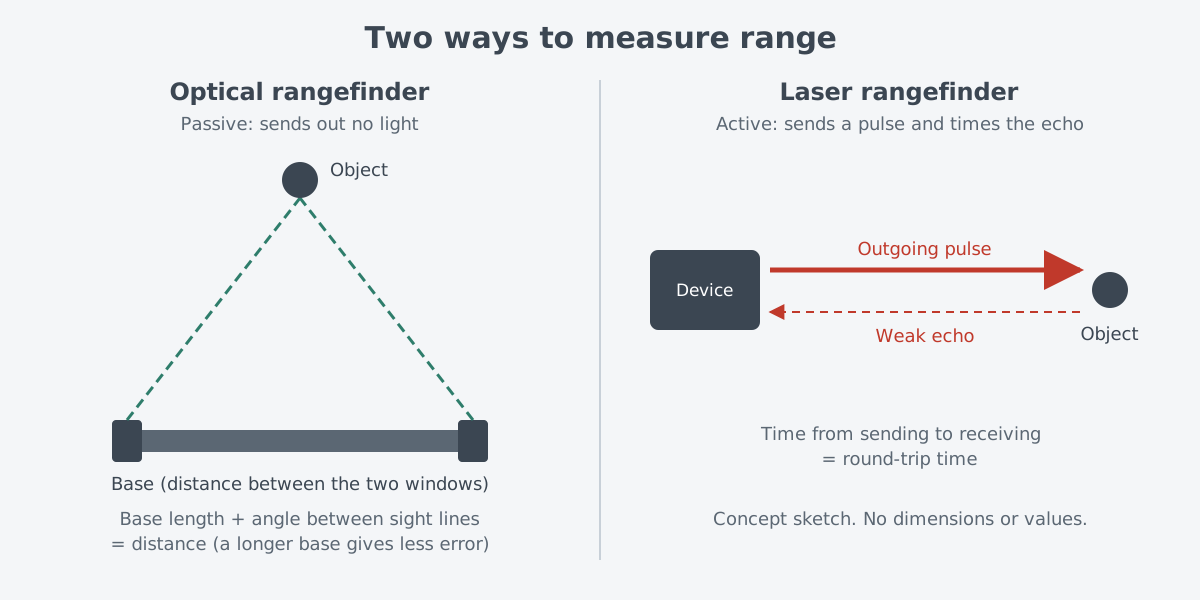
Rangefinders before the laser solved a triangle. They had a window at each end of a long bar, and both windows looked at the same object. If you know the length between the windows, called the base, and the angle between the two lines of sight, you know the distance.
It works like your two eyes, only with a much wider spacing. In practice the base is far longer than the gap between two eyes.
A longer base gives better results. A history paper on naval fire control around World War I gives the American base as 18 to 20 feet. British models used only 9 feet, which doubled the error. Optical rangefinders gave way to radar between the late 1930s and the early 1940s.
An optical rangefinder sends out no light. It only receives light coming from the object, so it is a passive method. A 1999 infrared passive ranging study from the Johns Hopkins Applied Physics Laboratory (APL) used the same idea of bringing two viewpoints into one lens. The method emits no energy at all while it measures range and angle.
Sending light and timing its return
A laser rangefinder works the other way: it is an active method. A pulsed laser sends a short burst of light toward the object, and a detector catches the weak light that comes back. The device measures the time between sending and receiving. That time covers the trip out and the trip back, so it is divided by two.
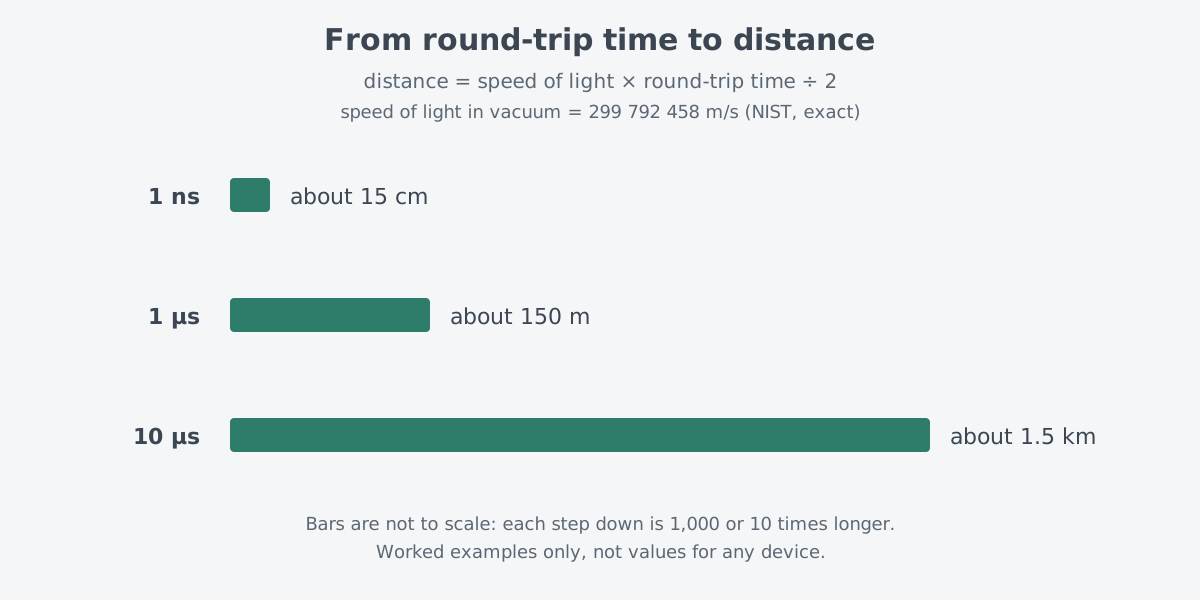
distance = speed of light × round-trip time ÷ 2
The ruler here is the speed of light in vacuum, 299 792 458 m/s. In the constants table of the U.S. National Institute of Standards and Technology (NIST), its uncertainty is listed as "exact." With this value, a round trip of 1 µs works out to about 150 m, 10 µs to about 1.5 km, and 1 ns to about 15 cm.
NASA's ICESat-2 satellite follows the same steps. It sends laser pulses to the ground, uses a telescope to gather the photons that come back, and records how long the photons took. Satellite surveying and lidar are covered in more detail in Measuring with lasers: range finding and lidar basics.
The first laser and the first rangefinders
The first laser produced light on May 16, 1960. It was a synthetic ruby laser built by Theodore Maiman, a physicist at Hughes Research Laboratories. According to the history page of today's HRL Laboratories, the military was especially interested in the laser for weapons. Yet its biggest early use turned out to be tracking, sensing and ranging.
Traces of the early work also appear in a catalog of oral histories at the American Institute of Physics (AIP). One entry is an interview with a researcher who worked at Hughes Aircraft Company, and it centers on the design and development of the laser rangefinder. It also covers contract work for Frankford Arsenal and the Advanced Research Projects Agency (ARPA), and the first "Mark II Colidar" and its production.
A Congressional Research Service (CRS) report, quoting a think tank, adds two points. The first laser was a solid-state laser, and watt-class solid-state lasers now serve in military roles such as target range finders.
Rangefinders inside military equipment today
A laser rangefinder is often built into other equipment rather than used alone. A TOW missile chronology from the Redstone Arsenal history office describes the Improved Target Acquisition System (ITAS). The upgrade combined automatic tracking, a laser rangefinder and a second-generation forward looking infrared (FLIR) sensor, so the system could find and recognize targets better.
Some equipment combines measuring range with lighting up a target with a laser. A laser designator and a rangefinder can share one unit, as in the U.S. Army's Lightweight Laser Designator Rangefinder (LLDR). The principle of the lighting-up part is covered in the article on precision-guided bombs.
The measured range then goes to a calculating device. Even on World War I warships, the present range from the rangefinder was telephoned to a plotting room, where a mechanical calculator received it. A rangefinder alone does not finish the job of aiming. The chain from sensors to calculators is described in the article on fire-control systems.
Eye safety: classes and wavelengths
Rangefinders are used where people are present, so eye safety always comes with them. The U.S. Army safety center states that every laser system must carry a warning label showing its class, including the rangefinders and target designators that soldiers use. In the class chart of the same guidance, Class 1 is "Eye Safe" and Class 3B is a direct viewing hazard. How to read these classes is explained in Laser safety.
Accidents have happened. In fiscal years 2009 and 2010, 16 reports of laser eye injuries reached the Army safety center. Such injuries can be prevented when soldiers are properly trained and put that training into practice.
Along with the laser safety class, wavelength matters. Guidelines from the International Commission on Non-Ionizing Radiation Protection (ICNIRP) say the risk of retinal injury is of particular concern for visible and near-infrared light, from 400–1,400 nm. For a point source, the irradiance grows about 100,000 times between the cornea and the retina. Above 1,400 nm, the concern shifts to heat damage in the cornea and skin.
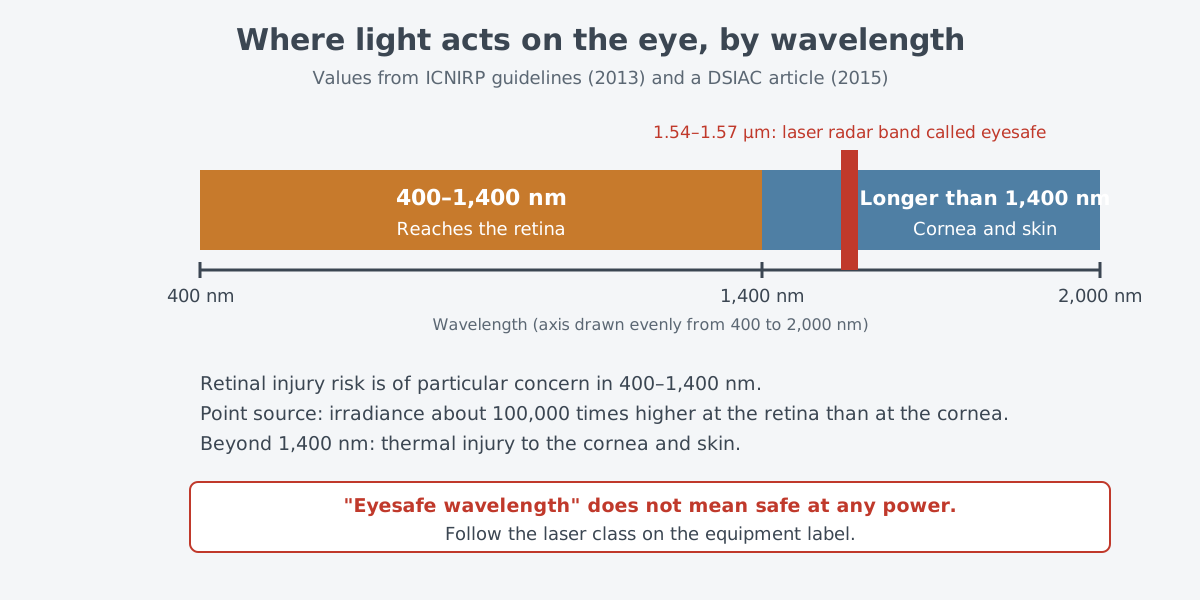
Some equipment works above 1,400 nm. An infrared technology article from the Defense Systems Information Analysis Center (DSIAC) notes that laser radars can also form images at 1.54–1.57 µm, a choice of wavelength it calls eyesafe.
That does not mean any power level is fine. As the guidelines above say, heat can still damage the cornea and skin beyond 1,400 nm. The class label on the equipment is the rule to follow.
The blinding laser ban and rangefinders
Protocol IV of the Convention on Certain Conventional Weapons (CCW) forbids using or handing over laser weapons built for the purpose of causing permanent blindness. Article 2 requires all feasible precautions to avoid permanent blindness when laser systems are used, and those precautions include training of armed forces. Under Article 3, the ban does not cover blindness that happens as a side effect when laser systems are used lawfully by the military.
A guide to the convention from the United Nations Office for Disarmament Affairs (UNODA) gives rangefinders and target selection devices as examples of the other laser systems in Article 3. Such equipment is not banned, but "all feasible precautions" still apply to it. How the protocol came about is told in Eye safety and international rules: the protocol on blinding laser weapons.
Limits: the air the light passes through
Laser light has to cross the air to the object and back again. Water vapor, dust, smoke and similar substances in the air absorb and scatter the light. For shipboard laser weapons, CRS writes that these effects can shorten the distance over which a laser works.
The same problem shows up in measurement. In the laser measurements of the ICESat-2 satellite, particles or clouds in the air can also skew the ground data. If the light does not come back, or comes back from the wrong place, even perfect timing will not give the range you want. More on the air is in Light through air: absorption, scattering, turbulence, thermal blooming.
What to read next
- Measuring with lasers: range finding and lidar basics: pulse width and resolution, and how lidar builds a point cloud
- Laser safety: classes and how to read eyewear labels: how to read the class label on a rangefinder
- Fire-control systems: linking sensors and weapons: where the measured range goes