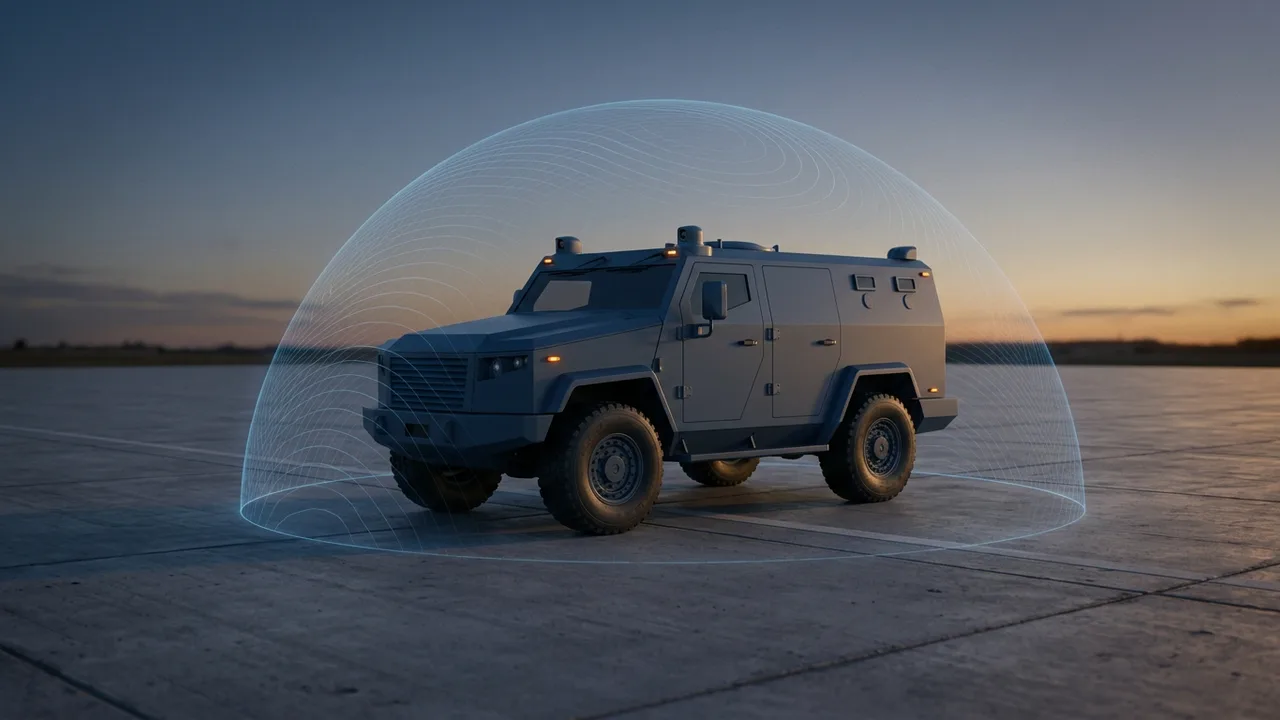
The oldest way to protect a tank is thicker steel. Keep adding plates, though, and at some point the tank becomes so heavy that moving it is hard and crossing a bridge is harder.
That is where the active protection system (APS) comes in. Instead of taking the hit and holding, it spots the incoming round early and acts before the round reaches the vehicle.
How does it notice the round, and what does it do next? The answers fall into two groups: soft kill, which makes the round miss, and hard kill, which stops it before it arrives.
The limit of adding armor
Ever since wheeled and tracked military vehicles appeared, better protection has usually come from more armor, at a price in speed and weight. Col. Kevin Vanyo of the U.S. Army Tank Automotive Research, Development and Engineering Center (TARDEC) spoke about this in December 2017. He said the Abrams tank had become so heavy that moving it was a problem and many bridges could not carry it.
Extra armor costs more than weight. It can affect the vehicle's performance and where it can go on the battlefield. It loads the power system, fuel use and suspension, and the added wear can shorten the vehicle's life.
The armor plate that shields soldiers inside is called "passive protection." All it does is turn aside or soak up blasts and projectiles.
Active protection works the other way: it moves first. That does not mean giving up armor. The head of Army Test and Evaluation Command also backed a mix of active and passive protection as the right path.
Detect, track, respond
The Congressional Research Service (CRS) defines an APS as a subsystem built into or mounted on a combat vehicle. It automatically acquires and tracks threats such as rocket-propelled grenades (RPGs) and anti-tank guided missiles (ATGMs), then responds with hard kill or soft kill. The idea is not new. Several countries have already used APS in combat.
The work can be split into four steps. Small on-board radars or optical sensors first detect an incoming projectile and classify it. The system follows the projectile, works out where, away from the vehicle, it could be intercepted, and uses a countermeasure if the round threatens the vehicle. The whole sequence happens almost at once.
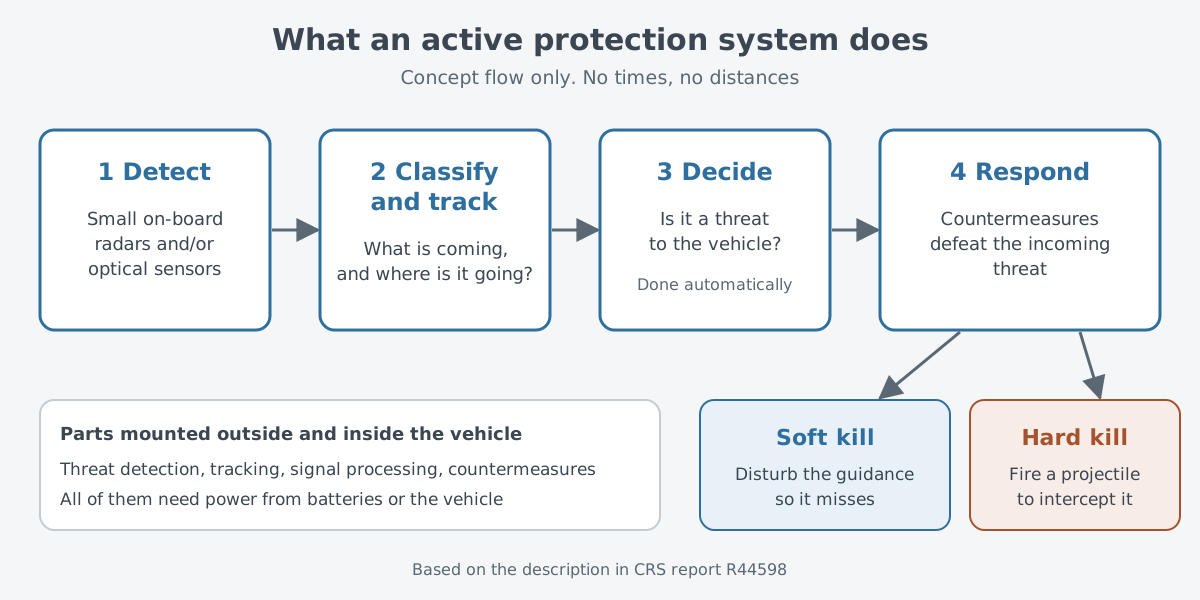
Several parts make this possible: something to detect the threat, a tracking system, signal processing, and the countermeasures themselves. These parts sit both outside and inside the vehicle, and they run on power from batteries or from the vehicle.
Soft kill: making it miss
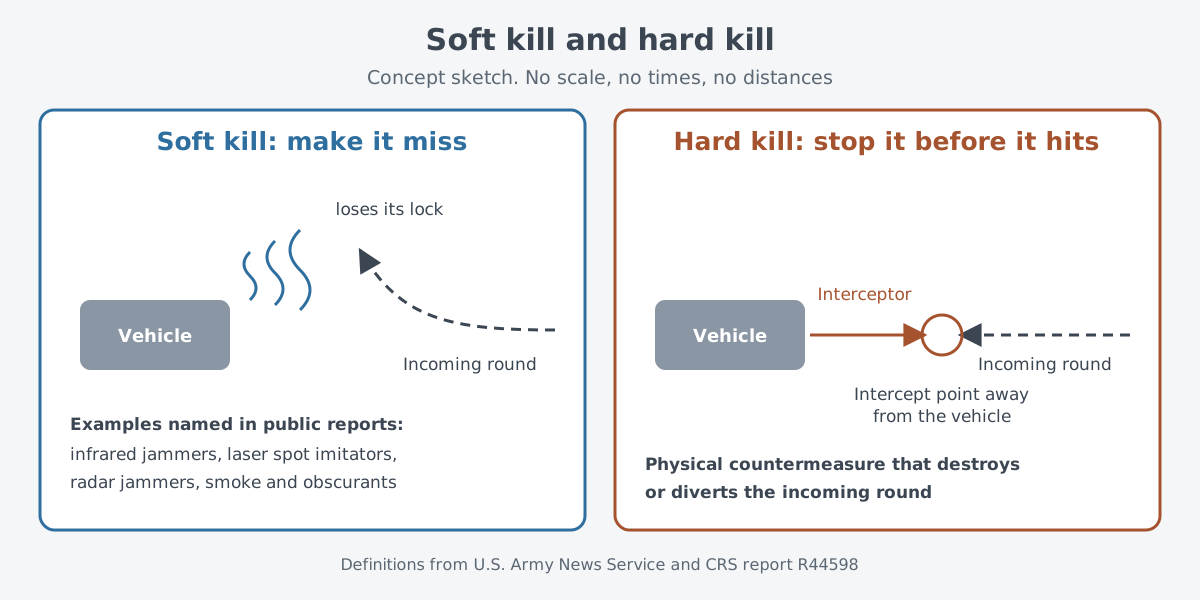
Soft kill does not break the incoming weapon. It keeps the weapon from finding its target. Sensors pick up signatures from the weapon, and electromagnetic countermeasures then interfere with it.
A 2012 Congressional Budget Office (CBO) report, quoted by CRS, gives examples of soft-kill countermeasures: infrared jammers, laser spot imitators and radar jammers. These devices stop the missile's guidance from staying locked onto the vehicle. The missile then misses, or its warhead fails to fuze, and the vehicle is spared.
Why does soft kill matter? Hard kill draws more attention, yet Army officials say most ATGMs in use are highly susceptible to soft kill. For that reason they see value in having both.
At the time of the 2016 CRS report, the Army's soft-kill work focused on electro-optical/infrared (EO/IR) ATGMs. The same officials said smoke and obscurants can also work against ATGMs.
Hard kill: stopping it before it arrives
Hard kill stops the threat physically. A hard-kill system detects and engages an incoming threat and destroys or neutralizes it before it hits the protected vehicle. To do so, it actively fires some kind of projectile to meet and stop the threat.
A goalkeeper blocking a shot comes to mind. The real thing differs a lot. A machine makes the call, not a person, and the block comes from an exploding round, not a pair of hands. That is why hard kill brings safety problems that soft kill does not.
Most APS designs under development use explosive rounds to intercept. The risk that fragments and blast from those rounds pose to nearby soldiers, civilians and other vehicles is a serious concern. Meeting the timeline means the rounds must fire automatically, with no person in the loop, and that adds to the concern.
Two layers in one framework: MAPS
The U.S. Army program for building countermeasures of both kinds, hard kill and soft kill, side by side is called the Modular Active Protection System (MAPS). The name caused a lot of confusion. Vanyo was blunt that MAPS "is not an active protection system" but a framework for a modular, open-systems architecture. The framework is made of controller software and hardware.
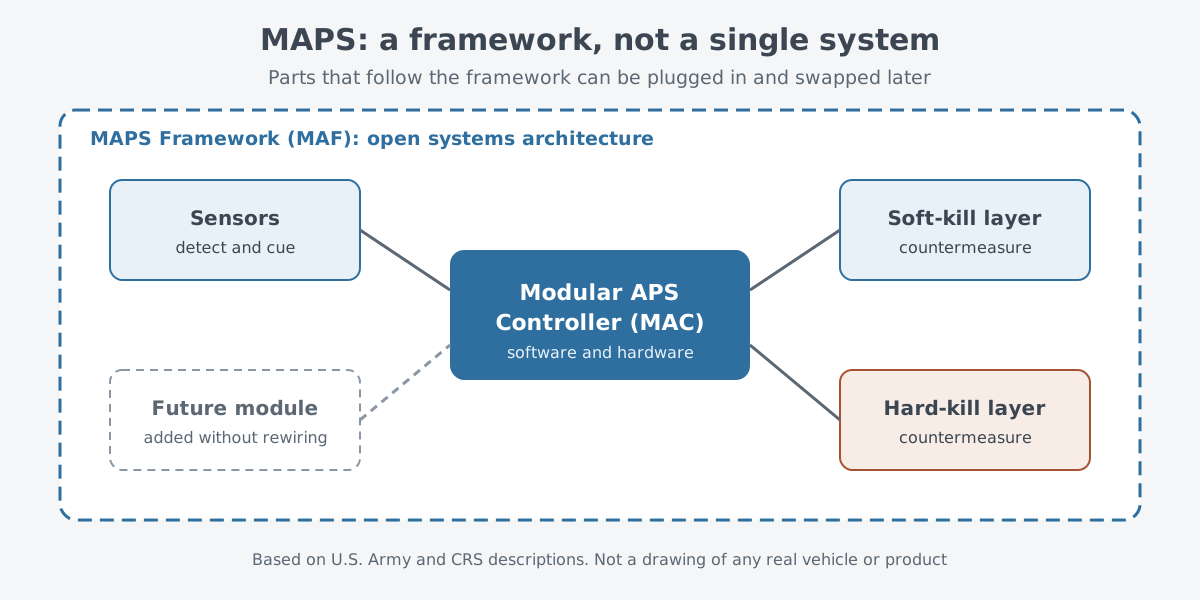
The Army itself compared MAPS to a household electrical system. You do not rewire a house each time you buy a new appliance, and the goal was likewise to let compliant sensors and countermeasures be swapped in. On a real vehicle it is not as simple as plugging into an outlet. Each part has to meet safety rules, which is why one of the key deliverables is a safety-compliant controller (MAC).
The reason for an open design is also on record. Unlike a closed, hard-wired system, an open one lets new features reach the field quickly when new anti-vehicle threats appear. That is said to be why U.S. defense officials favor it.
Testing followed. A live-fire soft-kill demonstration in April 2017 showed, for the first time, a full engagement from cue to defeat using the MAPS approach. In the first three months of fiscal year 2019, a six-week test series called the "Soft Kill Rodeo" ran at Redstone Test Center. Three systems faced live-fired ATGMs, and all of them used electronic countermeasures.
The rodeo ended with a recommendation to put BAE Systems' RAVEN countermeasure on a Bradley Fighting Vehicle for a "layered" demonstrator. That demonstrator was planned as the first physical test linking the MAPS Base Kit with systems of both kinds, hard kill and soft kill. Industry has the same layered idea. IMI's own description, quoted by CRS, presented Iron Fist as a system that stacks electro-optical jammers, instant smoke screens and, if needed, an interceptor-based hard kill.
A short history
The Drozd, named as the first operational APS, was a Soviet development of 1977–1982, built to guard against RPGs and ATGMs. In the late 1990s, France fitted the Galix countermeasure system to its Leclerc tanks; it could automatically fire smoke, anti-personnel or decoy rounds.
Israel's Trophy went into operational service in 2009 and is built into the Merkava Mk4 tank. Russia's T-14 Armata tank carries hard-kill and soft-kill APS as two separate systems.
The United States studied APS for a long time, but integration came slowly. APS had been in design and development since the early 1950s, yet as of a 2010 TARDEC summary none had made it past development onto a U.S. platform. APS work had a large place in the Future Combat System (FCS), an Army program that was cancelled in 2009.
In December 2017, Vanyo said the Army was pursuing Trophy for the Abrams tank, Iron Curtain for the Stryker and Iron Fist for the Bradley. At the time, the Army hoped to field Trophy by 2020.
The new tank starts from a different place. A 2026 CRS product on the next tank, the M-1E3, says the Army wants to build an APS into its design instead of adding a separate stand-alone kit. Reports cited by CRS say the development work includes an APS for the M-1E3. It is meant to guard the tank not only against ATGMs and RPGs but also against many kinds of armed drones and loitering munitions.
Problems still to solve
The first problem is the safety of people. The United States and Israel tended to choose interceptors that lower the danger to people around the vehicle, but they did not remove it. The threat to friendly soldiers and civilians may only be reduced, not fully eliminated.
Hard kill also carries a risk of collateral damage to property such as buildings. Army officials counter that counter-munitions are fairly small, so the incoming round may pose the far larger collateral-damage threat.
The second is size, weight and power (SWaP). Because APS may first be retrofitted to existing vehicles, fitting parts into an already cramped interior could be hard. Powering the system from the vehicle raises its own questions. Older vehicles, the M-1 Abrams among them, were not designed to carry the extra size, weight and power an APS needs.
Vehicles still in development are likely to include APS in their design from the start, and Army officials also note that the Merkava Mk 4 was designed around Trophy. The plan to tie the M-1E3 to an APS from the design stage reads as part of the same trend.
The third is cost and the electromagnetic environment. The total bill covers more than the purchase price: training, installation, maintenance including spare parts, and how often software and hardware need updates. Jammers that cover a wide band can also harm friendly communications and electronics. The Army Test and Evaluation Command commander named a related worry: whether the signal an APS emits might interfere with other software on the vehicle.
Where this meets lasers
Some soft-kill countermeasures work with light. Infrared jammers and laser spot imitators disturb a missile's guidance, and the electro-optical jammers named by a manufacturer also deal with light.
That does not make them the same thing as laser weapons, since the aim of soft kill is to make the incoming round miss. What is a laser? explains how a laser differs from ordinary light. What is a laser weapon? explains what it means to use a laser as a weapon.
What to read next
- Composite and reactive armor: the blocks on a tank. The passive side of protection that works alongside APS.
- Anti-tank guided missiles: rockets versus guided missiles. How the threats that APS tries to stop are guided.
- Chaff and flares: the sparks behind an aircraft. How aircraft make missiles miss.