Switch on a laser pointer in a room and aim it at a white wall. Look closely and the spot is not a smooth disk. Bright grains and dark gaps lie across it like sand, and when you move your head a little, the grains squirm and change places.
This grainy pattern is called speckle. It is not painted on the wall, and the laser is not broken. It forms as light scattered by the wall adds up and cancels out on its way to your eye. So why does a flashlight on the same wall show no grains, and why is the pattern a nuisance in one place but a useful clue in another?
A pattern made by a rough wall
A wall that looks smooth is bumpy when measured against the wavelength of light. Inside a laser spot there are countless tiny bumps, and each one scatters light in all directions. Any single point in your eye collects light from many of these bumps at once.
The trouble is distance. Each bump sits a slightly different distance from your eye, so light from the same laser arrives with its timing slightly off. Waves that arrive in step add up and get brighter, while waves in opposite step cancel. This is interference: the bright case is constructive interference, and the dark case is destructive interference.
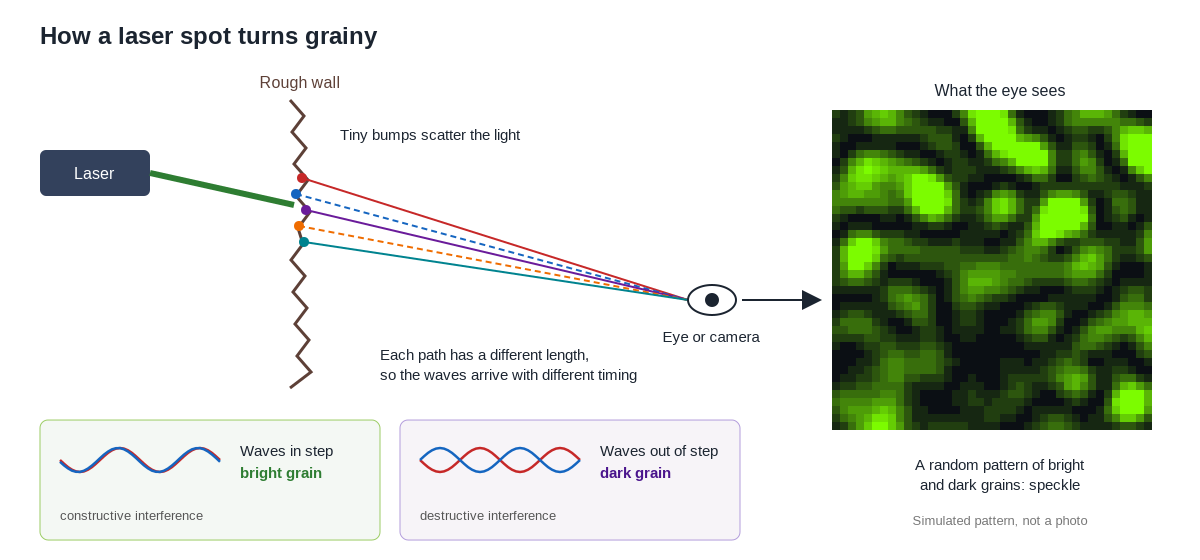
The bumps follow no rule in how they are arranged. So the places where light adds or cancels are scattered at random, and the result is a pattern of bright and dark grains. A 2010 review paper by Boas and Dunn defines speckle as a random interference pattern, formed when coherent light bounces off a disordered material. Skin, paper or a cinema screen in place of the wall gives the same effect.
Why a light bulb shows none
Flashlight light also scatters off the wall, and it also reaches your eye along paths of different length. Yet no grains appear. The difference lies in how long the light keeps its rhythm.
A clear interference pattern needs light that holds its coherence. Even when the paths differ in length, the wave's timing must stay steady across that difference for the adding and canceling to work out. Blood-flow imaging research puts the condition in terms of length: the light must stay coherent over a distance greater than the spread of path lengths inside the material. Coherence itself gets a fuller treatment in Interference and diffraction: how light adds up and spreads.
Wavelength plays a part too. As with other interference effects, the pattern changes when the color of the light changes, and two wavelengths that differ enough give unrelated patterns. A light bulb mixes many wavelengths, so many different patterns pile up and fill each other in.
A laser has a narrow linewidth and leaves just one pattern. The "single color" and "waves in step" from What is a laser? How it differs from a light bulb show up here as grains.
Grain size, and moving your head
The size of one grain is set by the viewer, not the wall. A 2002 paper by Trisnadi on speckle in laser projection displays looks at a detector with a limited opening, like an eye, viewing a screen. The screen then seems split into patches as small as the finest spot the detector can resolve.
If the light inside such a patch all cancels, the patch is darkest; if it all adds, it is brightest. So a grain is the same size as the detector's resolution spot.
A camera works the same way. The smallest speckle on a camera depends on the wavelength of light, the magnification and the f-number of the lens. Stopping down the aperture to a larger f-number makes the grains larger. This is why designers of blood-flow imaging systems compare the grain size with the camera's pixel size.
Moving your head changes the pattern for the same reason. When your eye moves, the whole set of path lengths from the wall's bumps to your eye changes. Where light adds and where it cancels is decided anew, so the grains land in new places even though the wall has not changed. It also shows that the pattern is not painted on the wall but formed on the viewer's side.
Averaging many patterns makes them fade
The way to remove the grains is not to get rid of the pattern but to mix many of them. If several independent speckle patterns overlap within the time the eye takes in one view, the bright grains of one pattern fill the dark gaps of another. The Trisnadi paper takes the eye's light-gathering time as about 50 ms.
The strength of the grain is measured as speckle contrast. It is the fluctuation in brightness divided by the average brightness, and it lies between 0 and 1. A single sharp pattern has a contrast of 1.
In the best case, averaging N independent patterns lowers the contrast to 1/√N. Four patterns halve it, and sixteen cut it to a quarter.
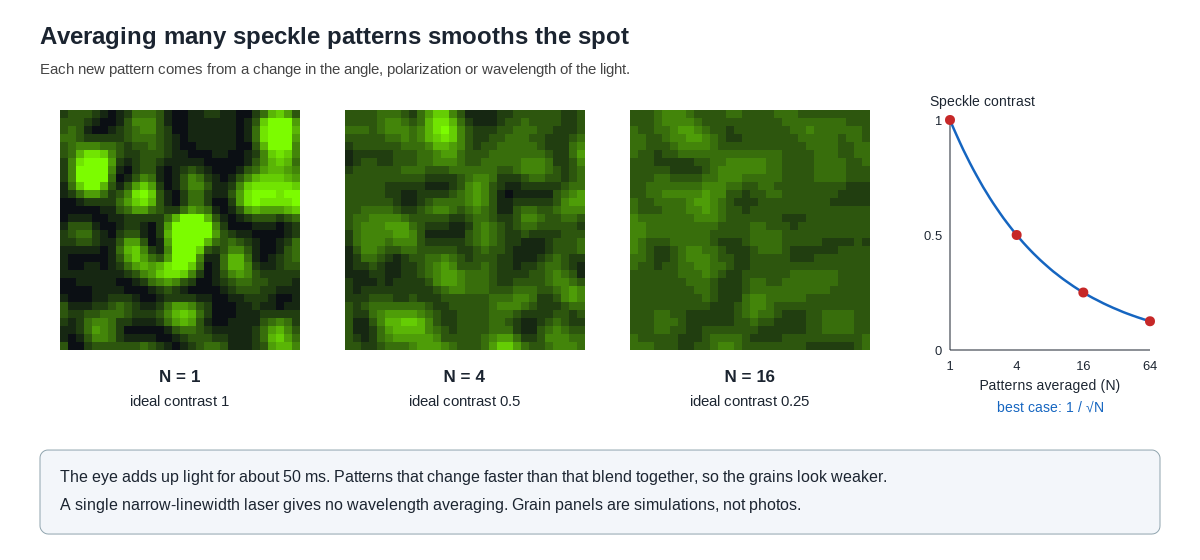
There are three knobs for making new patterns: the angle at which light arrives, its polarization, and its wavelength. Ordinary screens and even a sheet of copier paper scramble polarization well, so patterns with different polarization mix on their own. With a single narrow-linewidth laser, on the other hand, there is no wavelength mixing to use.
The homework for laser displays
A projector that uses lasers as its light source can reach a wide range of colors that older light sources struggle to produce. The catch is speckle on the screen, which tends to hide fine detail in the image. It has followed visible lasers since they were invented.
So laser display research has focused on turning those three knobs together. A common method is a diffuser that scrambles the phase of the light and changes over time, which varies the angle. The company team behind the Trisnadi paper reported that this kind of method cut the remaining speckle contrast in its own projection system to 8%. That figure comes from the company's own device and does not carry over directly to other devices.
Useful grains: blood-flow images and radar images
The grains are not always a nuisance. When light-scattering particles move, as blood does in vessels under the skin, the interference shifts too, and a detector sees the brightness flicker. Where blood flows faster the pattern flickers faster, and over a camera exposure (typically 1–10 ms) the grains in that area blur.
Laser speckle contrast imaging (LSCI) turns this blurring into a map. A contrast of 1 means no blurring and therefore no motion; values closer to 0 mean faster motion. According to the Boas and Dunn review, the method first appeared in the 1980s and grew into blood-flow imaging of the retina and skin in the 1990s. It is now used in neuroscience, dermatology and ophthalmology research.
The same grain also shows up with radio waves instead of light, as the rough "salt and pepper" texture in synthetic aperture radar (SAR) images. NASA Earthdata describes it as a scattering effect that appears because the radar's resolution cannot separate individual scatterers. It also sets speckle apart from random noise, since the pattern comes back when the image is taken under identical conditions. Radar images reduce it with multi-looking, which averages several separate looks, the same idea as mixing patterns on a laser screen.
What to read next
- Interference and diffraction: how light adds up and spreads: constructive and destructive interference and coherence, the ingredients of speckle, from the start.
- What is a laser? How it differs from a light bulb: the single color and coherence that make speckle so easy to see with lasers.
- Synthetic aperture radar: images from radio waves: the speckle in radar images and the other ways those images differ from photos.