On the battlefield, some laser equipment is not used as a weapon. There are rangefinders that measure the distance to a target, and laser designators that point out a target with light. So how does the side being lit up know that it is being lit?
That is the job of a laser warning system (LWS). On October 14, the Swedish subsidiary of the defense company Elbit Systems announced plans for the group's first European center to build and maintain this equipment. This letter looks at the plan in the announcement and at what a laser warning system actually is.
This letter in brief
- On October 14, Elbit Systems Sweden announced plans to set up Elbit Systems' first European production and maintenance center for laser warning systems in Sweden. The center is expected to start operating in 2027.
- The center will integrate, assemble, maintain and support laser warning systems in Europe through their service life. The product is the company's next-generation passive laser warning system.
- The center's city, investment, production volume and customers have not been disclosed.
What was announced
The first source is Elbit Systems' October 14 press release. It says the Swedish subsidiary, Elbit Systems Sweden AB, announced its "intention" to set up the group's first European production and maintenance center for laser warning systems. The company framed the plan as part of strengthening the defense industrial base of Sweden and Europe and supporting the security needs of European and NATO member states.
Elbit Systems Sweden was founded in 2020. It now has a staff of over 100 in Sweden and acts as the group's hub for Northern Europe.
The European defense outlet Defence Industry Europe reported the announcement on the 18th, and the U.S. outlet The Defense Post ran it on the 15th. The Defense Post added a few product details that are not in the release.
What is publicly known
| Item | What the release says |
|---|---|
| What | Elbit Systems' first European production and maintenance center for laser warning systems |
| Who | Elbit Systems Sweden AB |
| When | Expected to start operating in 2027 |
| Jobs | Integrating, assembling, maintaining and supporting laser warning systems in Europe over their service life, done locally |
| Expected benefits, per the company | Better availability, shorter delivery times, stronger support for European customers |
| Product | Next-generation passive laser warning systems |
| CEO's remarks | Through the center and technology transfer, the company aims to give Swedish, European and NATO customers self-protection equipment backed by local support and supply chains that are secure and under their own control |
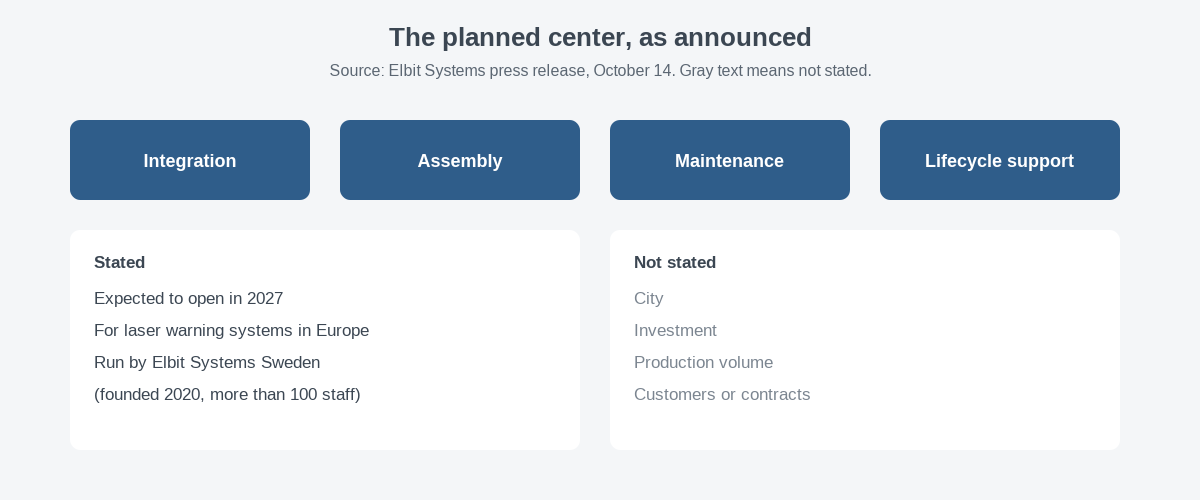
The words in the table that show the stage are "intention" and "expected." The company is announcing a plan; no construction start or production start is stated. The benefits are also written as expectations.
The technology, explained
A laser warning system is mounted on a military platform and notices laser light that reaches it. The release says the product is built to sense and pinpoint laser threats instantly, giving users as much time and flexibility as possible to take protective measures.
Why would anyone need one?
A laser rangefinder measures the distance to a target from the round-trip time of light. A designator points out a target with laser light so that a guided weapon can home in on that spot. Either way, for the side receiving the light, it is a sign that someone is measuring or marking it. How designators work is explained in Laser Designators: Pointing Out a Target with Light.
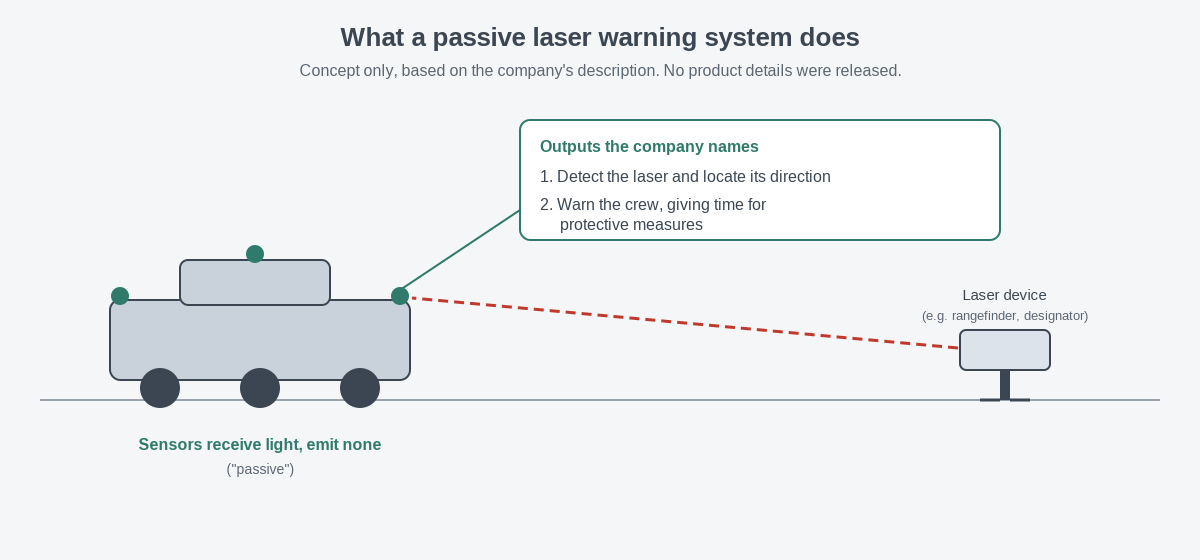
The word "passive" in the release means the equipment only receives light and sends out no light or radio signal of its own. Sending out no signal of its own is what sets it apart from active equipment that transmits, such as radar.
The company says the new generation links into existing command-and-control systems and uses a decentralized design that cuts the number of parts and the changes needed on the platform. It also says its laser warning systems are in service with armed forces around the world and form a key part of self-protection suites on military platforms. What self-protection equipment does beyond the armor is covered in Active protection systems: defending beyond the armor.
The Defense Post described the system as a 360-degree solution. It also lists Elbit's laser warning equipment as fielded on everything from light and heavy combat vehicles, tanks and mortar carriers to large warships, patrol boats, helicopters and fighter jets. Both points come from the outlet, not from the release.
Limits and open questions
This news is a company's announcement of a plan. No statement on the center from the Swedish government or armed forces could be found. The city, the money involved, the planned output and the number of new hires are all missing.
The customers are also a blank. The company mentions Swedish, European and NATO customers, but it names no contract to buy equipment made at this center. So it is not yet possible to judge how much shorter delivery times or better availability will turn out to be.
The same goes for the product. There is no product name, no list of detected wavelengths and no detection range. Words such as "instantly" and "maximum" are the company's description, and no test data came with them.
What to watch next
- Center opening: the company said it expects the center to start operating in 2027.
What to read next
- Laser Rangefinders: Measuring Range from Light's Round Trip: to see where the light a laser warning system watches for comes from.
- Laser Designators: Pointing Out a Target with Light: to see how equipment that marks a target with light connects to guided weapons.
- Active protection systems: defending beyond the armor: for a wider look at what a platform's self-protection equipment is made of.