Turn on a phone camera in a dark room, and the screen still shows a dim view of the room. In a laser lab, a power meter puts the strength of an invisible beam on a display as a number. A satellite in orbit counts grains of light coming back from Earth one by one. All three depend on a part that turns light into an electrical signal: the photodetector.
The most common photodetector is the photodiode. When light lands on a small piece of semiconductor, current flows. The size of that current tells how much light came in.
So how does light become a current? This article starts with the photoelectric effect. From there it follows public sources through the inside of a photodiode, the wavelengths a material can see, and what it takes to measure fast. It ends with how faint light gets boosted, where these detectors are used, and where they fall short.
Light knocks electrons loose: the photoelectric effect
Shine light on metal electrodes, and sparks jump between them more easily. This is the photoelectric effect. Hertz first found it in 1887, in experiments that shone ultraviolet light on a negative electrode.
There was a puzzle. Theory at the time said brighter light should free electrons more easily. In practice, the effect appeared only when the light's frequency was above a certain value.
Starting with work in 1905, Albert Einstein described light as coming in packets, or quanta, each with a fixed energy. One such packet, a photon, can free an electron only if its frequency passes a certain minimum. No matter how bright the light is, if each photon carries too little energy, no electron comes loose.
The Nobel Foundation gave Einstein the 1921 Nobel Prize in Physics "especially for his discovery of the law of the photoelectric effect." That year the selection committee decided that no nomination met the criteria and held the prize over, so Einstein received the 1921 prize in 1922.
Today, photodetectors fall into three broad groups by how they work. Light can knock electrons out of a surface into a vacuum (the external photoelectric effect) or free them to move while they stay inside the material (the internal photoelectric effect). Thermal types turn light into heat and measure that. A photodiode uses the internal photoelectric effect.
What happens inside a photodiode
At the heart of a photodiode is a PN junction. It is where an N-type semiconductor, with extra electrons, meets a P-type semiconductor, with too few. Between the two layers forms a thin region with almost no free charge, called the depletion layer. An electric field sits across the depletion layer.
If the light's energy is greater than the semiconductor's band gap energy, a bound electron jumps to a state where it can move freely. The spot it leaves behind acts like a moving positive charge, called a hole. The light has made an electron-hole pair.
The field in the depletion layer pulls the pair apart: the electron heads for the N side, the hole for the P side. Put electrodes on both layers and connect them to an outside circuit, and these charges flow as a current. The more light comes in, the more pairs form, in direct proportion.
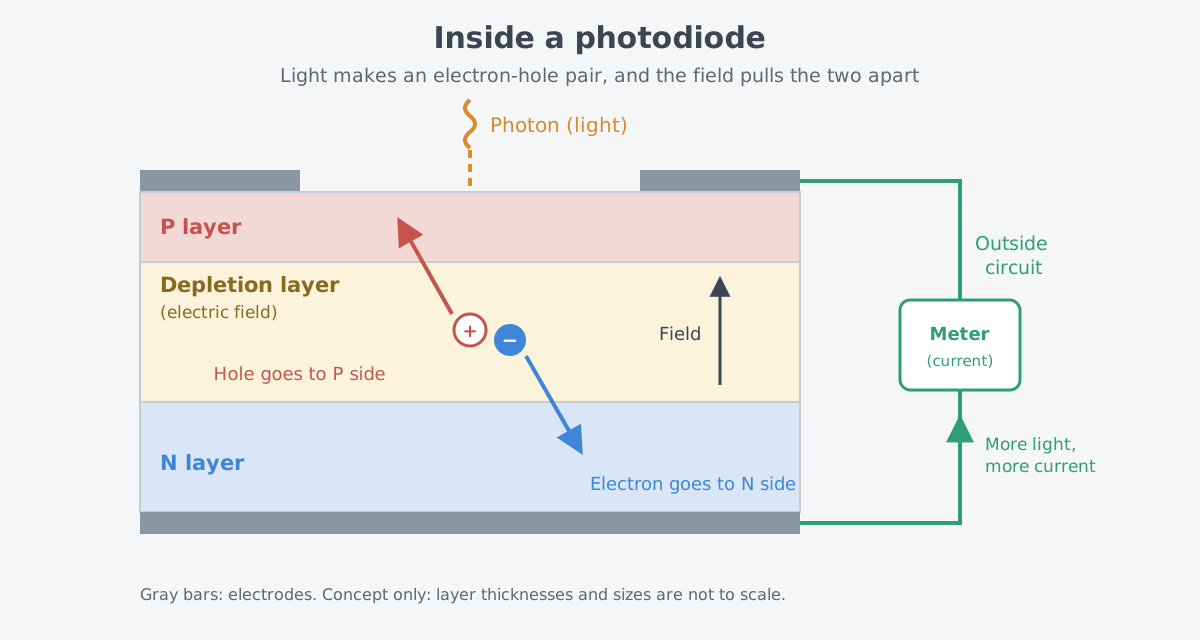
Picture balls dropped onto a slope. The field in the depletion layer is the slope, and the electrons and holes made by light roll off in opposite directions. In reality, electrons and holes have opposite charges, so the same field pushes them in opposite directions. Charges made outside the depletion layer have no slope at all and only spread slowly toward the junction.
Textbooks draw a photodiode as a current source whose output depends on the light. The current is set by the incoming optical power, with the quantum efficiency in between. Quantum efficiency tells how many electrons can be taken out as current for each photon that comes in. If ten photons come in and nine electrons come out, it is 90%.
The photocurrent of a silicon photodiode follows the amount of light very closely. Depending on the type and the circuit, this straight-line relation can hold over a range wider than nine orders of magnitude. That is one reason photodiodes are used in power meters that put light into numbers.
The material decides which wavelengths it sees
A photon's energy is smaller when its wavelength is longer. If the photon's energy is below the band gap, it cannot lift an electron and simply passes through. So every semiconductor has a longest wavelength it can see, called the cutoff wavelength.
Silicon at room temperature has a band gap energy of 1.12 eV and a cutoff wavelength of 1100 nm. There is also an edge on the short side: a normal silicon photodiode stops at 320 nm, and one built for better ultraviolet response stops at 190 nm. These edges come from silicon itself and from the window material the light passes through.
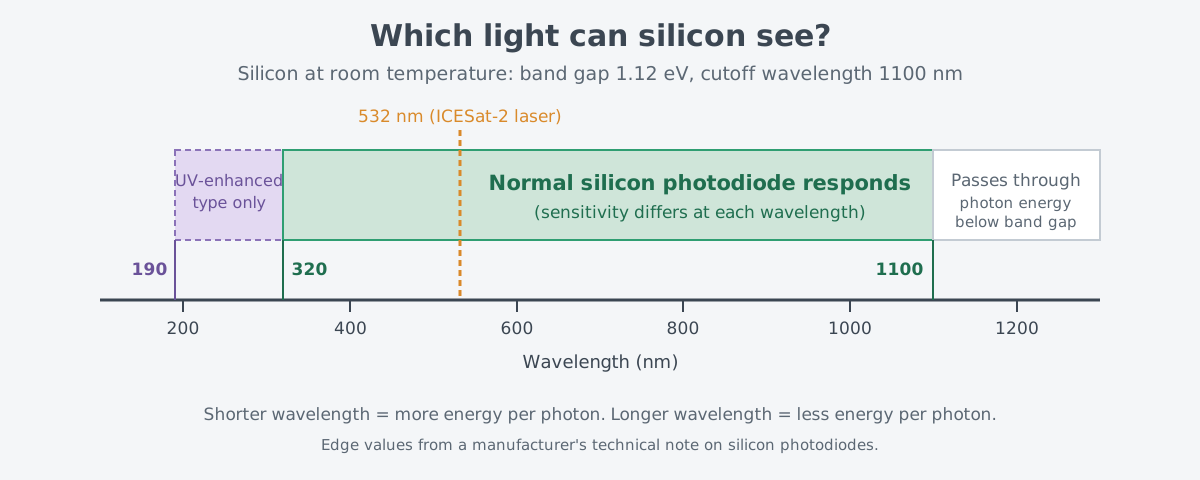
Within infrared light, the near-infrared part close to the cutoff is hard for silicon. A silicon PIN photodiode tuned for the near infrared greatly raises sensitivity between 900 nm and 1100 nm. A thicker light-absorbing layer would also help, but then the device needs a higher voltage, has more dark current, and responds more slowly.
Longer infrared light needs other materials. The infrared detectors of NASA's Jet Propulsion Laboratory (JPL) are built on III-V semiconductors, one example being InGaAs (indium gallium arsenide). These materials combine elements from groups III and V of the periodic table. Why Wavelength Matters: Visible and Invisible Light covers why wavelength makes such a difference.
Fast detectors have to be small
How fast a photodiode reacts is usually given as its rise time. That is the time for the output to climb from 10% to 90% of its peak. Two main things set this time.
The first is the time constant of the electrical circuit. A PN junction is like a capacitor, a thin layer between two electrodes, so it has capacitance. This capacitance grows almost in step with the light-receiving area and shrinks as the depletion layer gets thicker. A large capacitance takes time to charge and empty, and most photodiodes are limited by exactly this time constant.
The second is the time charges need to reach the electrodes. A smaller area and a thicker layer lower the capacitance, but a thicker layer also means a longer trip for the charges. Past a certain point, this transit time sets the speed. Charges made outside the depletion layer, which spread in slowly, also delay the response.
That is why very fast photodiodes are small. A textbook explains that in most cases the light must be tightly focused onto the detector's small area to reach the time resolution needed. Fast commercial photodiodes can reach a bandwidth of about 60 GHz and a shortest time resolution of around 5 ps, but using that resolution takes a special high-speed sampling oscilloscope.
Electronics cannot follow a pulse duration shorter than that. Such pulses are measured separately with optical methods. Those methods appear in Instruments That Measure Light: Power Meters, Beam Profilers, and Spectrum Analyzers.
Boosting faint light: APDs and photomultiplier tubes
When light is very faint, one photon making one electron is not enough, and the signal gets lost in noise. The fix is to multiply the number of electrons inside the detector.
An avalanche photodiode (APD) puts a high reverse voltage on a photodiode to create a region with a very strong electric field inside. An electron made by light speeds up in this region, hits the crystal lattice, and creates a new electron-hole pair. New pairs make still more pairs, and this snowballing of charge is called avalanche multiplication. With a bigger signal, noise matters less, so an APD's signal-to-noise ratio beats that of a plain PIN photodiode.
A photomultiplier tube (PMT) is a vacuum tube that uses the external photoelectric effect. When light hits the photocathode, electrons jump out into the vacuum. Each electron is pulled toward an electrode called a dynode, hits it, and knocks out several secondary electrons, and this repeats over many stages. The cluster of electrons leaving the last stage has grown up to 1 million to 10 million times before it reaches the anode.
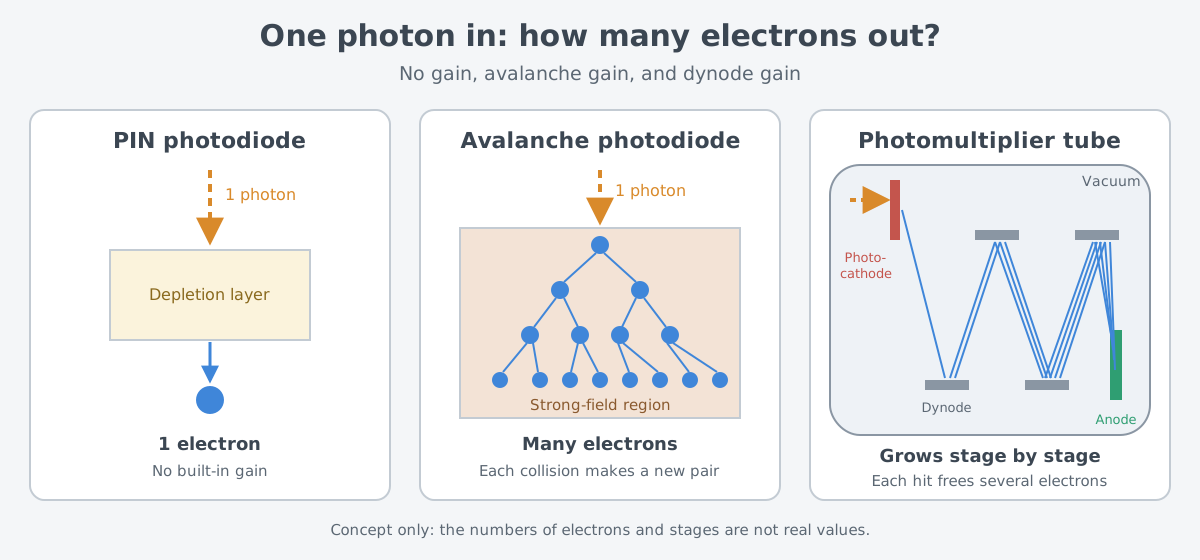
The basic design of the photomultiplier tube is fairly old. The history section of a manufacturer's handbook says the electrostatic-focusing photomultiplier tube that Zworykin and Rajchman developed in 1939 is the basic structure of the tubes used today.
Detectors that measure heat instead
Not every photodetector frees electrons. Some power meters that measure laser output use a thermopile. A thermopile is many thermocouples, which turn a temperature difference into voltage, packed closely and wired together.
An absorbing material on one side of the thermopile takes in the laser light and warms up, while the other side sits on a heat sink and stays cool. The absorbed laser energy turns into heat and sets up a temperature difference between the two sides. The output voltage follows that temperature difference, and the temperature difference follows the laser power.
The two approaches trade strengths. Thermal types have low sensitivity, but their response does not change with wavelength. A photodiode's responsivity depends on the material's band gap and varies a lot with wavelength, so measuring a different light source can call for a different detector.
In return, photodiodes are faster than thermopiles, less affected by temperature changes, and lower in noise. Their high sensitivity also makes them prone to noise from room light.
Counting photons one by one from space: ICESat-2
ATLAS, the instrument on NASA's ICESat-2 satellite, pushes photodetectors to the extreme. ATLAS sends out 532 nm laser light in six beams and uses detectors that respond to a single photon to time each photon's round trip to the surface.
Light gathered by the receiver passes filters that cut sunlight and then travels through optical fibers, one per beam, to photon-counting detectors. Each detector puts out one digital signal every time it catches a photon. The time of each event is recorded with about 200 ps precision. The receiver optics also include a photomultiplier tube.
ATLAS was designed so that, from clean snow under a clear sky, each strong beam gets back 12 photoelectrons per shot on average. More might seem better, but it is not. When too many photons arrive, some detection events are lost during the photon-counting detector's dead time, and the measurement gets distorted.
This value is a compromise between signal-to-noise ratio and that distortion. How ATLAS measures distance is explained in Measuring with Lasers: The Basics of Ranging and Lidar.
Limits and difficulties
First, some current flows even with no light. It is called dark current, and it becomes noise when measuring very faint light. A reverse voltage on a photodiode widens its straight-line range and speeds it up, but it also raises dark current and noise. Even on ATLAS in space, the dark count of each detector stays below 10,000 per second, but over the South Atlantic Anomaly it can reach 50,000 per second.
Strong light is a problem too. Focusing laser light onto a small spot raises the light per unit area and breaks the straight-line link between light and current. Yet fast detectors must be small, so there is a tug-of-war between speed and how much light a detector can take.
Temperature matters as well. An APD's gain drops at the same voltage as temperature rises. Getting a steady output means adjusting the voltage with temperature or holding the device at a constant temperature. Extra noise, called excess noise, also comes in because multiplication is uneven from one carrier to the next.
Infrared detectors often need to be kept cold. NASA JPL notes that running warmer than earlier detectors is a big advantage. It has developed an infrared detector that operates at 150 K and has shown a picture taken with a long-wave infrared array operating at 80 K. Even with higher operating temperatures, JPL says custom-built coolers are still needed.
What to read next
- Light Basics: Waves, Wavelength, Frequency, and Photons: a second look at how photon energy relates to wavelength.
- Instruments That Measure Light: Power Meters, Beam Profilers, and Spectrum Analyzers: the measuring tools that hold detectors, and how they are calibrated.
- Measuring with Lasers: The Basics of Ranging and Lidar: how the timing of returned light gives distance.
- "Wavefront Sensors: Measuring Distortion with a Shack-Hartmann Sensor": a device that uses a detector array to measure the shape of light.