Read enough tank news and the armor names pile up. Rolled homogeneous, spaced, composite, reactive, active protection. When all five land in one paragraph, it is hard to tell which is a kind of which.
The five are not rivals standing in one row. They read more like a sequence of ideas.
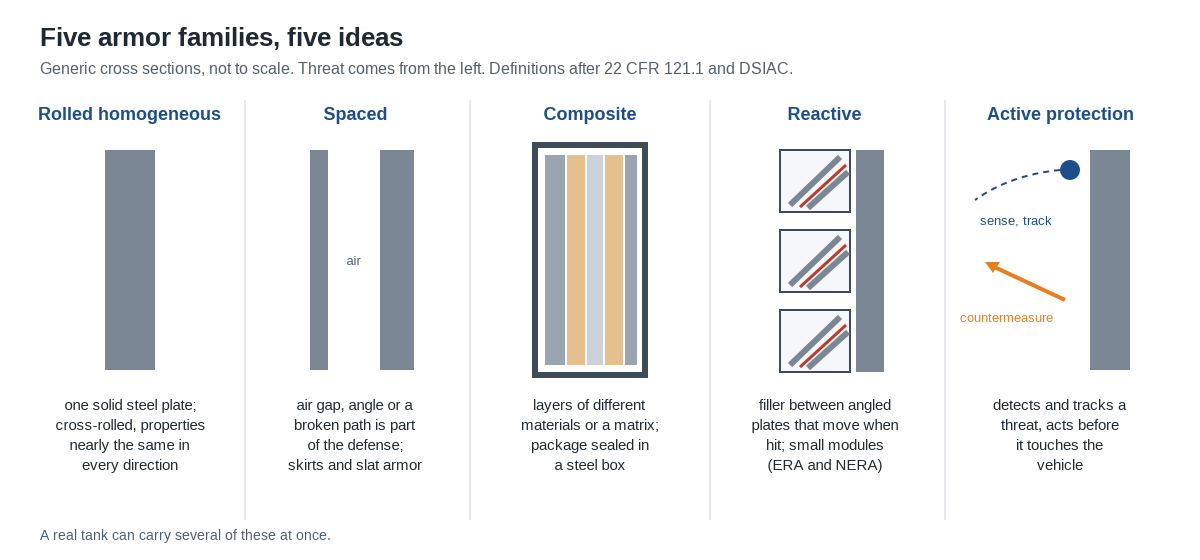
Start with one steel plate and put air between plates. Then stack different materials and make the plates move when hit. Finally, act before anything reaches the armor.
The yardstick: weight
What makes armor "good"? The armor monograph from DSIAC, an information center under the Defense Technical Information Center, states the yardstick plainly. The usual measure of performance is the weight needed to stop a threat of a given penetrating power.
Weight, not thickness, is the key word. A tank has to cross bridges and ride on trains, so most of armor history is the search for better protection at the same weight. Each name below is a different answer to that question.
Rolled homogeneous armor: the baseline for every comparison
The starting point is steel. Where cost is the only concern, a low-alloy steel of moderate strength is used almost everywhere, and each nation has its own recipe.
The United States uses RHA, rolled homogeneous armor. It is a low-alloy steel that hardens deep into thick sections, and because it is rolled in crossing directions its properties barely depend on direction. That is where "homogeneous" comes from.
How the steel is made also mattered. In the United States, cast hulls poured from molten steel stayed standard for a while even after welding had matured. Yet hardened and tempered rolled plate protects better than the old cast armor at the same weight. The "so many millimeters of RHA" in news stories compares other armor against this plate.
Spaced armor: air between the plates
The U.S. Munitions List (22 CFR 121.1) has an interpretive clause on spaced armor. It is metallic or non-metallic armor that uses an air space, obliquity or a broken material path as part of how it stops a threat. Instead of one thick plate, you split the steel into two and leave a gap.
A visible example is the skirting plate, a light curtain of armor hung outside a tank's road wheels. In experiments, spaced armor proved very efficient for its weight. The same list places slat armor parts, the grille-like kind, under spaced armor too. The steel bars around some armored vehicles belong to this family.
Composite armor: stacking materials
The definition of composite armor is short. It is armor built from two or more layers of unlike materials, or from a matrix. The list then names possible materials: metals, plastics, elastomers, fibers, glass and ceramics. Each layer takes on a property that one material alone would struggle to supply.
In the United States, this path led to the special armor of the M1 tank, placed in the hull, turret and skirting plates. The special armor package goes into a steel box compartment that is then welded shut, and when the technology improves only the package design changes. Leaving plenty of air space inside the armor was another way to add protection. So the outside thickness of a tank's armor and the actual amount of steel can differ.
Reactive armor: plates that move when hit
Reactive armor often shows up as square blocks on a hull. By the list's definition, it places explosives, propellants or other fillers between plates to boost plate motion when a round strikes, or to defeat the penetrator in some other way. The DSIAC monograph draws it even more simply: a pair of angled plates with something solid sandwiched between them.
There is a reason it comes as many small modules rather than one pair of plates over a wide area. A hit then costs protection only over that one module. Today both explosive reactive armor (ERA) and non-energetic reactive armor (NERA) are in use.
Active protection and other ideas: outside the armor
The fifth name is not really an armor plate. An active protection system (APS) is a defense that detects and tracks incoming threats on its own. It then launches a countermeasure to neutralize the threat before it touches the vehicle. The DSIAC monograph credits the rapid growth of the personal computer with making this possible.
One more name is still at the research stage. Electromagnetic armor is defined as armor that uses electric current against threats like shaped charges, and most of the open literature on it is Russian. How active protection works, and the soft-kill and hard-kill split, are covered in Active protection systems: defending beyond the armor.
The order in which they came
On the first tanks of World War I, about 12 mm of good steel plate was the thickest armor. That was enough to stop every rifle and machine-gun round of the day. In World War II armor grew thicker and began to slope. The Tank Museum singles out thick sloped armor as a mark of the Soviet T-34/76, which first entered service in 1940.
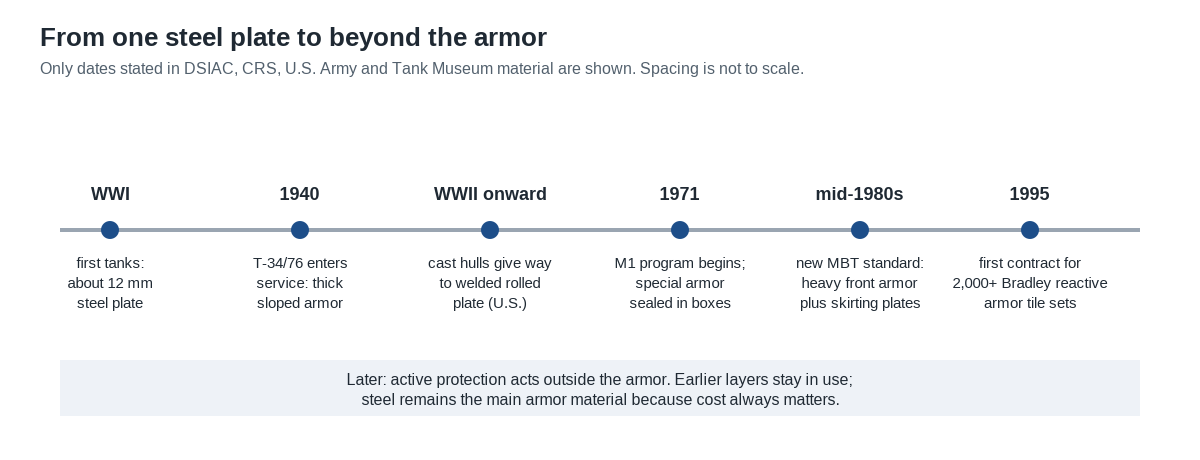
Later in the Cold War, materials and space took the lead. The M1 program began in 1971. The new main battle tank (MBT) standard of the mid-1980s reflected the thinking of the day: heavy armor around the front, with skirting plates adding protection to the sides.
Reactive tiles also went onto vehicles lighter than tanks. According to the U.S. Army, a 1995 contract, the first of its kind, covered over 2,000 Bradley reactive armor tile sets.
None of the earlier names disappeared. A modern main battle tank can carry steel plate, spacing, composite packages, reactive modules and active protection all at once. The DSIAC monograph expects steel to remain the main material for armor elements because cost always matters. New names keep arriving, but steel plate is still at the bottom.
What to read next
- Composite and reactive armor: the blocks on a tank: why the two armors appeared and how to read the marketing
- Active protection systems: defending beyond the armor: sense, track, respond
- What "So Many mm of RHA" Means: Describing Armor with One Thickness: comparing armor against a reference plate
- World War II Tanks: How the T-34, Sherman and Tiger Differed: the era when sloped armor stood out