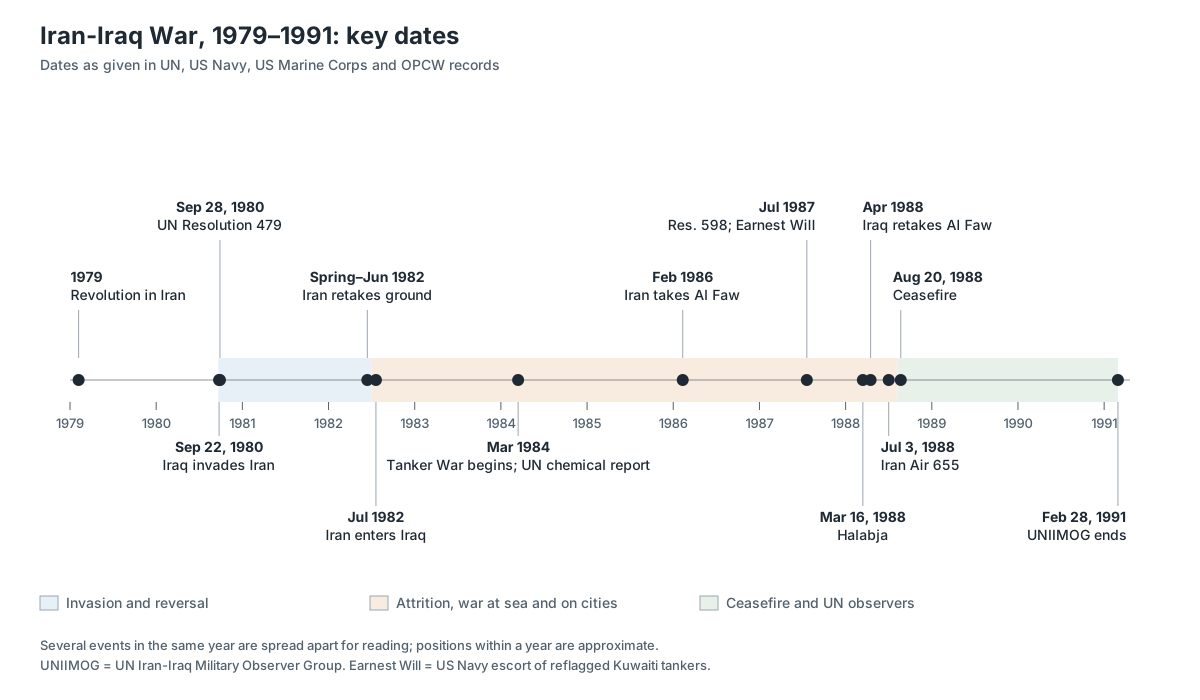
At 0300 GMT on August 20, 1988, a ceasefire between Iran and Iraq came into effect. The ceasefire lines between the two armies ran for about 1,400 km. A war that began in September 1980 had lasted almost eight years.
At the start, Iraqi leader Saddam Hussein ordered his commanders to finish the invasion fast and keep losses low. So why did the war drag on for eight years, and why did it spread to oil tankers at sea, to distant cities and to chemical weapons? This article follows it in order: the invasion and reversal, attrition in front of Basra, the fighting at sea and on cities, and the ceasefire.
A revolution and the Shatt al-Arab
In 1979 a revolution in Iran removed the pro-American Shah. In its place came an Islamic Republic headed by Supreme Leader Ruhollah Khomeini.
Between the two countries lies the Shatt al-Arab waterway. Merchant ships use it, and during the war UN mediation kept stalling over two issues: who was to blame for starting the war, and who would control the waterway. The internationally recognized border between the two countries is the one described in the 1975 Treaty concerning the State Frontier and Neighbourly Relations between Iran and Iraq.
Why did Iraq start the war? In the account of the US Naval History and Heritage Command (NHHC), Saddam hoped to take advantage of the turmoil in Iran after the revolution. A 1990 US Marine Corps publication, FMFRP 3-203, adds that Khomeini was stirring up Iraq's Shia and funding a revolt of Iraqi Kurds. Saddam claimed he only meant to win back the Shatt al-Arab.
The two populations were very different in size from the start: 45 million Iranians and 16 million Iraqis. FMFRP names two reasons why Saddam tried to keep casualties down through most of the war: keeping public support, and Iraq's small population.
September 1980: an invasion meant to be quick
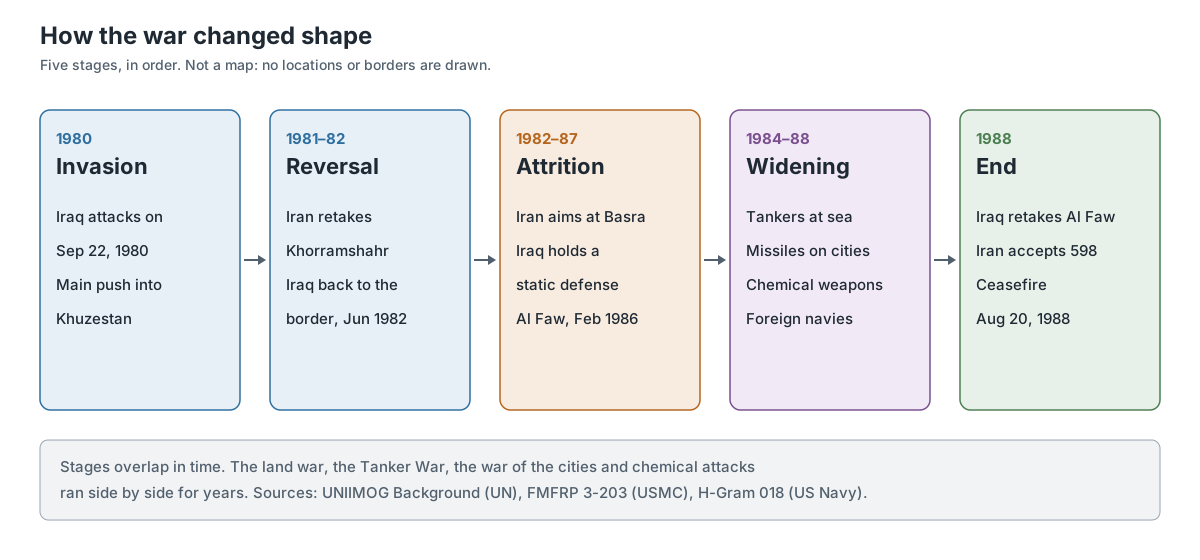
On September 22, 1980, Iraqi forces moved into Iran. The main push went into Khuzestan province in the south, and 7 of Iraq's 12 divisions took part. The goal was four cities: Khorramshahr, Abadan, Dezful and Ahvaz.
A purge had cut the Iranian army to about 150,000. Even so, the Iraqis met their first serious resistance at Khorramshahr and did not control the city until October 24.
The UN acted quickly. On September 23, Secretary-General Kurt Waldheim brought the threat to the Security Council under Article 99 of the UN Charter. On September 28, Security Council Resolution 479 called on both countries to stop using force at once and to settle the dispute by peaceful means. The UN peacekeeping record says briefly that it had little effect.
The reversal of 1982
In Iran, the Pasdaran became the government's main military force. A paramilitary force called the Basij also appeared. On November 29, 1981, at Bostan, Iran first used the so-called human wave attack, in which large numbers of fighters advance at once.
In the spring of 1982 the war turned. Iranian forces lifted the siege of Abadan and soon took back Khorramshahr. In June 1982 Iraqi forces pulled back to the border, and the first stage of the war was over.
Saddam offered to negotiate even before the withdrawal was complete, but Khomeini refused. In July 1982 Iranian forces crossed into Iraq. That offensive failed, with heavy Iranian losses.
Attrition in front of Basra
The war turned into an eight-year stalemate. Throughout the war Iran kept to its plan of taking Basra, a city in southern Iraq, and in Iraq a static defense began to take shape by about 1984. Most Iranian offensives came in the rainy season, between December and April, each time trying to break through the defenses around Basra.
On the night of February 10, 1986, Iranian forces crossed the Shatt al-Arab and took Iraq's Al Faw peninsula. On January 9, 1987, the battle of Karbala V began around Basra and went on until February 2. Some claimed that Iran suffered as many as 70,000 casualties. The FMFRP authors say that estimate may be right but suspect Iran lost fewer, and they put Iraqi losses at about 10,000 killed and wounded.
The two sides also had very different access to weapons. Because of embargoes and sanctions, Iran found it harder and harder to keep its advanced US-made aircraft and ships, bought under the Shah, ready for use. Iraq received help from the Soviet Union and from Western countries such as France. According to FMFRP, the United States began assisting Iraq after Baghdad backed its Algiers Accord with the Shah, and ran Operation Staunch to cut off arms to Iran.
The war spreads to sea: the Tanker War
In March 1984 the Iraqi air force used French-made Super Étendard fighters and Exocet anti-ship cruise missiles (ASCM) to attack Iran's oil export facility on Kharg Island. Iran struck back by attacking neutral ships in the Gulf, and Iraq went after tankers sailing to and from Kharg. This was the start of the Tanker War.
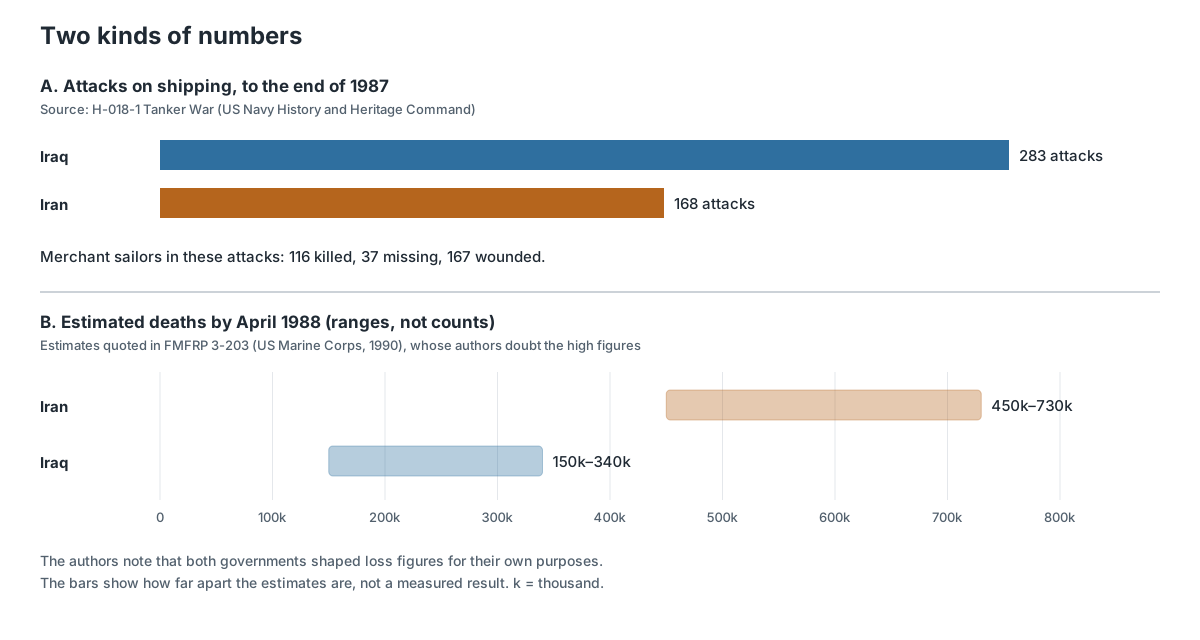
By NHHC's count, Iraq attacked ships 283 times and Iran 168 times by the end of 1987. These attacks killed 116 merchant sailors from many countries, left 37 missing and wounded 167. Few ships actually sank. At first there was great fear that the Gulf's oil flow would be cut off, but the attacks mainly drove up insurance rates.
As attacks on merchant ships and oil tankers grew more frequent in 1986 and 1987, several countries sent minesweepers and escort ships to the Gulf on their own. In November 1986 Kuwait asked other countries to protect its tankers, and the Soviet Union answered first. In March 1987 the United States chose to put 11 Kuwaiti tankers under the US flag. That made it legal for US Navy ships to defend them.
The US Navy escort operation Earnest Will ran from July 24, 1987, to September 26, 1988. NHHC describes it as the biggest naval convoy effort since World War II. The first convoy left the United Arab Emirates on July 22, and on the 24th the tanker Bridgeton struck an Iranian moored contact mine. An article in the CIA's Studies in Intelligence notes that the operation was controversial because critics saw it as the United States giving up its neutrality.
The war at sea also reached US warships. In May 1987 the US frigate Stark was hit by two Exocet missiles fired by an Iraqi aircraft, and 37 sailors died; Iraq apologized and called it an accident. On April 14, 1988, the frigate Samuel B. Roberts struck a mine, and ten sailors were severely injured. The mine was an Iranian-made Sadaf 02, based on a 1908 Russian design.
Four days later, on April 18, the US Navy struck back with Operation Praying Mantis. In one day it destroyed two Iranian surveillance platforms, sank two Iranian ships and badly damaged another. Earlier, on October 19, 1987, the United States had shelled Iranian oil platforms in Operation Nimble Archer. In 2003 the International Court of Justice ruled that this attack could not be justified as self-defense.
Chemical weapons and the war of the cities
On November 3, 1983, Iran told the UN for the first time that Iraq was using chemical weapons. Specialists sent by the Secretary-General reached a unanimous conclusion in their report of March 26, 1984. In the areas of Iran they inspected, chemical weapons had been used in the form of aerial bombs, and the agents were mustard agent and the nerve agent tabun. With the time and resources they had, they could not determine how widely the agents had been used.
The use of chemical weapons then spread. NHHC writes that Iraq used them widely to blunt Iranian counterattacks. Iraq had already used them against Iranian troops with artillery shells, rockets and aircraft. On June 28, 1987, Iraqi aircraft used chemical weapons against a civilian target in Iran for the first time.
On March 16, 1988, the Kurdish town of Halabja in northern Iraq was hit by a chemical attack. Chemical weapons killed thousands of innocent people there.
In a March 2003 statement, the White House wrote that the Iraqi air force had dropped a mix of mustard and nerve agents on the town. In a 2013 statement, the German government's commissioner for human rights also said the Iraqi army carried out the attack and some 5,000 people died. He said Saddam Hussein bore political responsibility.
There was another claim as well. In an appendix to FMFRP 3-203, the authors pointed to the kind of agent that had been reported and concluded that Iran carried out the attack. They also doubted the reports of 5,000 dead. The government statements checked for this article, made later, still name the Iraqi military as the attacker.
The Organisation for the Prohibition of Chemical Weapons (OPCW) remembers it as the deadliest chemical attack on civilians in history. It also says the attack pushed the world to finish negotiating the Chemical Weapons Convention. The convention entered into force in 1997.
Cities became targets too. On June 9, 1984, Secretary-General Javier Pérez de Cuéllar appealed to both countries not to attack civilian population centers on purpose, and both agreed. UN inspection teams were based in Baghdad and Tehran, and this truce in the "war of the cities" lasted about nine months.
The truce did not hold. Both countries began launching many Scud surface-to-surface missiles at one another's cities. After the clashes between the United States and Iran in the Gulf in the fall of 1987, the war of the cities grew. To see how missiles like these climb high and then fall, read the article on ballistic missiles.
Resolution 598 and the ceasefire
On July 20, 1987, the Security Council adopted Resolution 598. It demanded an immediate ceasefire, an end to all military action on land, at sea and in the air, and the withdrawal of all forces to the internationally recognized boundaries. It also provided for a team of UN observers and the release and return of prisoners of war.
Its preamble deplored how the war had begun and gone on, the bombing of civilian cities, and attacks on neutral ships and civilian aircraft. Above all, it deplored the use of chemical weapons in breach of the 1925 Geneva Protocol.
Iraq welcomed the resolution. Iran did not reject it but criticized "fundamental defects and incongruities" in it.
Meanwhile the fighting went on. Unexpectedly, Iran did not try to invade in 1988, and Iraqi forces retook Al Faw on April 17. On July 3 the US Navy Aegis cruiser Vincennes shot down Iran Air Flight 655. It was a regularly scheduled Airbus A300 flight from Bandar Abbas to Dubai, and all 290 passengers and crew died.
In NHHC's account, the cruiser's combat information center wrongly took the airliner for an Iranian F-14 fighter coming to attack the ship. The Navy's formal investigation concluded that, given the information the commanding officer had and the short time he had to decide, he acted prudently, and it recommended no disciplinary action. Others in the Navy, such as commanding officers of other ships nearby who had correctly judged the aircraft to be an airliner, thought the captain had been too aggressive. Iran still regards the shoot-down as deliberate and as a war crime.
On May 17, 1989, Iran took the United States to the International Court of Justice. It argued that by destroying the airliner and refusing to pay compensation, the United States had broken international agreements on civil aviation. On February 22, 1996, the two countries told the court they had reached "an agreement in full and final settlement," and the case was withdrawn.
On July 17, 1988, Iran formally told the UN Secretary-General that it accepted Resolution 598. The ceasefire took effect on August 20, and the two foreign ministers were to meet face to face in Geneva from August 25.
The UN Iran-Iraq Military Observer Group (UNIIMOG) watched over the ceasefire. At its peak it had about 400 personnel, including some 350 military observers.
After confirming that both armies had fully withdrawn to the internationally recognized boundaries, the group ended its mission on February 28, 1991. In the meantime, in August 1990, Iraq invaded and occupied Kuwait. Security Council Resolution 678 authorized a multinational coalition to use all necessary means if Iraq did not leave Kuwait by January 15, 1991.
What the numbers show and what they do not
NHHC writes that each side suffered casualties in the hundreds of thousands. FMFRP points out that both countries consistently manipulated their loss figures to suit their own purposes. The estimates it quotes for around April 1988 are 450,000–730,000 Iranian dead and 150,000–340,000 Iraqi dead.
Its two authors were researchers at the US Army War College's Strategic Studies Institute. They argue that losses as large as those of the American Civil War were not possible, partly because Iranian offensives were mostly limited to the rainy season.
These ranges and that reading come from one publication. None of the official sources checked for this article gives its own death count for the whole war. So the ranges are best read alongside NHHC's "hundreds of thousands" on each side.
Some numbers are firmer: 116 merchant sailors killed in the Tanker War by the end of 1987, 37 sailors of the Stark, and 290 people aboard Iran Air Flight 655. In Halabja, thousands of residents lost their lives. Every number stands for people, and that is just as true of the estimates written as ranges.
Resolution 598 asked the Secretary-General to explore, with the two countries, giving an impartial body the task of looking into responsibility for the conflict. In December 1991 the Secretary-General spoke about that question. He added that nothing useful would come from pursuing it further, and that for the sake of peace the settlement process had to move on.
What to read next
- Anti-ship missiles: dealing with moving targets at sea: how weapons like the Exocet used in the Tanker War fly.
- Ballistic missiles: why they climb high and come down: the principle behind missiles like the Scuds of the war of the cities.
- The Aegis combat system: why it sounds like a ship name: what the system carried by cruisers like the Vincennes is.
- The Falklands War: Naval War and Landings at the Edge of the Atlantic: another Cold War history article about war at sea.
- The Gulf War, 1991: From Desert Shield to Desert Storm: the war that followed Iraq's invasion of Kuwait in August 1990.