On 24 March 2007, the UN Security Council adopted Resolution 1747. An annex to the resolution lists entities linked to the Islamic Revolutionary Guard Corps, and the first line names a company that makes drones. This article starts from that line and follows the order in which Iran's drones, and the bodies that build them, entered the public record.
What path has Iran's unmanned aerial system (UAS) program taken? Starting from the IRGC, the path runs by date through UN and U.S. designations, three family names, records abroad, claims and denials over Ukraine, and later sanctions. Different bodies wrote these records, so U.S. government findings, claims by states, and denials by Russia and Iran are kept apart. This article reflects the situation as of October 2026.
Background: the IRGC and an eight-year war
According to a RAND study quoted in a Congressional Research Service (CRS) report, the IRGC was founded by a decree from Khomeini shortly after the 1978–1979 Islamic Revolution succeeded. The IRGC turns up again in almost every drone record that follows.
Soon after the revolution, Iran fought a war with Iraq from 1980 to 1988, and the ceasefire took hold on 20 August 1988, at three in the morning GMT. The course of the war is covered in The Iran-Iraq War: Eight Years of Attrition.
Long after the war ended, in 2007, the IRGC's name appeared in a UN resolution next to a drone maker.
A drone maker named in a UN resolution
The first line of the annex's list of IRGC entities is Qods Aeronautics Industries. It is described as a maker of unmanned aerial vehicles (UAVs) as well as parachutes, paragliders and similar goods. The entry also mentions that the IRGC has bragged about these products, presenting them as part of its doctrine for asymmetric warfare.
The United States acted in the same year. On 25 October 2007, the U.S. Department of State designated Iran's Ministry of Defense and Armed Forces Logistics (MODAFL) and the IRGC under Executive Order 13382. That order targets those who spread weapons of mass destruction and their means of delivery. On 17 September of the following year, the Treasury designated the aircraft company HESA under the same order.
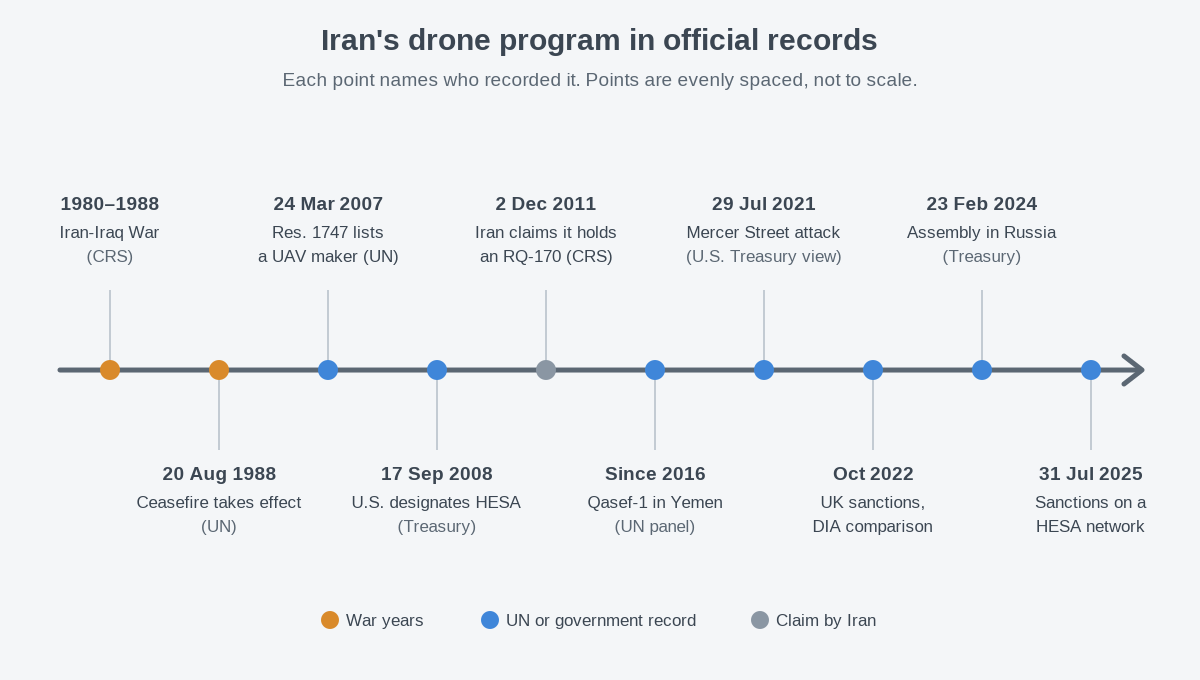
In 2011, a record pointing the other way appeared. On 2 December that year, the government of Iran claimed to hold an intact U.S. RQ-170 drone that had entered Iranian airspace.
In March 2012, the European Union put the IRGC-operated Qods Aviation Industries (QAI) on its list. The listing linked QAI to Iran's proliferation-sensitive nuclear activities or to the development of nuclear weapon delivery systems. The United States designated QAI under Executive Order 13382 on 12 December 2013. Its English name differs by one word from the company in Resolution 1747, and neither document says the two are the same, so they are kept apart here.
Three families: Ababil, Mohajer and Shahed
A table of Iran's arsenal in a 2021 update of a report by the CRS has a separate row for drones. Names such as Ababil, Shahed, Mohajer and Toufan sit side by side there. The table cites reports by the IISS and the Defense Intelligence Agency (DIA), along with various press reports. This article follows three of them: Ababil, Mohajer and Shahed.
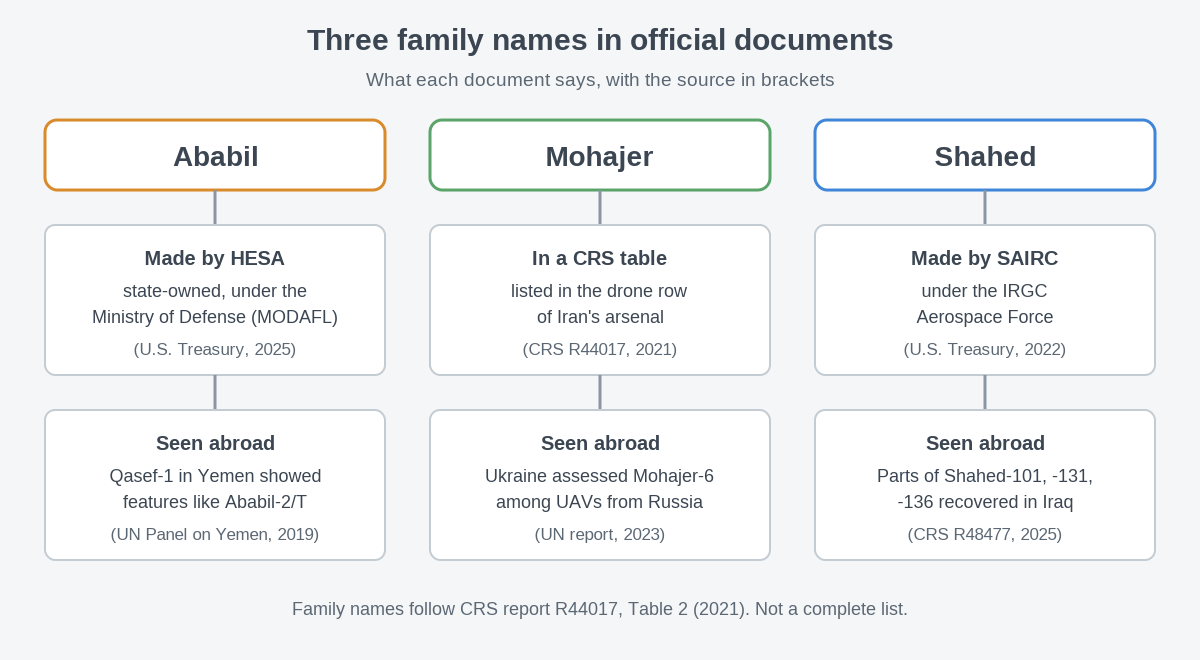
The Ababil family is made by HESA, a state-owned subsidiary of MODAFL. It is the same company that was designated in 2008, as seen in the section above. In a 2021 statement from the Treasury, HESA's work inside Iran covers the research, development, production and flight operations of UAVs, and the IRGC uses the UAVs HESA makes. When the Treasury sanctioned a global network supporting Iran's military UAV program on 31 July 2025, that statement again described HESA and its Ababil-series UAVs.
Mohajer is listed in the drone row of the CRS table next to Ababil and Shahed. In the 2023 UN document covered below, Ukraine named the Mohajer-6 among UAVs on the Russian side. Clues for telling the aircraft apart by its shape are in the table in The Shahed series: same name, different drones.
The Shahed family is made by the Shahed Aviation Industries Research Center (SAIRC), which sits under the IRGC Aerospace Force. The numbers within the family and their roles, the Geran name used in Russia, DIA's comparison of debris, and assembly inside Russia are covered in the same Shahed series article. Weapons that fly out once and do not return are the subject of Loitering munitions: between missile and drone.
There is also a record about foreign drones. A Treasury statement of 8 September 2022 records that the IRGC Aerospace Force had once handed drones built in the United States and Israel to an Iranian company. Those aircraft were eventually used for reverse engineering, which means taking apart something another party built to work out its design. The U.S. government also found that the same company took part in research, development and production for the Shahed-171.
U.S. intelligence agencies, as quoted by the CRS, have assessed that Iran keeps building and refining new military means aimed at U.S. and allied assets in the region. Armed UAVs are on that list. Why drones that stay aloft for a long time matter is the subject of ISR drones: why endurance matters.
Beyond Iran's borders: Yemen, the sea and Iraq
The U.S. Treasury set out its view on 29 October 2021. In that view, the IRGC Qods Force used lethal UAVs and passed them on to Ethiopia and to groups Iran backs, such as the Houthis, Hizballah, Kata'ib Hizballah and HAMAS. The Treasury also wrote, more generally, that lethal UAVs have been used in attacks on international shipping and on U.S. forces.
In Yemen, a UN record came first. In the final report of the UN Panel of Experts on Yemen, issued in January 2019, the Qasef-1 appears among the most common UAVs in the Houthi arsenal. Its features resembled those of the Ababil-2/T, an Iranian-made loitering munition, and it had been in use in Yemen since 2016 at the latest. It is worth noticing that the panel chose "similar characteristics," not "the same."
The October 2021 Treasury statement also covers the sea. In its account, the merchant ship Mercer Street was attacked off Oman on 29 July 2021 and two crew members died. The Treasury found that the IRGC Aerospace Force UAV Command directed the attack.
The 2019 attacks on Saudi Arabia also left a mark in UN documents. The UN Secretariat had examined debris from the delta-wing UAVs used in those attacks, and a 2023 UN document refers back to that work.
A 2025 CRS counter-drone study records a drone strike on a U.S. base in Jordan on 28 January 2024 that killed three U.S. troops and injured more than 40. Department of Defense officials blamed militia groups in Iraq and Syria that Iran backs. In Iraq, U.S. forces picked up parts of Shahed series drones of Iranian origin, among them the Shahed-101, Shahed-131 and Shahed-136. Similar drones were used in Houthi attacks on Red Sea shipping and in Russian strikes on Ukraine.
The names confirmed in Ukraine
On 8 September 2022, the U.S. Treasury issued a statement about the route Iranian drones were taking to Russia. An Iranian aviation services company had arranged Russian military flights that moved Iranian drones, along with staff and equipment, to Russia. The statement also cited information that the Russian Aerospace Forces meant to field the Iranian drones next to their own in the war against Ukraine, after assembly and testing.
A month or so later, records came in quick succession. On 20 October 2022, the UK government named Shahed Aviation Industries as the Iranian maker of the Shahed drones and froze its assets. In a comparison with an information cutoff of 27 October that month, DIA concluded that its analysis confirmed Russia's use of several Iranian lethal UAVs.
Both sides then wrote to the UN, and letters from France, Germany, the United Kingdom and Ukraine appear in a June 2023 document of the Secretary-General. Among them, the United Kingdom informed the UN that it held two UAVs recovered and lent by Ukraine's armed forces, and claimed they were the Iranian Shahed-131 and Shahed-136. Ukraine assessed the UAVs launched by Russia as the Shahed-131, Shahed-136 and Mohajer-6. Russia replied that the accusations were not substantiated with any credible evidence, and Iran rejected these countries' allegations as unfounded.
After that, U.S. statements turned to production and supply. As of a statement on 27 September 2023, the Treasury had issued nine rounds of designations against Iran's UAV program since September 2022. On 25 April 2024, the Treasury announced that a front company of MODAFL had played a key role in designing, making and selling thousands of UAVs. Many of them ended up in Russia.
On the same day, the United Kingdom and Canada announced sanctions on parties involved in Iran's UAV procurement. The run of sanctions continues to the 31 July 2025 statement seen earlier. The assembly contract inside Russia is covered in The Shahed series. The record of attacks inside Ukraine is the subject of a separate article in the same series, "Shahed and Geran Drone Attacks: The Pattern in Official Statements."
Where this meets lasers: claim, assessment, denial
When you meet a sentence about Iranian drones, it pays to check first which kind of record it comes from. Even for the same drones, the records fall into four kinds.
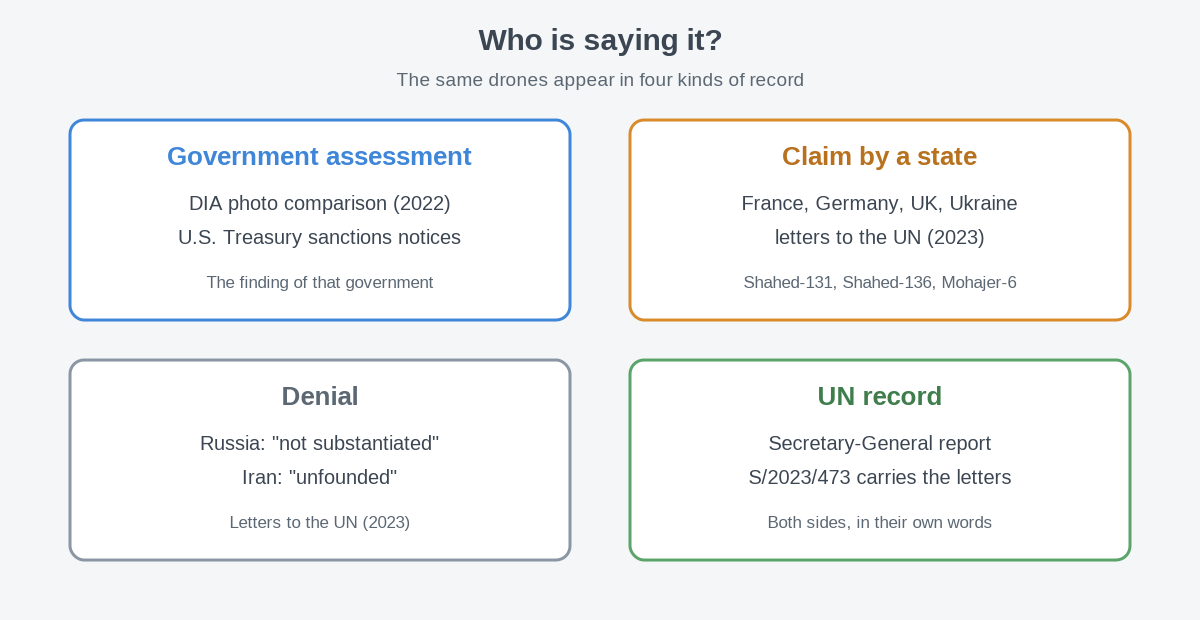
The DIA comparison and the Treasury sanctions notices are U.S. government assessments. The letters that France, Germany, the United Kingdom and Ukraine sent to the UN are claims by those states, and the letters from Russia and Iran are denials. The Secretary-General's document places these letters side by side. When a news line says something was "confirmed," asking who confirmed it and on what basis changes how much weight the sentence carries.
Laser weapon news can be read with the same eye. Checking what conditions sit behind a number, and how a "successful test" differs from "deployment," is covered in How to read laser weapon news: "kW-class", "range" and "cost per shot".
The record of Iranian drones meets lasers most directly in counter-drone defense. The 2025 counter-drone study by the CRS opens with the attack on the base in Jordan. It goes on to record that U.S. policymakers and Department of Defense officials want the department to speed up its investment in defensive counter-drone capabilities.
Later on, some Department of Defense officials are said to see directed-energy weapons and high-power microwave systems as possibly cheaper alternatives to conventional air and missile defense interceptors. The study also mentions reported delays in the Army's directed-energy work, and the up-front cost of producing such systems at scale, separate from the cost per shot.
How lasers and other counter-drone tools are tied into one system is covered in Counter-drone systems: why one device is not enough.
What to read next
- The Shahed series: same name, different drones: how the Shahed numbers and the Geran name split.
- The Iran-Iraq War: Eight Years of Attrition: the war that forms this article's background.
- Counter-drone systems: why one device is not enough: how systems that stop drones like these are built.
- "Iran's April 2024 Attack on Israel: Drones, Missiles and a Multinational Defence": an article in the same series, still in progress.
- "The 2025 Israel-Iran War and US Strikes: Twelve Days Seen Through Drones": an article in the same series, still in progress.