On the evening of Saturday, April 13, 2024, drones and missiles began to rise from Iran toward Israel. The two countries had been enemies for decades, but Iran had never attacked Israel directly from its own soil. Overnight, Israel, the United States, the United Kingdom, France and Jordan moved to intercept them, and the UN Security Council held an emergency meeting the next afternoon.
This article lays out, in date order, what was launched that night, who said they helped stop it, and what each country told the UN. For every number, it also notes who put it out. This article reflects the situation as of October 2026.
Background: Damascus, April 1
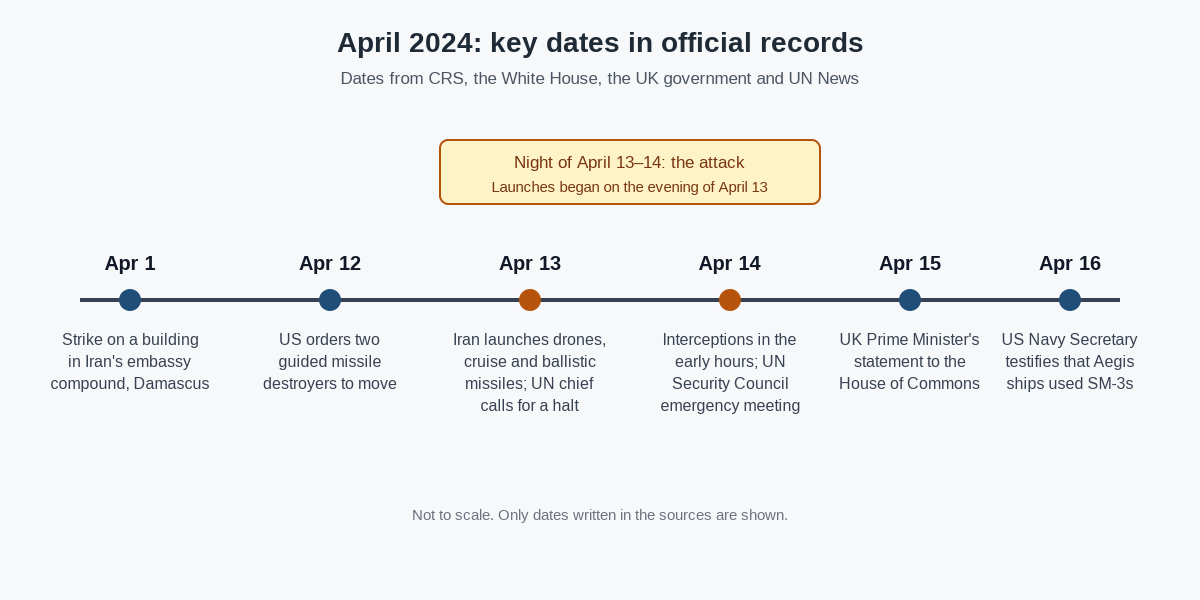
The story starts twelve days earlier. On April 1, a building inside Iran's embassy compound in Damascus, Syria, was struck, and several senior figures in Iran's Islamic Revolutionary Guard Corps (IRGC) were killed. Israel was reported to be behind the strike. Iran said its April 13 attack was retaliation for it.
The rivalry was old, but it had looked different. In the words of the Congressional Research Service (CRS), it was a "shadow war" that had run for years, fought until then mostly outside the two countries' own territory. It was fought between Israel and groups Iran supports, or through covert and non-kinetic means such as cyberattacks. April 13 broke that pattern.
On April 12, the day before the attack, President Biden ordered two guided missile destroyers to move. One of them carried the Aegis combat system. Over the week before the attack, aircraft and ballistic missile defense (BMD) destroyers had also been moved to the region on the president's orders.
What was launched on the night of April 13–14
Three kinds of weapons were in the air. Drones are aircraft with no one on board, and cruise missiles fly like airplanes. A ballistic missile follows an arch up into space and then falls under gravity at several times the speed of sound. A drone is the aircraft part of an unmanned aerial system (UAS).
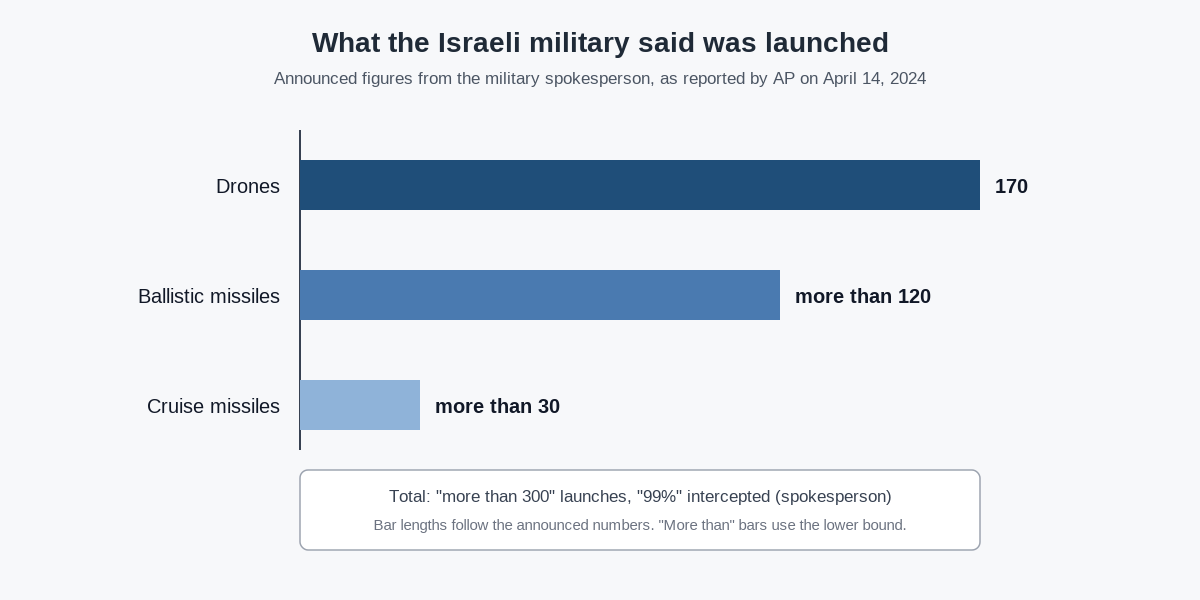
The Israeli military spokesperson gave these figures, as reported by the Associated Press: 170 drones, more than 120 ballistic missiles and more than 30 cruise missiles. In all, more than 300 were launched and 99% were intercepted. By the announced numbers, drones were the largest group of the three.
Not everything came from Iran. In President Biden's statement, the attackers were Iran and proxy groups based in Yemen, Syria and Iraq. In the CRS summary, Iran and allied groups were reported to have fired about 350 drones and missiles, launched from four countries: Iran, Lebanon, Iraq and Yemen.
Iran's side gave no total. In a statement carried by Iran's state news agency IRNA, the Revolutionary Guard acknowledged launching "dozens of drones and missiles" toward "the occupied territories and positions of the Zionist regime."
Who helped stop it
Israel had already called up its air defense reserves, canceled school and closed its airspace. Once the weapons were in the air, Israel and four partners, the United States, the United Kingdom, France and Jordan, were reported to have stopped most of them. Fighter jets and missile defense systems of several kinds were used.
The Israeli military said its Arrow system, which is built to stop ballistic missiles, handled most of the interceptions, with "strategic partners" also involved. Israel has a layered air defense network built to stop many kinds of threats.
The U.S. president said American forces helped Israel take down "nearly all" of the drones and missiles coming in. Defense Secretary Austin said separately that American forces shot down dozens of missiles and drones heading for Israel. On April 16, Navy Secretary Del Toro told a Senate subcommittee that, over that weekend, Aegis ships able to perform BMD fired SM-3 interceptors at ballistic missiles launched from Iran. This was the first time destroyers had fired ballistic missile interceptors in combat, according to a press report later carried by CRS.
The United Kingdom set out its part in Prime Minister Sunak's statement to the House of Commons on April 15. Extra Royal Air Force Typhoon fighters were sent into the region under existing operations against Daesh (ISIS) in Iraq and Syria. British forces destroyed several Iranian drones. The UK also gave intelligence, surveillance and reconnaissance support.
France is named as a partner in both the CRS summary and the UK statement, and Jordan in the CRS summary. Iranian missiles or drones were also intercepted in the sky over Amman, Jordan's capital.
What was said about damage
Statements on damage were brief. In the Israeli military's account, several ballistic missiles landed in Israel and caused minor damage to one air base. The CRS report notes that one base in the Negev desert, in the south, reportedly suffered minor damage and that one person was reported injured. The president's statement said no attacks on U.S. forces or facilities had been seen that day.
One of the injured was a child. According to rescue workers, a girl of seven from a Bedouin Arab community was seriously wounded in a town in southern Israel. It appeared to be from a missile strike, but police were still looking into how she was hurt. A few civilians were also hurt, according to the UN Secretary-General's report to the Security Council.
What was said at the UN Security Council
In a statement on the evening of the 13th, UN Secretary-General Guterres called for "an immediate cessation of these hostilities." He warned that the region and the world could not afford another war. The President of the UN General Assembly noted that Iran explained its action under Article 51 of the UN Charter. That article covers self-defense, and Iran tied its action to the attack on its embassy in Damascus.
Israel asked for the emergency meeting held on the afternoon of the 14th. In its letter to the Council, Israel described a direct attack by Iran with "more than 200 UAVs, cruise missiles, and ballistic missiles" in clear breach of international law. Iran's separate letter called its strikes self-defense under the UN Charter, in response to the April 1 armed attack on Iranian diplomatic premises.
In the chamber, Israel's ambassador said the attacks came from Iranian soil and also from Lebanon, Syria, Yemen and Iraq. In his words, "this attack crossed every red line and Israel reserves the right to retaliate." Iran's ambassador repeated that his country wants neither escalation nor war in the region. He said that the operation was purely self-defense, aimed only at military targets, and carried out to avoid harm to civilians.
The days that followed
Iran's mission to the UN said "the matter can be deemed concluded." President Biden planned to bring together the Group of Seven (G7) leaders on the 14th to agree on a joint diplomatic response. The next day in the Commons, Prime Minister Sunak said the G7 leaders were united in condemning the attack, and added: "All sides must show restraint."
According to CRS, Israel struck several Hezbollah sites in Lebanon on the same day, the 14th, in response to some 40 rockets Hezbollah fired toward Israel during the Iranian attack. The Israeli government was reported to be weighing a range of responses to Iran.
The record in this article ends there. The later clashes of 2025 are covered in a separate article.
Where this meets lasers: who counted the numbers
Put the numbers for that one night side by side and they spread wider than you might expect. The counts run from more than 300 (the Israeli military spokesperson) and more than 200 (Israel's letter to the UN) to about 350 (CRS) and dozens (the Revolutionary Guard). The results are worded differently too: "99%," "nearly all" and "almost all of the missiles."
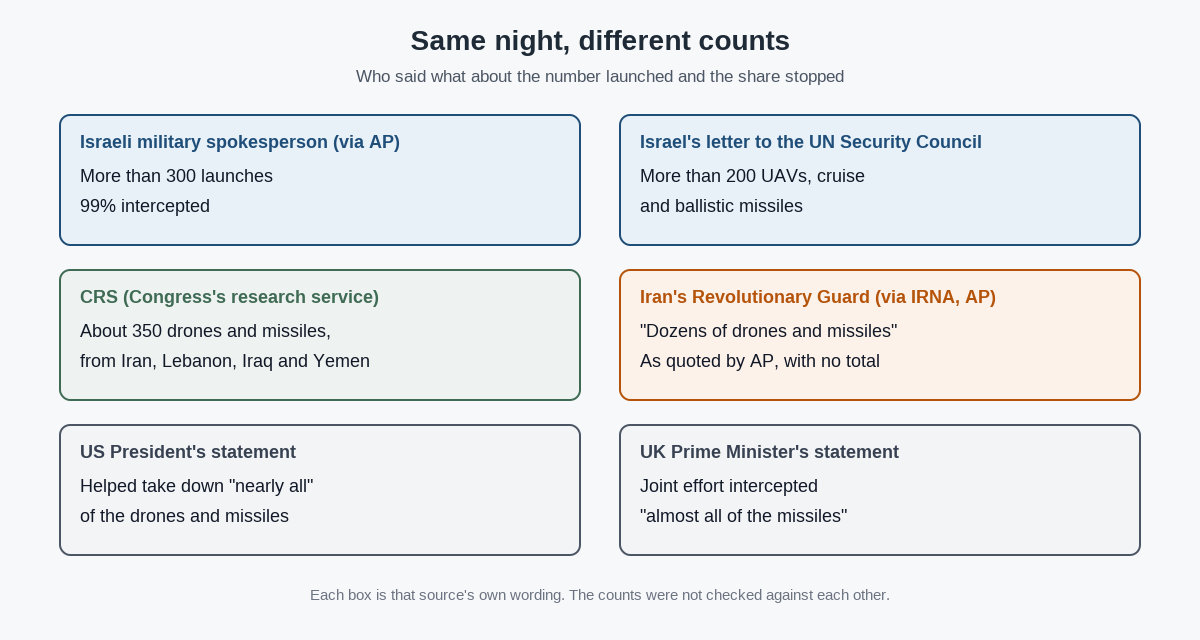
The counts do not even cover the same ground. The CRS figure of 350 includes launches from Lebanon, Iraq and Yemen. A letter, a press briefing and a research report are also put out by different bodies. Before deciding which number is right, it is safer to ask who counted, when, and on what basis.
The same habit works for laser weapon news. How to read laser weapon news shows how to find the missing conditions behind phrases such as "kW-class" or "successful test." Stories about intercepting drones raise the same questions: who counted, what they counted, and when.
What to read next
- The Shahed series: same name, different drones: what the names of Iranian drones actually refer to.
- Ballistic missiles: why they climb high and come down and Cruise missiles: how they resemble aircraft: how the two kinds of missiles from that night work.
- Layered missile defense: why defense comes in layers: why air defense is built in several layers.
- The cost of drone defense: how to compare the price of drones with the price of stopping them.
- How to read laser weapon news: how to find the conditions behind the numbers in a news story.
- The 2025 Israel-Iran War and US Strikes: Twelve Days Seen Through Drones: a date-ordered account of the 2025 clashes that came after the events in this article.