During the 1991 Gulf War, a small drone flew low over Faylaka Island near Kuwait City. Iraqi soldiers on the ground waved white flags at it. The aircraft was Pioneer number 159, and the Smithsonian National Air and Space Museum now holds it.
The Pioneer was built in the United States, but its roots lie in Israel's Scout. Israel went on to build drones and sell them to many countries, and two companies stand at the center of that story. One is Israel Aerospace Industries (IAI), owned by the government. The other is Elbit Systems, which grew by buying other firms.
How did the two companies' drones develop? What did the buying countries say they bought, and how do the numbers from a research institute and from Israel's Ministry of Defense differ? This article follows those questions in turn. It reflects the situation as of October 2026.
Drones that began after the 1973 war
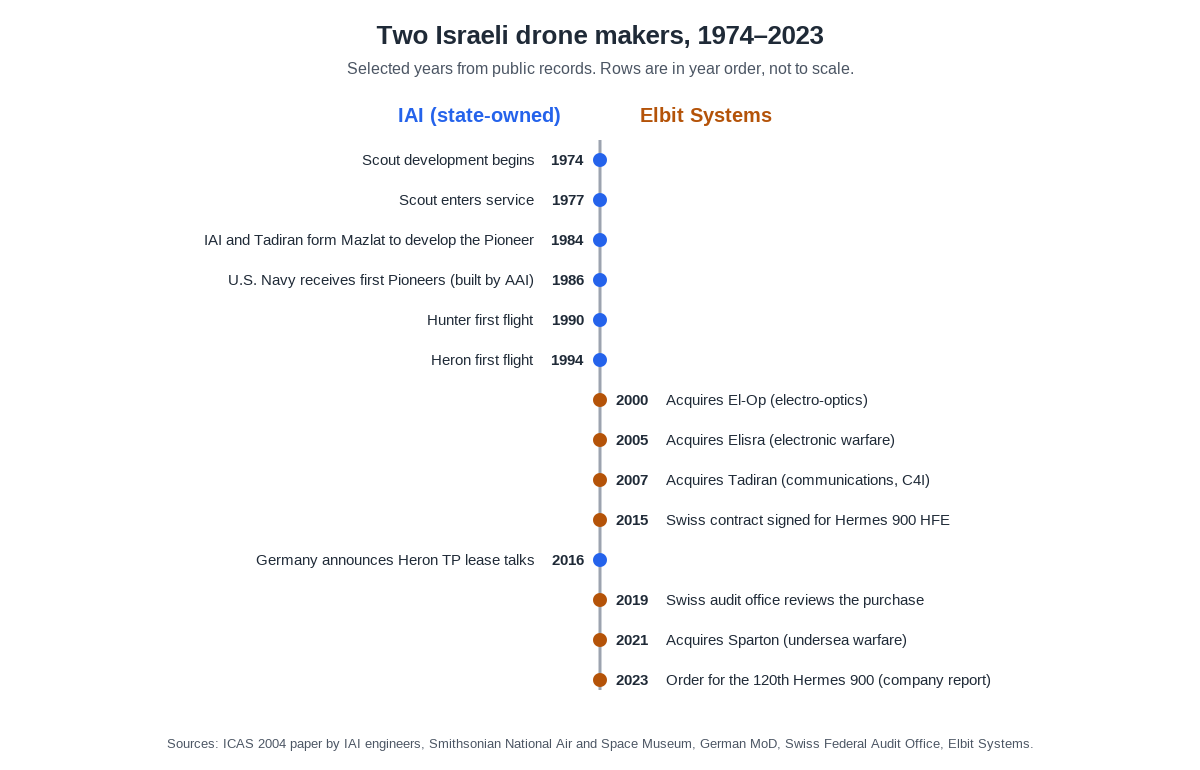
A paper that four IAI engineers presented at the 2004 International Congress of the Aeronautical Sciences (ICAS) dates the start of the company's drone work to the end of 1973. The trigger was the Yom Kippur War that year. Aircraft losses were heavy, and surprise from SA-6 and SA-2 surface-to-air missiles held back air operations. The course of that war is covered in The Yom Kippur War.
IAI's first drone was a decoy, the UAV-A, carried aloft and released by combat aircraft. It was built to look like a real combat aircraft, but the program was later dropped.
Another major lesson of the war was a shortage of useful operational intelligence. At the start of 1974, IAI began work on a tactical surveillance drone and named the first one Scout. The Scout reached initial operating capability in 1977.
The first Scouts were made of aluminum. At the time, the company had no experience with composite materials. Its first experimental fiberglass fuselage appeared only in early 1980, and that fuselage was later used for the Pioneer. The layout with two booms holding up the tail also first appeared on the Scout in 1974 and carried on through the Pioneer, Searcher, Hunter and Heron.
The Pioneer crosses to the U.S. Navy
According to the museum, when Israel moved into Lebanon in 1982, IAI was building the Scout. The U.S. Navy then showed interest in adapting the Israeli drone to American needs. In 1984 IAI and Tadiran set up a joint subsidiary, Mazlat, to develop an improved Scout called the Pioneer. The Pioneer won a Navy competition, and the American company AAI took on production.
The U.S. Navy received its first Pioneers in June 1986. They were the first batch from an $87.7 million order that covered 72 Pioneers along with support equipment. The Marine Corps began using the aircraft the next year, and the Army was flying it by 1990. The IAI paper puts the Navy's initial operating capability in 1985, so the two sources give different years.
What the military bought was more than a few aircraft. A complete Pioneer unit usually had five drones, a ground control station, a tracking control unit, a portable control station, four remote receiving stations, and launch and recovery gear. The tracking control unit on the ground kept the data link with the aircraft. The whole package of aircraft, ground equipment and communications is called an unmanned aerial system (UAS).
In Operation Desert Storm during the Gulf War, Pioneers from the Navy, Marine Corps and Army, about 40 in all, carried out over 300 missions. The surrender scene from the opening happened then. Losses not related to combat were high, though, and the GAO (then called the General Accounting Office) reviewed the program unfavorably. The wider war is covered in The Gulf War, 1991.
IAI's American business did not end with the Pioneer. When the United States asked for proposals for a "Short Range" drone in 1989, IAI answered, and its Hunter made its first flight in September 1990. That U.S. program ended in late 1996 after a series of malfunctions and some crashes. Improved Hunter systems entered service in France in 1997 and in Belgium at the end of 2001.
IAI: a state-owned company and the Heron line
IAI belongs to the Israeli government. A March 2022 summary report by Israel's State Comptroller states that the government owns the company entirely. Its work is broad, covering missiles, space, military aircraft and military electronics, along with civilian fields such as business jets. Three of its four business divisions focus mainly on military and defense work, and one focuses on civilian work.
Military and defense work brought in about 73% of the company's revenue in 2019. Customers outside Israel accounted for about 74%, and at the end of that year the company had about 15,000 employees. It is a government-owned company that earns roughly three quarters of its revenue abroad.
IAI's drones grew larger after the Scout. The Israel Defense Forces (IDF) kept flying the Scout and learned that it needed heavier payloads, longer endurance and higher flight. The Searcher that followed began flight tests in 1991 and went into service with the IDF.
As Israel's Ministry of Defense, industry and users found new missions, the demands grew again. They called for payloads in the 100–250 kg class, more electrical power and longer endurance.
The Heron was designed to meet those demands. Preliminary design began in the spring of 1993, manufacturing got the go-ahead in January 1994, and the first flight came that October. It has a 17 m wingspan and is in the 1,100 kg class. At the end of 2000 it won a competition in France together with E/ADS and was renamed Eagle.
A larger aircraft in the Heron family is the Heron TP. In January 2016, Germany's Ministry of Defense announced that it would negotiate with Israel to lease the Heron TP, an aircraft that can be armed. The ministry described it as a development of the much smaller Heron 1, which the German armed forces were already leasing for use in Afghanistan. The Heron TP is 14 m long, has a 26 m wingspan and can fly for up to 36 hours, and it is controlled over satellite communication (SATCOM).
The lease had a time limit. It was meant to bridge a gap until 2025, when the Eurodrone being developed with France, Italy and Spain was expected. The ministry also looked at the American Predator/Guardian Eagle, but it said advantages such as earlier availability of the Heron TP came out ahead. The plan was to lease three to five systems, keep the aircraft in Israel, and leave any decision on arming them to parliament case by case.
Elbit: a company grown by acquisition, and the Hermes line
Elbit Systems is built differently from IAI. It has more than 21,000 employees spread over dozens of countries on five continents. It files its financial statements with the U.S. Securities and Exchange Commission (SEC). The company reports revenue of $7.9 billion for 2025.
The acquisition timeline in the company profile shows how the firm grew. It lists El-Op (electro-optics) in 2000, Elisra (electronic warfare) in 2005, Tadiran (communications and C4I) in 2007 and Sparton (undersea warfare) in 2021. A drone maker took in companies working on sensors, communications and electronic warfare, one after another.
Elbit describes its business as developing and supplying airborne, land and naval systems for military, homeland security and civilian customers. Among the areas where it says demand has grown are unmanned aircraft systems, autonomous systems and uncrewed surface vessels. After supply chain problems that followed October 7, 2023, Israel's Ministry of Defense launched a "Blue and White" strategy in 2024 to expand local production. The company writes that this strategy has shown up in several orders it has won.
The Hermes 900 is Elbit's MALE-class drone. The company's product page gives a takeoff weight of 1,180 kg, a maximum payload of 350 kg, endurance of up to 36 hours and a service ceiling of 30,000 ft. It uses satellite communication and a line-of-sight (LOS) data link, and the company says the IDF and several other countries' users have bought it. For what the MALE class means, see MALE and HALE Drones.
A record from the buying side also exists. A July 2019 report by the Swiss Federal Audit Office shows armasuisse, the Swiss buying agency, purchasing a Hermes 900 HFE system from Elbit for CHF 250 million. The purchase covers six drones plus ground equipment, a simulator and logistics, and it replaces the ADS 95 "Ranger," which was at the end of its service life. Preparation began in 2011, and the contract was signed in 2015.
This version differs a little from the standard Hermes 900. The Swiss army is the first customer for the HFE, and it costs more because it has a stronger diesel engine, improved sensors for reconnaissance and an emergency parachute. So that it can fly in all airspace without a crewed escort aircraft, RUAG and Elbit built a system for automatically detecting other aircraft (Sense & Avoid, SAA) from scratch. The Swiss government supported part of the development, and the contract says Elbit will repay Switzerland if it sells the system to other customers.
The two companies as a research institute measures them
The Stockholm International Peace Research Institute (SIPRI) publishes a list of the world's 100 largest companies by arms revenue. Arms revenue here means income from selling military equipment and services to armed forces and other military buyers. It is a different yardstick from a company's total revenue.
In the 2024 edition, released in December 2025, Elbit ranked 25th (27th the year before) and IAI ranked 31st (34th the year before). Elbit's arms revenue rose 14% to $6.3 billion, and IAI's rose 13% to $5.2 billion. Arms made up 92% of Elbit's total revenue and 85% of IAI's. SIPRI names IAI the second largest arms producer in Israel.
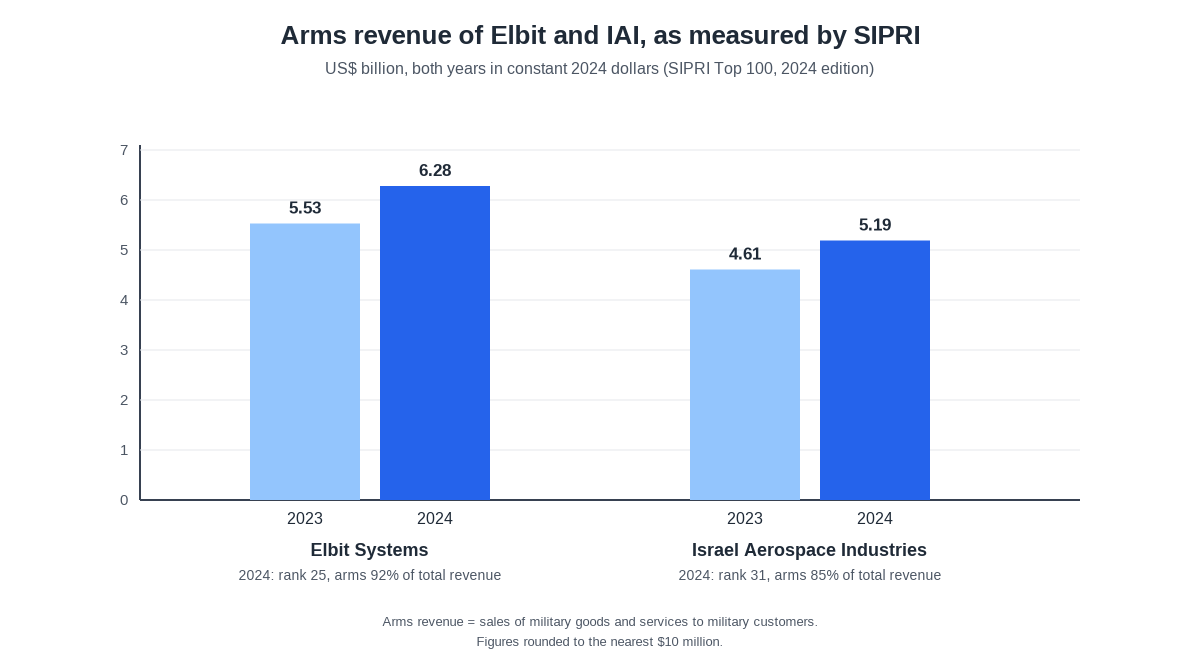
The three Top 100 companies based in Israel had combined arms revenue of $16.2 billion in 2024, up 16% from the year before. SIPRI pointed to Israel's continuing military operations in Gaza and to strong global demand for Israeli equipment such as advanced drones. Of Elbit's $22.6 billion order backlog, 65% came from customers abroad, among them European countries that ordered long-range drones.
Drones' share of the country's exports
Israel's Ministry of Defense also announces export figures. Its June 2025 announcement shows that Israel's defense industries signed $14.795 billion in new export contracts in 2024. That was 13% more than the year before and a record for the fourth year in a row.
Broken down by category, the picture changes. Air defense systems, missiles and rockets together made up 48%, nearly half, while drones and UAVs made up 1%. Of the contracts, 54% were with European countries.
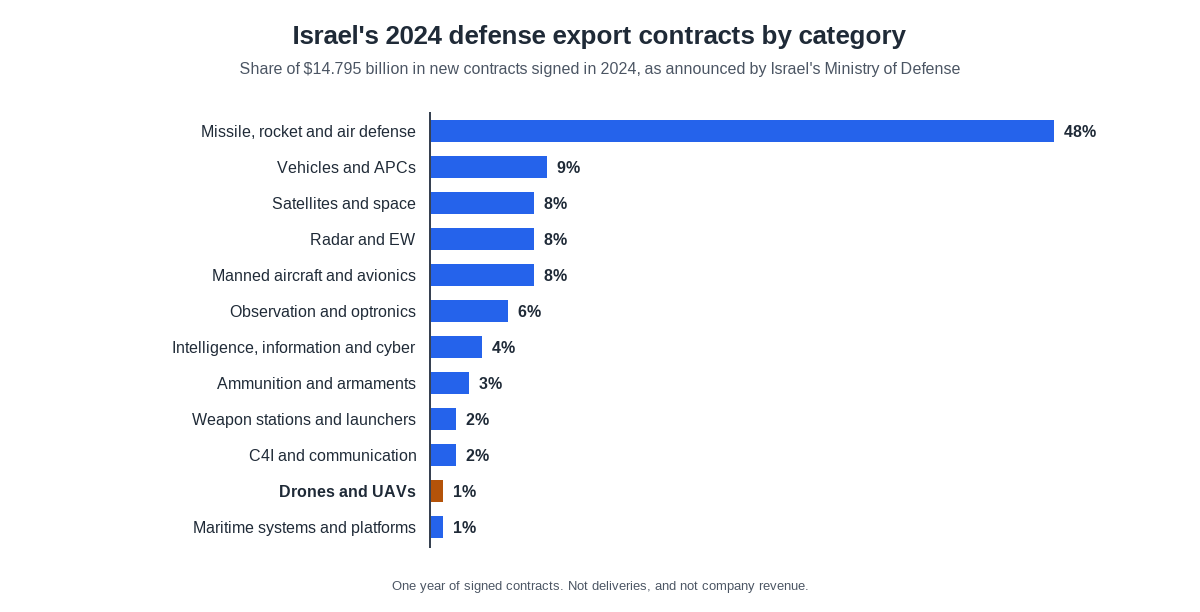
Reading that 1% as a sign that Israel's drone industry is small would be a mistake. The figure is the value of new contracts signed during one year, not the aircraft delivered that year or the revenue companies earned. The shares are percentages, so when one category grows sharply, the others shrink by the same amount.
What to check when reading the numbers
First, look at who did the measuring. The Hermes 900's specifications and order news come from Elbit itself, while the price and contents of the Swiss contract come from the buying country's audit office. The early dates for IAI's drones also come from a paper written by the company's own engineers.
The same year can show different numbers in different editions. SIPRI's 2023 edition put Elbit's 2023 arms revenue at $5.38 billion, while the 2024 edition puts the same year at $5.53 billion. The reason is that the 2024 edition restates even the 2023 figures in constant 2024 dollars to make years easier to compare. The 2023 bars in the chart above also use the 2024 edition's numbers.
Do not compare numbers built on different yardsticks. SIPRI's arms revenue is money one company earned, and the Ministry of Defense figure is contracts the whole national industry signed in a year. Even for the same year, there is no reason for the two to match.
Sources sometimes disagree on dates. For the Pioneer, the IAI paper gives initial operating capability in 1985, while the museum gives the first delivery in June 1986. Before settling on one year, it is safer to read both sources together.
What to read next
- ISR drones: what the surveillance and reconnaissance work done by these aircraft means
- MALE and HALE Drones: the class the Heron TP and Hermes 900 belong to
- The Yom Kippur War: the war where IAI's drones began
- General Atomics: The Company Behind the Predator and Reaper Family / Baykar: At the Centre of Turkey's Drone Exports: drone companies in the United States and Turkey