Look at the Red Sea on a map and its southern end narrows to a thin gap. That gap, between Yemen on the Arabian Peninsula and Africa, is the Bab al-Mandab strait. From the autumn of 2023, merchant ships passing near this narrow gate began to come under attack from drones and missiles.
Navies from many countries arrived to guard ships. The UN Security Council passed resolutions, and many shipping lines chose the long way around the southern tip of Africa. Meanwhile, two phrases kept coming up in the U.S. Congress and Navy: depth of magazine and cost exchange ratio.
This article follows the dates and figures in UN resolutions and in reports by the Congressional Research Service (CRS). It also uses official European Union (EU) pages and data from UNCTAD, the UN Conference on Trade and Development. Along the way, it asks who counted each number.
This article reflects the situation as of October 2026.
The narrow gate of the Red Sea: Bab al-Mandab
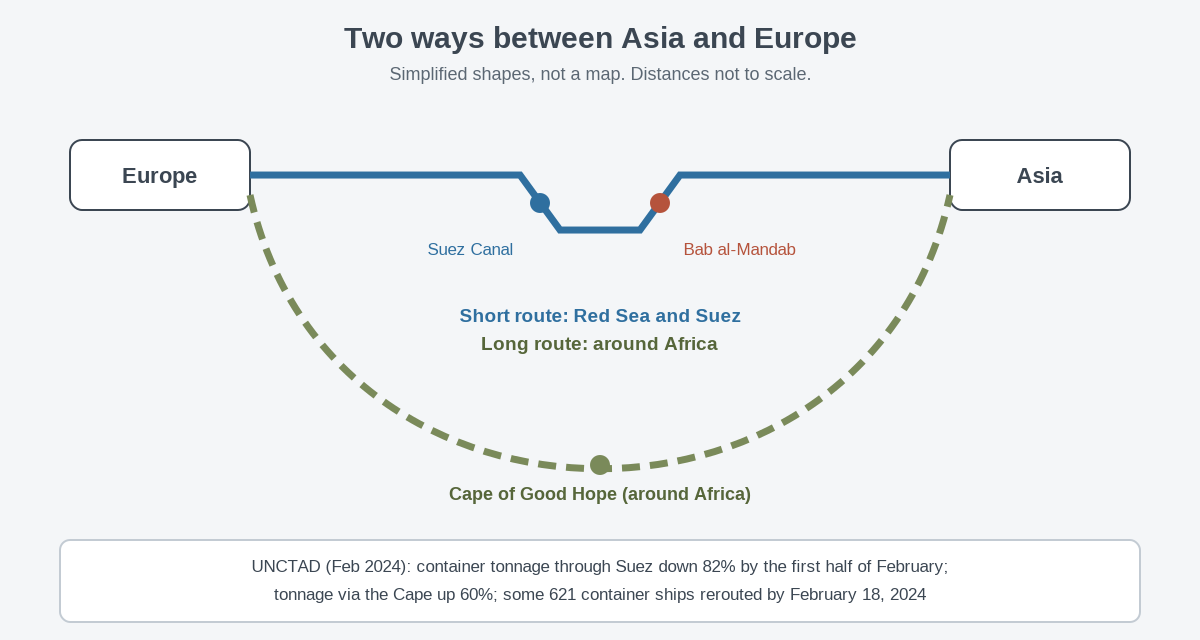
A ship heading from Asia to Europe usually leaves the Indian Ocean through the Bab al-Mandab strait. It sails up the Red Sea and exits through the Suez Canal into the Mediterranean. The canal is the passage that lets energy, raw materials, consumer goods and parts move between the Indian Ocean and the Mediterranean and Atlantic. That makes the Bab al-Mandab strait a key maritime choke point.
A choke point is a narrow stretch of sea that many ships have no choice but to use. When such a place turns dangerous, ships must go a long way around. It is a bit like a city's main bridge closing and traffic piling onto a distant detour. At sea the difference is scale: the detour is not one bridge away but around a whole continent.
The numbers show how much the canal matters. According to UNCTAD's February 2024 report, around 26,000 vessels crossed the canal in 2023, and an estimated 22% of global seaborne container trade passed through it. The same report found no ideal alternative to Suez for trade between Asia and Europe.
The Houthis and their drones
The Houthi family founded the movement in northern Yemen in 2004, as both a political group and an armed insurgency. Its formal name is Ansar Allah, meaning "Partisans of God." It took the capital, Sana'a, in 2014, and in March 2015 a Saudi-led coalition opened a military campaign against it. From 2022, an uneasy truce had frozen the front lines.
What weapons do the Houthis have? A CRS report updated in September 2024 lists ballistic missiles, cruise missiles, rockets, unmanned aerial vehicles and unmanned underwater or surface vehicles. It also mentions regular and irregular forces on land and in the air. An unmanned aircraft combined with its ground control station and data link is called an unmanned aerial system (UAS).
The link to Iran is recorded mostly in the words of U.S. government officials. The first version of the CRS report, from January 2024, says Iran gave the Houthis components and technical knowledge to build long-range missiles, rockets and unmanned aircraft. In February 2024, Vice Admiral Brad Cooper, deputy commander of U.S. Central Command (CENTCOM), said: "For a decade, the Iranians have been supplying the Houthis."
In August of the same year, the commander of the U.S. Navy's 5th Fleet pointed to another side. He described the Houthis as having built their own capacity, so that their ability to threaten the region had become "far more complex" than simple dependence on Iran. The drone family developed by Iran is covered in The Shahed series.
The record from November 2023
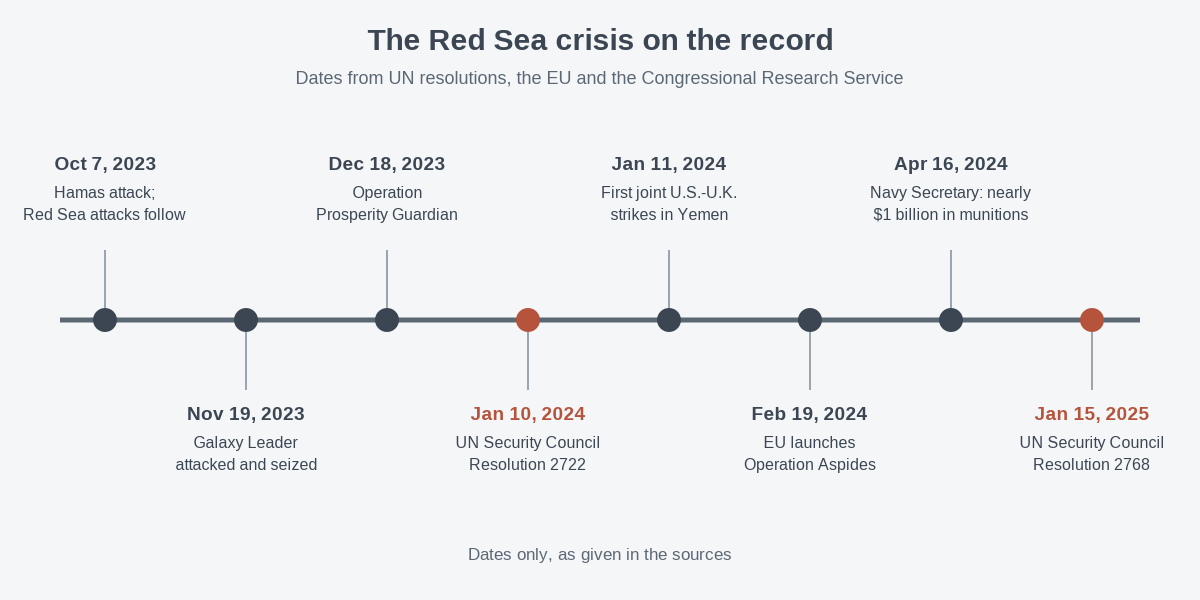
It began with Gaza. After the Hamas attacks of October 7, 2023, and Israel's military response in Gaza, the Houthis threatened that month to intervene against Israel on behalf of the Palestinians. In November they declared Israeli ships in the Red Sea to be targets, and they downed a U.S. drone. In December they widened the threat to any ship bound for an Israeli port unless more humanitarian aid reached Gaza.
UN Security Council Resolution 2722 takes November 19, 2023, as its reference point. On that day the Houthis attacked the merchant ship Galaxy Leader and seized the ship and its crew. Adopted on January 10, 2024, the resolution condemned "in the strongest terms" at least two dozen attacks on merchant ships since then. It demanded that all attacks stop at once and that the ship and crew be released.
The resolution also noted that member states have a right under international law to protect their ships from attack.
The next day, January 11, U.S. and British forces, backed by other countries, struck Houthi targets in Yemen together for the first time. The September 2024 version of the CRS report lists further joint strikes on January 22, February 3 and February 24. In January, the Houthis also threatened ships owned by U.S. and U.K. companies.
The attacks did not stop. From October 2023, the Houthis attacked merchant ships dozens of times and put naval vessels at risk in dozens of other incidents. In July 2024 a drone launched by the Houthis struck Tel Aviv, Israel. On January 15, 2025, the Security Council repeated its demand in Resolution 2768 and took note of the use of "advanced weaponry" in these attacks.
The navies that came to guard ships
On December 18, 2023, the U.S. started Operation Prosperity Guardian. The first CRS version described a coalition of 22 nations led by U.S. Naval Forces Central Command (NAVCENT). At that point, five countries had sent or pledged warships, and Bahrain was the one Arab country in the group. By the September 2024 version, the count had grown to 24 nations, organized through the Combined Maritime Forces (CMF).
The European Union set up its own operation. On January 29, 2024, the EU Council signed off on a crisis management concept for a sea security operation. The operation was set up formally on February 8 and launched on February 19 under the name EUNAVFOR ASPIDES.
The page of the European External Action Service (EEAS) lists three tasks. The operation accompanies ships in its area and keeps track of the situation at sea. In part of that area, it also shields ships from attacks at sea that may come from several domains.
Aspides was set up as a defensive mission. It acts in line with UN Resolutions 2722 and 2768 and does not strike targets on land.
Ships that went around Africa
As the attacks went on, many shipping lines changed course. Instead of the Red Sea and Suez, they took the route around the Cape of Good Hope at the southern tip of Africa. It is a longer voyage, and a costlier one.
The numbers moved fast. In the UNCTAD report, container tonnage through the Suez Canal was down 82% by the first half of February 2024. From the first half of December 2023 to the first half of February 2024, the tonnage of ships sailing into the Gulf of Aden dropped by over 70%. Over the same span, tonnage rounding the Cape grew by 60%.
By February 18, 2024, some 621 container ships had been rerouted around the Cape.
In the same report, transits through both the Suez and Panama canals were down by more than 40% from their peaks. But the drops had different shapes. Panama's transits had been falling slowly over two years, while most of the Suez decline came in the last two months. UNCTAD worked out the transit figures from numbers supplied by Clarksons Research, a shipping data firm.
Not every ship turned away. Some vessels kept using these waters, and some of them were hit by Houthi attacks. Resolution 2722 stressed that dearer shipping for essential goods would harm economies and humanitarian conditions around the world, Yemeni civilians among them.
Depth of magazine and the cost exchange ratio
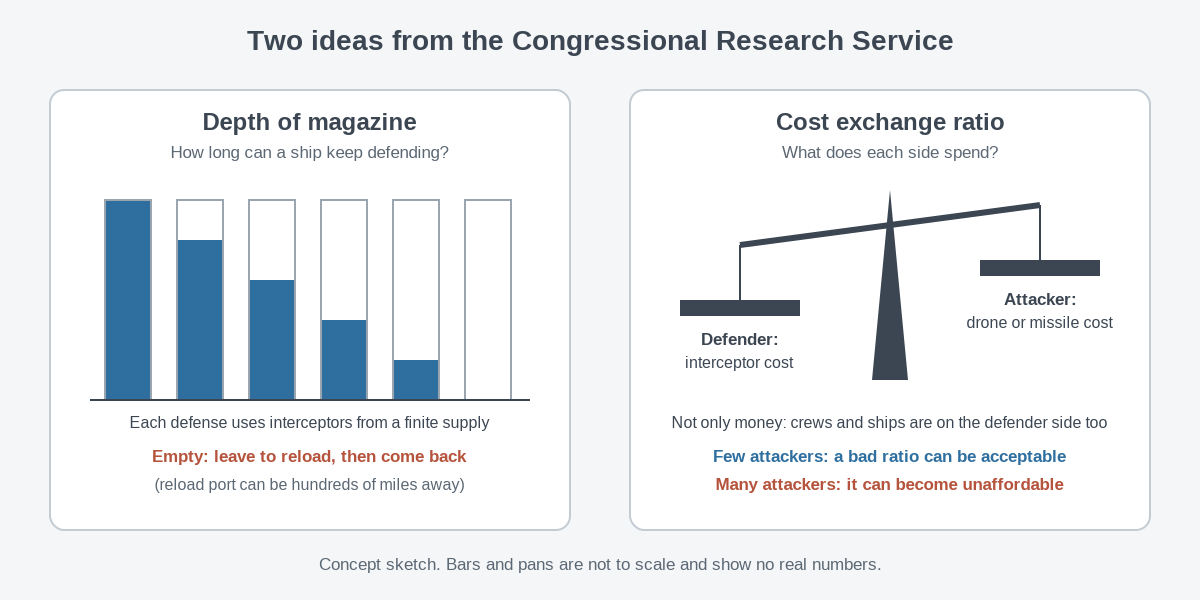
Now turn to the warships. CRS report R44175, on shipboard lasers, names two key limits that U.S. Navy surface ships face when defending against drones and anti-ship missiles. One is a limited depth of magazine. The other is an unfavorable cost exchange ratio.
Depth of magazine is about how many times a ship can keep defending itself. With its surface-to-air missiles and close-in weapon system (CIWS) rounds, a surface ship can down only so many drones and anti-ship missiles before it runs dry. It may then have to leave the fight, restock at a safe spot possibly hundreds of miles off, and sail back.
The missiles sit in the cells of a vertical launch system (VLS). Those cells cannot be refilled while the ship is under way at sea, so it has to reach a port or a sheltered anchorage.
The cost exchange ratio compares what each side spends. The air-defense missile used to shoot down one drone or missile can cost more than the other side paid to build or buy it. CRS writes that it can cost "perhaps much more." It puts the procurement cost of Navy air-defense missiles at several hundred thousand to several million dollars each, depending on the type.
So is it always a loss? CRS says it depends on the opponent. Against an adversary with only a limited number of drones and anti-ship missiles, an unfavorable ratio can be acceptable. It keeps sailors alive and spares ships from very costly damage.
Against an adversary that has many and can build or buy many more, the picture changes. Then a poor ratio could turn into a very costly way to defend ships, and perhaps one that cannot be afforded. The example of such a country given in the report is China.
R44175 treats the 2023–2025 naval operations off Yemen, in the Red Sea and Gulf of Aden, as a case that put both problems in the spotlight. U.S. and allied warships guarded merchant ships and themselves against Houthi attacks carried out with drones, ballistic missiles and cruise missiles. The two problems stood out most in shooting down large numbers of drones. A framework that splits costs into the price of one shot, one system and a whole program is laid out in The cost of drone defense.
Who counted the numbers
When reading Red Sea numbers, start with where each number came from. Appendix B of R44175 is not a count made by CRS itself. It collects examples of press reports on how many missiles and other munitions U.S. Navy ships fired. So each number below has a person who said it and an outlet that carried it.
Admiral Lisa Franchetti, the Chief of Naval Operations, reportedly spoke on February 13, 2024. She said five destroyers in the area had by then shot down 14 anti-ship ballistic missiles, 7 cruise missiles and more than 70 drones. That made a total of more than 91 targets. Stopping ballistic missiles with interceptor missiles is called ballistic missile defense (BMD).
CRS attached caveats to this figure. Many of the 91-plus shootdowns might have used surface-to-air missiles, and some might have used more than one missile on a single target. More missiles might also have been fired in engagements where the target was not shot down. The number of targets downed and the number of missiles fired are not the same number.
The same care applies to a U.S. Navy news release of July 15, 2024. It said ships of the Dwight D. Eisenhower carrier strike group fired 155 standard missiles in Middle East combat between November 2023 and June 2024. CRS added that not all 155 were necessarily used to counter missiles or unmanned vehicles.
The money figure came from the Navy Secretary. An April 16, 2024, press report quoted Navy Secretary Carlos Del Toro at a congressional hearing. He said munitions spending that needed to be paid back by a supplemental budget was approaching $1 billion. That sum mixed two things: fighting off Houthi attacks in the Red Sea since October, and defending Israel from Iranian missiles the weekend just before.
A figure also appears in law: the FY2024 national security supplemental act, Public Law 118-50, set aside $2.4 billion for the CENTCOM area of operations. The money could go to operations, protecting troops, deterrence and replacing what combat had used up. It covers the whole CENTCOM area, not only the Red Sea.
One-line comparisons also spread. Among the press reports in a CRS footnote is an article titled "A $2M Missile vs. a $2,000 Drone." It is easy to remember, but those figures come from a headline, not from a CRS calculation. As shown above, CRS also gave cases in which an unfavorable ratio can be acceptable.
Officials spoke in two directions.
On April 24, 2024, Bill LaPlante, the Under Secretary of Defense for Acquisition and Sustainment, said "cost curve matters" in countering drones. He set a goal of roughly a few tens of thousands of dollars a shot and said a price over $100,000 a shot is "getting too expensive." In March 2024, CENTCOM commander General Erik Kurilla told lawmakers that worse than not using an expensive missile would be "hitting that $2 billion ship with 300 sailors on it." Both remarks come from press reports quoted by CRS.
Where this meets lasers
The Red Sea operations led to talk of lasers. Attention turned to lasers and high-power microwave (HPM) weapons. These could handle drones without drawing so heavily on a ship's limited stock of air-defense missiles, and at a better cost exchange ratio. When people talk about shipboard lasers, a high-energy laser (HEL) usually means a laser whose beam carries 10 kW or more.
The reason lies in the two ideas above. A shipboard solid-state laser takes its electricity from the same supply that powers the rest of the ship. It can fire again and again as long as the laser keeps working and there is fuel on board for the generators.
CRS cites a 2021 Navy information paper for its estimate. Depending on beam power, each shot costs roughly $1 to under $10 to repeat, and most of that is fuel.
Even a laser not powerful enough to stop an anti-ship cruise missile (ASCM) may help. CRS explains that it could let a ship spend fewer surface-to-air missiles on drones. More of them would then be left for anti-ship cruise missiles, which indirectly improves the ship's defense.
Navy leaders spoke in the same direction. On May 1, 2024, Admiral Christopher Grady, Vice Chairman of the Joint Chiefs of Staff, called downing missiles and drones with multimillion-dollar missiles a "bad exchange" that must change. He wanted more directed energy systems deployed "where a drop of fuel becomes a weapon."
On May 16, Navy Secretary Del Toro said the Navy would increase funding for directed energy such as lasers. He hoped to reach a point, perhaps five to 10 years out, when ships could start using these capabilities aggressively.
Lasers do not answer everything. CRS lists line of sight and atmospheric absorption, scattering and turbulence as potential limits of shipboard lasers, and notes that these keep them from being all-weather weapons. How lasers and high-power microwaves differ is covered in Lasers and high-power microwaves.
What to read next
- The cost of drone defense: splits the cost exchange ratio into three layers, the price of one shot, one system and a program.
- The Shahed series: how Iranian drones sold under one name differ.
- The Aegis combat system: the combat system on most U.S. Navy cruisers and destroyers.
- Anti-ship missiles: the technology of missiles aimed at moving targets at sea.
- Close-in weapon systems: a warship's closest layer of defense.
- Lasers and high-power microwaves: the two branches of directed energy compared.
- One-Way Attack Drones: How They Differ from Cruise Missiles
- Iran's Drone Programme: From the Iran-Iraq War to the Shahed
- Iran's April 2024 Attack on Israel: Drones, Missiles and a Multinational Defence