
Something is flying toward a warship. The ship tries to stop it with several methods, starting far out. But if it gets past all of them and comes close to the ship, what is left at the very end?
That spot belongs to the close-in weapon system (CIWS). It is a weapon that ties sensor and gun into one unit, and it covers the innermost of several layers of defense. Following its limit on rounds carried also leads on to laser weapons.
The weapon on the last layer
At heart, a CIWS is a Gatling gun steered by radar. The U.S. Navy counters missiles and drones headed for its ships in several ways. A ship can jam the sensor or guidance of a missile or drone, or use decoys of various kinds to draw enemy missiles away. It can also fire surface-to-air missiles at them, or bring them down with the Phalanx CIWS.
Of these, the CIWS steps in last. A 1990s U.S. Navy fact file, kept as a copy in a Defense Department archive, describes Phalanx as a fast-reacting, fast-firing 20 mm gun system. It gives Navy ships a terminal defense, the final one, against anti-ship missiles that got past the fleet's other defenses.
The maker RTX (Raytheon) describes it today on the same lines, presenting Phalanx as a fast-firing gun that is computer-controlled and guided by radar. It adds that the system is able to stop anti-ship missiles, along with other close threats, at sea and on land.
From search to kill assessment in one mount
Getting from finding a target to hitting it takes several steps. Something has to find it, follow it, aim, fire and check the result. How these steps link into one chain is covered separately in "Fire-control systems: linking sensors and weapons." How radar finds a target is explained in "Radar: measuring distance and motion with radio waves".
Usually several pieces of equipment share these steps. In the maker's description, Phalanx does jobs that normally take several systems, all automatically within one package: searching, detecting, judging the threat, tracking, engaging and assessing the kill. Its sensor is a search and track radar built into the unit itself. The 1990s fact file splits the work even more finely, adding acquisition, destroying the target and ceasing fire.
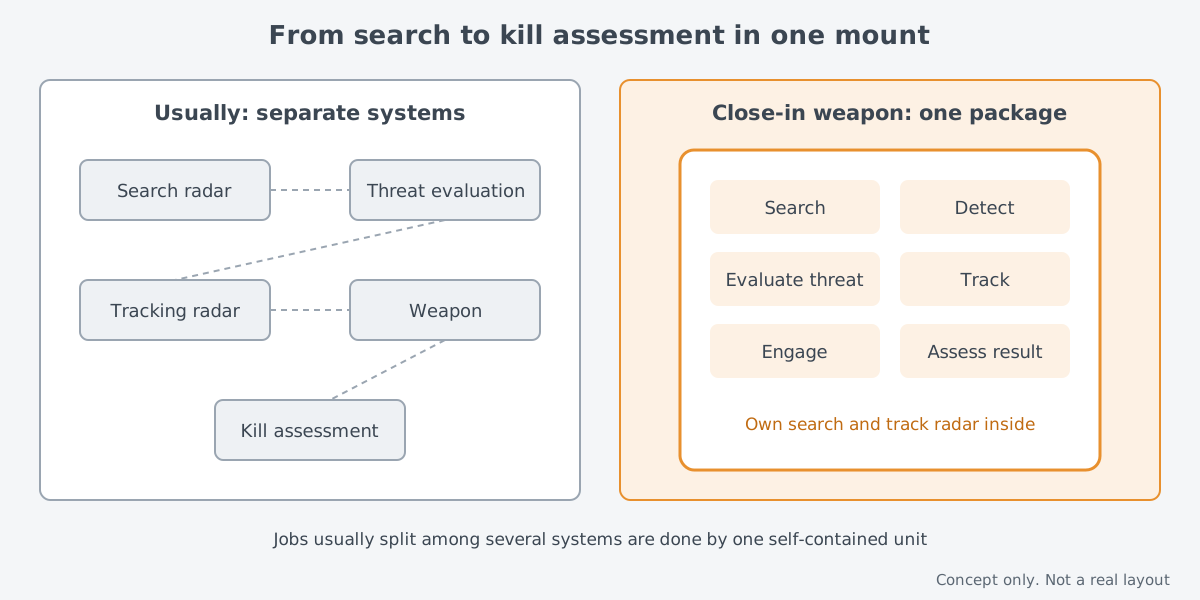
A soccer goalkeeper helps make the picture clear. A goalkeeper sees the ball, judges whether it is dangerous, dives to stop it and checks that it was stopped, all alone. The difference is that in a CIWS, radar and computers carry out these steps one after another instead of a person.
The innermost of several layers
One CIWS does not guard the whole ship. Using jamming, decoys, missiles and the CIWS together follows an approach the Navy has kept for a long time: stacking defenses in several layers against enemy missiles. The idea is to attack the enemy's "kill chain" at several points and so raise the chance of breaking it.
The kill chain is the series of steps an attacker must complete to hit a ship with a missile. Disrupting any single step can break the chain and stop the attack. A layered defense creates several chances to break it.
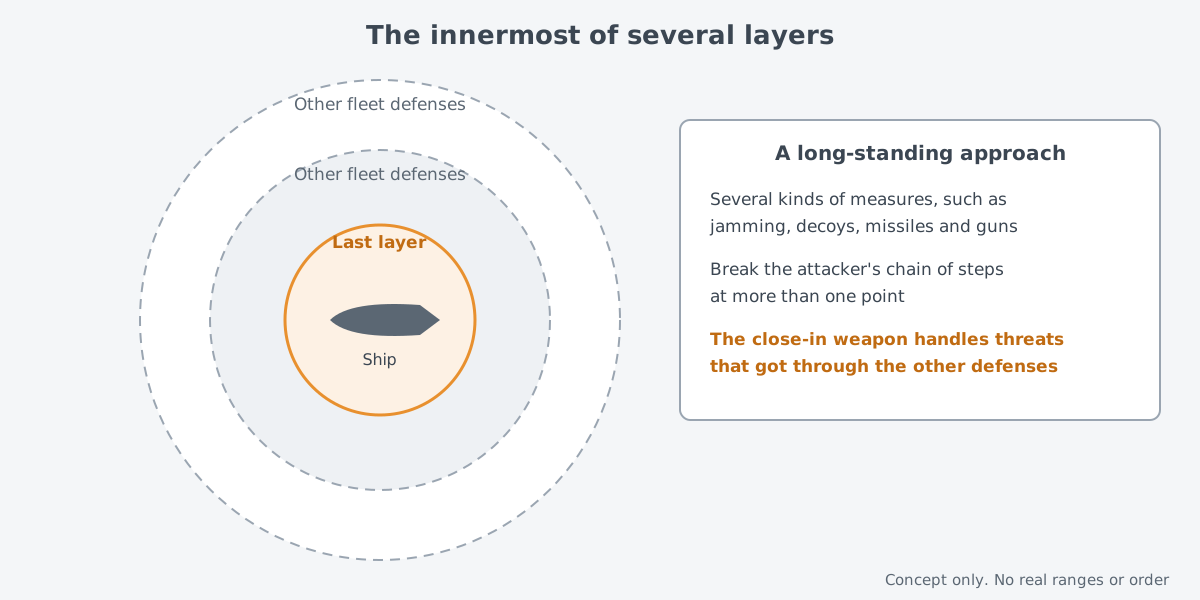
Among those layers, the CIWS sits innermost. How guns cover one layer among several on land is covered in "Anti-aircraft artillery in the missile age."
Where it came from: a short history
Phalanx went through operational test and evaluation aboard USS Bigelow in 1977. Production started in 1978, and the system was deployed aboard USS Coral Sea in 1980.
Human checks and more sensors came later. In the maker RTX's account, the upgraded Block 1B adds control stations that let operators track and identify targets by eye before engagement. It also adds a forward-looking infrared sensor, so at sea it can be used against helicopters and fast surface craft too. By the same account, it is now installed on every class of U.S. Navy surface combatant and on ships of 24 allied nations.
From sea to land
The equipment that guarded ships also came ashore. Phalanx, first used on Navy ships, was modified for operations on land. A 2009 U.S. Army article says it was by then in use throughout the region under U.S. Central Command.
On land the targets are rockets, artillery shells and mortar rounds. A 2013 Army article describes the Counter Rocket, Artillery and Mortar system (C-RAM) and the land-based Phalanx working together to defend a base. C-RAM gives early warning by detecting incoming fire, while Phalanx is meant to take on the incoming rockets, shells and mortar rounds. The equipment was deployed on a trailer.
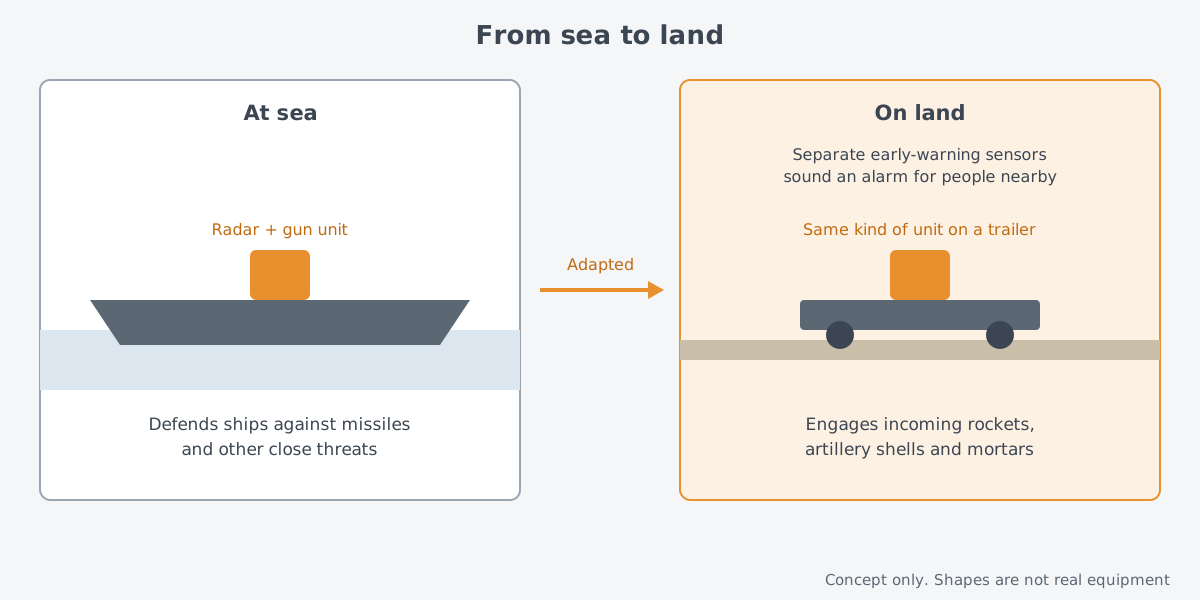
There are differences from the sea version too. The land version's 20 mm rounds are meant to knock an incoming weapon off its path and put it out of action. If it still falls inside the base, it stays unexploded. The rounds blow themselves up after a certain distance to reduce harm to civilians, and an alarm gives troops and civilians on the base time to react.
Rounds run out
A gun can fire only as many rounds as it carries. A surface ship's missiles and CIWS Gatling guns can bring down only a limited number of drones and anti-ship missiles. After that, the missiles and CIWS ammunition are used up. The ship may then have to leave the fight and go to a safe place to reload, one that may lie hundreds of miles off.
The Congressional Research Service (CRS) calls this a limited depth of magazine. A figure that sets rounds carried and reloading side by side for missiles, guns and lasers appears in "Lasers, interceptor missiles and guns: how they share the work".
Where lasers come in
The limit on rounds leads on to shipboard lasers. A ship's solid-state laser runs on electricity from the ship's own power system. It can fire again and again, while the laser works and the ship has fuel for its generators. CRS expects a shipboard high-energy laser (HEL) to be, in general, a short-range defensive weapon.
Lasers have limits too. A laser engages one target at a time, needing several seconds to disable each one and several more to swing over to the next. During those seconds of disabling, the light has to stay on one spot of the target, and that time is called the dwell time. Fitting more than one laser can ease this limit, much as the Navy fits several CIWS units on some ships.
What laser weapons do well and what they find hard is covered in "Strengths and limits of laser weapons". Which other devices join the laser to form one system is laid out in "A laser weapon is more than a laser: the system at a glance". Just as a CIWS ties its sensor and gun into one unit, a laser weapon also needs sensors and tracking equipment alongside it.
What to read next
- "Lasers, interceptor missiles and guns: how they share the work": the three means of defending the sky, set side by side on cost, rounds carried, weather, and size, weight and power.
- "Strengths and limits of laser weapons": what laser weapons do well and what they find hard.
- "Anti-aircraft artillery in the missile age": why guns are still used on land.
- "Fire-control systems: linking sensors and weapons": the chain that links a target found by a sensor to a weapon.