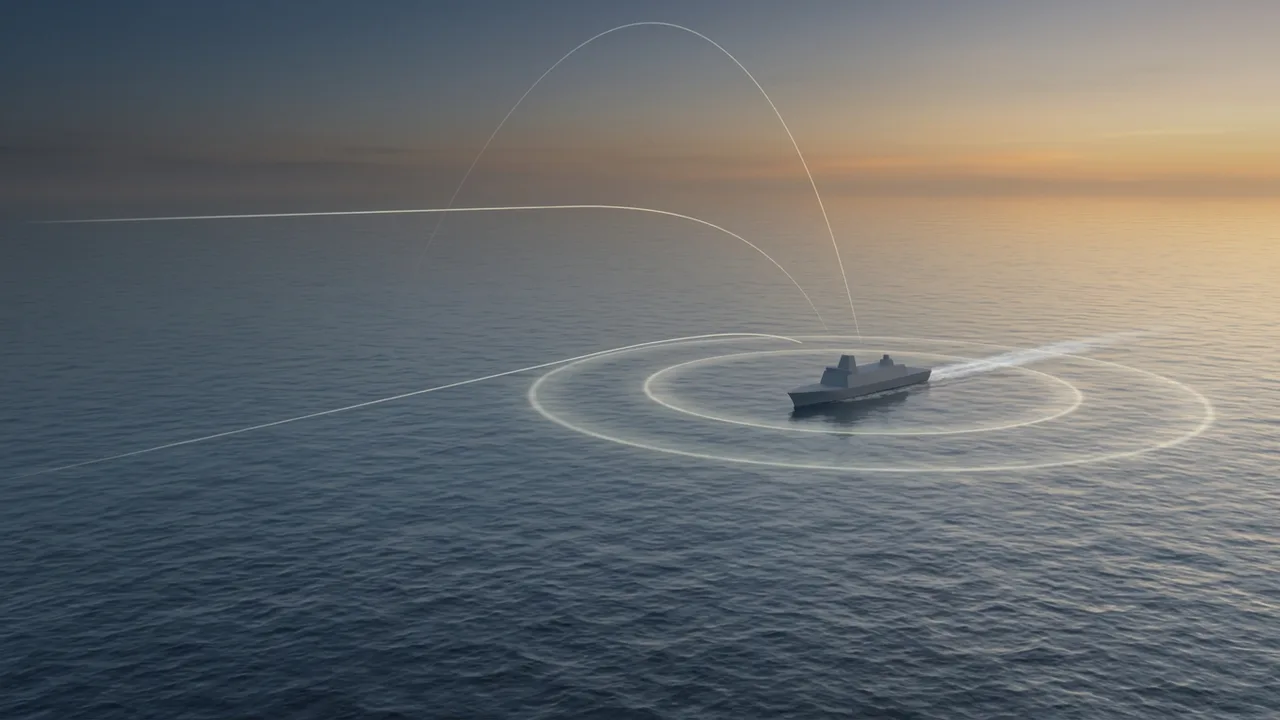
A building on land stays where it is. A ship at sea does not. Even while a missile is in the air, the ship keeps moving through the water. So what does a missile aimed at a moving ship need to do differently?
An anti-ship missile is a missile meant for ships at sea. Sort these missiles by family and by flight profile first. Then two things line up: the technology needed to hit a ship, and the way a ship protects itself. The sources are public reports from the Congressional Research Service (CRS) and public articles from the technical journal of the Johns Hopkins University Applied Physics Laboratory (APL).
Two families of anti-ship missiles
Anti-ship missiles fall into two broad families: the anti-ship cruise missile (ASCM) and the anti-ship ballistic missile (ASBM).
The difference lies in the second word. A cruise missile is a guided missile that flies low over long distances and can start from the air, the sea or land. A ballistic missile, once its push ends, follows a path shaped only by gravity and air drag. Both are general missile definitions from the U.S. Defense Threat Reduction Agency (DTRA), not ones written for anti-ship weapons.
Cruise types can start from many places. Aircraft, submarines, ships and ground-based launchers can all serve as launch points. A ship working close to shore sits within range of cruise missiles fired from any of these.
The ballistic type was a new problem for the Navy. CRS writes that before these weapons appeared, the U.S. Navy had never faced highly accurate ballistic missiles able to hit moving ships at sea. Ballistic missiles were familiar as weapons sent to fixed coordinates on land. One accurate enough to hit a moving ship was that unfamiliar.
Flight profiles: low or high
Two cruise missiles can still take different paths to a ship. Ship defenders have long pointed to two classic examples. One is the sea-skimming missile, which flies very low over the water. The other cruises high and then dives toward the ship, and up to the early 1990s the cruise altitude of this kind kept rising.
An anti-ship ballistic missile draws yet another shape. As the definition above says, once the engine stops it follows a ballistic arc, climbing high and coming back down under gravity and air drag.
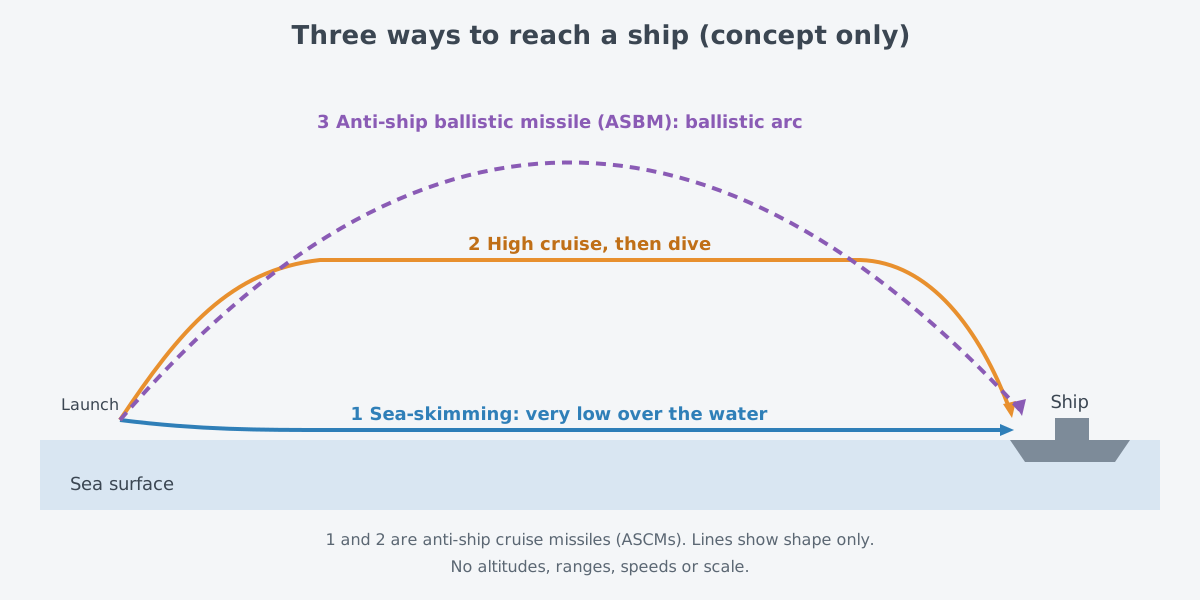
The defender has to watch for all of these shapes. By 1993, plans for ship self-defense no longer put the weight on radar bands alone but on several parts of the spectrum. How radar uses radio waves to measure distance and motion is covered in Radar: measuring distance and motion with radio waves.
Hitting a ship that moves
If the target is a fixed point on land, the path is fairly simple. Inertial guidance suits a target whose place on Earth is fixed and known, for example when sending a long-range ballistic missile precisely. It does not suit a target whose exact position is unknown at launch.
To hit that kind of target, the missile has to sense where the target is in real time and correct quickly as things change. When a sensor on the missile supplies the target data and guidance decisions rest on it, the method is called homing guidance.
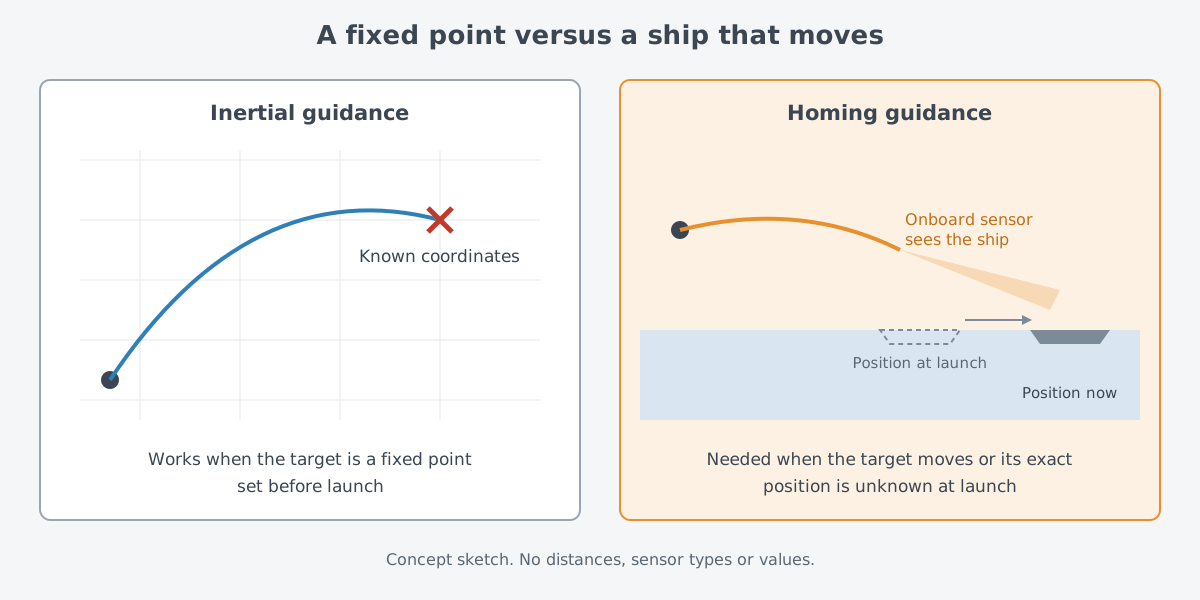
Compare walking to a fixed signpost with chasing a friend who runs away. To reach the signpost, you follow the route you planned; to catch the friend, you keep watching and changing direction the whole way. The real thing is different: a missile's "eye" is not a human eye but a sensor called a seeker.
Harpoon is an example of that eye on an anti-ship missile. Between the late 1960s and the early 1970s, APL developed the radar seeker that Harpoon, an anti-ship cruise missile, would carry. Harpoon did well, and that led on to Tomahawk, which was built both to strike ships and to strike land. The kinds of seekers are covered in Missile seekers: the eye at the front.
How ships defend: in layers
How does a ship stop such missiles? The U.S. Navy's methods fall into three groups. The ship can jam a missile's sensor or guidance system or lure it away with decoys. It can also shoot it down with its own surface-to-air missiles or the close-in weapon system, which is at heart a radar-controlled Gatling gun.
The Navy has long used all of these together to build several layers of defense against enemy missiles. This is where the term "kill chain" comes in. It is the sequence of steps an attacker must complete to hit a ship with a missile, and cutting any single step can stop the attack. Why defense is split into layers is covered in more detail in Layered missile defense: why defense comes in layers.
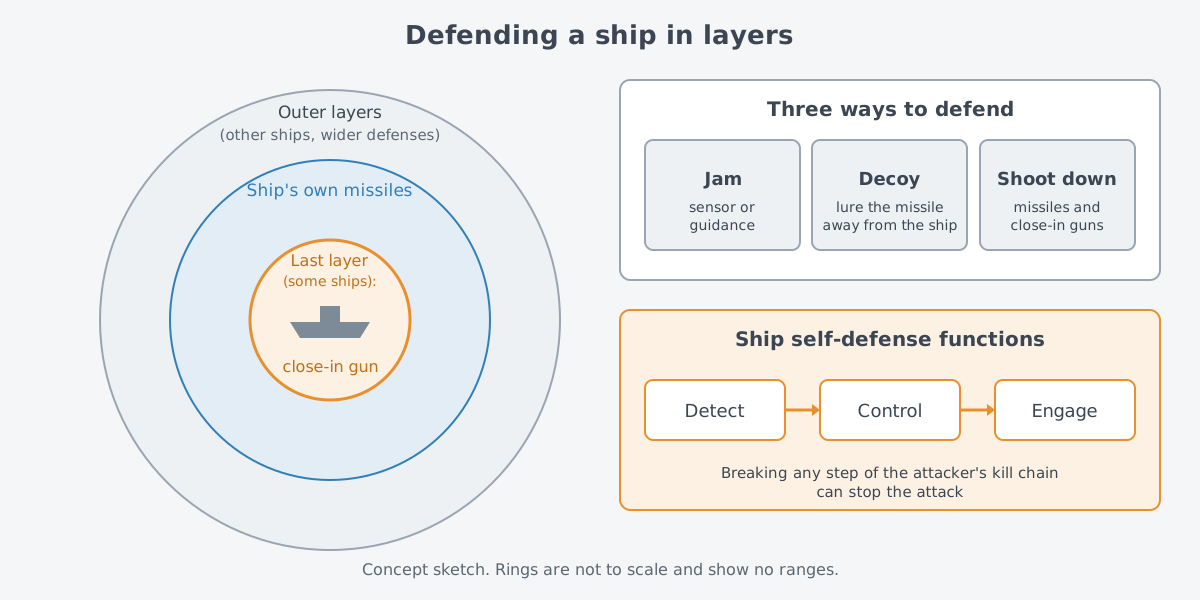
Inside a single ship, the work also runs in order. The Ship Self-Defense System (SSDS) is made up of three functions: detect, control and engage. The detection need named in a 2001 APL article is to catch small, fast targets flying low "just as they cross the sensors' horizon."
The system picks and fires its weapons through automated command and decision steps. Short-range homing missiles finish the engagement, and on some classes of ship a very fast-firing gun is the last line of defense.
This last layer matters even more for a ship on its own. A ship's self-defense has to act as the final layer when it sails with a group, and as its own protection when it operates alone.
Defense also raises questions of quantity and cost. CRS names two key limits for surface ships defending against drones and anti-ship missiles: a shallow magazine and an unfavorable cost exchange ratio. Buying one Navy air-defense missile costs anywhere between several hundred thousand and a few million dollars, depending on the type.
Names in use today
The U.S. Navy uses or is buying several anti-ship missiles. One, the AGM-158C LRASM, is an anti-ship cruise missile fired from aircraft and belongs to the Navy program called Offensive Anti-Surface Warfare (OASuW).
A Norwegian company developed the RGM-184 NSM in the early 2000s as a low-observable anti-ship cruise missile. Low-observable means it was built to be hard for an opponent's sensors to pick up.
In 2018 the Navy contracted for this missile to arm the Littoral Combat Ship's Over-The-Horizon Weapon System (OTH-WS). NMESIS, a land-based Navy and Marine Corps system for striking ships, carries the NSM too. Air, ship and land, the three launch places, match the list seen earlier.
The defending side also has weapons reworked with anti-ship missiles in mind. The RIM-162 ESSM, an anti-air missile fired from ships, was upgraded to do better against anti-ship cruise missiles and first entered service in 2004.
Where this meets lasers
Lasers are a candidate for a new layer of ship defense. The Navy is developing higher-power solid-state lasers (SSLs) that are meant to take on anti-ship cruise missiles. The plan is to use them first to dazzle surveillance sensors and to deal with small boats and drones, and possibly later against an enemy's anti-ship missiles too.
A lower-power laser can still help indirectly. If a laser handles the drones, the ship spends fewer surface-to-air missiles on drones and can save more of them for anti-ship cruise missiles. This links back to the shallow-magazine problem above.
The challenges are also on record. Navy budget material for fiscal year 2022, quoted by CRS, lists the technical challenges of defeating anti-ship cruise missiles with a high-energy laser (HEL). They include strong atmospheric turbulence, finding and identifying the target, tracking it, holding and automatically placing the aim point, and controlling jitter.
The High Energy Laser Counter ASCM Project (HELCAP) is meant to assess, develop, test and demonstrate these technologies. What a laser weapon needs besides the laser itself is shown in A laser weapon is more than a laser: the system at a glance.
What to read next
- Missile seekers: the eye at the front: the kinds of sensors that follow a moving target.
- Close-in weapon systems: a warship's last layer: the innermost layer of ship defense.
- Layered missile defense: why defense comes in layers: why defense is split into layers.
- Cruise missiles: how they resemble aircraft: how anti-ship cruise missiles fly through the air.