
A news story says an "Aegis ship" has left port, and it sounds as if there is a ship called Aegis. Yet the U.S. Navy ships called Aegis ships belong to classes named Ticonderoga and Arleigh Burke. The word Aegis does not appear in either class name.
So what does Aegis name? The combat system the ship carries. Once you see what it ties together, from radar to missiles, it becomes clear why its name came to stand for the ships and how it reached dry land.
Aegis is a system, not a ship
The Aegis ship combat system bundles these parts into one: sensors, computers, software, displays, launchers for weapons, and the weapons themselves. Its name comes from the shield that protected Zeus in Greek myth. A system built to protect ships carries the name of a shield.
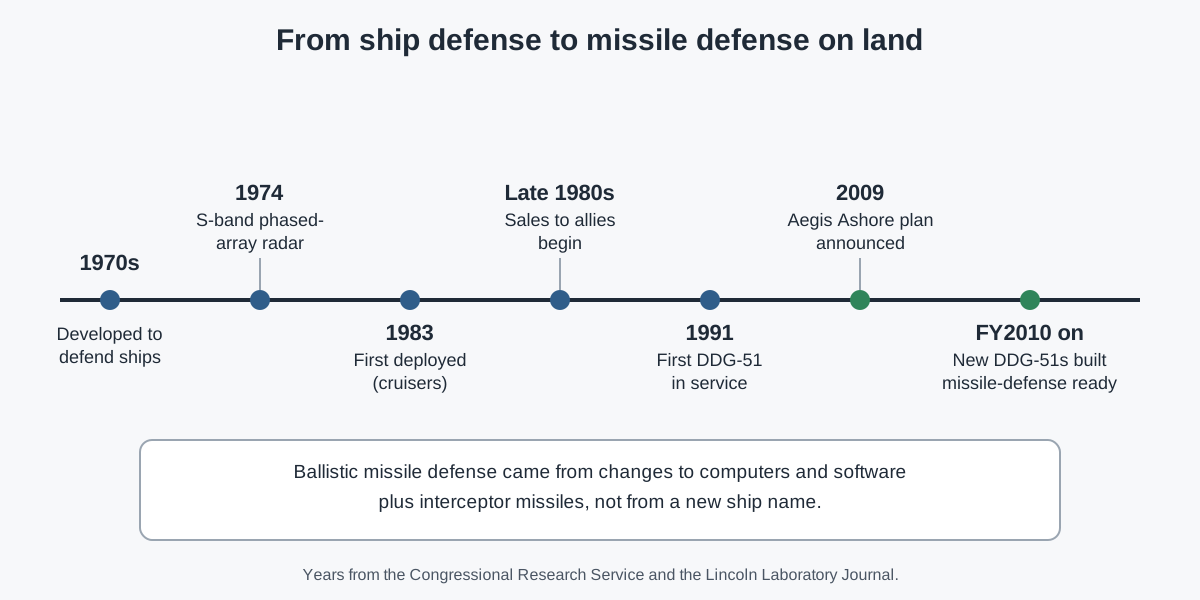
Its first job fits the name. Aegis was developed in the 1970s to protect ships from aircraft, anti-ship cruise missiles, and threats on and under the sea. The Navy first deployed it in 1983 and has updated it many times since.
Think of phones. When phones from different makers run the same operating system, people sometimes group them by that system rather than by model. The real case differs in one big way. Aegis is not only software; it also includes hardware such as radar, launchers and weapons.
What is tied together: sensors, command, weapons
Sensors sit at the front of the bundle, and the main one is radar. Ticonderoga-class cruisers and earlier Arleigh Burke-class destroyers carry the SPY-1 radar. The Flight III Arleigh Burke design now being bought uses a new radar called SPY-6, which the U.S. Congressional Research Service (CRS) describes as more capable than SPY-1.
The Aegis radar began as a phased-array radar, which steers its beam without turning the antenna. A history of phased-array radar in the Lincoln Laboratory Journal cites an S-band phased-array radar for Aegis, built by RCA for the Navy in 1974. The basic idea of measuring distance with radio waves is in Radar.
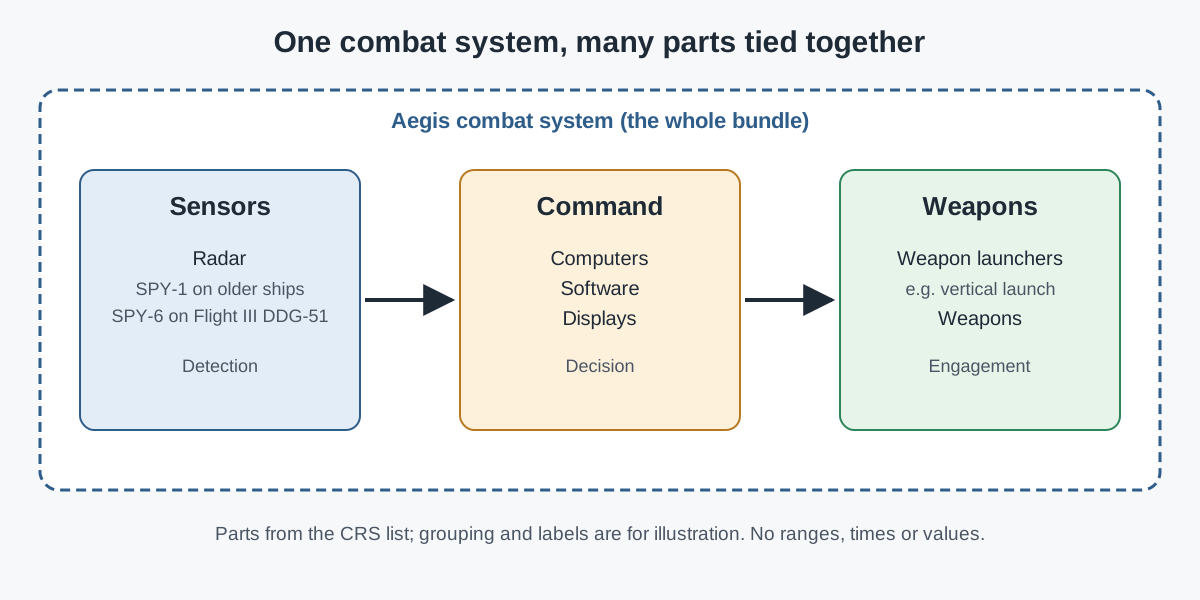
Computers, software and displays sit in the middle. Lockheed Martin, which makes the system, calls Aegis an integrated system that layers sensors, weapons, combat management and command and control (C2) together. In its description, automated, centrally run C2 and weapon control support the chain from detection to engagement.
Launchers and weapons sit at the end. One example is the vertical launch system (VLS), which stands missiles upright below the deck. The basics of linking sensors to weapons are in Fire-control systems.
The company that builds the ship and the company that makes the system are not the same. Two shipyards build Arleigh Burke destroyers: General Dynamics/Bath Iron Works and Huntington Ingalls Industries/Ingalls Shipbuilding. On every Arleigh Burke, the prime contractor for Aegis is Lockheed, while Raytheon makes SPY-6, the main radar on Flight III ships.
Where the phrase "Aegis ship" comes from
The U.S. Navy's Aegis ships come in two classes: cruisers of the Ticonderoga (CG-47) class and destroyers of the Arleigh Burke (DDG-51) class. Because both carry the Aegis combat system, they are often called "Aegis cruisers" and "Aegis destroyers," or together "Aegis ships." The name of the system on board became the name people use for the ships.
Both classes were built in numbers. The Navy bought 27 Ticonderoga-class ships between FY1978 and FY1988, and they joined the fleet from 1983 to 1994. Seven were still serving on October 1, 2025.
Arleigh Burke procurement began in FY1985, and 97 had been bought through FY2025. The first ship joined the fleet in 1991, and 76 were serving on that same date in 2025.
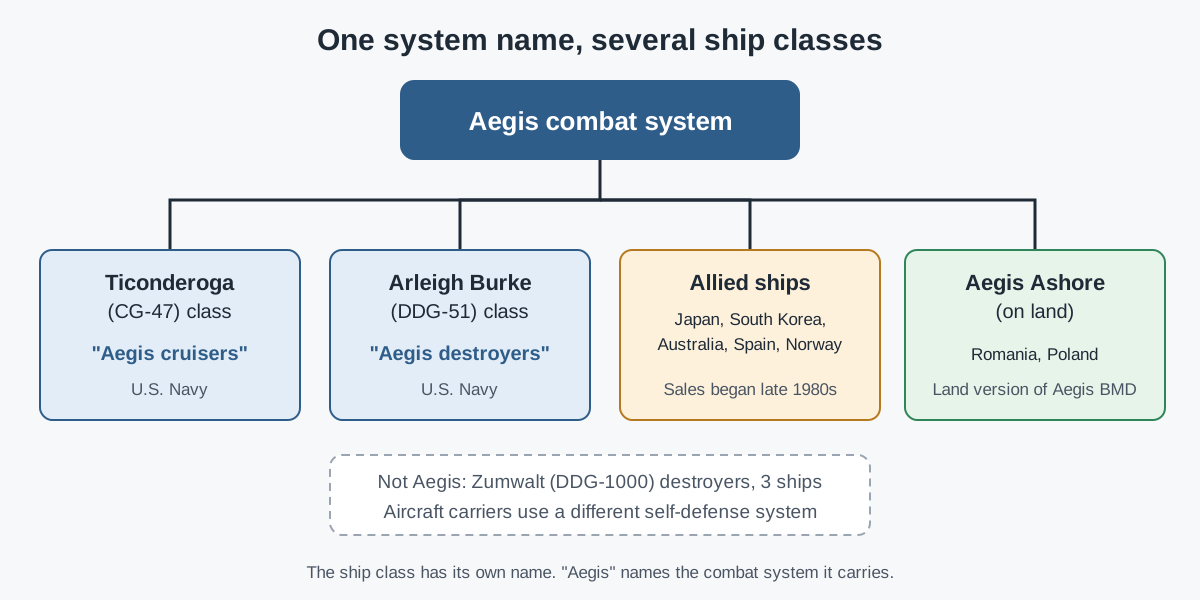
Not every surface combatant is an Aegis ship. The exception among Navy cruisers and destroyers is the Zumwalt (DDG-1000) class: its three destroyers do not use Aegis and have no ballistic missile defense capability. Aircraft carriers, according to Lockheed Martin, use a different self-defense system.
Ballistic missile defense and Aegis on land
Aegis was first meant to guard against threats such as aircraft and cruise missiles. Today the Missile Defense Agency (MDA) and the Navy jointly run a program called Aegis ballistic missile defense (BMD). It gives Aegis cruisers and destroyers the ability to defend against ballistic missiles.
That ability did not come from a new ship. It came from changes to the Aegis computers and software, plus BMD interceptor missiles on board: SM-3s and SM-6s. Existing Aegis ships can be upgraded to gain BMD capability, and Arleigh Burke destroyers bought in FY2010 and later were built with it from the start.
Over the years, more and more Aegis ships have gained this capability. In its FY2026 budget request, quoted by CRS, MDA expects 63 BMD-capable Aegis ships needing maintenance support by the end of that fiscal year. Where these ships fit among the layers of missile defense is covered in Layered missile defense.
On land, it becomes even clearer that the system name stands apart from any ship. The land-based Aegis BMD system goes by the name Aegis Ashore. Europe has two such sites, one each in Romania and Poland, and the plan for both was announced in 2009.
Each site has a building similar to the deckhouse of an Aegis ship, and the Aegis system sits inside it. Missiles are launched from a relocatable VLS based on the one installed on Aegis ships. There is no ship, yet the Aegis name stays.
Aegis outside the United States
Aegis first went to allied navies through sales in the late 1980s. The allied countries that operate, are building or plan to build Aegis-equipped ships are Japan, South Korea, Australia, Spain and Norway. Lockheed Martin says Aegis is installed on more than 120 ships.
The Aegis in each country is not identical. Japan's Aegis ships are capable of ballistic missile defense. A press report from October 16, 2023, quoted by CRS, says the newest South Korean Aegis destroyer will also have that capability. The Aegis ships of Australia, Spain and Norway currently do not.
Some versions are sized to fit the ship. Norway's ships are somewhat smaller than other Aegis ships, so they carry a reduced-size Aegis system with a scaled-down, lower-power SPY-1 radar. The same name can cover different setups, depending on the ship and the country.
Where this meets lasers: plugging a new weapon into the system
Shipboard laser weapons connect to Aegis too. HELIOS is a U.S. Navy shipboard laser system whose name begins with "High Energy Laser" (HEL), and it was installed on the Arleigh Burke-class destroyer USS Preble (DDG-88). In the Navy's FY2026 budget request, quoted by CRS, HELIOS works as part of the Aegis combat system on a Flight IIA destroyer.
This case shows again why Aegis is a system. The new laser did not stay a separate device; it went inside the existing Aegis combat system. A laser weapon itself is also easier to understand as a system of many parts rather than a single laser. That story continues in A laser weapon is more than a laser.
What to read next
- Phased arrays and AESA radar: steering without moving: how the phased-array radar that Aegis started with works.
- Vertical launch systems: what sits below a warship deck: the launcher on Aegis ships, which the Aegis Ashore launcher is based on.
- A laser weapon is more than a laser: the system at a glance: how to see a laser weapon as one system.