In July 1994, an airplane with no cockpit lifted off from a flight test site at El Mirage, California. It was the first Predator. In the thirty-odd years since, the name has grown from one aircraft into a whole family of uncrewed aircraft.
The company that built it has "Atomics" in its name. How did a firm set up for atomic research end up making drones? And what does the family tree from Predator to Reaper, and then to jets, actually look like?
Put the company's own history next to public documents from the U.S. Air Force, the Army, the Congressional Research Service and NASA, and the path becomes fairly clear. This article reflects information as of October 2026.
A company that began with atomic research
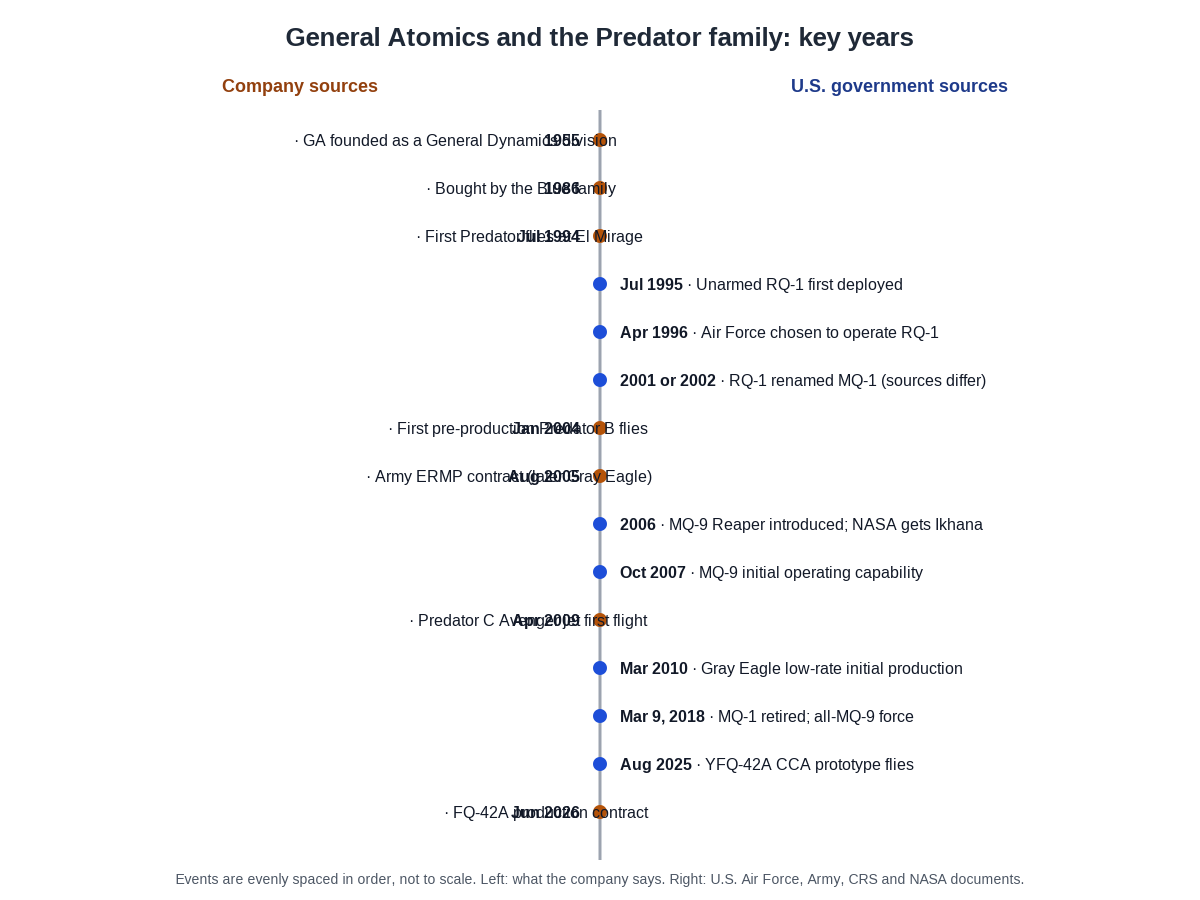
General Atomics (GA) dates from July 1955. The defense firm General Dynamics created it as a division to study and develop peaceful uses of atomic power. In 1986 the Blue family bought the company.
Traces of that start still show in its business today. GA has built more than 60 TRIGA research reactors in 24 countries. It has more than 14,000 employees, and its affiliated companies work on five continents.
Drones belong to one of those affiliates, GA-ASI (General Atomics Aeronautical Systems, Inc.). GA-ASI makes a series of uncrewed aircraft along with electro-optical gear, radar, signals intelligence equipment and automated airborne surveillance systems. So when people speak of "General Atomics drones," the maker is usually GA-ASI.
The group's Electromagnetic Systems Division is a different kind of business. It makes electromagnetic systems that launch and recover aircraft for the U.S. Navy, an electromagnetic railgun, high power lasers, hypervelocity projectiles and power conversion systems. In April 2004 the Navy picked GA to develop and demonstrate the Electromagnetic Aircraft Launch System (EMALS) for its next-generation carrier.
How that launcher works is covered in Carrier catapults and EMALS. Where a high power laser fits inside a weapon system is the subject of A laser weapon is more than a laser.
From a garage to El Mirage: the birth of Predator
Predator's roots go back to one engineer's garage. A 2018 Air Force story on the Predator's retirement introduced Abraham Karem, who heads Karem Aircraft, as the MQ-1's original engineer. His first drone, Albatross, came out of his garage, and the more advanced Amber followed.
Speaking at the ceremony, Karem traced the path "from the garage to Amber to GNAT 750 to Predator A." A 2012 Congressional Research Service (CRS) report uses a slightly different name: it traces the Air Force's Predator and Reaper back to the General Atomics I-GNAT.
The first Predator flew in July 1994. The company's history says GA had a prototype out within half a year of winning a Pentagon contract for an advanced concept drone demonstration.
Deployment began a year after that test flight. An unarmed reconnaissance version, the RQ-1 Predator, first deployed in July 1995, flying from Albania, and in the same month the Air Force set up its first Predator unit. The secretary of defense picked the Air Force to operate the system in April 1996. The first combat missions came over the Balkans in 1999.
A Predator does not work as a single aircraft. The Air Force fact sheet counts four aircraft with sensors, one ground control station and one satellite link as a single package. A package like this is called an unmanned aerial system (UAS).
The remote crew is two people: a pilot and a sensor operator. What satellite communications (SATCOM) are, and why a faraway aircraft needs them to stay linked to the ground, is explained in MALE and HALE Drones.
The letters change: from RQ-1 to MQ-1
The letters in a U.S. military drone's name have meanings. On the Air Force fact sheet, R stands for reconnaissance, M for multi-role, and Q for remotely piloted aircraft system. The number 1 marks the first aircraft in that remotely piloted series. So RQ-1 reads roughly as "remotely piloted reconnaissance aircraft, number one."
The R became an M once the aircraft could carry missiles. CRS writes that in 2001 the Predator gained the ability to carry missiles as a secondary function. As a result, the Air Force renamed it MQ-1 (multi-mission unmanned), replacing RQ-1B (reconnaissance unmanned). The Air Force fact sheet gives 2002 for the name change, so the two sources are a year apart.
It takes off and lands like a regular airplane. The difference is that the pilot flies it from the ground.
A larger successor: the Reaper
A science agency stands near the Reaper's starting point. The firm began developing the bigger, stronger Predator B in 2000 with partial funding from NASA. NASA was interested in using a civilian model of the aircraft for Earth science.
In January 2004 the first pre-production Predator B flew, and the aircraft soon became known as the Reaper. The Air Force introduced the MQ-9 Reaper in 2006 as the Predator's successor and reached initial operating capability (IOC) in October 2007. The 9 at the end marks the ninth aircraft in the same series.
The Reaper is bigger than the MQ-1 and has more power. The engines make the difference plain. The Predator uses a Rotax 914F four-cylinder engine, while the Reaper uses a Honeywell TPE331-10GD turboprop.
The Reaper, too, is a system rather than one aircraft. On the fact sheet, a full system includes the aircraft, a ground control station, a satellite link, spare equipment, and the people who operate and maintain it. The basic crew is a pilot who flies the aircraft and commands the mission, plus a crew member who runs the sensors. The aircraft can be taken apart and packed into a single container for shipping.
On March 9, 2018, the Air Force marked the MQ-1's retirement with an official ceremony at Creech Air Force Base, Nevada. Airmen had flown it for over 20 years, and the Air Force then moved to a force of MQ-9s only. Karem, who built his first drone in a garage, also spoke that day.
One airframe, many branches
The idea of fitting different gear to the same basic airframe appears in the CRS report as well. With different sensors, a mostly common airframe can meet the needs of several services. Predator and Reaper are its example. These two aircraft became the basis for the Army's Gray Eagle and for a Department of Homeland Security Predator adapted to marine environments.
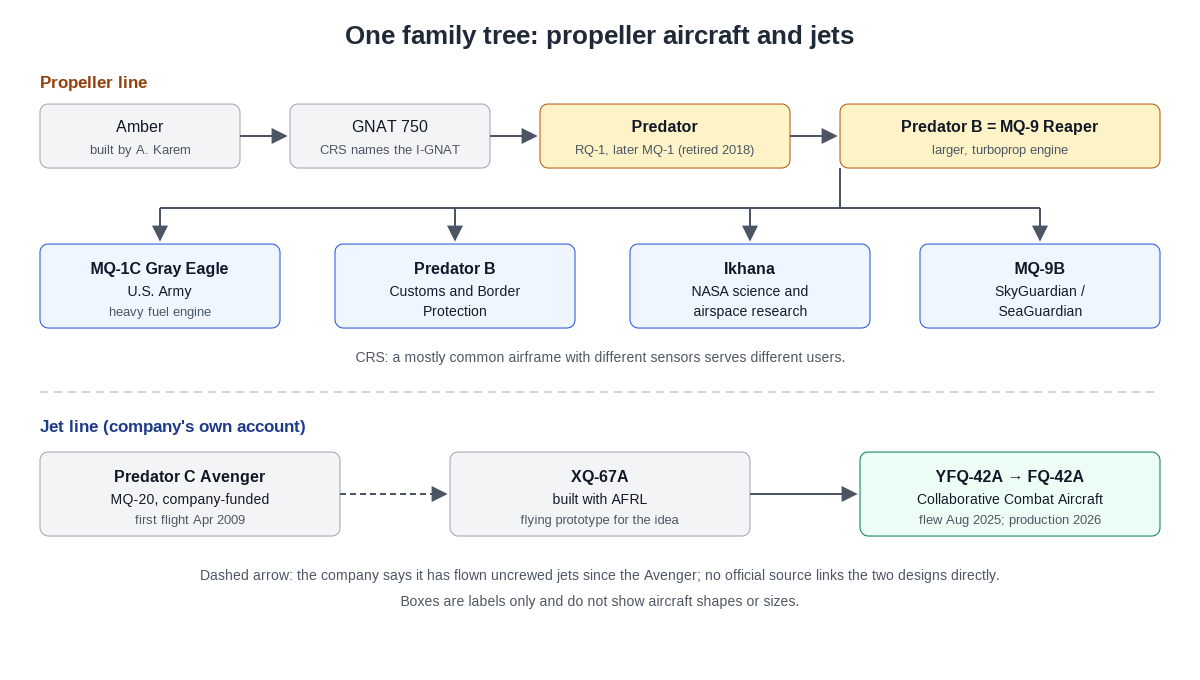
The first branch is the Army. In August 2005 the Army gave the contract for its Extended Range Multi-Purpose (ERMP) drone program to General Atomics' Warrior, which later became the MQ-1C Gray Eagle. The Gray Eagle is a slightly larger, longer-flying Army version of the Predator, and its low-rate initial production began on March 29, 2010.
The Gray Eagle runs on a heavy fuel engine. The reasons are performance, fuel efficiency and a longer engine life, plus the chance to use the same fuel as other equipment in the field.
The second branch is border patrol. In February 2009 the border agency, U.S. Customs and Border Protection (CBP), announced it had received its sixth Predator B.
The third branch is science. In November 2006 NASA took on a GA-ASI MQ-9 Predator B, named it Ikhana, and used it for Earth science missions and aeronautics technology work. From 2007 to 2009 it took part in NASA's Western States Fire Missions. From 2014 until its retirement in 2018 it helped research on bringing drones into the national airspace.
One moment from that research came in June 2018. Ikhana became the first aircraft to get permission from the Federal Aviation Administration (FAA) to fly without a chase plane following it. It then made a six-hour flight through several classes of civilian airspace. An aircraft from the same family doubled as a test bed for sharing the sky with civil traffic.
The fourth branch is the MQ-9B. The company presents the MQ-9B SkyGuardian and SeaGuardian as a new generation of remotely piloted aircraft. By the company's account, it was designed from the start to meet a NATO standard (STANAG 4671) and the civil airspace rules of the United States and other countries. It has also worked closely with the FAA and the UK Civil Aviation Authority toward approval for civil airspace flight, the company says.
From propellers to jets
Ahead of the 2018 ceremony, the Air Force wing commander called the Predator "a remotely piloted, propeller-driven aircraft." The company's jet drones are the next step, starting with the Avenger, also called the Predator C.
Even the company's own sources give slightly different years for the Avenger. The company history puts its first flight in April 2009. A 2026 company press release instead says GA-ASI has built and flown uncrewed jets for almost 20 years, starting with the company-funded MQ-20 Avenger in 2008. As of 2012, the Avenger was being developed as a third-generation Predator with a turbojet engine.
Next comes the collaborative combat aircraft (CCA). CCAs are uncrewed aircraft built to fly next to crewed fifth- and sixth-generation planes. It had earlier chosen two companies, Anduril Industries and General Atomics, to build production-representative prototypes.
In 2025 the YFQ-42A, developed with General Atomics, flew at a California test site. That was less than two years after the program began. The company dates the first flight to August 2025 and says it received a production contract for the FQ-42A on June 17, 2026.
The company adds that the XQ-67A, built with the Air Force Research Laboratory (AFRL), acted as a flying test version of the FQ-42A idea. The letters in the name are new, too. Y marks the prototype stage, F means fighter, and Q means the aircraft is uncrewed. The wider program is covered in Collaborative Combat Aircraft: Uncrewed Jets Flying Beside Fighters.
Company numbers and government numbers
Big numbers show up often in the company's material. A June 2026 press release says the Predator line has flown for more than 30 years and logged more than 9 million flight hours. That line runs from the MQ-9A Reaper to the MQ-9B. The company's home page claims it is the only line to pass 9 million flight hours.
The MQ-9B page says the same family built up more than 8 million hours over the past decade. Even within one company, the period and the figure change from page to page. The Air Force's numbers count something else again. The Air Force fact sheet says that by August 2011 the Predator alone had passed 1 million hours of development, test, training and combat combined.
A 2018 Air Force article gives a different million. In that same year, 2011, MQ-1 and MQ-9 crews reached 1 million combat hours alone, and 2 million two years later. So 2011 has two million-hour marks that mean different things.
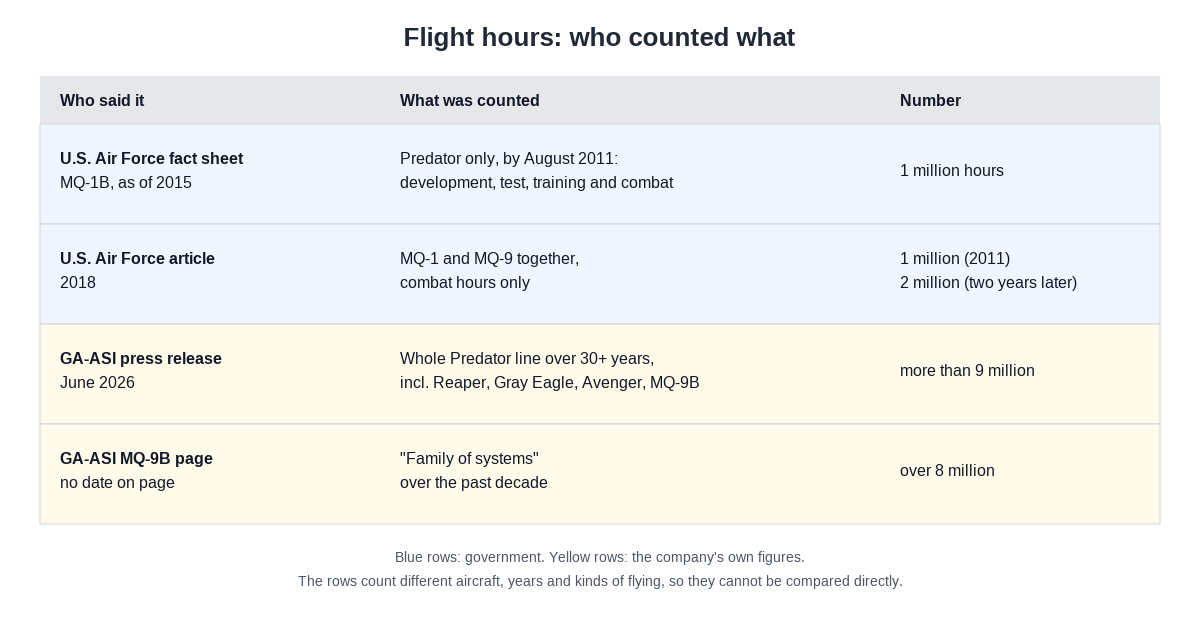
Three questions help with figures like these: which aircraft are grouped together, over what period, and whether only combat is counted or training too. The company's count includes aircraft outside the Air Force, such as the Army's Gray Eagle. That is why setting the company's 9 million hours beside the Air Force's 2 million and comparing their size does not work.
What to read next
- MALE and HALE Drones: Aircraft That Stay Up for More Than a Day: the physics that lets this family stay aloft so long.
- ISR drones: why endurance matters: the roles reconnaissance drones have played.
- Collaborative Combat Aircraft: Uncrewed Jets Flying Beside Fighters: the program the YFQ-42A belongs to, in more detail.
- Autonomous weapons and human control: the debate around armed drones and autonomy.
- Baykar: At the Centre of Turkey's Drone Exports: a drone company from another country.