A land mine goes off the moment someone steps on it. The UN Office for Disarmament Affairs gives mines as an example of weapons with autonomous functions: once activated, they act on their own when a trigger mechanism is set off. It adds that systems with basic autonomous functions have existed for decades.
The question grows once sensors and computers can find a target, pick it and decide to attack. How far may a machine decide, and where must a person stay? The U.S. Department of Defense and the meeting rooms of the United Nations have dealt with this question in different words. This article follows that debate through the sentences in official documents.
What counts as an autonomous weapon
There is no single agreed definition. The UN Office for Disarmament Affairs says there is, for now, no definition of lethal autonomous weapon systems (LAWS) that states have all accepted. Even the word "lethal" is disputed. Several states objected to it, arguing that lethality comes from the way a weapon is used.
Some institutions do use definitions of their own. The U.S. Department of Defense defines an autonomous weapon system as one that, after it is switched on, can choose and engage targets with no more action from an operator. The International Committee of the Red Cross (ICRC) puts it in a similar way. After a person first activates the system, it starts a strike by itself, based on what its sensors pick up from the surroundings and a generalized "target profile."
Both definitions look at what happens after activation. The ICRC spells out the result: the user neither picks nor even knows the exact target, or the exact time and place where force lands.
In, on and out of the loop
The U.S. directive does not sort weapons by how sophisticated they are. As the Congressional Research Service (CRS) points out, the test is the role the human operator plays in decisions to select and engage targets. So weapons built with the same technology can land in different categories depending on where the person stands.
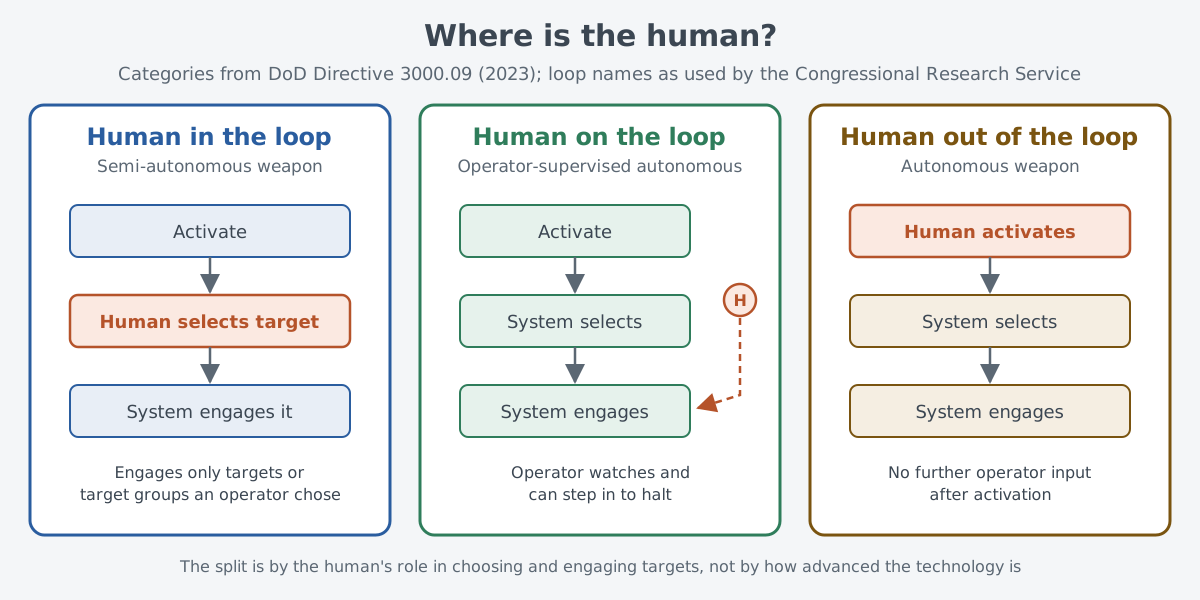
The first category is the semi-autonomous weapon. It is meant to engage only targets, or particular groups of targets, that an operator has picked. This is also called having a "human in the loop."
A target group here means a concrete group, such as a particular formation. A general class, such as every tank of one model, does not count. So-called "fire and forget" weapons, which use autonomous functions to deliver effects on targets a person identified, also fall in this category.
The second category is the operator-supervised autonomous weapon. The system selects and engages targets, but operators can watch the process and halt it. Here the person is "on the loop."
The third category is the autonomous weapon with the human "out of the loop," also called "full autonomy." After activation, it selects and engages targets with no further operator input. For how a drone flying by itself differs from a weapon deciding by itself, see Drone autonomy: navigation is not the same as communication.
U.S. DoD Directive 3000.09
The U.S. Department of Defense first issued its directive on autonomy in weapon systems, Department of Defense Directive (DoDD) 3000.09, in November 2012. The version in force today is the update that took effect on January 25, 2023.
The directive's first requirement fits in one sentence. Autonomous and semi-autonomous weapon systems must be designed so that commanders and operators can exercise "appropriate levels of human judgment" over the use of force. The word "appropriate" is not fixed in advance. A 2018 U.S. government white paper, quoted by CRS, explains that it is a flexible word, reflecting the fact that no single level of human judgment fits every context.
CRS notes that, contrary to frequent reports, human judgment does not mean steering the weapon by hand. It means that people stay broadly involved in deciding how the weapon is used, and when, where and why.
Several measures back up this requirement.
- Testing and checking: Hardware and software go through rigorous verification and validation, plus realistic test and evaluation. If a system cannot finish an engagement within the time and area that commanders and operators intended, it must stop the engagement or get more operator input before going on.
- The screen between person and machine: It must be easy for trained operators to understand, show the system's status clearly, and give clear steps for switching functions on and off.
- Law and rules: Anyone who authorizes, directs or operates these weapons must follow the law of war, treaties, weapon safety rules and rules of engagement.
- Senior review: On top of the normal weapons review, autonomous weapon systems covered by the directive need approval from two under secretaries and the Vice Chairman of the Joint Chiefs of Staff before formal development, and approval again at the same level before fielding. In case of "urgent military need," the Deputy Secretary of Defense can waive this review. The directive also lists cases that do not need the senior review, such as semi-autonomous weapons with no autonomous mode of operation.
The directive is also clear about what it leaves out. Seven things are outside its scope: cyberspace capabilities, unarmed platforms, unguided munitions, munitions guided by hand by the operator, mines, unexploded explosive ordnance, and autonomous systems that are not weapons. So before applying it to a ground robot, the first question is whether the robot is armed. This point also comes up in Unmanned ground vehicles: robots for dangerous places.
The directive's meaning of "failure" is worth a look too. Listed causes include mistakes by people, flawed interaction between people and machines, malfunctions, weakened communications and errors in software code. Reducing failures means bringing the chance and consequences of unintended engagements down to acceptable levels. It does not mean pushing risk to the lowest point by never engaging targets.
This directive is not a ban. CRS notes that, despite what some news reports say, U.S. policy does not forbid developing or using LAWS.
The discussions at the UN CCW
The place where states have met to discuss this issue is the Convention on Certain Conventional Weapons (CCW). It is an international humanitarian law instrument that bans or restricts specific weapons seen as causing needless suffering to combatants or affecting civilians without discrimination. New protocols can be negotiated and added, and five protocols exist today.
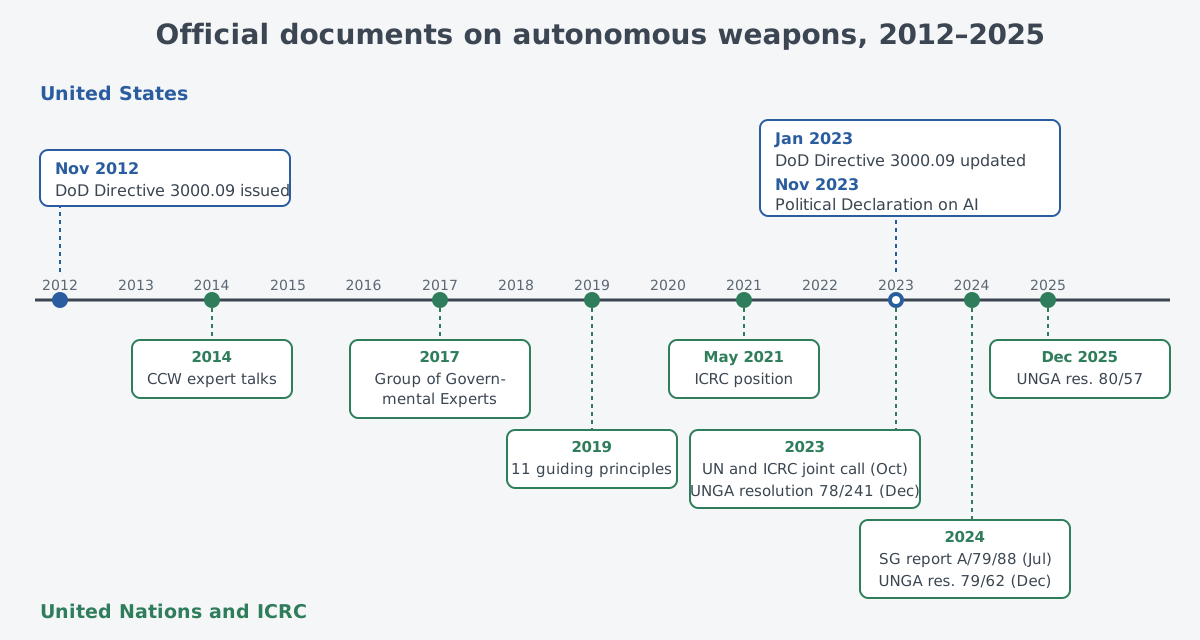
According to CRS, the United States has taken part in LAWS discussions under the CCW since 2014. In 2017 the talks moved from an informal meeting of experts to a formal Group of Governmental Experts (GGE). The CCW is a forum that decides by consensus.
In November 2019, the CCW meeting of states parties endorsed eleven guiding principles affirmed by the GGE, set out in its final report. A few of them speak directly to the question of this article:
- International humanitarian law still applies in full to every weapon system, LAWS included.
- People must stay responsible for decisions to use weapon systems, because accountability cannot be handed over to machines. This applies across the weapon's whole life cycle.
- Human-machine interaction can take various forms and happen at various stages of a weapon's life cycle.
- When shaping policy, the technology should not be treated as if it were human.
- The CCW is a framework that tries to weigh military necessity against humanitarian concerns.
The debate then widened to the UN General Assembly. Resolution 78/241, adopted on December 22, 2023, affirmed that international law covers autonomous weapons, in particular the UN Charter, humanitarian law and human rights law. It asked the Secretary-General to gather the views of member states and report back. One of the topics was what part humans play when force is used.
Resolution 79/62 of December 2, 2024 restated that a weapon which cannot be used within international humanitarian law must not be used, and that this includes autonomous weapons. It called on the GGE to finish its mandate as soon as possible, ideally before 2025 was over. It also set up two days of informal consultations in New York in 2025.
Resolution 80/57 of December 1, 2025 noted with appreciation the GGE chair's effort to record progress in a "rolling text." It called upon CCW parties to work toward completing the set of elements for an instrument, looking ahead to negotiations.
A proposal to prohibit some and regulate the rest
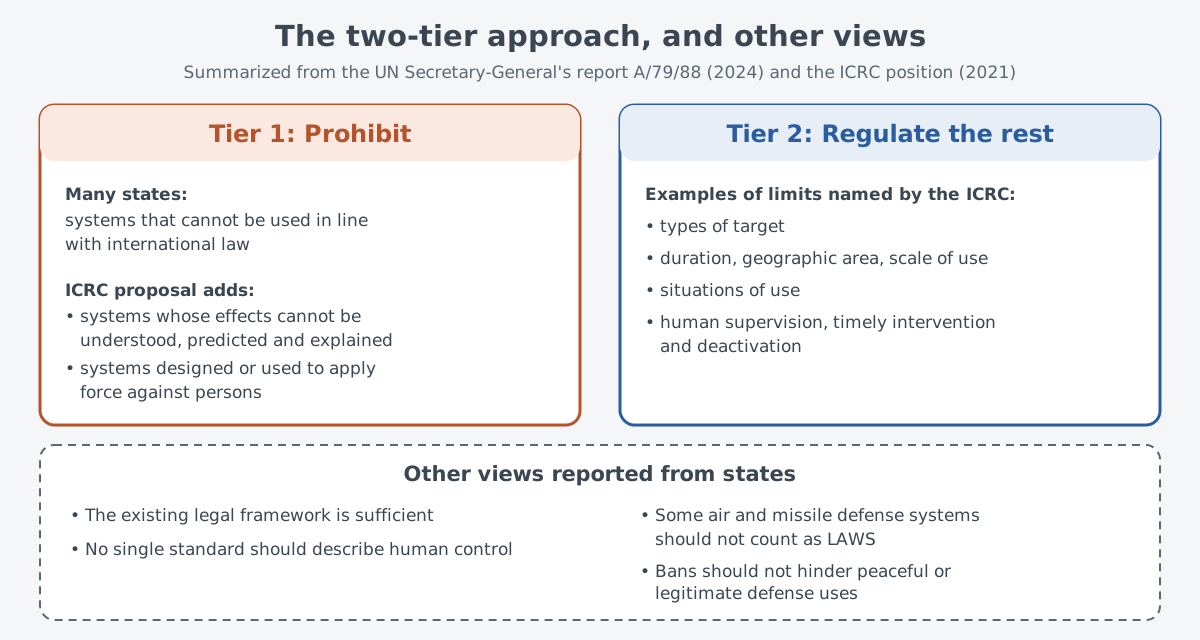
International organizations have put forward a concrete framework. In its May 2021 position, the ICRC urged states to agree on new rules that would bind them in law. It proposed two bans: on autonomous weapons whose effects people cannot understand, predict and explain well enough, and on autonomous weapons built or used to use force on people.
The rest would be regulated through limits on the types of target, on the duration, geographic scope and scale of use, and on situations of use. Requirements for human supervision, timely intervention and deactivation would be added.
On October 5, 2023, the UN Secretary-General and the ICRC President issued a joint appeal. They asked states to set out clear bans and limits for autonomous weapon systems.
In his report the next July (A/79/88), the Secretary-General restated his own call for a legally binding instrument by 2026. It would ban LAWS that work without human control or oversight and cannot be used within international humanitarian law. All other autonomous weapons would be regulated.
This split between what to ban and what to regulate is called the "two-tier approach." The Secretary-General's report records that many states supported it. It also records the view that bans should not hinder technological innovation or the use of technology for peaceful or legitimate defense purposes.
Where states disagree
The Secretary-General's report pulls together the views states submitted, without prejudice to each state's own position. The first thing that stands out is the wording. Human control, meaningful human control, appropriate human judgment and human involvement were all widely discussed, and the report notes that these ideas need more discussion and clarification. Another view held that putting the focus on meaningful human control did not help, and that one single standard would not fit.
Even so, states were fairly concrete about what human control should include. Some of the elements they named:
- Enough information about the weapon's capabilities and the operational context to comply with international law
- Power to restrict which tasks and targets the system takes on
- Power to restrict how long, where and on what scale it is used
- Power to reset or change its goal or missions
- Power to pause it or shut it off
The report also carries the view that autonomous weapons may bring benefits. These include better safety and efficiency, better compliance with humanitarian law and protection of civilians through greater precision, a lower risk of collateral damage, and less risk to defense personnel. Several states suggested that certain autonomous or automatic air and missile defense systems should not count as LAWS. Their reasons: the systems are defensive, their detection and engagement algorithms are deterministic rather than probabilistic, and they have been in use for decades without legal dispute.
States also split on whether new law is needed. Some called for strengthening and further specifying the international legal framework, while others held that the existing framework is sufficient. CRS reports that about 30 countries and 165 nongovernmental organizations have asked for LAWS to be banned in advance, citing ethical concerns. The U.S. government, it adds, does not back a ban at present.
On November 9, 2023, the U.S. State Department issued the "Political Declaration on Responsible Military Use of Artificial Intelligence and Autonomy." As of November 27, 2024, 58 states had endorsed it.
South Korea appears in this story too. Resolution 78/241 mentions the summit hosted by the Netherlands and co-organized by South Korea on February 15–16, 2023. Resolution 79/62 mentions the Responsible Artificial Intelligence in the Military Domain (REAIM) Summit that South Korea hosted on September 9–10, 2024. Both are listed as contributions to the international discussion.
Where AI fits in
Back to the question in the title. Many people think of artificial intelligence (AI) first when they hear "autonomous weapon," but the UN Office for Disarmament Affairs puts it differently.
AI is not a prerequisite for autonomous weapons to work. Autonomous functions can come from pre-set tasks and sequences of actions, or from AI tools that derive behavior from data. When AI is added, it can extend what such systems are able to do.
The reverse also holds: having AI inside does not make a weapon autonomous. AI can play only a helper role in a system a person operates directly. One example is computer vision that marks notable objects in view without being able to act on them by itself.
States' views split here as well. One view was that AI in target selection and the use of force could be a feature of LAWS. Another was that LAWS do not need to include AI. The U.S. directive requires that any AI used in autonomous or semi-autonomous weapons follow the DoD AI Ethical Principles.
The joint appeal by the UN Secretary-General and the ICRC President called for banning autonomous weapons whose effects cannot be predicted. Its example was letting machine learning algorithms control autonomous weapons.
One of the 2019 guiding principles said the technology should not be treated as if it were human. With that in mind, the question "how far can AI decide?" reads a little differently. What the official documents in this article hold on to is less the machine's judgment than where people remain and what they answer for.
Where this meets lasers: another protocol of the same convention
The CCW, where the autonomous weapons talks take place, already has a protocol that deals directly with lasers. Protocol IV forbids using or transferring laser weapons built to blind people permanently. The Secretary-General's report also records the view that the CCW's structure, which allows new protocols to be negotiated, is well suited to problems raised by new technologies. For what the protocol banning one kind of laser weapon says, see Eye safety and international rules: the protocol on blinding laser weapons.
Lasers also appear once in the U.S. directive. Munitions guided by hand by the operator are outside its scope, and its examples are laser-guided and wire-guided munitions. Even with a laser on board, a munition that a person guides falls outside this directive.
What to read next
- Eye safety and international rules: the protocol on blinding laser weapons: a protocol inside the same CCW that bans one kind of laser weapon.
- Drone autonomy: navigation is not the same as communication: how autonomy in flight differs from autonomy in using a weapon.
- Unmanned ground vehicles: robots for dangerous places: uncrewed systems on the ground and the question of human judgment.