When DJI drones come up in the United States, the word "ban" follows quickly. Yet the Federal Communications Commission (FCC) tells consumers they can keep using drones they bought lawfully. Which is right?
Each is about half right. The US government did not issue one single ban on DJI. Several agencies acted through different lists and laws, and each one limits something different.
This article follows each action, from the 2020 Commerce Entity List to the 2025 FCC Covered List, with its date and its own wording. It also sorts out what each one blocks and what it leaves alone. The field changes fast, so this article reflects the situation as of October 2026.
Not one list but several
DJI makes consumer and commercial drones. A 2026 ruling by a US federal appeals court notes that DJI drones are sold through retailers worldwide and that its buyers include governments, businesses and hobbyists. Since 2019, the US government has layered several measures that touch this company and its drones.
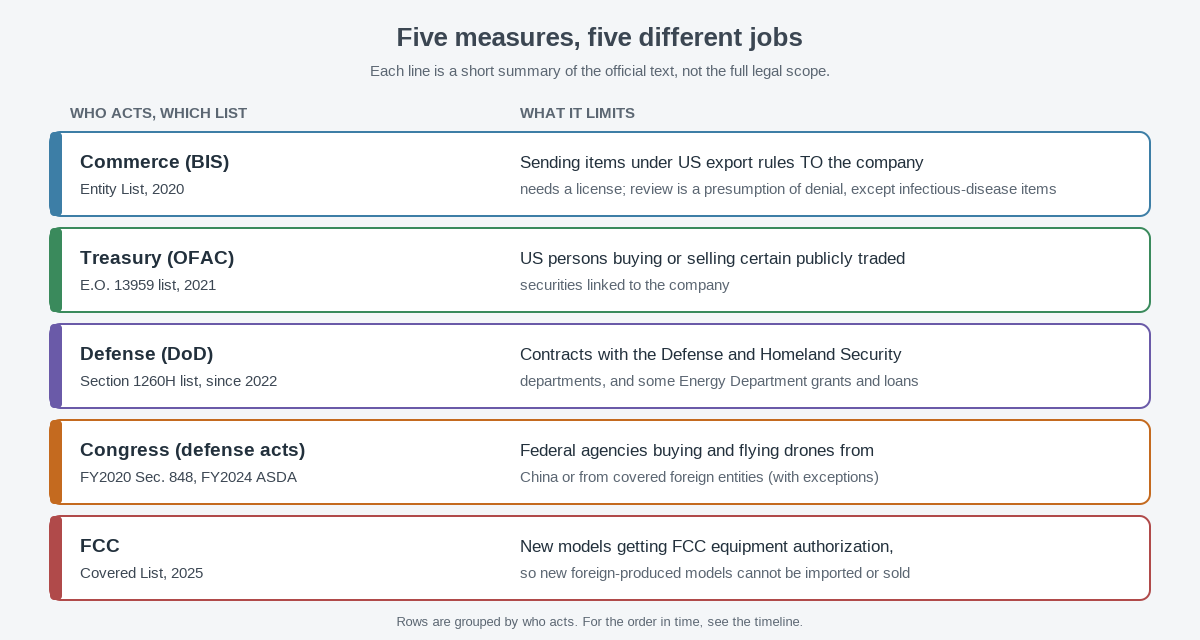
The measures fall into five groups. Commerce deals with exports, the Treasury with securities trading and the Defense Department with government contracts. Congress sets how federal agencies buy and fly drones, and the FCC approves devices that use radio. The same company name can sit on several lists, but each list binds different people and different actions.
Picture one person facing a separate border check, a bank trading limit and a ban on selling to government offices. The real targets are companies and products, not a person, and the latest FCC action picks its targets by place of production rather than by company name.
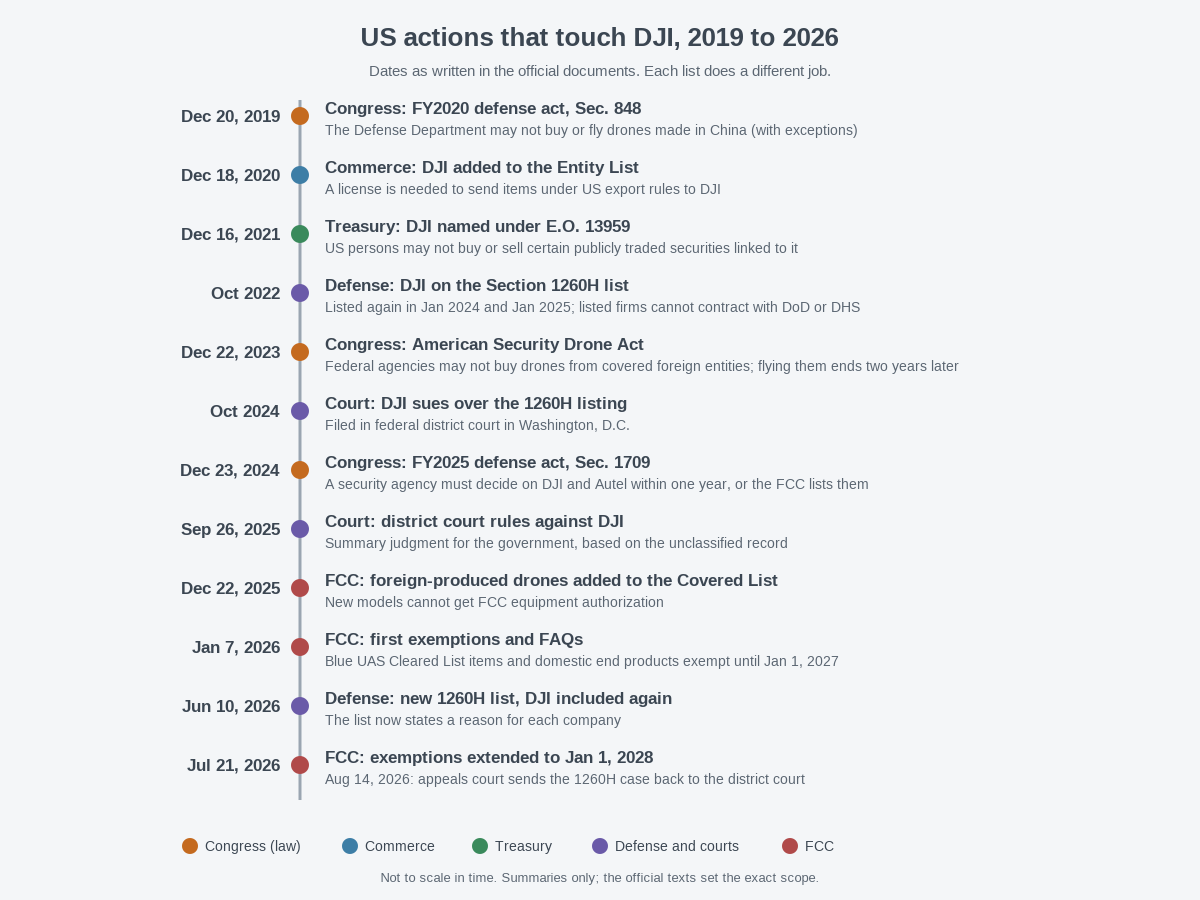
2020, the Commerce Entity List: a license to send US items
On December 18, 2020, the Commerce Department's Bureau of Industry and Security (BIS) amended the Export Administration Regulations (EAR) and added 77 entities to the Entity List. The rule appeared in the Federal Register on December 22, and DJI was among the 77. The Entity List names entities tied to activities against US national security or foreign policy interests. Specific facts must give reasonable cause to believe the entity has been, is, or is at significant risk of becoming involved.
The stated reason was foreign policy. The US government judged that four of the entities, DJI among them, had made large-scale human rights abuses in China possible through genetic collection and analysis or high-tech surveillance. The other possible ground was helping China export items that aid repressive regimes.
Direction matters when reading the effect. Once an entity is on the list, exporting, reexporting or transferring items under US rules to it needs an extra license, and most license exceptions are off the table. What the rule binds is the flow of items going to DJI.
DJI also got its own review policy. Items needed to detect, identify and treat infectious disease are reviewed case by case, and all other items are reviewed with a presumption of denial. For the bigger picture of export controls, see Export Controls: What ITAR and the Wassenaar Arrangement Restrict.
2021, the Treasury: buying and selling securities
A year later, on December 16, 2021, the Treasury acted. Its Office of Foreign Assets Control (OFAC) named eight Chinese tech companies under Executive Order 13959, as amended by Executive Order 14032, and SZ DJI Technology was one of them. The press release placed the eight within China's military-industrial complex.
The Treasury's stated reason was surveillance. Its judgment was that DJI had operated in China's surveillance technology sector. It also said DJI had supplied drones to the Xinjiang Public Security Bureau, and that those drones are used to watch Uyghurs in Xinjiang.
As a result, US persons may not buy or sell certain publicly traded securities connected with the listed firms. If the Entity List binds the flow of goods, this action binds the flow of investment.
The Defense Department list and the court fight
The third list belongs to the Defense Department. Under Section 1260H of the fiscal 2021 defense act, the Secretary of Defense must publish, every year, a list of "Chinese military companies" operating in the United States. In October 2022, the Secretary put DJI on that list without advance notice.
DJI asked to be removed, and the request was denied. The Secretary named DJI again in January 2024, and the January 2025 list included it as well. A listed company cannot contract with the Defense Department or the Department of Homeland Security, and it cannot receive certain Energy Department grants, contracts and loans.
DJI went to court in October 2024. It argued that the listing broke its right to due process, had too little evidence behind it and was not properly explained. In March 2025 it widened its complaint to cover the January 2025 listing too. On September 26, 2025, the district court, looking only at the unclassified record, granted summary judgment for the government.
On August 14, 2026, the federal appeals court in Washington, DC, affirmed in part, reversed in part and sent the case back to the district court. The key point was the section of the Secretary's report saying DJI "contributes" to the Chinese defense industrial base. In the public record, all of it but the heading was blacked out. The appeals court said the district court may look at the classified record and decide whether to uphold that finding.
Meanwhile, a new Defense Department list in the Federal Register on June 10, 2026 included DJI again. Since a 2024 amendment, the list must give a reason for each company. The new list says DJI is indirectly affiliated with China's State-Owned Assets Supervision and Administration Commission (SASAC). It also says DJI is directly affiliated with the Ministry of Industry and Information Technology (MIIT) and the People's Armed Police (PAP).
Drones the government buys and flies: the defense bills
Congress drew its own lines in law. The first is Section 848 of the defense act for fiscal year 2020, signed on December 20, 2019. It bars the Secretary of Defense from operating an unmanned aircraft system (UAS) made in China or by an entity based in China. It also bars entering into or renewing contracts to buy one.
The rule looks beyond the whole aircraft. A drone is also covered if its flight controllers, radios, data transmission devices, cameras or gimbals come from such a source. Counter-UAS surrogate testing and training, and intelligence and electronic warfare work, are exempt, and the Secretary may grant case-by-case waivers in the national interest.
On December 22, 2023, the defense act for fiscal year 2024 brought in the American Security Drone Act of 2023. Under it, the head of an executive agency may not buy a UAS made or assembled by a "covered foreign entity." Starting two years after the law took effect, federal departments and agencies may not fly such systems either; two years after the signing date is December 22, 2025.
A covered foreign entity is one on a list that the Federal Acquisition Security Council keeps and posts in the federal contracting system. It includes entities on the Consolidated Screening List, among others. It also includes entities that the Secretary of Homeland Security finds are based in China or under the influence or control of China's government or Communist Party. What these two laws bind is the government buying and flying drones.
2025, the FCC Covered List: new models cannot be certified
The last strand starts with Section 1709 of the defense act for fiscal year 2025, signed on December 23, 2024. It required an "appropriate national security agency" to decide, within one year, whether communications and video surveillance equipment and services from DJI and Autel Robotics pose an unacceptable risk. Subsidiaries, affiliates and partners of the two companies are covered as well.
The section came with a deadline. If no decision was made within one year, the FCC had to put all of that equipment and those services on the Covered List. Counted from the signing date, the deadline was December 23, 2025.
The Covered List names communications equipment and services judged to pose an unacceptable risk to US national security or to the safety of US persons. The FCC explains that it cannot change the list on its own and must carry out the decisions of national security agencies.
On December 22, 2025, the FCC's Public Safety and Homeland Security Bureau put foreign-produced uncrewed aircraft systems and their critical components on the Covered List. It also added the equipment and services named in Section 1709. The basis was a national security determination from an interagency body of the executive branch, received the day before, on December 21.
The determination says drones and their critical components need to be made in the United States. One line of it calls drones inherently dual-use: both commercial platforms and possible military or paramilitary sensors and weapons.
The way the targets were chosen is worth a close look. The newly covered equipment is defined by place of production, not by company. The target is every drone and drone part produced abroad, not one company, and the nationality of the producing company does not decide the question. Critical components include data transmission devices, flight controllers, and batteries and battery management systems, among others.
Equipment on the Covered List cannot receive FCC equipment authorization. In the United States, most electronic devices need this authorization before they are imported, marketed or sold. A new foreign-produced model that cannot get it therefore cannot be brought in or sold.
Drones already bought, and the exemptions
So what about a drone already sitting at home? A fact sheet the FCC released on January 7, 2026 says the restriction looks forward. The import, sale and use of existing models the FCC already authorized are not prohibited, and consumers can keep using devices they bought lawfully. What is blocked is authorization of new models.
Drones built only for the federal government usually need no FCC equipment authorization in the first place. For that reason, the Covered List leaves sales to federal agencies untouched. The defense acts described earlier handle what the government buys and flies.
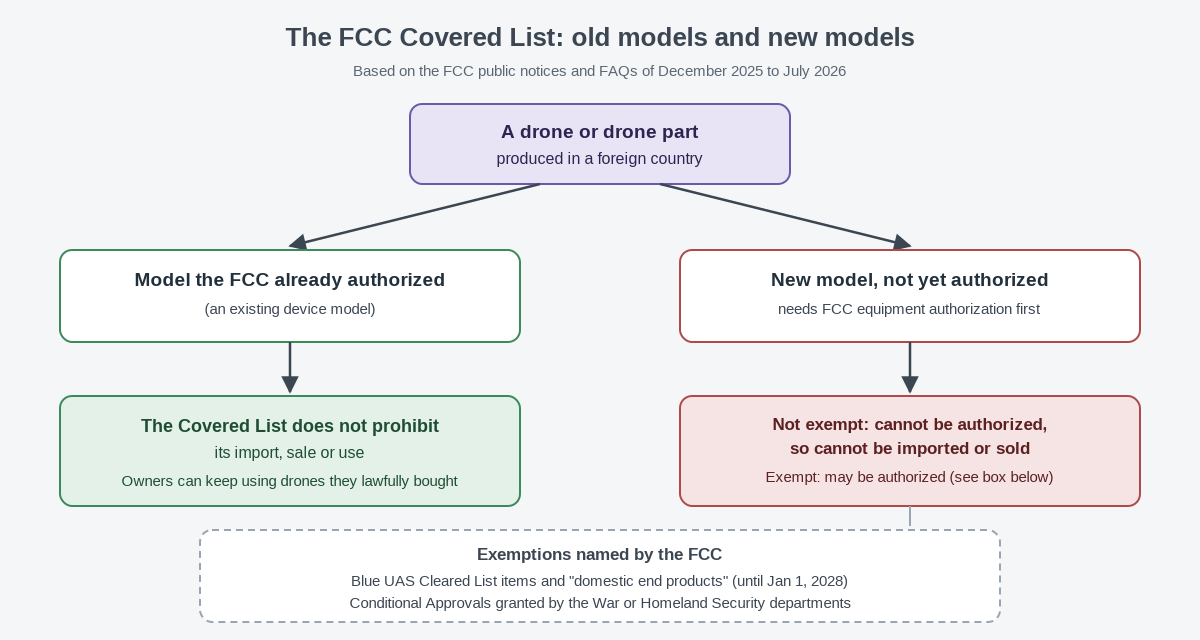
Exemptions followed. On the same day, the FCC removed two groups from the list based on a Defense Department determination. They are items on the department's Blue UAS Cleared List and items that count as "domestic end products" under the Buy American Standard. The first deadline for both was January 1, 2027.
Companies also gained a way to apply for individual "Conditional Approvals." The Defense Department and the Department of Homeland Security review the applications. FCC documents call the Defense Department the Department of War.
In March 2026, the FCC added the first Conditional Approvals from the Defense Department to the list, and in May it announced Conditional Approvals for some more drones. A notice on July 21 extended the Blue UAS and domestic end product exemptions to January 1, 2028. A Conditional Approval holds for as long as the applicant keeps to the onshoring plan in its application.
Where this meets lasers: reading the original text
Calling all of these measures a "DJI ban" erases the differences. The Entity List covers items going to DJI, the Treasury action covers securities trading, the Defense list covers government contracts, and the FCC covers authorization of new models. What was blocked, and from when, only becomes clear in the original text.
Laser weapon news works the same way. For how to check what phrases like "kW-class" and "range" actually refer to, see How to read laser weapon news: "kW-class", "range" and "cost per shot".
What to read next
- DJI: The Company That Built the Civil Drone Market: how the company behind these rules grew.
- Blue UAS: The Drones the US Government Approves: what the list named in the FCC exemptions is.
- Export Controls: What ITAR and the Wassenaar Arrangement Restrict: the wider export control system the Entity List belongs to.
- Counter-drone systems: why one device is not enough: how drones seen as threats are found and stopped.