What else could you do with the money for one fighter jet? One answer from the U.S. Air Force is a large aircraft with no pilot on board that flies beside the fighter. It is called a collaborative combat aircraft (CCA).
This article follows why CCA came about, which stages the program has gone through and how far it has come, and what the numbers in the news mean. It draws on Congressional Research Service (CRS) material and U.S. Air Force releases.
The broader idea of pairing crewed aircraft and drones as one team, called manned-unmanned teaming (MUM-T), is covered in the article on manned-unmanned teaming. Here the focus is the CCA program alone, in more depth.
Why put uncrewed jets beside fighters
Developing, buying and flying military aircraft usually costs a lot. Since the 1990s the U.S. Air Force fleet has shrunk, and those costs are part of the reason. The service has ended up with fewer and fewer expensive aircraft.
CCA is an attempt to change that trend. Air Force officials have estimated that a CCA might cost roughly one-third as much as a crewed fighter. If training can happen virtually, the airframes fly less and upkeep may cost less, and the savings might let the Air Force buy more CCAs than crewed fighters. All three are estimates or possibilities, which is worth keeping in mind.
The operating environment is another reason. CRS sees China's anti-access/area-denial (A2/AD) capabilities, such as long-range missiles and advanced air defenses, as a challenge to the Air Force's ability to gain air superiority. The Air Force is also pursuing a concept called agile combat employment (ACE), which moves operations from large, central bases to a network of scattered sites. CCAs placed at those sites could help add sensors or long-range weapons to the combat fleet.
What a CCA might do
The Air Force describes a CCA as a large uncrewed aircraft powered by jet engines. The missions it might take on include air-to-air combat, air-to-ground combat, electronic warfare, targeting, and intelligence, surveillance and reconnaissance. The original wording is that it could be "potentially equipped" for these missions. It does not mean one aircraft does all of them at once.
The more important part is how it relates to people. The AI software in a CCA is planned to work with human pilots and take direction from them. A 2025 Air Force report to Congress on tactical fighter force structure also treats CCA as an addition to crewed aircraft, not a replacement. CCAs are meant to have some level of autonomy, with humans involved in how they are operated.
Picture a flight lead who gets a new teammate. The real thing is different. This teammate is an aircraft run by software, and how much it should decide on its own is still a question that Congress and the military are weighing.
CCA is not a program on its own, either. It belongs to the Air Force's Next-Generation Air Dominance (NGAD) family of systems, which may also include a future crewed fighter, sensors, weapons and more. That makes CCA one piece of a system of systems, where many weapons have to work together as one.
From five companies to two: Increment 1
CCA did not appear out of nowhere. Over the past decade, three organizations ran many efforts in this area: the Air Force, the Defense Advanced Research Projects Agency (DARPA) and the Air Force Research Laboratory (AFRL). They developed and tested autonomy, software and modular platforms that can be upgraded piece by piece.
In 2024 the Air Force gave first design-and-build contracts to five companies: Anduril, Boeing, General Atomics Aeronautical Systems (GA-ASI), Lockheed Martin and Northrop Grumman. Later that year, Anduril and GA-ASI were picked from that group to build Increment 1 test aircraft that stand in for the production design. At that point the plan was to buy more than 100 Increment 1 aircraft across five years.
In March 2025 the two prototypes got their names. The GA-ASI aircraft is the YFQ-42A and the Anduril aircraft is the YFQ-44A. Y means prototype and is dropped once production begins. F stands for fighter, Q for unmanned aircraft, 42 and 44 are design numbers, and A marks the first version.
Gen. David W. Allvin, then Air Force Chief of Staff, said the aircraft had existed only on paper less than two years earlier and would be ready to fly that summer. He called it the first fighter designation of its kind in Air Force history and added that it may be just symbolic.
The first flights came in the second half of that year. The YFQ-42A first flew on August 27, and in October Anduril announced the first flight of the YFQ-44A, which was designed to be semi-autonomous. Both aircraft were put through development tests in California, while an Experimental Operations Unit (EOU) at Nellis Air Force Base, Nevada, assessed them from an operational point of view. In May 2025, Beale Air Force Base, California, was named the preferred base to host the CCA Aircraft Readiness Unit.
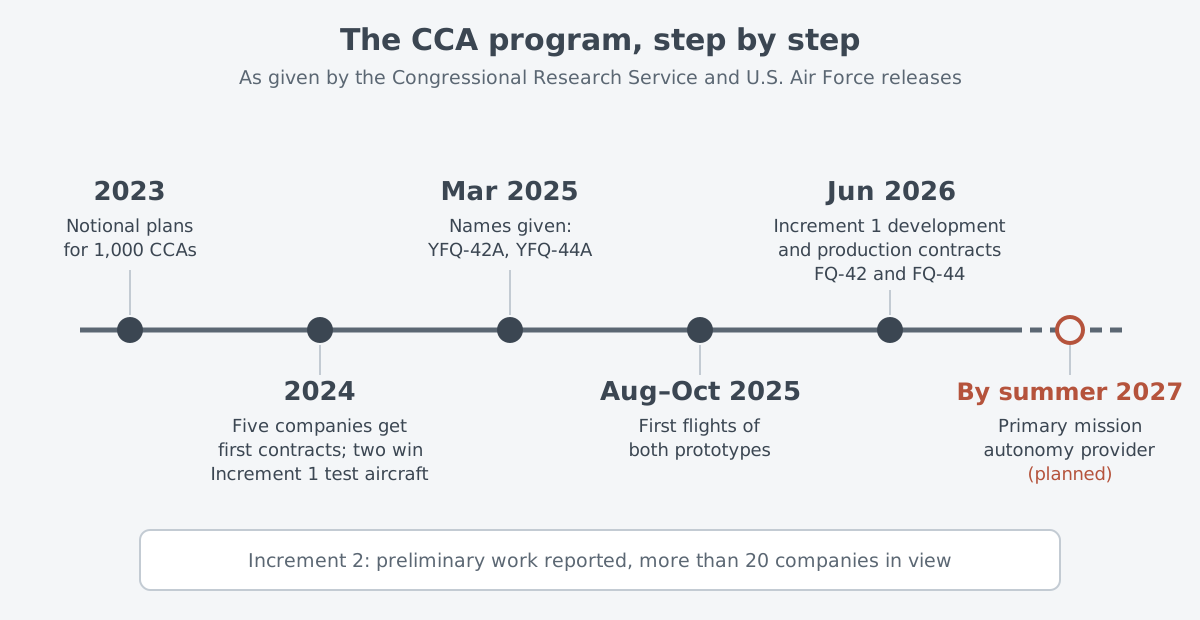
In June 2026 the program took another step. General Atomics, for the FQ-42, and Anduril, for the FQ-44, received Increment 1 contracts that cover both engineering and manufacturing development (EMD) and production. The Y for prototype is gone from the names. The Air Force said it awarded these contracts four months ahead of schedule.
Increment 2 is at an earlier stage. According to reports cited by CRS, the Air Force said early work on Increment 2 had begun. It expects to involve over 20 companies, among them firms not chosen for Increment 1. An Air Force official was also reported as saying that Increment 2 contracts could go to several companies, possibly including foreign ones, early in fiscal year 2026.
Buying the aircraft and the software separately
When you buy a smartphone, you install apps separately and swap them when new versions arrive. The CCA program splits the aircraft from its mission autonomy software, the software that lets it carry out a mission, in a similar way. The Air Force calls this decoupling hardware from software and treats mission autonomy as "software sold separately." Unlike an app store, though, not just anyone can join: chosen companies compete inside a contract.
In June 2026 the Air Force signed six companies into a shared pool for producing mission autonomy software. They are Anduril, General Atomics, Lockheed Martin, Northrop Grumman, RTX Collins Aerospace and Shield AI, all under a six-year baseline contract. Three of them, Anduril, RTX Collins Aerospace and Shield AI, were funded for the opening round of two competitive rounds, each six months long. At the end, the Air Force picks one main supplier of mission autonomy for Increment 1, with the choice planned by summer 2027.
Putting software from several companies on the same aircraft needs a shared framework. That framework is the government-owned Autonomy Government Reference Architecture (A-GRA). Every vendor must keep meeting it, so software from any of them can be integrated, updated and moved to other aircraft with little effort.
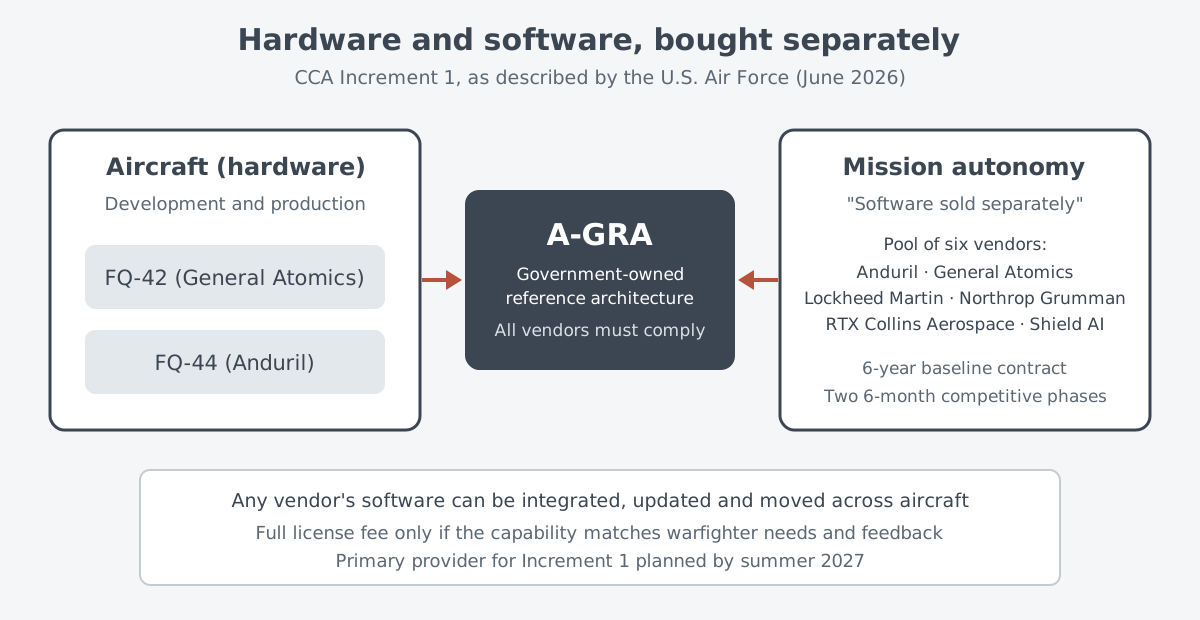
The way the Air Force pays is new too. Operator feedback and combat performance set how much it pays for mission autonomy. A vendor gets the full license fee only when its software delivers a capability that matches what the warfighters need and say.
Money and questions from Congress
In fiscal year 2025 the money came through two channels. A full-year continuing appropriations act gave CCA research, development, test and evaluation (RDT&E) $711.7 million of discretionary money. On top of that, the FY2025 reconciliation act added $678 million of mandatory money. Along the way, the Senate Appropriations Committee recommended moving CCA funding out of the NGAD budget line into a line of its own.
For fiscal year 2026 the Air Force asked for $126.4 million of discretionary money. Of that, $111.4 million goes to RDT&E and $15 million to procurement. With the mandatory money added, the Air Force's FY2026 total for CCA comes to $804.4 million. A request is only a request: Congress may approve it, reject it, change it or not act on it.
Congress looks at more than money. The House Armed Services Committee wants a briefing on the planned mission sets with their cost and schedule. It also asked about the human-machine interfaces for CCA operators and whether prototypes can grow into full production. The Senate Armed Services Committee asked how the F-35, the National Guard and the Reserve would fit into CCA operations, and whether the EOU repeats testing done elsewhere.
Bigger questions remain, and one is what is gained and what is risked by leaning harder on autonomy. Others are whether the plans to buy, test, build and operate large numbers hold up, and how to store and move hundreds of large drones. The first question comes with a CRS outlook: as AI software improves, future CCAs may respond to battlefield changes faster than human operators. Where human judgment should sit is taken up in autonomous weapons and human control.
1,000, 150, 100: reading the numbers
Numbers show up often in CCA news. Even when they all count aircraft, they are not the same kind of number.
- About 1,000: what an Air Force official in 2023 called "notional plans." It assumed two CCAs would fly with each of about 500 advanced crewed fighters. In its June 2026 release, the Air Force again said it means to deploy about 1,000 CCAs ready for combat, but gave no deadline.
- Over 150: the figure Air Force Secretary Troy Meink gave in June 2026. It is the path to buying more than 150 combat-ready CCAs before the 2020s are out.
- Over 100: the Air Force's plan to buy more than 100 Increment 1 aircraft across five years. CRS writes it in the past tense, as something the service "planned."
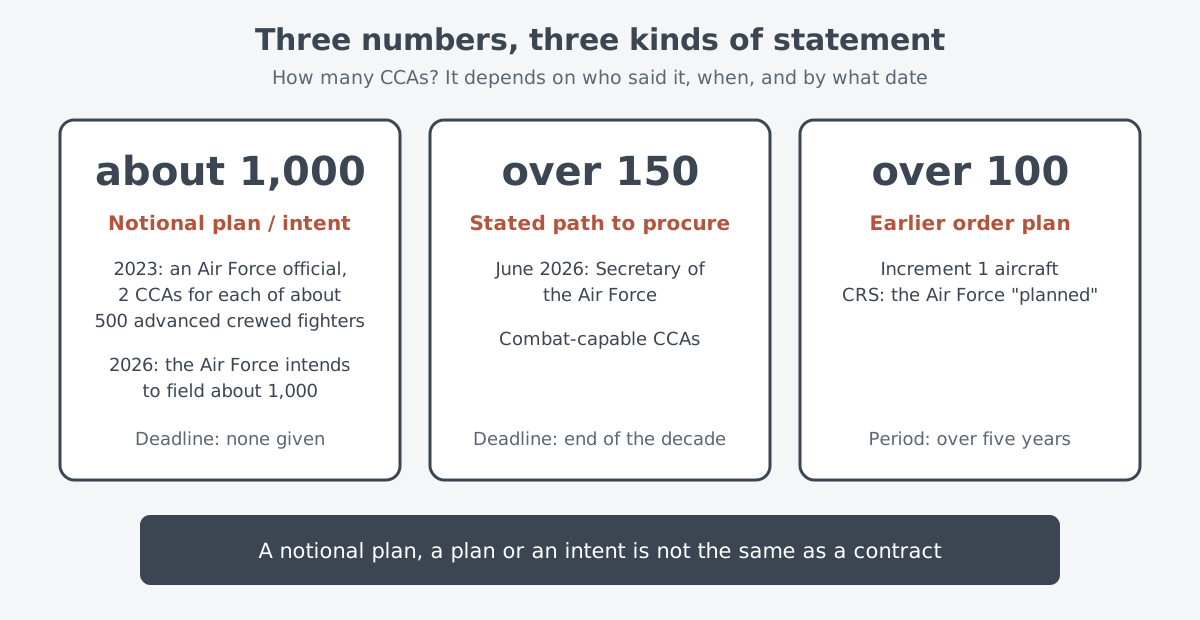
None of the three numbers is wrong. They differ in when they were said, who said them and what deadline they carry. A notional plan, a plan and an intent are not contracts, so when a headline says "1,000 CCAs," it pays to check who said it, when, and under what conditions.
Laser weapon news is no different. Words like "kW-class" or "range" only make sense once you know whether they describe a test result or a future goal. How to read them is laid out in how to read laser weapon news.
What to read next
- Manned-unmanned teaming: the whole idea of teaming people and drones, from helicopter-drone pairs to Australia's program.
- Autonomous weapons and human control: where human judgment stays as systems rely more on autonomy.
- How to read laser weapon news: practice reading the numbers and phrases in the news, using laser weapons.
- How weapon systems work together: a system of systems: how an aircraft like CCA fits into a larger system.