"Europe has historically lacked an independent, high-performance MALE RPAS." That line comes from a 2025 article by the aerospace company Airbus. Four nations are now building a large drone together to fill that gap. Alongside them, firms that make micro drones under 1 kg or surveillance drones are winning orders from armed forces.
Europe's drone industry does not fit in one line. There are joint programmes where nations pool money for one aircraft, aircraft a big aerospace firm built alone, and small drones from comparatively small companies. On top of that, the European Union (EU) is shaping the field with a fund and a plan.
This article follows those four strands through company material and government and EU sources. Figures the companies report are kept apart from figures governments publish. This article reflects the situation as of October 2026.
Eurodrone: one aircraft, four nations
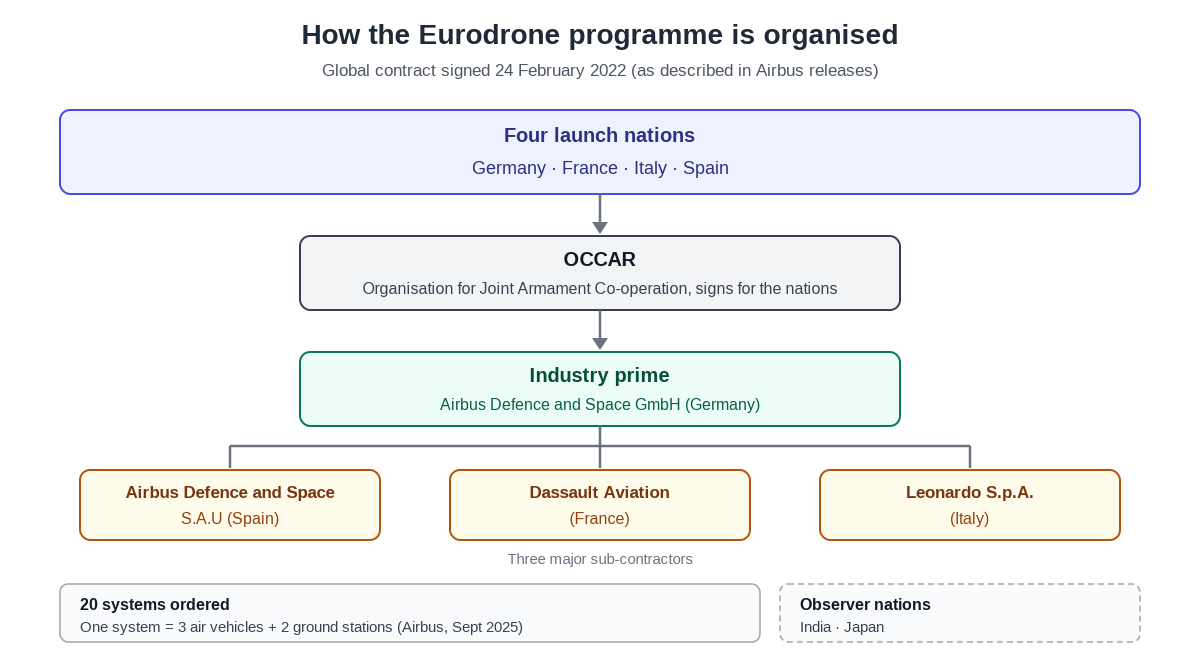
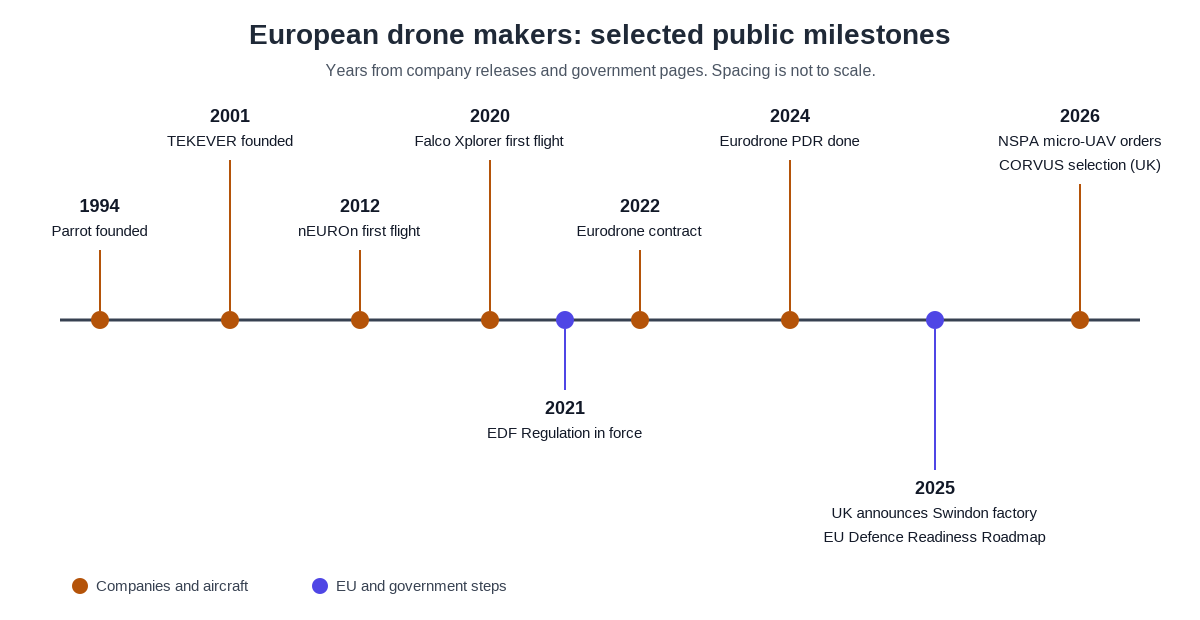
On 24 February 2022, a contract was signed in Manching, Germany. It was the Eurodrone global contract between Airbus and OCCAR, the Organisation for Joint Armament Co-operation. According to the Airbus press release, it covers development and manufacture of 20 systems plus five years of initial in-service support.
The programme is built in layers. At the top are the four launch nations that pay for it: Germany, France, Italy and Spain. OCCAR signed on their behalf.
On the industry side, Airbus Defence and Space GmbH in Germany signed as the prime. Its three major sub-contractors are Airbus Defence and Space S.A.U in Spain, Dassault Aviation in France and Leonardo in Italy.
Eurodrone is a remotely piloted aircraft system (RPAS) in the medium-altitude long-endurance (MALE) class. The article MALE and HALE Drones explains what the MALE class is. Airbus describes Eurodrone as the first MALE aircraft designed from the outset to meet the rules for flying in civil airspace.
"20 systems" does not mean 20 aircraft. What an armed force buys is an unmanned aerial system (UAS): aircraft bundled with ground control equipment. An Airbus article dated 10 September 2025 says each Eurodrone system has 3 air vehicles and 2 ground stations. India and Japan take part as observer nations.
In that article, the programme stood at the threshold between design and production. The preliminary design review (PDR) was finished in 2024, and the contractual critical design review (CDR) was aimed at Q4 2025. After that, the company's plan runs through manufacturing, testing and a first flight, with service entry planned before the decade is out. The article gives no date for the first flight.
The company gives two reasons for the programme. One, quoted at the top, is that Europe lacked an independent, high-performance MALE drone.
The other is that Eurodrone is not subject to the US International Traffic in Arms Regulations (ITAR). Both are Airbus claims. The article Export Controls explains what ITAR restricts.
nEUROn and Falco Xplorer: what the big firms have done
European firms had built a drone across borders before Eurodrone. The nEUROn made its first flight on 1 December 2012 at Istres in France. It was billed as Europe's demonstrator for an unmanned combat aircraft.
A demonstrator is not a production aircraft. The nEUROn was built to test a set of key technologies and is not going into series production.
The work was split by country. Sweden's Saab handled the avionics, the fuel systems, key parts of the ground station, and the design and build of the main fuselage. It delivered the fuselage to Dassault Aviation in France in 2011.
Italy's Leonardo shows a different path. On 15 January 2020, the first Falco Xplorer took off from Trapani Air Force base, flew for about 60 minutes and came back. The company says it is the largest remotely piloted aircraft system it has ever built.
The figures the company gives are endurance of more than 24 hours, a maximum payload of 350 kg and a maximum take-off weight of 1.3 tons. Later flight campaigns were also planned to certify the aircraft to STANAG 4671, a NATO airworthiness standard. An airworthiness standard is the yardstick for whether an aircraft can fly safely.
The Falco line has earlier members. Earlier Falco variants were chosen by the United Nations and by Frontex, the EU agency for border and coast guarding. The company says the Falco Xplorer is not subject to ITAR restrictions either. So the descriptions of Eurodrone and the Falco Xplorer share the same point.
Small drones and newer firms
Large programmes are only part of the picture. Comparatively small companies that make micro drones or surveillance drones are also winning military orders. Small aircraft of this kind are often called a small unmanned aircraft system (sUAS).
France's Parrot was founded in 1994 by Henri Seydoux. He is still its chairman, chief executive and main shareholder. Its head office is in Paris and product development is done in Europe, while the drones are built in the US and South Korea. Parrot says its customers include governments, businesses and operators across over 50 countries.
On 17 March 2026, Parrot announced the first orders for its ANAFI UKR micro drone placed through the NATO Support and Procurement Agency (NSPA). NSPA is a NATO agency that handles procurement and life-cycle support for NATO and participating nations.
The first two users are the Finnish Defence Forces and a second customer not yet named. Shipments were going out in Q1 2026 in batches of 100–500 units. The ANAFI UKR weighs less than 1 kg.
Portugal's TEKEVER was founded in 2001 by computer scientists who worked on artificial intelligence, machine learning and distributed systems. It started with no outside funding. It turned toward the unmanned aerial system market around 2010.
The company also appears in UK government announcements. On 15 September 2025, the UK Ministry of Defence announced a new drone factory in Swindon run by TEKEVER. It is the country's largest drone factory, due to open the following year with 1,000 highly skilled jobs.
The site covers 254,000 square feet. For the first time, the main production of the AR5 unmanned aerial system moves to Britain, and AR3 output grows.
The same announcement says that since Russia's full-scale invasion in 2022, the UK has spent about £270 million buying TEKEVER drones for Ukraine. That amount includes money from international partners.
On 3 August 2026, TEKEVER announced that it had been chosen to supply CORVUS, the British Army's new surveillance capability. CORVUS is based on the AR5, is worth up to £400 million over ten years, and replaces the Army's Watchkeeper. The AR5 carries cameras, sensors and other surveillance gear weighing as much as 50 kg. The article ISR drones covers what drones like this do.
Delair, headquartered in Toulouse, France, is another name. The observation drones Delair designs and builds have carried the "Origine France Garantie" label since 23 March 2023. The label certifies that a product is made in France.
What the EU does with money and plans
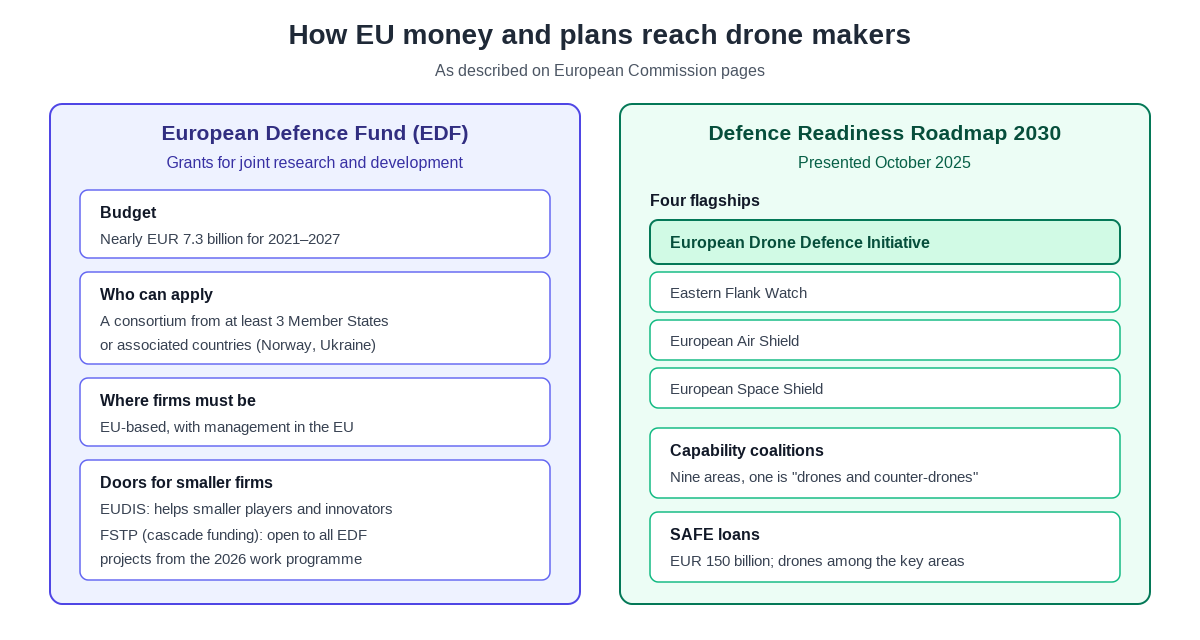
Companies are not the only actors. The EU pays for member states to develop weapons together, and the channel for that is the European Defence Fund (EDF). The EDF budget for 2021–2027 is nearly EUR 7.3 billion, and the rules that set up the EDF took effect in May 2021.
There are conditions attached. Applicants must form a consortium spanning three or more Member States or associated countries, which are Norway and Ukraine. Recipients and their subcontractors must be based in the EU, and so must their management. A single firm from a single country cannot apply on its own.
There are also doors for smaller firms. Within the EDF, the EU Defence Innovation Scheme (EUDIS) helps small companies and innovators enter the defence sector. Financial Support to Third Parties (FSTP), also called cascade funding, is a tool for drawing smaller players into new technology work.
From the 2026 work programme on, every EDF project can use it. The Commission approved that work programme on 17 December 2025, with EUR 1 billion for joint research and development. It also lists drones and counter-drone systems among the EDF's project areas.
There is a plan as well. The Commission put forward the Defence Readiness Roadmap 2030 in October 2025.
The first of its four proposed flagships is the European Drone Defence Initiative. The other three are the Eastern Flank Watch, the European Air Shield and the European Space Shield. The article Counter-drone systems explains why defending against drones takes more than one device.
The roadmap asks member states to complete capability coalitions in nine areas, and one of them is "drones and counter-drones." The Commission says it will monitor how much Europe's industry can produce, beginning with air and missile defence, drones and space systems. SAFE is a EUR 150 billion loan instrument that the Council of the EU approved in May 2025. It names drones as a key investment area alongside missile defence and cyber security.
Telling announcements, contracts and deliveries apart
Drone industry news mixes words that look alike but carry different weight. "Selected," "contracted," "ordered," "delivered" and "entered service" are separate steps.
CORVUS is a good example. The 3 August selection release said service entry would start later in the year, but only once the contract was signed and final approvals were given. Later, the TEKEVER home page carried a news headline saying it had signed the CORVUS contract worth up to £400 million.
The words "up to" also matter. Up to £400 million is the ceiling of the contract. It does not mean that much has already been spent. The dates for Eurodrone's first flight and entry into service are, for now, company plans.
It also helps to ask who is speaking. The company pages and releases in this article often use self-descriptions such as "Europe's leading." Those are company claims, not rankings measured by an independent source. They carry different weight from what governments state directly, such as the UK's factory announcement or the Commission's fund rules.
What to read next
- MALE and HALE Drones: what the MALE class that Eurodrone belongs to is
- ISR drones: why surveillance drones like the AR5 and the Falco Xplorer need to stay up for a long time
- Counter-drone systems: how drone defence, the subject of the EU's drone initiative, is put together
- Export Controls: what ITAR, mentioned in the Eurodrone and Falco Xplorer descriptions, restricts
- A laser weapon is more than a laser: since drone defence came up, what parts a laser weapon is made of
- Baykar: At the Centre of Turkey's Drone Exports: a look at one drone company near Europe that grew through exports