On 8 April 2026, at Korean Air's Tech Center in Busan, a drone and its ground control equipment were shown in public for the first time. It was the first production example of the MUAV, a medium-altitude reconnaissance drone developed in Korea. Counting from the start of R&D in 2008, it took 18 years to get there.
South Korea's drone industry falls into two parts: large military drone programmes, and a market of small civil drone makers. The two have been overseen by different ministries, but recent government plans tie them together more and more.
This article follows that story through official documents and company pages. The documents come from the Defense Acquisition Program Administration (DAPA), the Ministry of National Defense and the Ministry of Land, Infrastructure and Transport. It sorts out who did what, and what has been done versus what is only planned. This article reflects the situation as of October 2026.
The Songgolmae, where Korea's military drones began
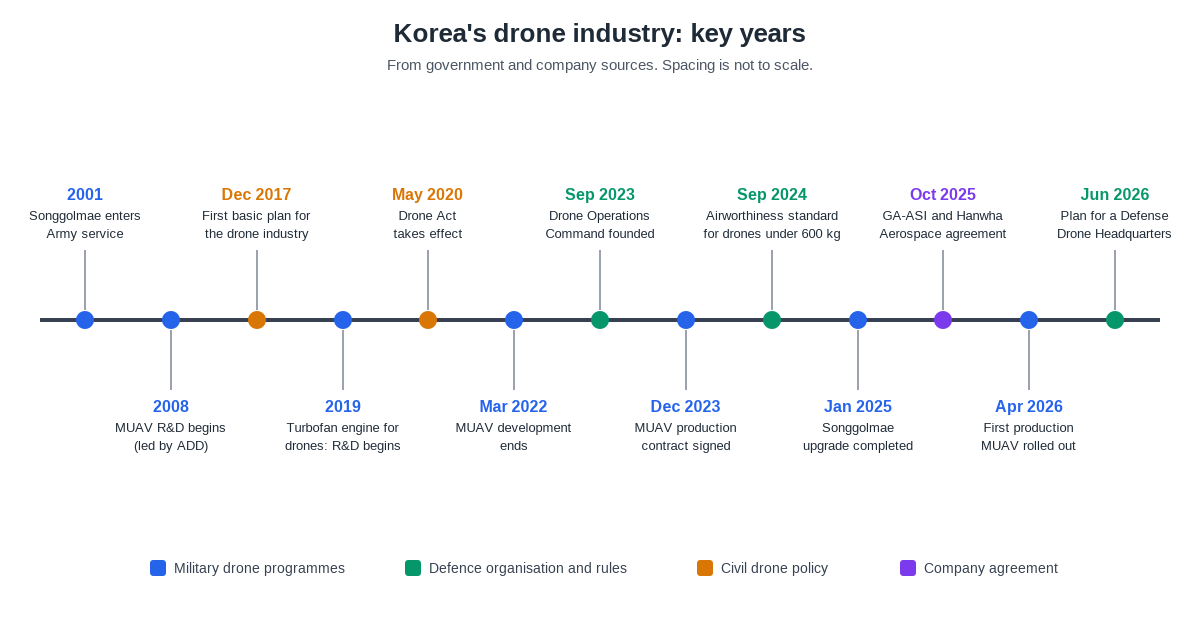
The first chapter is the Songgolmae (RQ-101). Korea Aerospace Industries (KAI) says it deployed this reconnaissance drone with the Republic of Korea Army in 2001. It was the first time that had happened in Korea.
DAPA describes the Songgolmae as a drone developed with domestic technology and fielded in the early-to-mid 2000s. It was upgraded once in the mid-2010s, but ageing and discontinued parts later made it hard to keep in service. In January 2025, DAPA announced that a minor upgrade replacing all key discontinued parts was complete and fielded.
One detail of that upgrade is worth noting: airworthiness certification. This is the process in which the government certifies that an aircraft can fly safely. In this upgrade, even key flight parts such as the propeller went through airworthiness certification to confirm flight safety.
KAI now takes part in developing the follow-on model, the next corps-level drone. Its website also lists advance research on vertical take-off and landing (VTOL) drones, strike-type drones and unmanned combat aerial vehicles (UCAV). Advance research means work done before a programme formally begins, which is worth keeping in mind.
The MUAV and the companies that share the work
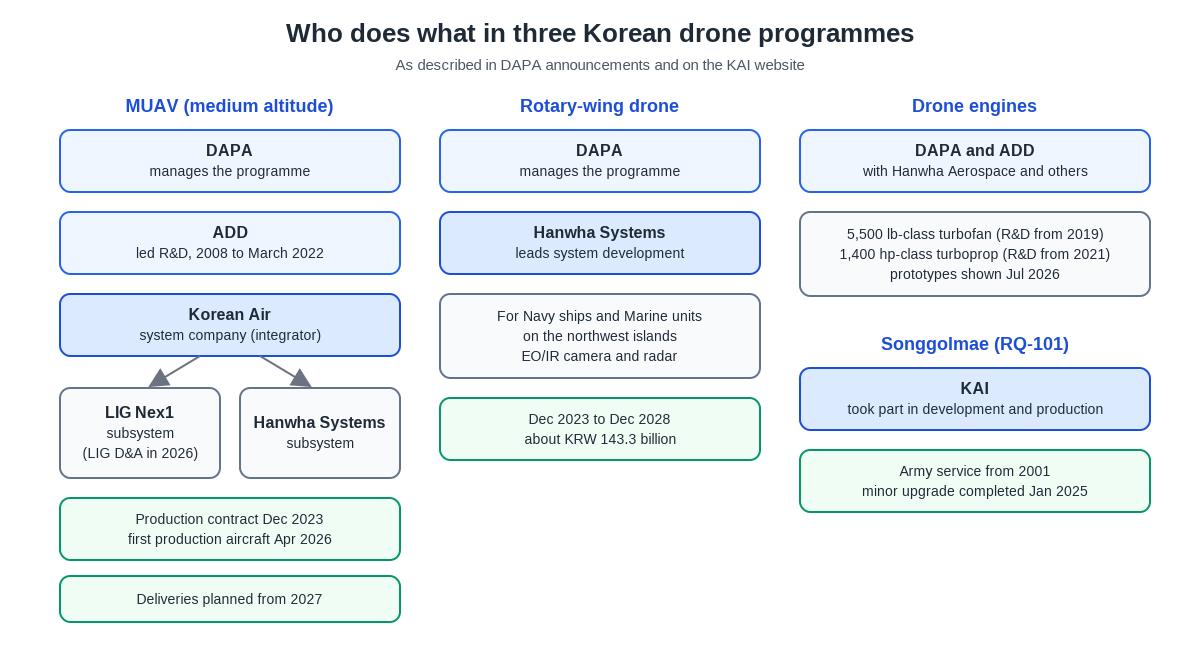
DAPA calls the MUAV "Korea's first strategic-class unmanned aerial vehicle." What a medium-altitude, long-endurance drone is can be found in the article on MALE and HALE drones. The Agency for Defense Development (ADD) led its R&D from 2008. Development ended in March 2022, when the aircraft was judged fit for combat use and its defence specifications were set.
The production contract was signed on 21 December 2023. The total programme cost is 4,717억 원 (about KRW 471.7 billion). Korean Air is the system company, and LIG Nex1 and Hanwha Systems are the subsystem companies.
What is the difference? The system company ties many pieces of equipment into one unmanned aerial system (UAS) and answers for the whole. Subsystem companies supply large equipment groups that go inside it. What the military buys is also not one aircraft but a system that includes the ground control equipment.
DAPA's announcements then give the schedule step by step. A production kickoff meeting was held on 24–25 January 2024 at Korean Air's aerospace research centre in Busan. On 17 December 2024 there was a ceremony for the finished production facility and the start of assembly. Each aircraft goes through sub-assembly, final assembly, and ground and flight tests before it is handed to the Air Force.
At the April 2026 rollout, DAPA gave the localization rate as 90%. The same announcement lists the companies as Korean Air, LIG D&A and Hanwha Systems, a different name from the LIG Nex1 in the 2024 documents. Deliveries are due to begin in stages from 2027, after Air Force acceptance tests.
In its January 2024 announcement, DAPA expected that modified versions of the MUAV could serve the coast guard or fire services, and that it could enter export markets. That is the agency's outlook. An actual modification programme or export deal becomes a fact only when it is announced separately.
Rotary-wing drones and drone engines
Drones that take off without a runway are also in development. In January 2024, DAPA announced the start of system development for a ship-based reconnaissance and northwest-islands drone. The work runs from December 2023 to December 2028, costs about 1,433억 원 (about KRW 143.3 billion), and is led by Hanwha Systems.
It is the first rotary-wing drone design developed in Korea. It carries both an electro-optical/infrared (EO/IR) camera and a multi-function radar, and is planned for Navy ships and Marine Corps units on the northwest islands. DAPA pointed out that the technology for a drone to take off from and land on a ship is highly demanding.
Engines are another task. On 7 July 2026, DAPA and ADD unveiled for the first time prototype engines being developed with Hanwha Aerospace and other Korean firms: a 5,500-pound-class turbofan and a 1,400-horsepower-class turboprop. The turbofan could power a collaborative unmanned combat aircraft in a manned-unmanned teaming (MUM-T) system of crewed and uncrewed fighters. The turboprop is being developed for a next-generation reconnaissance drone.
Why build drone engines at home? DAPA explains that several sets of rules tightly limit the transfer and export of such engines. They include the Missile Technology Control Regime (MTCR), the International Traffic in Arms Regulations (ITAR) and the Export Administration Regulations (EAR). As a result, the engines are hard to bring in from abroad.
Turbofan research began in 2019 and turboprop research in 2021. This is the first time a long-life aircraft engine, meant to be run again and again over many years, has been built with Korean technology. It is still a prototype, and ground tests are planned to verify its performance. Crewed and uncrewed aircraft flying together are covered in the article on Collaborative Combat Aircraft.
The civil drone industry: government plans and market figures
On the civil side, the story starts at the Ministry of Land, Infrastructure and Transport. The government drew up its first basic plan for the drone industry in December 2017. On 1 May 2020, the Act on Promotion of Drone Use and Creation of Its Infrastructure, often called the Drone Act, took effect.
The draft decree under this act covered how to draw up the basic plan, a drone industry survey, and a public-private council chaired by the transport minister. It also set up special drone free zones. These are areas where new drone products can be tested with fewer regulatory burdens.
Figures the government released in December 2021 show fast growth. The domestic drone industry market grew from 704억 원 (KRW 70.4 billion) in 2016 to 4,945억 원 (KRW 494.5 billion) in 2020. In February 2021, the first round of special free zones named 33 zones in 15 local governments.
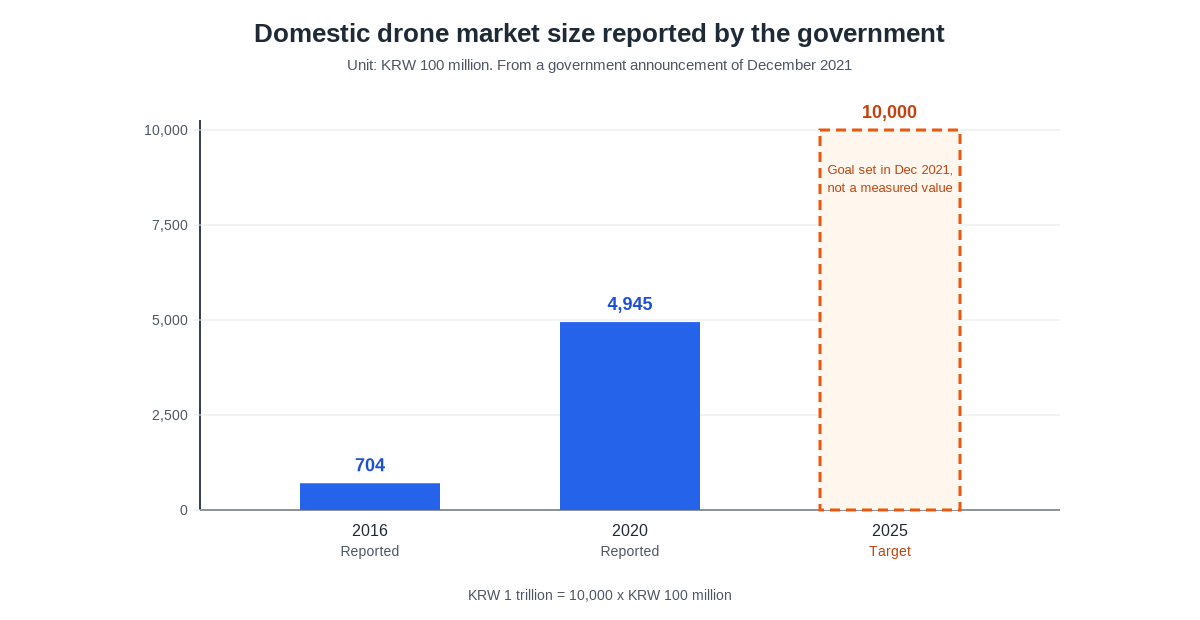
The same announcement set targets. By 2025, the government aimed to find 20 successful commercial models and grow the domestic market to 1조 원 (KRW 1 trillion). It also expected drone-related jobs to rise from 4,600 to 9,200.
These are targets, though. That is why the 2025 bar in the chart is dashed. Whether the market actually reached KRW 1 trillion in 2025 has to be checked against later survey figures.
The transport ministry also noted weak points itself. Drone use is concentrated in a few fields, there are worries about flights over cities, and infrastructure, workforce and rules all need more work.
Changes in military drone units and buying plans
On the military side, the organisation changed first. On 1 September 2023, a founding ceremony for the Drone Operations Command was held at a military airfield in Pocheon, Gyeonggi Province. The unit drew troops from the Army, Navy, Air Force and Marine Corps, and the ministry introduced it as the military's first joint combat unit.
Less than three years later, on 26 June 2026, the Ministry of National Defense announced a defence drone and counter-drone policy. One pillar is turning the Drone Operations Command headquarters into a Defense Drone Headquarters. It will report directly to the ministry and handle combat development, acquisition support, military trials, rule changes and civil-military cooperation, while each service runs drone operations itself.
The buying plans were large. The ministry plans to acquire more than 20,000 cheap, expendable drones, such as short-range reconnaissance and small suicide drones. It will also push ahead with fielding K-LUCAS, a Korean long-range one-way attack drone. For training troops, it plans to bring in about 60,000 Korean-made commercial drones.
For companies, the buying method matters. The 2026 training drone purchase was the first in the defence sector to use multiple award. Several Korean firms could supply it together.
Certification for bringing commercial drones into the military is also being prepared. The ministry said it will build a Korean military certification system based on the Blue UAS concept. It will also work with other ministries to standardise key parts such as batteries.
DAPA's rules changed too. On 11 September 2024, it issued a standard airworthiness certification criteria for military aircraft written only for drones with a maximum take-off weight under 600 kg. The scope of a small unmanned aircraft system (sUAS) differs from source to source, and this standard draws its line at 600 kg.
The standard has 125 criteria, more than 90% fewer than before. DAPA expected certification that usually took more than a year to shrink to within six months. It also noted that drone makers had sometimes seen airworthiness certification as a barrier to entering the defence market.
In July 2026, the Defense Agency for Technology and Quality issued three defence standards for military drones covering terms and classification, flight performance test methods and environmental test methods. They set basic principles and procedures for testing multirotor drones of 25 kg or less. Companies can refer to the test methods they need during development.
The ministry's June policy also covers the defending side. In the mid to long term, the ministry plans to acquire directed-energy weapons such as lasers and high-power microwaves, and low-cost interceptor drones. The broad picture of counter-drone technology is in the article on counter-drone systems, and a Korean laser air-defence demonstration is in the article on Hanwha Systems' Cheongwang laser demonstration.
Working with foreign companies
Korean companies and the government have also taken on more joint development with foreign firms. On 13 April 2023, DAPA signed a memorandum of understanding (MOU) with Boeing on joint R&D of advanced weapon systems. On 16 November that year, the two agreed to firm up cooperation on joint R&D of a high-altitude long-endurance (HALE) drone and on aircraft maintenance and upgrades.
On 2 April 2025, DAPA signed an MOU with Anduril Industries of the United States on jointly developing advanced unmanned combat systems. It was DAPA's second international joint development MOU, after Boeing. Leaders from Korean Air, Hanwha Aerospace, Hanwha Systems, KAI and LIG Nex1 attended the signing.
There are also deals between companies. General Atomics Aeronautical Systems (GA-ASI) of the United States announced an agreement with Hanwha Aerospace signed on 14 October 2025. Under it, the two will co-develop and co-produce the Gray Eagle STOL, a short take-off and landing drone. First flight is planned for 2027 and first customer delivery for 2028.
The two companies will build a plant in South Korea that handles final assembly and production, while GA-ASI does the final integration. In 2024 a demonstrator flew from the Korean Navy ship ROKS Dokdo while it was under way at sea. An MOU sets a framework for cooperation, and it carries different weight from a development or production contract.
What to check when reading the numbers and plans
Announcements in this field mix what has happened with what is planned. The Songgolmae deployment, the MUAV production contract and first rollout, and the airworthiness standard are done. The plans and targets include more than 20,000 drones, about 60,000 training drones and about 2조 원 (KRW 2 trillion) of public demand over five years. The KRW 1 trillion market for 2025 was a target as well.
Statements about the same programme sometimes differ a little. In April 2026, DAPA said MUAV deliveries would start in 2027. Two months later, the defence policy chief said in a briefing that the medium-altitude reconnaissance drone would be fielded "from this year." Company names also differ by document, with LIG Nex1 in some and LIG D&A in others.
The weak points the government itself names are worth reading too. In 2024, DAPA noted a long-standing concern that the defence drone industry rests mainly on small and mid-sized firms, so its base is somewhat unstable. It also noted heavy dependence on foreign suppliers for key parts. Companies at the meeting said their reliance on China for key parts such as engines and batteries is high.
The same issue came up at an integrated acquisition forum DAPA held in June 2026. The government strategy named the small scale of Korean drone firms and their dependence on Chinese technology and parts as problems to fix. Industry participants said weak domestic demand and low-price competition abroad were making things hard. The forum's aim is to pool drone demand scattered across ministries and buy it in one place.
There is also a link between civil and military. In January 2025, the Korea AeroSpace Administration and DAPA, as the two bodies in charge of the civil and defence drone industries, held their first director-level meeting. They agreed to build a common standard system for dual-use drones. Since makers have seen airworthiness certification as a barrier to the defence market, standards and certification sit right at the threshold civil firms must cross to supply the military.
What to read next
- MALE and HALE drones: the drone class the MUAV belongs to
- ISR drones: the work of drones that stay up for a long time
- Counter-drone systems: the technology on the defending side
- Collaborative Combat Aircraft: plans for uncrewed jets flying beside fighters
- In the same series, "Blue UAS: The Drones the US Government Approves" and "The Drone Supply Chain: Where Motors, Batteries and Cameras Come From": wider looks at certification and parts dependence