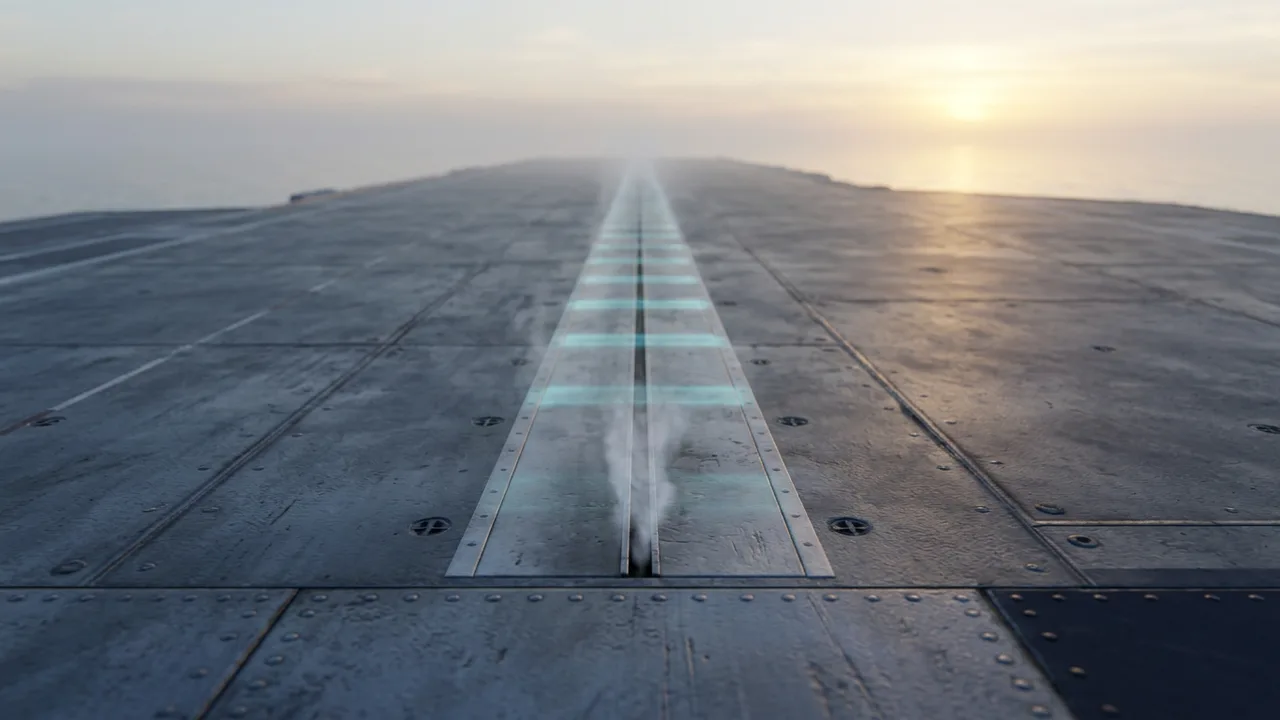
An airliner at an airport gathers speed on its own as it rolls down a long runway. An aircraft carrier at sea has no room for that. So how does a heavy aircraft get into the air from a ship?
The answer is hidden in the deck: the catapult. A catapult gives the aircraft a hard push along the deck.
There are two main ways to make that push. One is the steam catapult, used for decades. The other is EMALS, the Electromagnetic Aircraft Launch System on the newest U.S. carrier. This article explains what each one pushes with, using textbook physics, and then follows the public record of how the new system made it to sea.
Why the aircraft needs a push
A carrier is a ship built to carry aircraft. To do its job, it has to get those aircraft into the air quickly. A U.S. Navy engineering course for officers opens with exactly this point.
In that course material, a carrier is only as effective as its launching is fast. The ship therefore needs a compact, efficient device that gets every aircraft airborne in a short time. That device is the catapult.
The job itself is simple. Within a short stretch of deck, the catapult pushes the aircraft up to launch speed.
The steam catapult: steam pushes a piston
The main part of a steam catapult sits just under the flight deck. Below the deck, in a long channel, two rows of cylinders with slits along their tops run next to each other, each with a piston inside. The two pistons are joined by a connector shaped like an upside-down T, which is attached to a shuttle running on a track just under the deck. The upright leg of the T rises through a slot in the deck and becomes the hook that tows the aircraft.
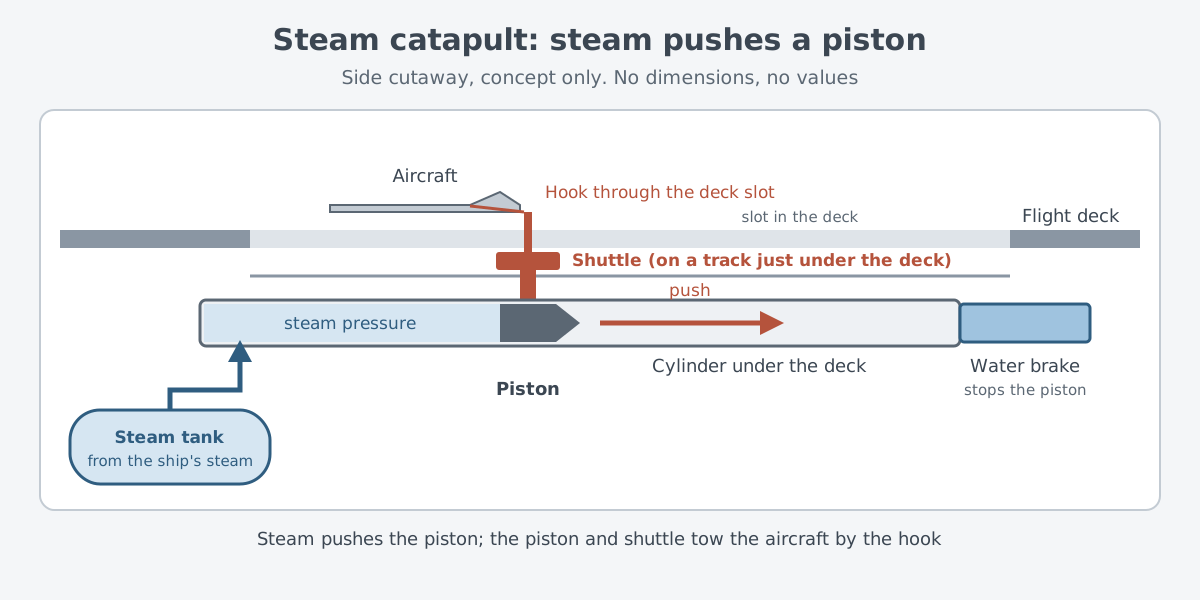
The push comes from the ship's steam. Steam drawn from the ship's main steam system waits under pressure in large tanks below the catapult. At the moment of launch it flows into the cylinders and pushes straight on the pistons, and the pistons and shuttle race down the cylinders together. As the pistons move, a sealing strip shuts the slit behind them so the steam cannot leak out.
The physics at work is pressure. Pressure is the force acting straight on a surface divided by the area of that surface. Turned around, the same pressure gives a larger force on a larger area. A steam catapult gets its large force by putting high-pressure steam against the face of the piston.
Think of a kettle lid rattling as the water boils. The real thing is different in important ways. The catapult's steam is gathered under pressure in a tank and let out all at once, and the piston can only move one way along a fixed cylinder.
At the end of the run, the front of the piston plunges into a cylinder full of water, called the water brake. Pushing into the water raises the pressure there, and that pressure stops the piston and shuttle.
The steam catapult is not new. The Imperial War Museums in Britain hold a Royal Navy film record dated 1951. It shows the carrier HMS Perseus with a steam catapult fitted at the front of its flight deck, moving from trials that fired weights to live launches of jet aircraft. The U.S. Nimitz-class carriers also use steam catapults.
EMALS: a moving magnetic field does the pushing
The newest U.S. carrier, USS Gerald R. Ford (CVN 78), pushes its aircraft with electricity instead of steam. In a Government Accountability Office (GAO) report, EMALS appears as the replacement for the steam catapult: a moving magnetic field, made with electricity, pushes aircraft up to launch speed.
There is still a shuttle. What pushes it is a magnetic field, not a piston.
How can a magnetic field push something? Two textbook facts are enough.
First, when a magnetic field changes, a voltage appears in a loop of conductor inside it. Second, a wire carrying current feels a force in a magnetic field. The second fact is the same principle that drives an electromagnetic railgun.
Material from the company that builds EMALS, General Atomics, says the system is driven by a linear induction motor. An ordinary electric motor turns a shaft, while a linear motor, as the name says, pushes along a straight line. An induction motor uses a changing magnetic field to make a current in a conductor, and that current then feels a force from the field. It puts the two textbook facts to work in one machine.
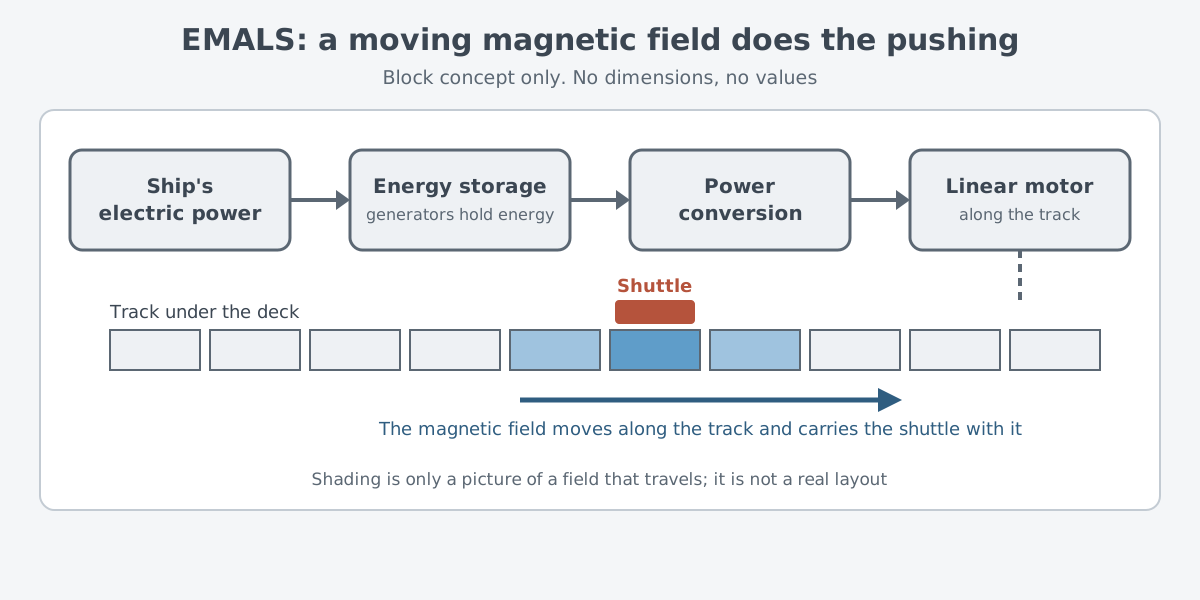
The electricity comes from the ship. Inside EMALS is a generator that holds the large amount of power the launcher needs.
The maker has delivered the "energy storage system motor generator" sets for the Ford to the Navy. The stored energy passes through power conversion equipment on its way to the motor along the track.
The two side by side
Both catapults do the same job. A shuttle tows the aircraft and pushes it to launch speed over a short distance. What differs is where the force comes from.
| Item | Steam catapult | EMALS |
|---|---|---|
| Energy comes from | The ship's steam | The ship's electricity |
| Stored in | Tanks of steam under pressure | Generators that store energy |
| What does the pushing | A piston in a cylinder | A magnetic field moving along the track |
Government reports also name some differences. In GAO's assessment, EMALS is easier on the airframe than steam catapults are. A 2013 GAO report links EMALS to the Ford's planned sortie rate and smaller crew. Part of the reason is the Navy's expectation that the system will be available more of the time.
The maker goes further, claiming the system will cut operating costs and maintenance, improve catapult performance, and widen the range of crewed and uncrewed aircraft a carrier can launch. These are the company's claims. The test reports below show separately how the system has done on a real ship.
Getting a new system to sea
EMALS started from a different place than the Ford's other key technologies. According to GAO, the Navy built competing prototypes in 2004 and tested them while choosing a developer, so EMALS was already close to maturity before the ship's detailed design contract.
The road to sea was still bumpy. In a 2007 GAO report, EMALS finished its system integration phase more than 15 months behind schedule and well over budget. Much of the technical trouble came from failures of the prototype generator that stores power.
By GAO's 2017 account, production began while land-based testing was still going on. Problems those tests found where EMALS connects to and converts the ship's power forced changes to equipment already being built.
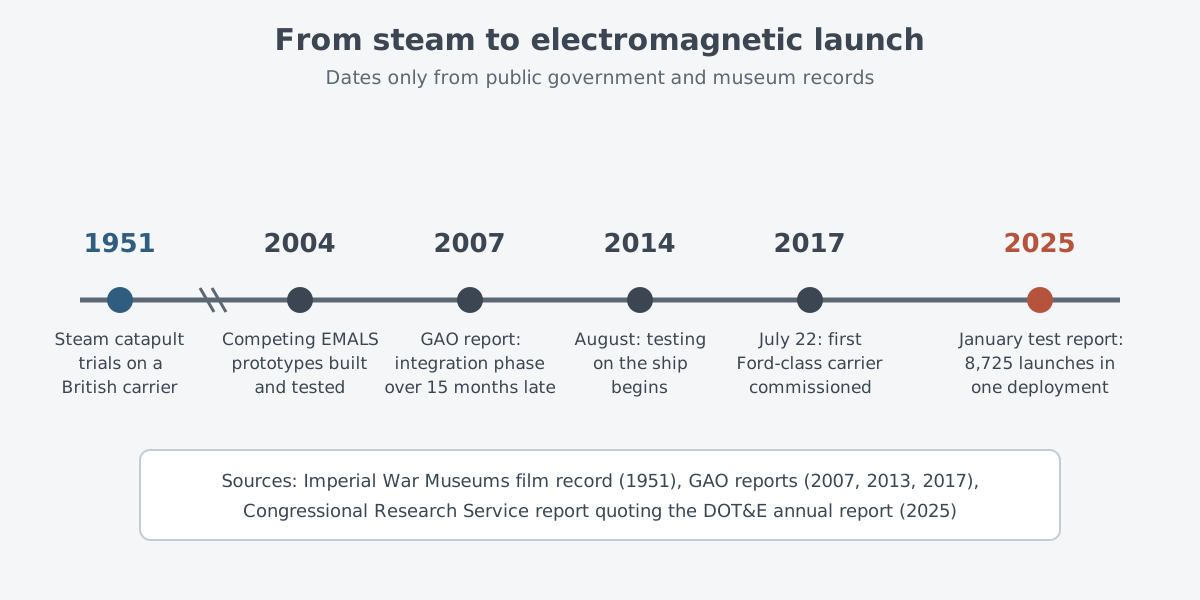
Testing on the ship began in August 2014, and EMALS later finished its trials firing test weights. The Ford was commissioned on July 22, 2017.
Reliability comes up often with any new system. The Navy measures EMALS reliability as the average number of launches it completes before a failure. The launches add up as cycles. In 2013, GAO found that EMALS was not scheduled to reach its required reliability until many years after the Ford finished initial operational test and evaluation.
The annual report for fiscal year 2024 from the Pentagon's Director, Operational Test and Evaluation (DOT&E), released in January 2025, also covers EMALS. In the part quoted by the Congressional Research Service (CRS), the ship and its air wing made 8,725 EMALS launches during the Ford's 262-day deployment, by the Navy's count. DOT&E had not received enough data to update its reliability statistics.
Despite hardware and software upgrades, reliability had not changed much from earlier years, in DOT&E's view. Relying on technical support from off the ship was still a challenge. The report adds that Naval Air Systems Command (NAVAIR) is continuing work on improvements.
In DOT&E's judgment, the reliability and upkeep of EMALS and the arresting gear keep hurting sortie rates and flight operations. That remains the biggest risk for the initial operational test and evaluation.
Where this meets lasers: the ship's electricity
EMALS is a large machine that runs on the ship's electricity. That makes the ship's power supply matter. The Ford class keeps the basic Nimitz-class hull but adds features for more sorties per day and more electrical power for the ship's systems.
The same CRS report also quotes a paragraph from a House Armed Services Committee report.
The committee sees a chance to build new technology and design updates into carriers that have not been delivered yet. Among its examples are directed energy applications, listed alongside better electronic warfare, ship self-defense and offensive combat systems. Laser weapons are one branch of directed-energy weapons (DEW), and they make light from electricity. How much of the electricity going in comes out as light is covered in Power and efficiency.
What to read next
- Aircraft carriers: turning a ship into an airport: the whole flight deck that the catapults are part of.
- Arresting gear: stopping a jet on deck: the other half of the job, catching and stopping aircraft.
- Electromagnetic railguns: launching with electricity: the force on a current in a magnetic field, in another weapon.
- Power and efficiency: why efficiency matters for laser weapons that run on a ship's electricity.