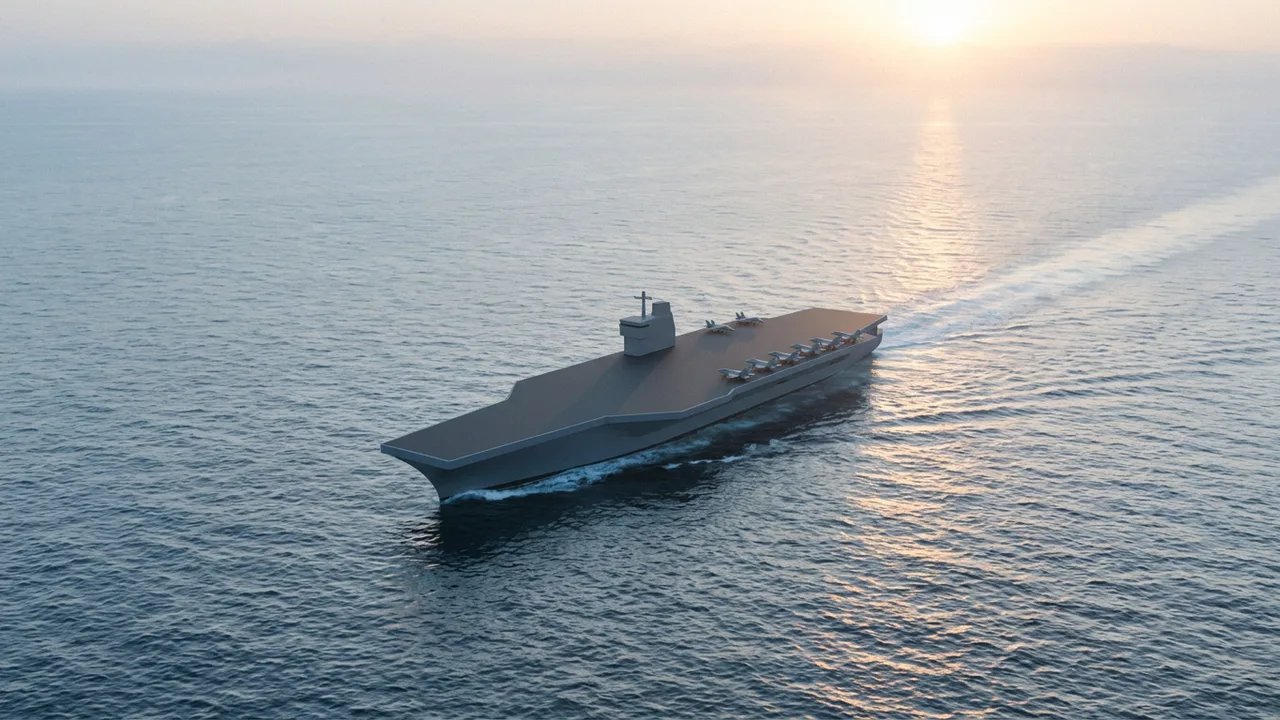
Picture an airport and several things come to mind at once: a runway, hangars for the aircraft, a control tower, and crews who fuel planes and load them. An aircraft carrier comes close to putting all of that on one ship and moving it out to sea.
This airport, though, moves under its own power, and it does not travel alone. To understand a carrier, you have to look at more than the ship. The people working on it and the fleet around it matter just as much, and the last part turns to nuclear-powered carriers and the light carrier discussion in South Korea.
What an aircraft carrier is: an airfield at sea
One chapter of a basic U.S. Navy training text sums up the job in one line. A carrier carries, launches, recovers and handles combat aircraft, and does all of it quickly and effectively. The same passage notes that a carrier can close in at high speed, send its aircraft out and take them back aboard.
In that text, the carrier is the center of a naval task force. A 1998 report by the U.S. Government Accountability Office (GAO) called the carrier a "building block" of naval power. It called the carrier the base unit for the Navy's peacetime presence abroad, its crisis response and its combat forces.
The airport comparison makes a good first picture, but the real thing differs in an important way. An airport on land is a facility that receives aircraft. A carrier is a system in which the ship and its aircraft work as one unit, and neither can do the job without the other.
Parts of the ship: flight deck, hangar and island
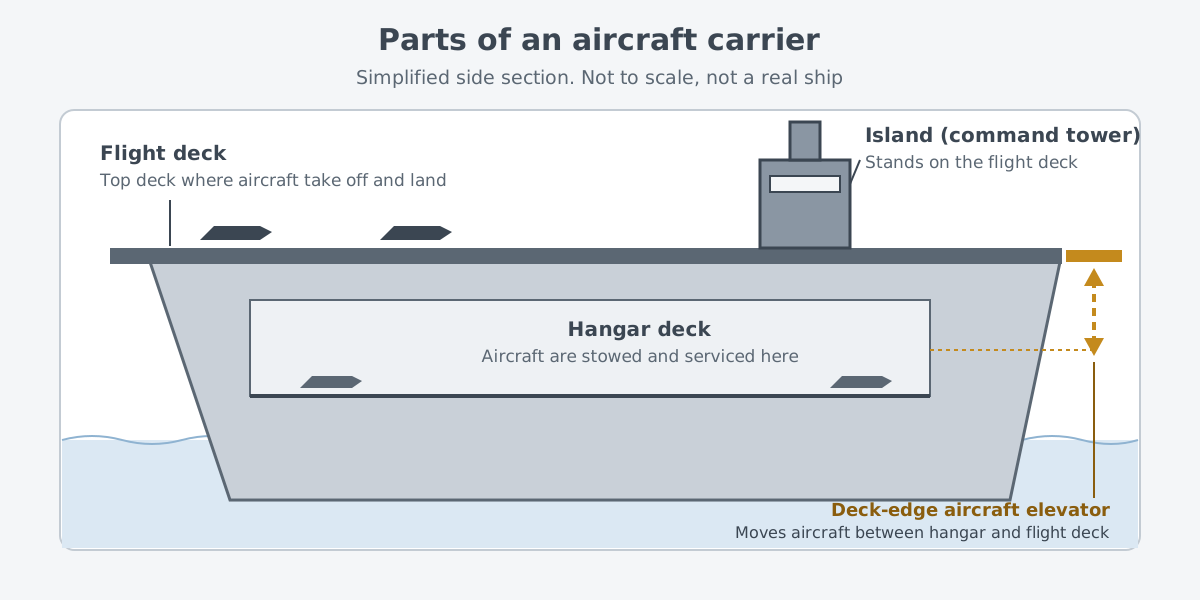
Most carriers share a common set of features. The list starts with an angled flight deck, catapults, and the ability to send aircraft off and take them back at the same time. It goes on with a large hangar deck for storage, elevators at the deck edge, big repair shops and storerooms, and gear for fast refueling.
The flight deck is the uppermost complete deck. Aircraft take off from it and land on it. How an aircraft gets airborne from such a short deck is the subject of the next article, on catapults and EMALS.
Below the flight deck is the hangar deck. Aircraft are stowed and serviced there when they are not up on the flight deck. On a carrier, the hangar deck is called the main deck.
Aircraft elevators at the deck edge join the two decks and lift aircraft quickly between the hangar and the flight deck. Layouts vary by design. According to a public affairs story from USS Gerald R. Ford, the Ford-class hangar has two bays where the Nimitz class has three, and three aircraft elevators where the Nimitz class has four.
One tall structure stands on top of the flight deck. It is called the island. When GAO described the building of the first Ford-class ship, it called the island the "command tower."
The bridge, where the ship is steered, sits in the structure that rises above the deck. On a carrier, the signal bridge, used for signaling, sits behind the navigation bridge and usually one deck higher. The Ford-class island is smaller than a Nimitz-class island, sits farther aft and carries fewer rotating radars.
Who does what on the deck
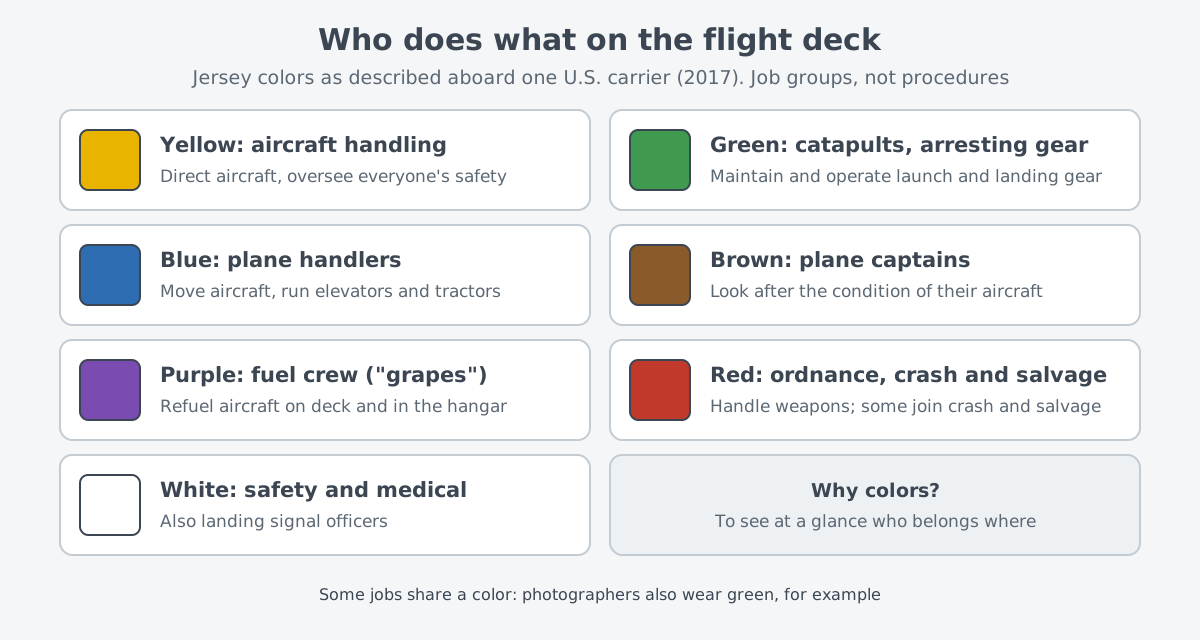
On the flight deck, you can tell who does which job from the color of the jersey. USS Gerald R. Ford has seven jersey colors. Each color stands for a group of jobs, as the table shows.
| Color | Name | Job |
|---|---|---|
| Yellow | Handlers | Direct aircraft and watch over the safety of everyone during flight operations |
| Blue | Plane handlers | Move aircraft and run the aircraft elevators and tractors |
| Purple | "Grapes" | Fuel aircraft, both up on deck and down in the hangar bay |
| White | Safety and medical staff | Usually cover safety and medical care; landing signal officers also wear white |
| Green | Catapult and arresting gear crews | Maintain and operate the catapults and the arresting gear |
| Brown | Plane captains | Look after the condition of their own aircraft and make sure it is inspected and serviced around each flight |
| Red | Ordnance crews | Usually move weapons and load them onto or off aircraft; some also serve on the crash and salvage team, first on scene at a deck fire |
One color does not always mean one job. Photographers and some other staff also wear green. The colors let anyone see at a glance where each person should be and which role and equipment each person answers for. The system grew out of lessons learned in the past.
One station keeps an eye on the whole deck. Primary flight control, or "pri-fly," serves as the control tower of the ship. Its crew watches the flight deck and talks to the people there so that crews and equipment stay safe. The air boss and an assistant called the "mini boss" run it, backed by a team of sailors from the aviation boatswain's mate ratings.
The air wing and the ships around it
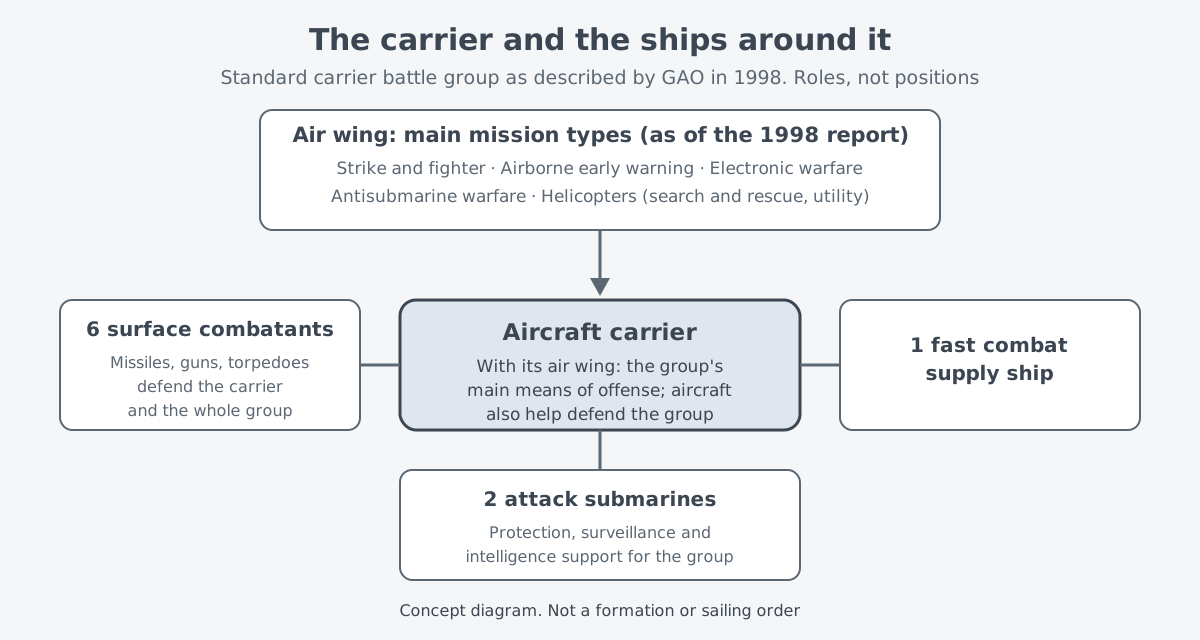
The group of aircraft a carrier takes to sea is its air wing. The 1998 GAO report shows that a Navy instruction from February 1995, the "Policy for Carrier Battle Groups," set a standard makeup for the air wing on each carrier. That makeup covered strike and fighter missions, airborne early warning, and suppression of enemy air defenses with electronic warfare. It also listed antisubmarine warfare, electronic intelligence, and helicopters for antisubmarine warfare and search and rescue.
Air wings are still a matter of law. U.S. law requires the Navy to keep at least a set number of carrier air wings, each with its own fully staffed headquarters.
A carrier does not sail alone. In that same report, a standard carrier battle group had the carrier with its aircraft at its core. Around it were six surface warships, two attack submarines and one fast supply ship that serves several purposes. Navy guidance called for at least one surface combatant to escort the carrier at all times.
Each ship has its own share of the work. The carrier and its aircraft are the group's main way to attack. Those aircraft also take part in defending the group against threats in the air, on the surface and under the sea.
The surface warships use missiles, guns and torpedoes to guard the carrier and every other ship in the group. The submarines add protection, watch the area and gather intelligence for the group.
Where carriers sit in naval history
GAO judged that carrier battle groups have been a central political and military means of peacetime "presence" abroad ever since World War II. It can be read as the same idea as the forward peacetime role mentioned earlier.
The way carriers are powered has changed too. The first nuclear-powered carrier, USS Enterprise (CVN-65), came from the Navy's nuclear propulsion effort in 1961, and Nimitz (CVN-68) joined the fleet in 1975. Kitty Hawk (CV-63), the final carrier that burned conventional fuel, left service on January 31, 2009.
A Congressional Research Service (CRS) report, updated in December 2025, shows that every U.S. Navy carrier today is nuclear-powered, 11 in all. Ten belong to the Nimitz class and joined the fleet from 1975 to 2009. The eleventh is the Ford-class lead ship, commissioned on July 22, 2017. U.S. law requires the Navy to keep no fewer than 11 operational carriers.
The Ford class builds on the Nimitz-class hull form with several changes. The changes aim for more flights each day and more electricity for the ship's systems. They also let the ship run with a crew several hundred people smaller than a Nimitz-class crew. On the Ford, the electromagnetic aircraft launch system (EMALS) takes the place of the steam catapults long used to launch aircraft.
Ship power also links to other weapons that run on electricity. The electromagnetic railgun article covers a weapon that draws on ship power to fire a projectile, and the power and efficiency article covers how laser weapons relate to electrical power.
New equipment brought new problems. Among the issues CRS puts before Congress are rising costs and late schedules in building the Ford class.
CRS also quotes the Pentagon's test office, known as DOT&E. Its report says that during the Ford's FY2024 deployment, the carrier and its aircraft flew enough sorties to meet the operational tasks set by commanders. It adds that the reliability and upkeep of the first ship's EMALS and new arresting gear (AAG) keep hurting the number of flights and flight work.
South Korea has its own carrier discussion. The Defense Acquisition Program Administration (DAPA) announced a kickoff meeting on October 27, 2020, for developing core technologies for a light aircraft carrier. At the meeting, DAPA, military and research officials were to review how to secure those technologies and the development plan.
In July 2025, Kookbang Ilbo, the Korean defense ministry's newspaper, reported that the Navy is pursuing a "multipurpose manned-unmanned teaming carrier" (MuM-T Carrier). Details of the plan came out at a National Assembly seminar.
The plan is to get this ship by reshaping the existing light carrier construction program. The ships Dokdo and Marado are to be upgraded so that drones can take off and land on them. The aircraft types and numbers are to be set through a defense policy study.
What to read next
- Aircraft carrier catapults and EMALS: how aircraft take off from a short deck: a look at the equipment that launches aircraft from the flight deck.
- Close-in weapon systems: a warship's last layer: how a warship stops threats that get close.
- Electromagnetic railguns: launching with electricity: what a weapon fired with ship power showed.