Videos of human-shaped robots carrying boxes down a factory aisle no longer surprise anyone. What a video cannot tell you is whether that robot works a paid shift every day or performed the scene once in a company lab.
A humanoid is a robot with a body like ours: two arms and two legs. Eight companies come up again and again in the news: Tesla, Figure, Boston Dynamics, Unitree, Agility, Apptronik, 1X and UBTech. Where do they want their robots to work, and what stage have they reached?
Every company detail here comes from material the companies published themselves, up to October 2026.
Two ways to read the map
The first is where a company aims. Most go after car plants and logistics warehouses first, and a few talk about the home. Their own explanations keep giving the same reason for a human shape. A robot shaped like a person can work in a site built for people, so the site does not have to be rebuilt around the robot.
The second is the stage. An unveiling shows a robot for the first time. A trial or proof of concept involves a few customers.
A commercial deployment puts robots to work at a customer site under contract, and a sale means anyone can order one. These are different stories. The same company can be at different stages for different robots and in different years.
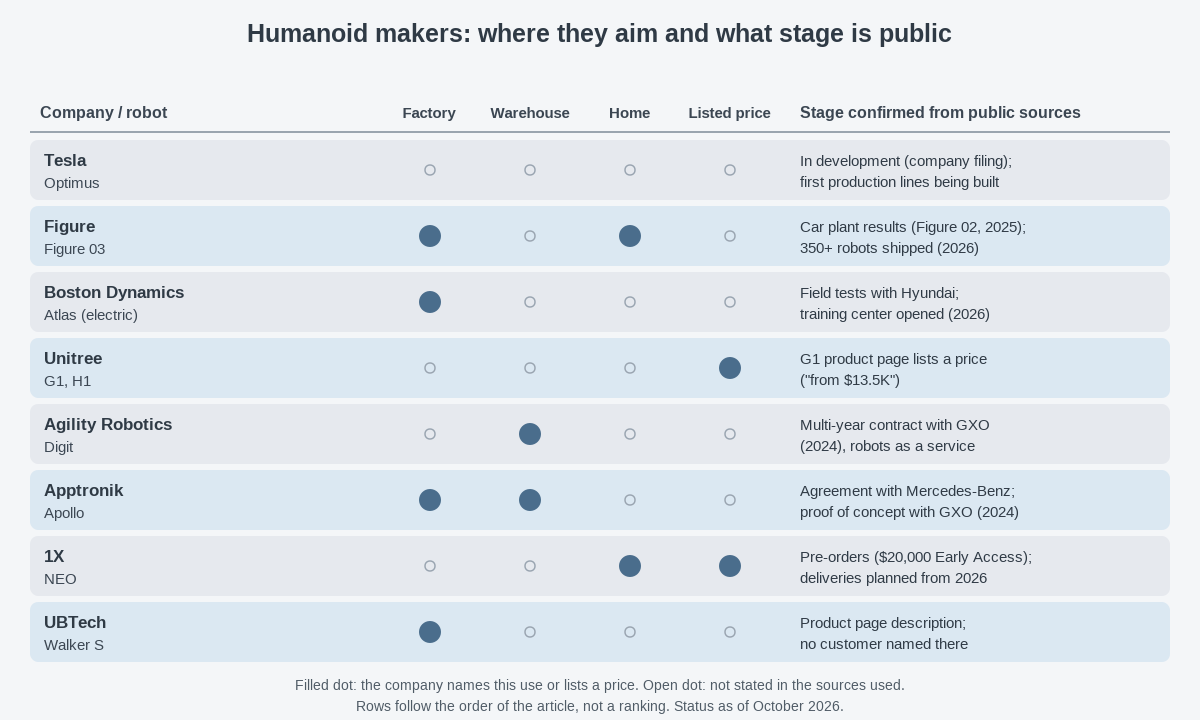
The table below puts both on one page. The stage column only goes as far as the companies' own published material confirms.
Tesla: Optimus in development
The humanoid from Tesla, the electric car maker, is Optimus. In the annual report Tesla filed with the US Securities and Exchange Commission (SEC), Optimus is described as an autonomous general-purpose humanoid robot "in development." The risk factors in the same filing say the robot business belongs to an early-stage industry that is not yet commercially established. Tesla has yet to commercialize its robots, and success is not guaranteed.
The shareholder letter at the front of the report has a different tone. The letter mentions the first Optimus production lines being built, and the cover carries the line "readied V3 Optimus for mass-production." It gives no count of robots built.
In short, as of October 2026 Tesla itself places Optimus at the "in development" stage, with preparations for mass production under way. Nothing in this filing confirms sales or customer deployments.
Figure: a car plant and the home
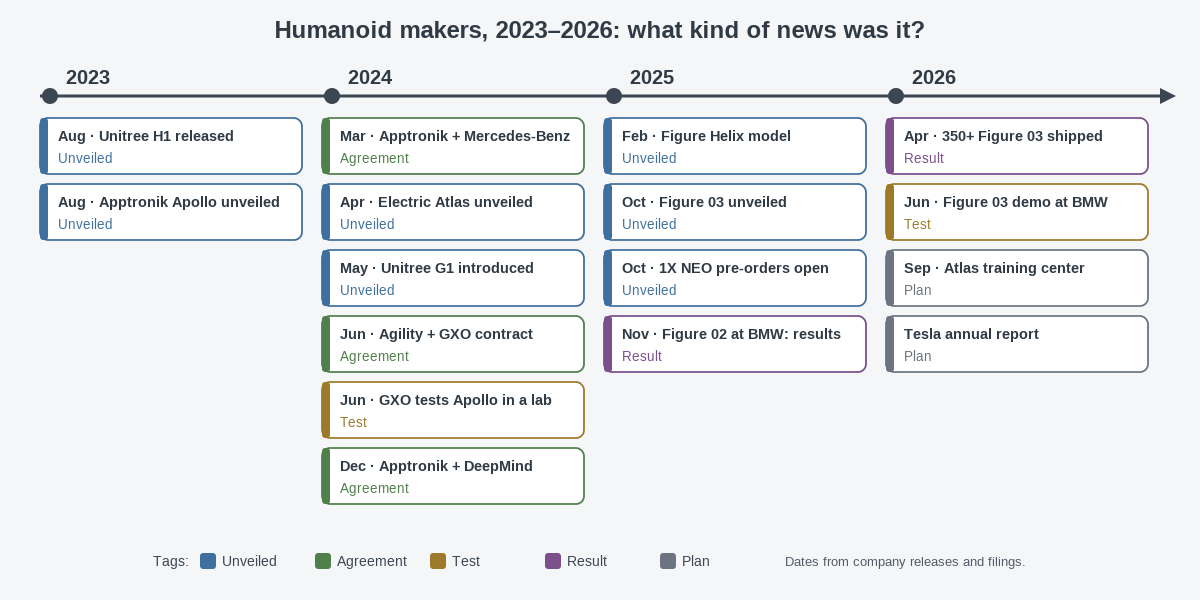
Figure unveiled its third-generation robot, Figure 03, on October 9, 2025. The design goals it named were its own AI, Helix, the home, and large-scale rollout. Helix is a vision-language-action (VLA) model announced in February 2025 that combines seeing, understanding language and moving the body in one model. The company presented Helix as "a series of firsts."
There is a factory record as well. On November 19, 2025, Figure published the results of an 11-month deployment of the previous model, Figure 02, at BMW's Spartanburg plant. The job was loading sheet-metal parts onto a welding fixture, and the company said the robots contributed to the production of more than 30,000 X3 vehicles. Figure 02 began its retirement at the same time.
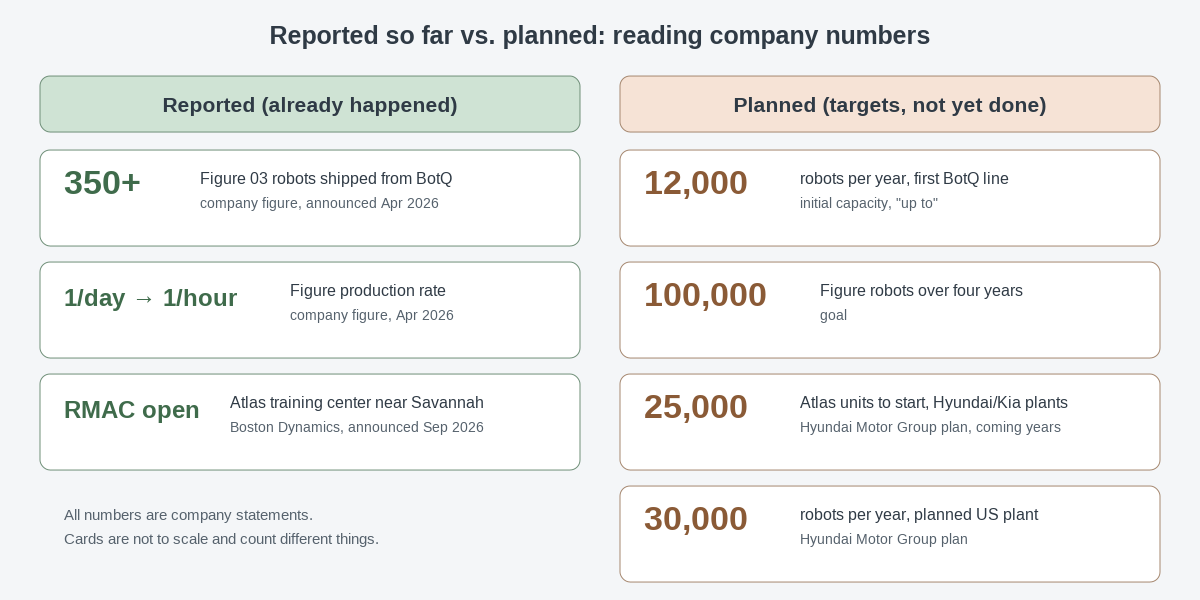
Production numbers need to be split into results and plans. The first line at Figure's BotQ plant can initially make as many as 12,000 robots a year, and the goal is 100,000 robots over four years. That is a plan.
By an April 29, 2026 announcement, more than 350 third-generation robots had left the plant, and the production rate had risen from one robot a day to one an hour. That is a result reported by the company.
On June 30, 2026, Figure 03 entered Hall 52 at the BMW plant. It was the first time Figure 03 had been shown doing logistics work at that plant. The robot picks and places parts while pulling a heavy wheeled cart. Figure has reached the stage of reported shipments and factory demonstrations, while a robot working in the home is still a design goal.
Boston Dynamics: from hydraulics to electric
For years, Boston Dynamics' Atlas appeared in videos as a research robot. In April 2024 the company retired the hydraulic Atlas, which moved by fluid pressure, and unveiled an electric Atlas aimed at real-world use. It said the electric version would have more strength and could move through a wider range than earlier generations, and called it "the first look at a real product."
Hyundai has invested in the company and is also its first test partner. Atlas has started field tests at a Hyundai customer facility, on tasks that put parts in the right order. It swaps its own batteries so it can keep working, and its first customers will be a small number of early adopters. Boston Dynamics calls Atlas "the world's first enterprise-grade, industrial humanoid robot."
On September 21, 2026, the company announced the Robotics Metaplant Application Center (RMAC), a training site for Atlas inside Hyundai Motor Group Metaplant America near Savannah, Georgia. Atlas will learn parts logistics and sequencing first, with component assembly added by 2030.
Hyundai Motor Group plans to start by deploying 25,000 units across Hyundai and Kia plants in the coming years. It also plans a US plant able to produce 30,000 robots a year. The company description in the same release still calls Atlas an electric humanoid platform "currently in development."
Atlas has come as far as customer site tests and an open training center, while the 25,000 units and the 30,000-a-year plant are plans.
Unitree: robots with a listed price
Unitree researches, builds and sells legged robots and humanoids. It develops core parts in-house, including motors, reducers, controllers and the lidar that measures distances to its surroundings.
Its first humanoid, H1, was officially released on August 15, 2023. The product page lists H1 at about 180 cm tall and about 47 kg. The smaller G1 followed in May 2024, and H2 was unveiled in October 2025.
What stands out is the price. The G1 product page shows a starting price, "Price from $13.5K," and a weight of about 35 kg. To see its surroundings it uses a depth camera and 3D lidar. How lidar uses laser light to measure distance is covered in Measuring with lasers: range finding and lidar basics.
Agility and Apptronik in warehouses
Agility Robotics' Digit went to work in logistics warehouses. On June 27, 2024, the company signed a multi-year agreement with the logistics firm GXO and began deploying Digit in GXO's operations. Before the deal, the two companies ran a proof-of-concept pilot at the end of 2023. Digit took on a repetitive job: taking totes handed over by collaborative robots and placing them on conveyors.
The agreement uses a subscription model called Robots-as-a-Service (RaaS), in which the customer uses the robots as a service instead of buying them. Agility described it as the first formal commercial humanoid deployment in the industry. Its current website presents Digit as the first robot hired by supply chain companies, naming Toyota, Amazon, Mercado Libre and GXO.
Apptronik spun out of a University of Texas at Austin lab in 2016. Apollo, unveiled on August 23, 2023, is about 173 cm tall, weighs about 73 kg and can lift about 25 kg. Its batteries swap out, and each battery runs for four hours. At the unveiling, the company called Apollo "the world's most capable humanoid robot."
Most Apollo news is about agreements and tests. In March 2024 Apptronik signed an agreement with Mercedes-Benz, which is exploring whether Apollo can do logistics work such as bringing kits of parts to the production line. In June of that year GXO started an early proof of concept with Apollo, starting with performance tests in a lab. In December Apptronik signed a strategic partnership with Google DeepMind's robotics team.
One more thing the map shows is a single logistics company looking at two humanoid makers. GXO has a commercial contract for Digit and a proof of concept with Apollo. By stage, Digit is in commercial deployment, and Apollo is at agreements and proofs of concept.
1X aiming at homes, UBTech in factories
On October 28, 2025, in Palo Alto, California, 1X announced the launch of NEO, a humanoid for the home. The company called NEO "the world's first consumer-ready humanoid robot." Pre-orders opened: Early Access at $20,000 comes with priority delivery in 2026, while a $499-a-month subscription will ship later. Deliveries are planned to start mainly in the US in 2026 and to reach other markets from 2027.
At first NEO handles only basic tasks, such as opening the door for guests or fetching items. For chores it does not know, the owner books a 1X expert, who remotely supervises NEO's actions at a scheduled time and teaches it along the way. Operating a machine from a distance like this is called teleoperation. For a home robot, autonomy is still mixed with human hands.
UBTech's Walker S is an industrial humanoid aimed at factories. Its product page lists a height of 1.7 m and 41 servo joints that feed back force. The page says it can work precisely and safely in step with a factory assembly line. The product page does not say which customer has used it, or where.
Reading a company announcement
Start with the verbs. "Unveiled," "began a pilot," "is running a proof of concept," "signed an agreement," "is taking pre-orders" and "lists a price" are different stages. Even inside one news story, the stage changes where the verb changes.
Next come the numbers. More than 350 Figure 03 robots shipped is a result the company reported; 12,000 a year or 25,000 deployed robots are plans. Plan numbers come with words like "over the next few years" or "goal."
"First" and "most" are the companies' own words. Five of the companies in this article claim a "first" or a "most," each in a different sense. The claims cover the first commercial deployment, the first consumer robot, the first enterprise-grade humanoid, the most capable robot, and a model with a series of firsts. They can all exist at once because each company picked its own yardstick.
The difficulties the companies admit are worth reading too. Tesla wrote that its robot business may not succeed, and Figure called the move from a working prototype to a large fleet a significant hurdle for humanoids. A home robot that arrives with a remote human expert in the loop points to the same reality.
What to read next
- What Is Physical AI: Artificial Intelligence with a Body: the term "physical AI" these companies share, and the stages from announcement to sale.
- How Humanoids Walk: Actuators and Balance Control: how a body like the electric Atlas actually stands and walks.
- Robot Foundation Models: Robots That Learn in Simulation: how models like Helix learn.
- Korea's Robotics Industry: Hyundai, Boston Dynamics and Rainbow Robotics: the Hyundai and Atlas story from the Korean side.
- The Debate over Military Physical AI: Company Policies and International Talks: the debate over using such robots in the military.