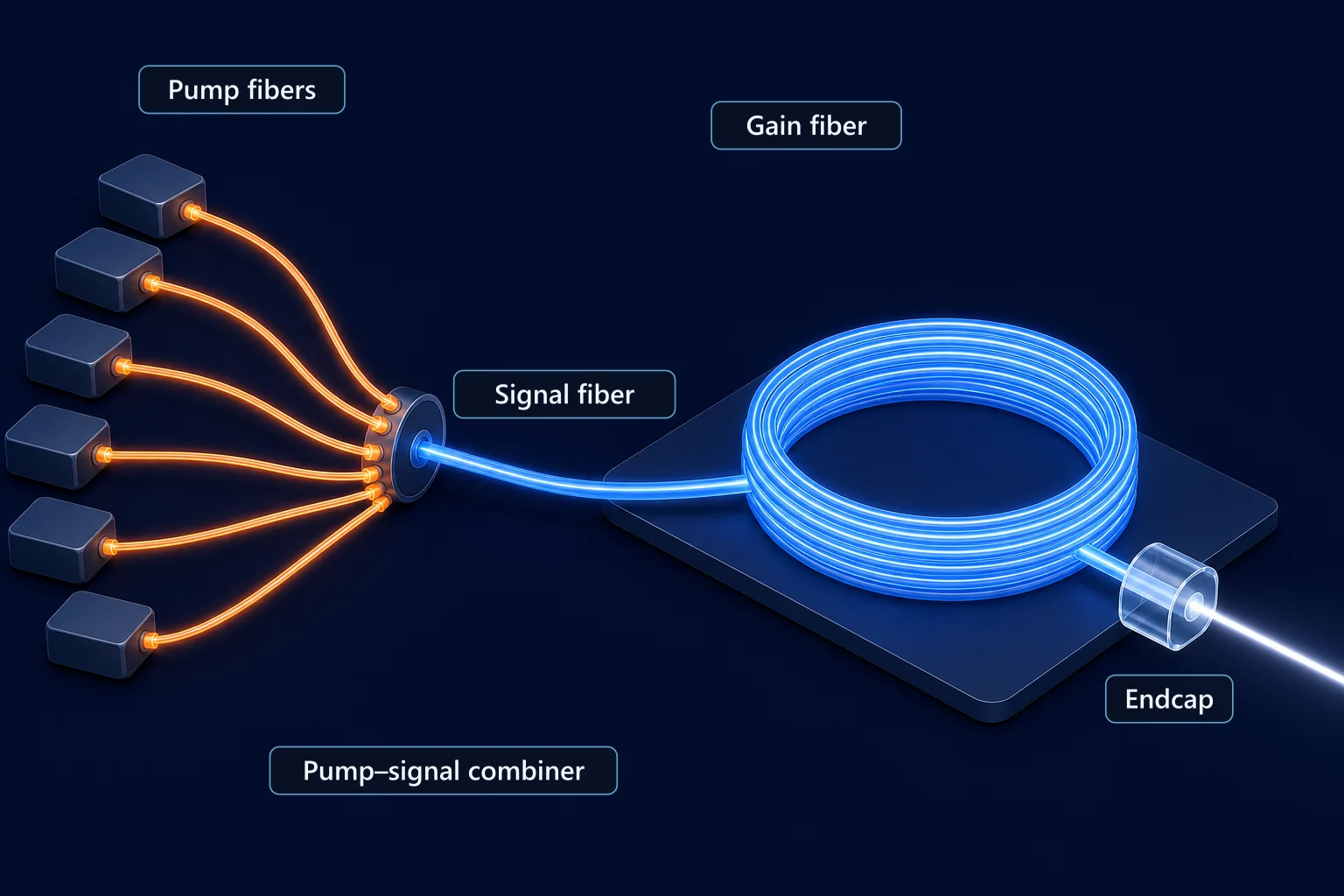
Imagine opening the box of a fiber amplifier. On one side, the fibers of many pump diodes come in a row, and on the other side the signal arrives in one fiber. Yet only one beam goes out. Where do all these strands become one?
Where the light leaves the glass is worth asking about too. The strong light that comes out of the amplifier exits into air at the end of a fiber. This article looks at two gateways inside an amplifier: the combiner that merges strands, and the endcap at the end.
The path of light through one amplifier
In a master oscillator power amplifier (MOPA), the path of light goes roughly like this. The weak signal from a seed laser passes an optical isolator and enters a pump–signal combiner. There it joins the pump light and enters a rare-earth-doped gain fiber, where it grows. The output end of the gain fiber often carries an endcap.
Combiners and endcaps are parts that several suppliers offer in standard configurations. A one-line list of such parts and what they do is in the Isolators and Fiber Components article. Which layer of a double-clad fiber the pump light travels in, and where it enters, is in the Double-Clad Fibers article. Here the focus is on what limits combiners and endcaps.
Pump combiner: why the number of strands has a limit
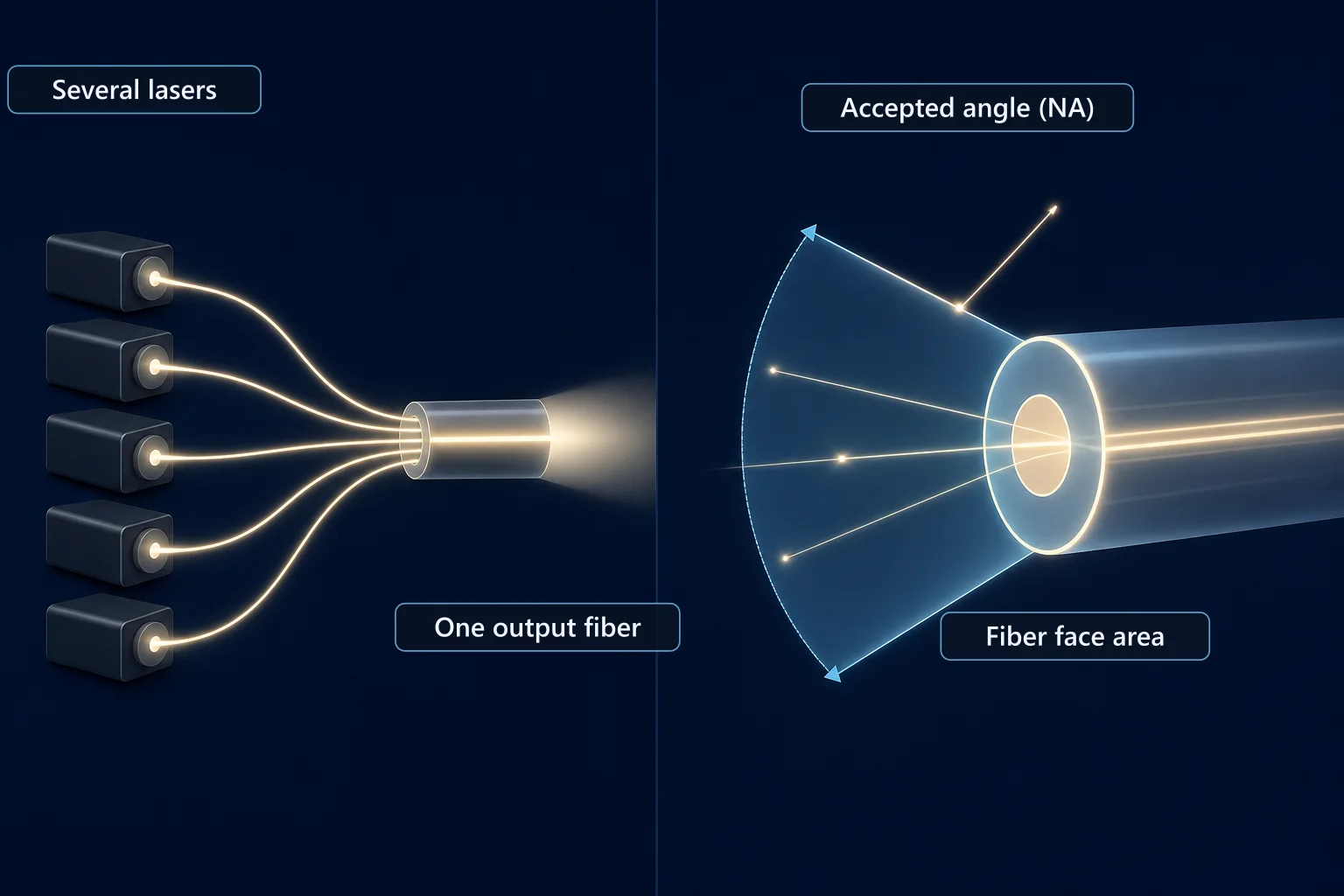
The pump combiner from the earlier article gathers the fibers of many pump diodes into one output fiber. So why not keep adding diodes and strands? How many strands fit is set by how wide the output fiber is and how steeply angled the light it can still accept. The second of these is the numerical aperture (NA).
The reason lies in brightness. Passive optics, such as lenses, mirrors and fibers that do not amplify light themselves, cannot raise brightness. In optics this is called the brightness theorem. It follows from the fact that a quantity measuring both the area a bundle of light covers and the angle it spreads into is conserved.
Area and angle trade against each other. Squeeze light into a smaller area and its angle widens; narrow the angle and the area must grow. So the areas and angles carried by all the input fibers, added together, have to fit inside the area and angle the output fiber can accept. Once the output fiber's width and NA are set, the number of inputs it can take is set too.
Pouring water into a funnel is a similar picture. The real case differs in one way. Water goes in if you push it, but light beyond the area and angle the output fiber accepts cannot follow the path and leaks out.
Leaking light turns into heat. A combiner handling kW of pump light must have very low loss, because pump light that strays from its path ends up heating its surroundings. The double-clad fiber article shows how light scatters and heats at splice points.
A combiner that also carries the signal
In an amplifier, gathering pump light is not the whole job. The signal has to pass through the core of the same fiber. So a pump–signal combiner is needed, with the signal fiber running through the middle and the pump fibers feeding light in around it.
This combiner carries one more burden. The signal is not light that can enter at any angle like pump light; it has to keep its beam quality all the way to the end of the amplifier. If the signal leaks out of the core or turns into higher-order modes inside the combiner, the beam gets worse by that much. Combiner products for high-power fibers are matched to large mode area fibers and accept either active or passive fiber as the signal fiber.
Such combiners are also used for counter-pumping, where pump light is sent against the direction of the signal. In this case there is a warning that signal light in the cladding can harm the combiner and the diodes. The reason is the same backward light covered in the Isolators and Fiber Components article.
Combiners seen through conferences
Combiners have been reworked each time laser power has risen. Talks at Photonics West, the yearly conference of SPIE, the international society for optics and photonics, show the trend year by year. The table picks out only the public talk abstracts that deal with combiners.
| Year | What the public talks reported |
|---|---|
| 2022 | Development of signal and pump combiners for a special large-core fiber (chirally coupled core) for use in all-fiber high-power systems |
| 2023 | A pump–signal combiner talk whose title names 6 kW power handling |
| 2024 | A side pump and signal combiner for kW-class fiber lasers from National Taipei University of Technology. A talk by OFS that measured how well a backward combiner suppresses higher-order modes. A talk by ISL and Exail on the first high-power triple-clad combiner for the 2 µm band |
| 2025 | A backward combiner with a large-mode-area output from OFS, and a counter-pumped narrow-linewidth ytterbium amplifier that reached 3.7 kW with a new combiner. A triple-clad side combiner for thulium and holmium sources |
| 2026 | A combiner from National Taipei University of Technology for next-generation multi-kW lasers, with 50% more pump capacity than the previous version. It is expected to handle more than 4.5 kW |
Three threads run through the table. First, the combiner has already become a part that handles kW-class power. The 2023 talk named 6 kW power handling in its title, and the 2026 talk looks ahead to lasers of several kW with a combiner that takes more pump power.
Second, attention for counter-pumping combiners has moved toward measuring and competing on the beam quality of the signal, that is, how well higher-order modes are blocked. Third, combiners have appeared for thulium and holmium fiber lasers in the 2 µm band, beyond the band of ytterbium fiber lasers. One way to read this is that the combiner sits at a point that ties the power and the beam quality of a laser together.
Many lasers into one strand: signal combiners
Pump light is not the only thing combiners gather. Some combiners merge the outputs of several lasers that have already been amplified into one strand. Because the light is merged without matching phases, this is one form of incoherent beam combining, and it is used in industrial lasers.
The brightness theorem applies here as well. Gather the light of several lasers into one strand with passive parts, and the power adds up, but the area and angle of the light do not shrink. So the output fiber becomes thicker, or the beam that comes out spreads more than the beam of one laser. A technology licensing page at MIT makes the same point when it says keeping high brightness is hard when light from different lasers is combined incoherently.
An optics lecture also describes ways past this wall. The conservation of area and angle counts only geometry, so properties of light such as its spectrum, polarization and coherence can pack more light into one beam. Spectral beam combining, which overlaps light of different wavelengths, and coherent beam combining, which matches phases so beams interfere, are exactly those ways. "Incoherent Beam Combining: Side by Side" compares the three methods.
Endcap: where light leaves the glass
Amplified light finally leaves the glass end face into air. This end face easily becomes the weak link. The damage threshold (LIDT) of the face depends heavily on how smooth and clean the surface is. An application note from NKT Photonics warns that one small flaw can cut the threshold by several powers of ten.
An endcap is a block of glass attached to the end of a fiber. After light leaves the core, it widens inside this block, and the wider beam passes the end face. The pulse energy that causes damage grows in proportion to the area the light passes through, so widening the beam at the face lets it handle more energy.
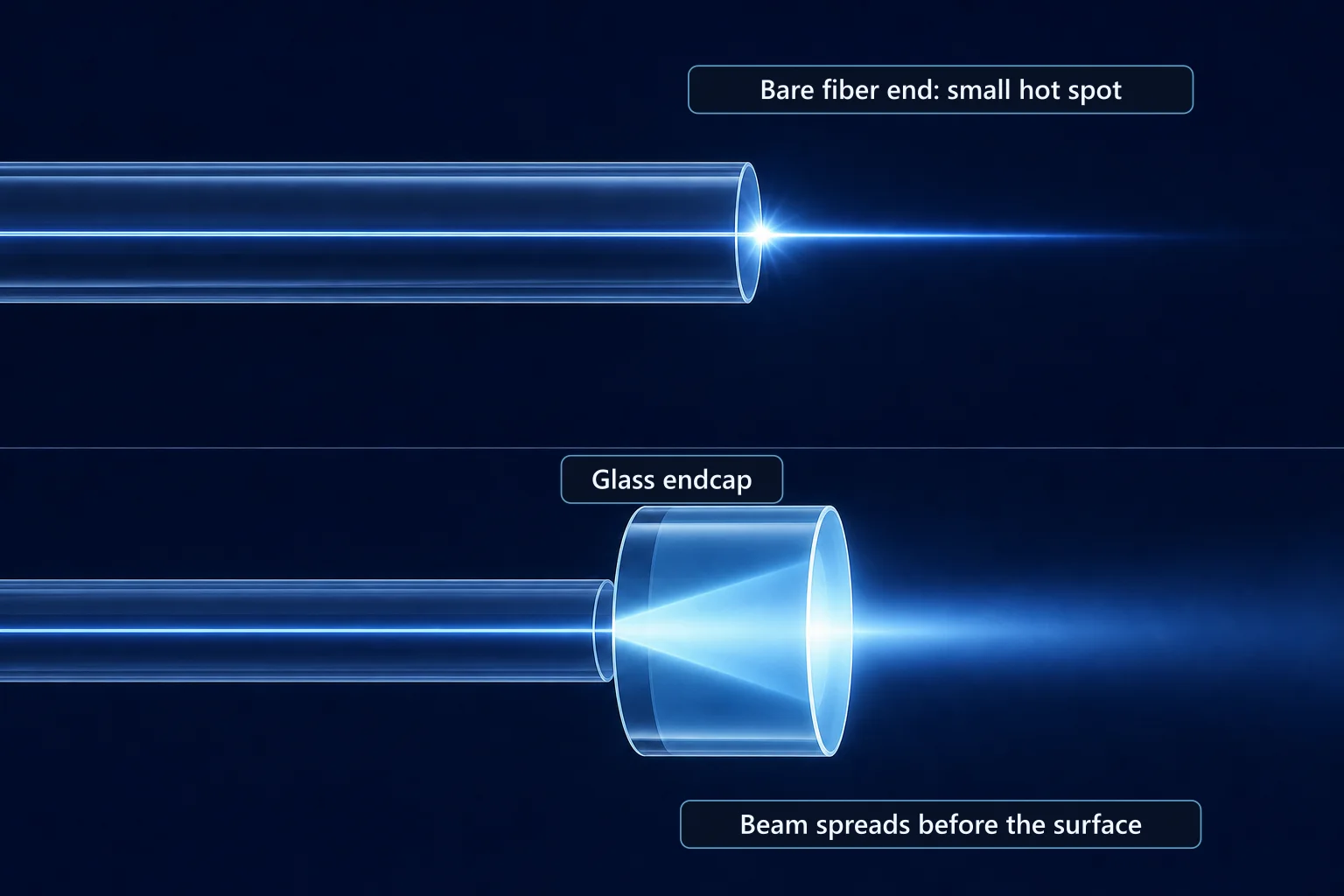
Not every endcap widens the beam. A thin endcap on a flexible fiber has the same outer diameter as the fiber and does not widen the beam much. Being pure silica, its threshold may sit a little above that of the doped core. Rod-type fibers get a thicker endcap so the light is less concentrated where it exits.
Light sent back is another reason for an endcap. Cutting the output end at an angle or adding an endcap reduces how much of the signal and the amplified spontaneous emission (ASE) reflects back into the core. A review chapter on high-power fiber amplifiers, released as a preprint, sums up that endcaps are generally needed at higher power.
Real parts follow this direction. Endcaps for kW-class beam delivery and for large mode area fiber amplifiers are made of low-absorption glass and coatings. The maker nLIGHT also lists an endcap among the fiber termination options for its amplifiers. What the coating on an endcap face does can be seen in the anti-reflection coating section of the Mirrors, Lenses and Coatings article.
When small parts limit the output
Combiners and endcaps are small parts inside an amplifier, yet they can limit the output of the whole amplifier. Pump light leaking from a combiner and a tiny flaw on an endcap face can both seed heat and damage.
Where damage happens tends to be predictable. According to the NKT note, in gain fibers damage usually appears at the output face, where the energy is higher. Other failures happen away from the end face too. Examples are a fiber fuse, which spreads damage inside the fiber, and damage where the fiber meets the endcap.
The note deals with pulsed systems. For amplifiers that deliver continuous light for long periods, makers also state that they build kW-class beam-delivery endcaps from low-absorption glass and coatings.
What to read next
- Double-Clad Fibers: follows the path the gathered pump light takes inside the gain fiber.
- Isolators and Fiber Components: looks at other fiber parts around the combiner and at light that travels backward.
- "Incoherent Beam Combining: Side by Side": looks at what is gained and lost when many lasers are merged without matching phases.