Many of the drones in today's news are small enough to hold in one hand. A typical example is the FPV drone, flown by a pilot who wears goggles and watches the video from a camera on the drone's nose. The idea of an aircraft with nobody on board, though, is more than a hundred years old.
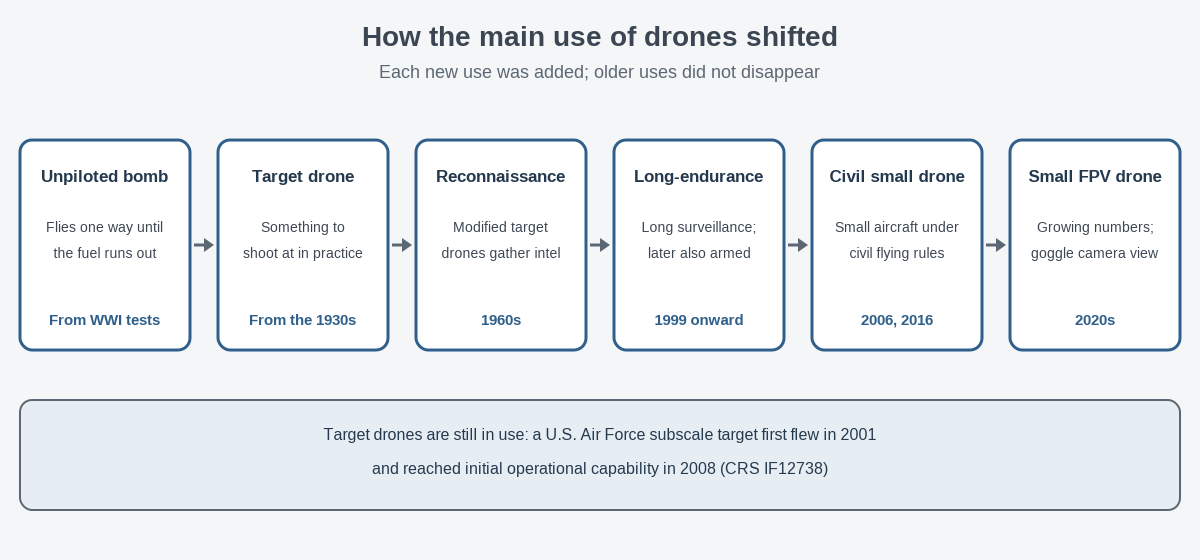
At first it was a flying bomb. Next it became a target for gunnery practice. The target then carried a camera and turned into a reconnaissance aircraft, and reconnaissance aircraft grew into surveillance platforms that stay aloft for a long time.
Civil drones that anyone can buy came next, and then small drones returned to the battlefield. This article follows that path through the years found in public records. It reflects the situation as of October 2026.
It started as a bomb with no pilot
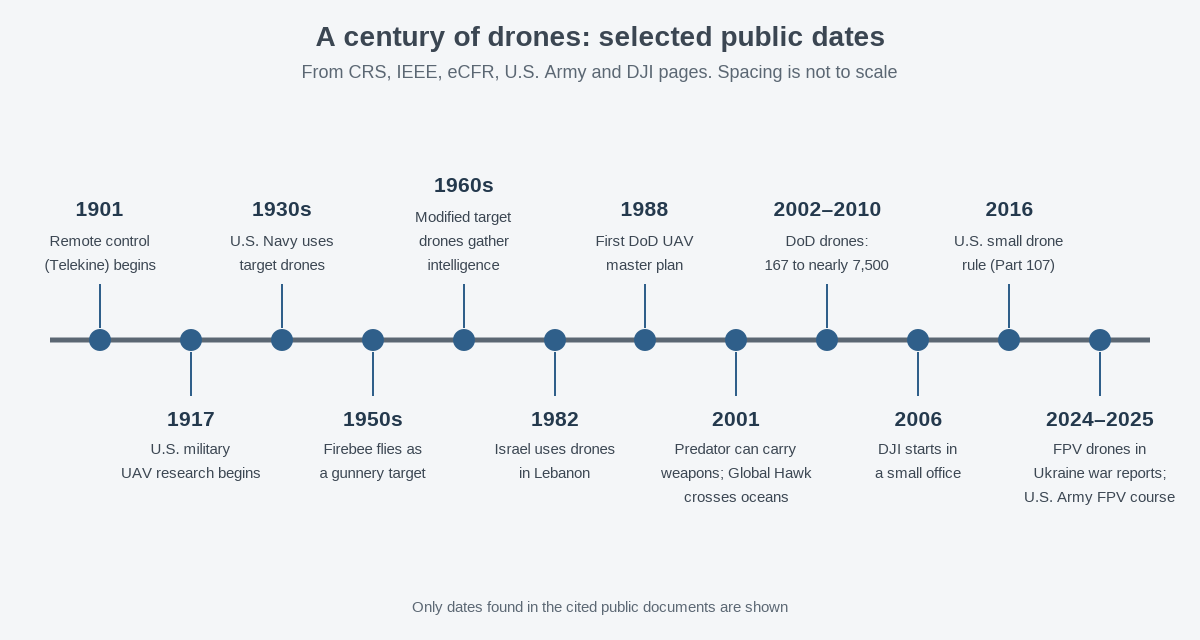
Start with the idea of moving a machine from far away. Leonardo Torres-Quevedo, an engineer from Spain, started building a wireless remote-control system in 1901 and named it the Telekine. His aim was to test airships he had designed without putting anyone's life at risk, and he filed patents for it in 1902 and 1903.
The U.S. military has studied and used unmanned aircraft since 1917. Their first tests took place in World War I, but the United States did not send them into combat in that war.
The first versions looked little like today's drones. In practice they were bombs without a pilot. They kept flying one way until their fuel was gone, and then the whole aircraft dropped to the ground.
So how do they differ from cruise missiles? The Smithsonian National Air and Space Museum describes the V-1 in its collection this way. Gosslau had worked on "pilotless aircraft" since 1939, and today they would be called cruise missiles. Their roots go back to World War I experiments in Germany and the Allied countries.
The current U.S. Department of Defense (DoD) definition leaves cruise missiles, ballistic vehicles and artillery shells out of the unmanned aircraft category. Where the two lines split is covered in more detail in Loitering munitions: between missile and drone.
The age of target drones
If you bring in a new anti-aircraft gun, what do you shoot at to see whether it works? During the 1930s, the Navy of the United States started a program that used drones to judge how well the anti-aircraft weapons on its ships performed.
In this way, the origins of military target aircraft are tied up with the origins of drones. One analysis cited in a Congressional Research Service (CRS) report on aerial targets found that flying against target drones showed where the Navy's defenses and gun training fell short. The Navy then made several changes to the anti-aircraft weapons on its ships.
There was more than one name, too. Drones, robot planes, pilotless aircraft, remotely piloted vehicles (RPVs) and remotely piloted aircraft (RPAs) were all in use. A footnote in a 2012 CRS report draws a line between two of them: what sets drones apart from RPVs is that drones are designed to fly autonomously.
Today the most common name is unmanned aerial vehicle (UAV). Counted together with its control stations on the ground and its data links, the aircraft becomes part of an unmanned aerial system (UAS).
Target drones never went away. For several years after World War II, pulsejet engines were a popular low-cost way to power subsonic missiles and target aircraft, in the United States and elsewhere.
The U.S. Air Force later brought in the BQM-167A to take over from two target drones of the Cold War years, the MQM-107 and the BQM-34. The BQM-167A first flew in 2001 and reached initial operational capability in 2008. Modern aerial targets stand in for real threats in the air: missiles, drones, and aircraft with crews on board.
From target to reconnaissance
What happens when you put a camera on something built to be shot at? The Firebee is one answer. It first flew in the 1950s as a target for aerial gunnery, and in the 1960s it was used as a drone for collecting intelligence.
From the early 1960s and on through the Vietnam War, the Air Force flew altered target drones to collect intelligence. CRS calls these flights the first time drones were used on a large scale in war, and says they helped unmanned aircraft spread more widely. In the same decade, autonomous drones also flew strategic reconnaissance missions over areas where access was denied.
Gathering intelligence stayed the traditional job of unmanned aircraft. Later, aircraft that could fly for longer made it possible to keep watching distant or moving objects. Why reconnaissance drones need to stay up so long, and what they look at, is the subject of ISR drones: why endurance matters.
Eyes that stay aloft
In the 1970s and 1980s, the usual term inside the DoD was remotely piloted vehicle (RPV). A turning point came in 1982, when U.S. observers took note of how Israel used unmanned aircraft systems during operations in Lebanon. The Reagan administration's budget request for fiscal year 1987 asked for notably more money for drones. CRS treats this as the point where U.S. drone work stopped being a set of experiments and became programs to buy aircraft.
In 1988, at the direction of Congress, the DoD published its first master plan for unmanned aircraft. In 2007–2008 it created the five-group classification that is still in use. The first U.S. capabilities came from aircraft bought from Israel, and one of them, the Pioneer, served as a source of tactical intelligence during Operation Desert Storm.
Experience in the Gulf War sped up the Air Force's Predator program. Predator first saw use in the Balkans conflict on surveillance missions, and satellite communications (SATCOM) let it operate beyond line of sight.
In 2001 Predator gained the ability to carry weapons as a secondary function. In the same year, Global Hawk made ocean crossings, with flights from U.S. soil to Australia and to Portugal. The wings and satellite links of these long-endurance drones are explained in MALE and HALE Drones: Aircraft That Stay Up for More Than a Day.
The numbers grew fast. The DoD's unmanned aircraft inventory rose from 167 in 2002 to nearly 7,500 in 2010. Drones have a long history, but advances in navigation, communications and materials made many of today's missions possible only within the 10–15 years before that 2012 report. More bandwidth on military communications satellites also made remote operation more practical.
Drones go civilian
The story also continued outside the military. DJI is a company well known for civil drones. Its company page says it started in a small office in 2006 and now has more than 6,000 employees. Its headquarters are in Shenzhen, China.
The United States set out separate rules for small drones. The federal rule for small drones, 14 CFR Part 107, was published in the Federal Register on June 28, 2016. Under this rule, a small unmanned aircraft is one under 55 pounds at takeoff, with everything carried on it or fixed to it included.
The same rule says the remote pilot and certain other crew must see the aircraft for the whole flight. They may use no device to help their vision other than corrective lenses. This naked-eye rule is where the regulation runs into FPV flying, in which the pilot watches a goggle screen. That story continues in FPV drones: flying through the drone's eyes.
Wars of small drones
FPV stands for first-person view. A 2024 article on the U.S. Army's official website describes how an FPV drone works. A camera on its nose streams live video to goggles or a headset that the pilot wears.
That sets it apart from an ordinary remote-controlled drone, which the pilot flies by looking down at the drone's position on a screen. The Army warrant officer who wrote the article says drones have proved more flexible and more affordable than traditional airstrikes, and that is the view of one author.
Small drones have also been used in the war between Russia and Ukraine. A March 2025 CRS report on counter-drone programs cites press reports on this. Both countries have made growing numbers of drones for the battlefield and have handed troops at the front FPV drones that carry explosives and are meant for one-way attacks. They are used alongside artillery shells and conventional missiles.
U.S. military training has changed as well. In August 2025 the U.S. Army Aviation Center of Excellence opened its first Unmanned Advanced Lethality Course (UALC) at Fort Rucker. It is a three-week course on small unmanned aircraft systems and FPV drone operation, and in the classroom students use off-the-shelf commercial drones and flight simulation software.
An earlier war in which small drones drew attention is covered in The 2020 Nagorno-Karabakh War: Forty-Four Days That Spotlit Drones. Why stopping small drones takes more than one device is explained in Counter-drone systems: why one device is not enough.
What changed in a century, and open questions
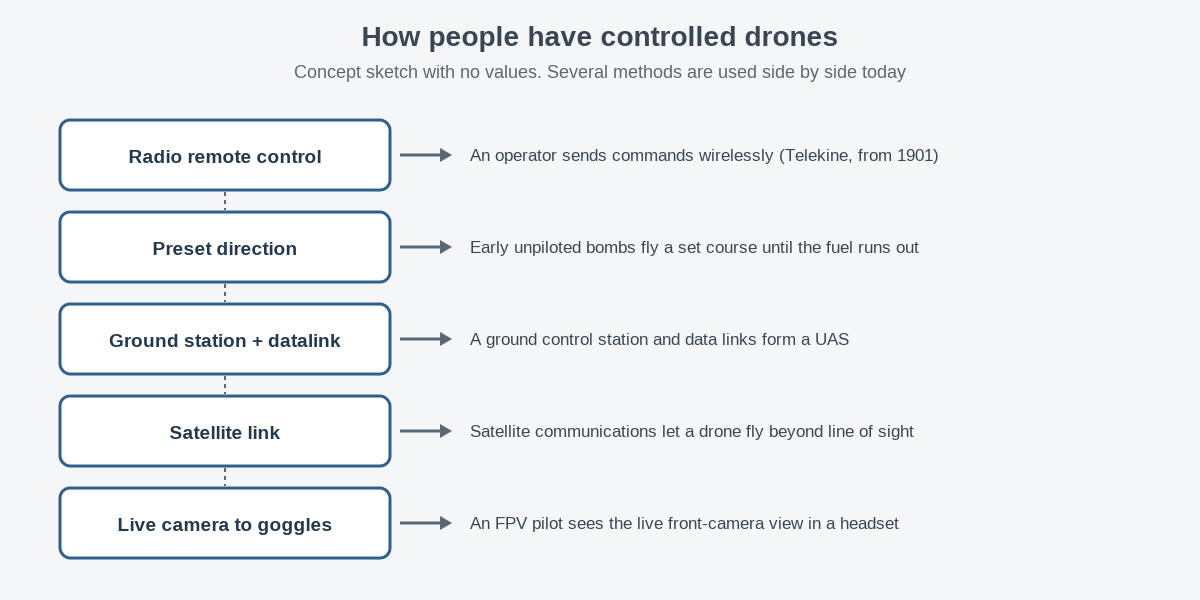
The biggest change is in how drones are controlled. It began with wireless remote control and bombs that flew in a set direction. Then came ground control stations with data links, satellite links, and finally the live camera view in front of the pilot's eyes.
New uses were added one after another: target practice, reconnaissance, long surveillance, civil flying and small attack drones. A new use did not wipe out the old ones. Target drones, which began in the 1930s, are still in use, and a new U.S. Air Force type reached initial operational capability as recently as 2008.
Open questions remain. The 2012 CRS report lists two main advantages of drones. No pilot's life is put at risk, and flying abilities such as endurance are not held back by human limits.
There are downsides too. The low purchase price has to be weighed against a greater tendency to crash. The reduced risk to a crew also has to be weighed against the hazards of sharing airspace with crewed aircraft. The debate over where human judgment should stay in weapon systems continues in Autonomous weapons and human control.
What to read next
- ISR drones: why endurance matters: why reconnaissance drones need to stay up for a long time.
- FPV drones: flying through the drone's eyes: first-person flying and the naked-eye rule in civil regulations.
- How Drones Are Classified: Size, Altitude, Mission and Groups 1 to 5: a chart-by-chart look at the five groups created in 2007–2008.
- What is a laser weapon? Film versus reality: what the term directed energy weapon actually refers to.