Anyone who has flown a small camera drone remembers the sky view on the controller screen. Push a stick and the aircraft moves, and the scene its camera sees comes down to the screen in your hands. There is no cable between them. So what carries the commands and the video?
Radio does. This article looks at what a data link between a drone and the ground carries and how far radio reaches. It then asks why aircraft flying far away go through satellites, and who decides which frequencies they may use. The field changes fast, so this article reflects the situation as of October 2026.
Three invisible threads
A drone does not fly on its own. The US Federal Communications Commission (FCC), following the Federal Aviation Administration (FAA), defines an unmanned aerial system (UAS) as an unmanned aircraft and its associated elements. Those elements include the communication links and the parts used to control the aircraft. The link is part of the system, not an add-on outside the aircraft.
The signals on the link fall into three threads. The first is commands going up from the ground to the aircraft. The second is telemetry, the data the aircraft sends down to report its own status. The third is the video and sensor data gathered by a payload such as a camera.
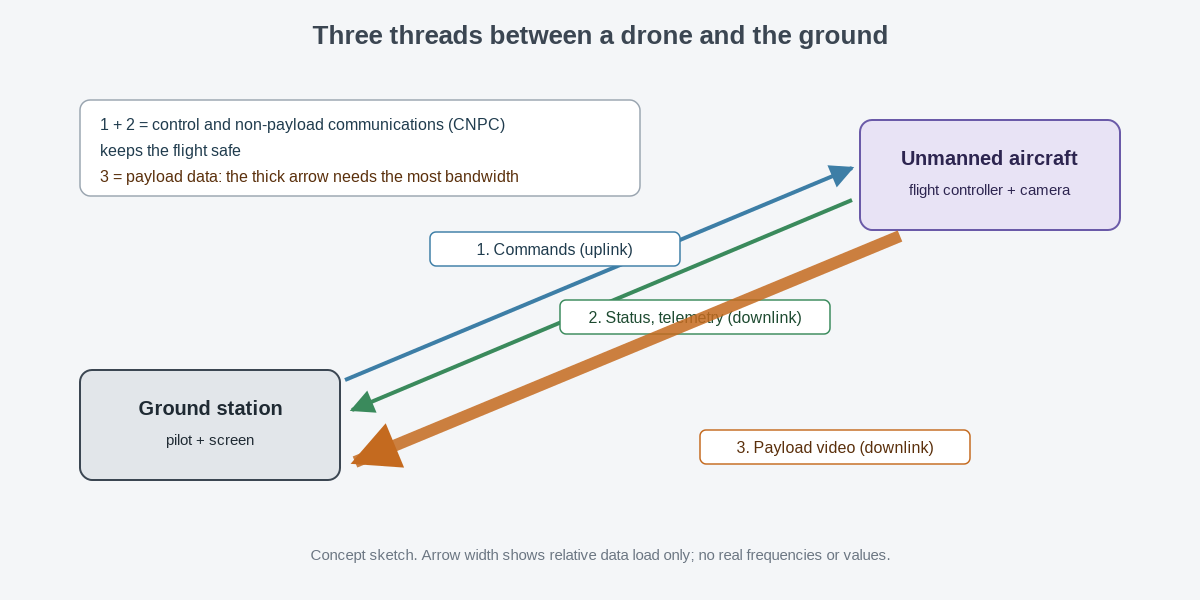
The first two threads together are called control and non-payload communications (CNPC). FCC rules define CNPC as any transmission sent between the aircraft and its ground station that helps keep the flight safe and running normally. Payload video is not part of it. If the video drops, the screen freezes; if the control link drops, the pilot loses the means to handle the aircraft.
That is why control links face a high bar. A 2013 conference presentation from NASA's Glenn Research Center said the CNPC link carries functions that are critical to safety. In its words, losing the link or having it compromised could have potentially catastrophic results. The FCC also wrote that flights with large aircraft, with passengers, or out of the remote pilot's view need highly reliable two-way links for flight control and telemetry.
The situation in which the link breaks has its own name: lost link. The idea of planning ahead for a break continues in Resilient military communications: systems built to survive a lost link.
How far radio reaches: line of sight
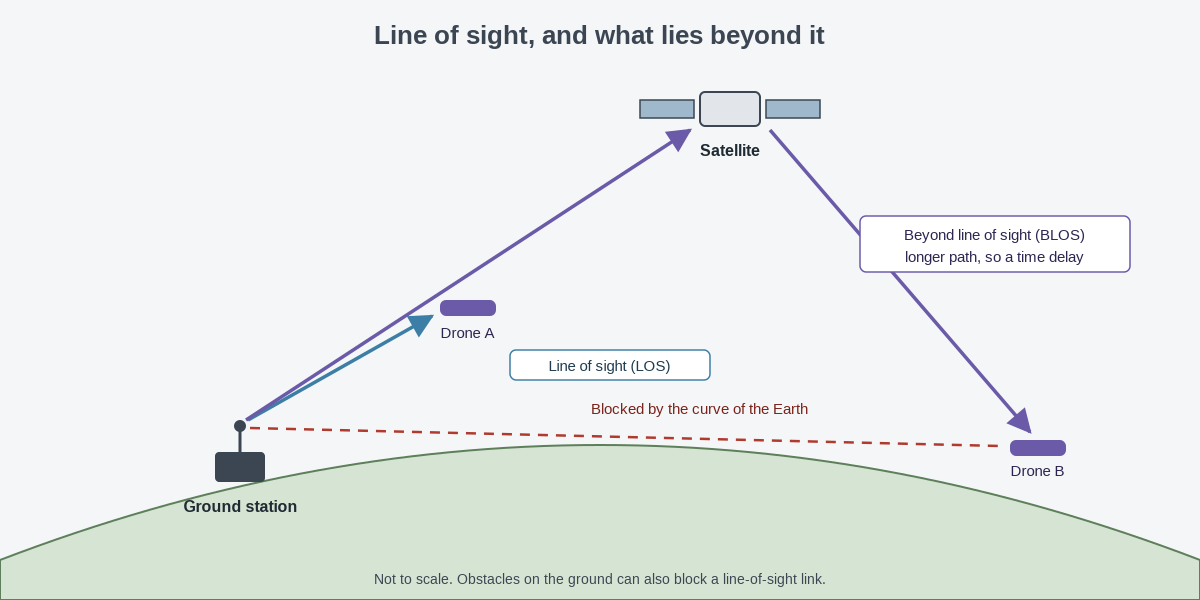
Radios on the ground do not reach as far as you might expect. The Congressional Research Service (CRS) explains that radios on the ground usually work over short distances, held back by line of sight (LOS) to 50 miles or less. The reason many ground radios are held to line-of-sight range is the curvature of the Earth.
Line of sight is a path along which the sender and the receiver can "see" each other in a straight line. Because the ground is curved, a faraway aircraft drops below the horizon, and the straight path between the two runs into the ground. It is like being unable to shine a flashlight over a hill. Real links are messier than this: even inside the horizon, obstacles and other radio signals get in the way.
Spec sheets for consumer drones show traces of this. The maximum transmission distance in the DJI Mini 4 Pro spec sheet was measured outdoors with no obstacles and no interference. Other distance figures, tested with weak interference and some obstacles, carry a note: they are for reference only and do not guarantee the real distance. In other words, the same aircraft can get a different link range depending on where it flies.
Frequency is also tied to the size of the hardware. A NASA Glenn paper on satellite links explains that most unmanned aircraft are small, so higher frequency bands are preferred to keep the antennas small enough to fit on board. Choosing a frequency is also about what the aircraft can carry, not only about how radio waves behave. The link between frequency and wavelength is laid out in Radar Frequency Bands: What Separates L, S and X Band.
Beyond the horizon: links through satellites
How do you control a large military drone flying beyond the horizon? Where line of sight on the ground ends, a satellite builds the bridge. For decades, the military has relied mainly on satellites to send radio signals beyond line of sight (BLOS). This long-distance satellite communications (SATCOM) includes the data streams of unmanned aircraft systems.
A 2012 CRS report found that more military communications satellite bandwidth had made it more practical to fly UAS remotely. At that time a Predator-family system was made up of four aircraft, one ground control station and a main satellite link. The satellite link is built in as a basic part of the system.
A US Army MQ-1C Gray Eagle company lists two kinds of terminals in its equipment. They are the ground data terminal (GDT) and the satellite ground data terminal (SGDT). As the name says, the second one exchanges data through a satellite.
Satellites come at a cost. The signal must climb to a satellite in orbit and come back down, and even light needs time for that trip, so the link has delay. Most communications satellites sit in geosynchronous orbit, about 22,000 miles above the Earth's surface, so even at the speed of light the round trip takes time. The workings of satellite communications are covered in more depth in Military satellite communications: linking ships, aircraft and forces past the horizon.
Ways to lean less on satellites have also been discussed. The 2012 CRS report described placing the mission control element in a crewed aircraft that has line of sight to the drone. The drone would then depend less on satellites to be reached beyond the horizon. When the report was written, experiments in this area were under way.
Video takes up the most room
Of the three threads, video is the thickest. Bandwidth is how much data a communications link can carry in a set amount of time. Think of it as the width of a water pipe. The difference is that you can lay a new water pipe, while bandwidth is a limited resource shared by many aircraft.
The 2012 CRS report noted that the data streaming from a drone's sensors is what pushes bandwidth needs up. In an example the report quoted, a single Global Hawk required 500 Mbps of bandwidth. That equaled 500% of the total bandwidth used by the entire US military during the 1991 Gulf War. The worry at the time was that the bandwidth available to all military aircraft is limited, so aircraft end up competing for it.
In consumer drones, too, the video link sits at the center of flying. One example is first-person view (FPV) flight, in which the pilot wears goggles and flies by the camera feed from the aircraft. That style of flying is covered in FPV drones: flying through the drone's eyes.
Who hands out the frequencies
Radio is not an empty space that anyone may use as they like. International bodies and national governments decide what each band is for. Drone links fall under three kinds of rules.
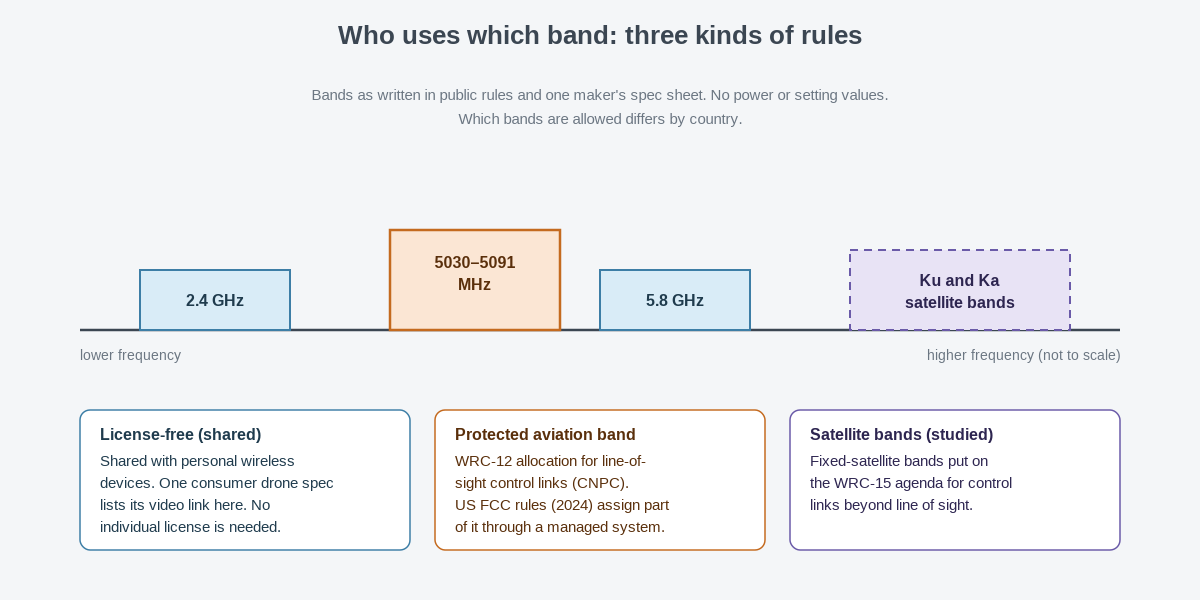
The first kind is bands shared without a license. The DJI Mini 4 Pro spec sheet lists its video transmission frequencies as 2.4000–2.4835 GHz, 5.170–5.250 GHz and 5.725–5.850 GHz. It adds that 5.170–5.250 GHz may be used only where local laws and regulations allow it.
Under US rules, 2400–2483.5 MHz and 5725–5850 MHz are bands covered by 47 CFR Part 15, and Part 15 operations need no individual FCC license. In exchange, they share the same bands with personal wireless devices.
The second kind is a band protected for aviation safety. The International Civil Aviation Organization (ICAO) has ruled that CNPC links belong on protected aviation spectrum. Such allocations are approved through the International Telecommunication Union Radiocommunication Sector (ITU-R). The 2012 World Radiocommunication Conference (WRC-12) approved a new allocation at 5030–5091 MHz for line-of-sight CNPC for unmanned aircraft.
The United States has written rules to put this band to use. In a decision adopted on August 21, 2024, the FCC created a new rule part, Part 88. It lets drone operators be assigned frequencies directly within part of the 5030–5091 MHz band. As a first step it set aside 10 MHz at 5040–5050 MHz and limited the communications allowed there to CNPC.
Operators do not sort out assignments among themselves. One or more dynamic frequency management systems (DFMSs) manage and coordinate access. Apart from some sections, the rules took effect on February 7, 2025.
The third kind is bands for satellite links. A NASA paper written ahead of WRC-15 explains that aviation safety allocations were not enough for satellite-based CNPC links beyond line of sight. That led to a proposal to use Ku-band and Ka-band fixed-satellite service (FSS), and the 2015 conference agreed to take it up as Agenda Item 1.5.
Lines drawn by law: no interference, remote ID
Sharing the airwaves also means you must not disrupt other people's communications. Under the US Communications Act, 47 U.S.C. 333, no one may deliberately or maliciously disrupt radio communications of a licensed or authorized station, or of a station the US government runs, or cause such disruption. The difference between jamming, which blocks a signal, and spoofing, which fakes one, along with the international rules, continues in Jamming and spoofing: interference versus deception.
Some of the signals a drone sends are meant for people other than the pilot. Under 14 CFR Part 89 in the United States, a standard remote identification (Remote ID) drone must broadcast a set list of message elements from takeoff to shutdown. The list includes the aircraft's identity, the latitude, longitude and altitude of both the control station and the aircraft, the aircraft's velocity, a time mark, and its emergency status.
This broadcast uses frequencies compatible with personal wireless devices under Part 15. If the broadcast stops, the person flying must land the aircraft as soon as practicable. Remote ID works a bit like a name tag shown to everyone sharing the sky. Unlike a tag pinned to a jacket, though, it is a radio signal sent out again and again for the whole flight.
Where this meets lasers: links made of light
Wanting to send more data with smaller equipment is not a problem only for radio links. Optical communications uses light to send information over long distances, and NASA sends data across space with lasers instead of radio. For NASA, radio links can carry higher data rates only with bigger antennas or more powerful transmitters. It says optical links can be faster and more secure, as well as lighter and more flexible.
There is a price. Radio can cover an area with a broad beam, while optical communications points a narrow beam straight at a receiver. Over very long distances, an aiming error of a small part of one degree can make the laser miss the receiver, and clouds and mist can cut the link. The optics that send out and aim a narrow beam of light are covered in Beam director optics: lenses, mirrors, coatings and a large aperture.
What to read next
- Resilient military communications: systems built to survive a lost link: communications planned on the assumption that links will break.
- Jamming and spoofing: interference versus deception: the two ways links and satellite signals get disrupted.
- Tactical data links: when equipment shares information: links that let military equipment share data.
- Counter-drone systems: why one device is not enough: how links become clues when finding and identifying drones.