A palm-sized drone rises off the floor with a whirring buzz. It can hang still in the air, slide sideways and turn on the spot. All of that motion comes from how fast each of the four propellers turns.
An aircraft with several propellers like this is called a multirotor, and one with four propellers is a quadcopter. This article looks at how a propeller makes lifting force and why two of them spin the other way. It then turns to the electric motor and to the electronic speed controller (ESC) that feeds it. Drone technology changes quickly, so this article reflects what was known as of October 2026.
Push air down, and the aircraft goes up
When the propellers of a drone, or unmanned aerial system (UAS), spin, they push air downward. By Newton's third law, the air pushes back on the aircraft with an equal force, upward. Once that upward push is larger than gravity pulling down, the aircraft rises.
The force a propeller makes is usually called thrust. NASA's quadcopter teaching guide calls it lift, since it holds the aircraft up. Adding up the lift of all four propellers gives the total lift on the aircraft.
If total lift exactly matches gravity, the aircraft neither climbs nor sinks and stays in one spot. That is a hover. With more lift than gravity it climbs, and with less it comes down.
Stand in front of a desk fan and you feel the breeze. The fan is pushed back as it pushes air forward, but its base stands on the floor, so it stays put. A drone has no base on the ground, and that same reaction lifts it.
A propeller blade is not a flat board. Cut it across its length and you see an airfoil, the same cross-section shape as an airplane wing. NASA's Glenn Research Center compares a propeller to "a rotating wing." As a blade turns, its outer end travels faster than its center, which is why blades are usually built with a twist for better efficiency.
A spinning propeller sets up lower pressure than the surrounding air on the side where air comes in, and higher pressure on the side where it leaves. Because the propeller puts work into the air, the air leaving it moves faster than the air coming in. Exactly how a propeller makes thrust is very complicated, so the teaching material treats the propeller as a thin disk that air passes through.
Two of the four spin the other way
Spinning a propeller creates one more force. It is a twisting force called torque. When a motor turns a propeller one way, an equal and opposite torque tries to turn the aircraft the other way.
This is why a helicopter carries a tail rotor. The reaction from the spinning main rotor would turn the body against the blades. Any device or method that cancels that torque, like a tail rotor, is called antitorque. The helicopter side of the story is in Helicopter rotors: how coaxial helicopters fly without a tail rotor.
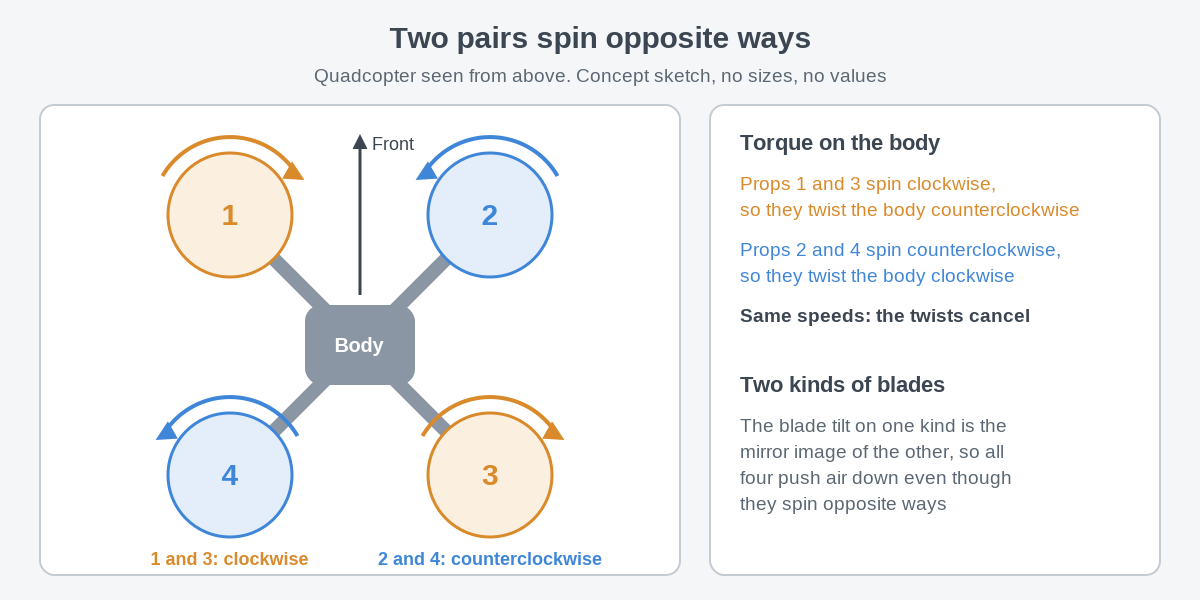
A quadcopter solves the problem with layout instead of a tail rotor. Of its four propellers, two turn clockwise and the other two turn counterclockwise. When the torque from each propeller is added up, the two clockwise ones and the two counterclockwise ones cancel. The two propellers that spin the same way sit across the diagonal from each other.
Spinning in opposite directions raises a new problem. With identical blades, two propellers would push air down while the other two pushed it up. The forces would add to zero lift, and the aircraft could not take off.
So two kinds of propellers are used, with blade angles that are mirror images of each other. That way all four push air in the same direction, even though they spin opposite ways.
Moving by changing speed alone
A quadcopter needs three kinds of motion to fly. It must climb and descend, move sideways or forward and back, and turn in place. All three come from the four propellers.
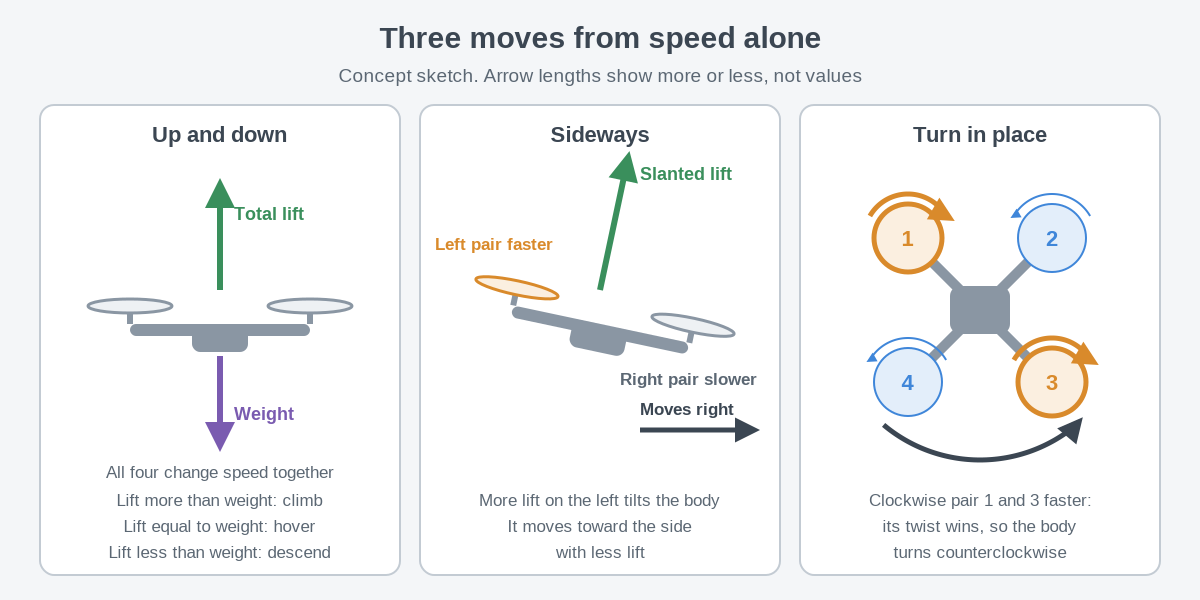
Climbing and descending are the simplest. Spin all four faster so total lift beats gravity, and the aircraft climbs. Slow all four together, and it comes down.
To move sideways, the pair of propellers on one side speeds up, or the opposite pair slows down. The faster side makes more lift, so the two sides no longer match. The side with more lift rises, so the aircraft tips toward the side with less lift.
Once the aircraft tips, its lift is tilted too, so part of it points up and part points sideways, toward the lower side. That sideways part pulls the aircraft along, so it moves toward the side making less lift. Moving forward and back works the same way.
Turning in place uses torque. If one diagonal pair, spinning the same way, runs faster than the other pair, its torque gets stronger. The two pairs no longer cancel, and the leftover torque turns the aircraft. When the clockwise pair is faster, the aircraft turns counterclockwise, and when the counterclockwise pair is faster, it turns clockwise.
To move like this without a rudder or tail rotor, each of the four motors has to change its speed on its own. That job belongs to the motors and the speed controllers that drive them.
Why an electric motor turns
On a drone that carries batteries, the propellers are turned by electric motors. The other ways to get that power, such as engines and hybrids, are compared in Drone Power: Batteries, Engines and Hybrids.
A motor rests on the force a wire feels in a magnetic field. A wire carrying current inside a magnetic field gets pushed. Bend the wire into a rectangular loop, and the two sides nearest the magnet's poles are pushed in opposite directions.
The loop wants to turn, and that torque turns a shaft. In the process, electrical energy becomes mechanical work.
As the loop turns, it reaches a point where its face sits square across the magnetic field and the torque drops to zero. There the current has to be reversed, so the torque keeps acting the same way. A simple DC motor in a textbook does this with a commutator and brushes. The commutator turns with the shaft, and the brushes rub against it to keep electricity flowing to the loop.
A brushless DC motor (BLDC) does away with that mechanical switch. The permanent magnets go on the rotor, the part that turns. The wire windings sit on the stator, the part that stays still. In place of the brushes and commutator, control electronics send power to the right winding.
Drones use both brushed and brushless motors. A Texas Instruments (TI) technical article on drone speed controllers names brushless motors as the type generally used in mid- to high-end drones.
The ESC: between the battery and the motor
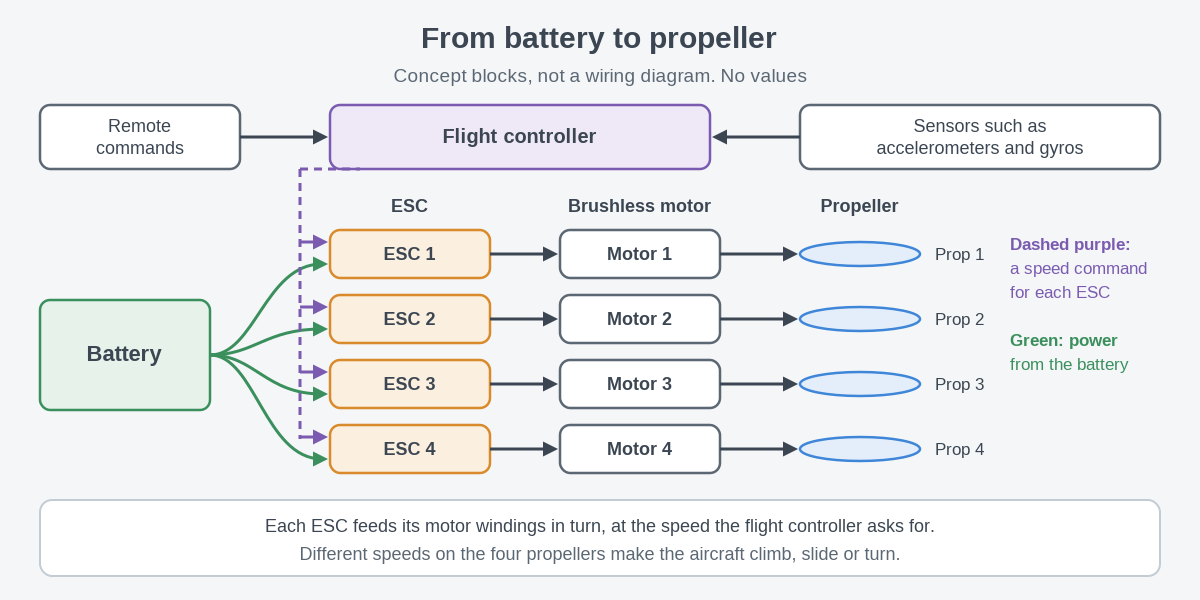
A brushless motor needs a separate device that feeds its windings in turn. On a drone, that device is the electronic speed controller, or ESC. According to the TI article, an ESC is usually built from a few blocks. There is a power stage that handles the power, a current-sensing part, a small computer (a microcontroller) that controls the motor and a link to the flight controller.
The same article describes a motor whose windings are evenly wound and whose back voltage has a trapezoidal shape, driven through a six-step commutation sequence. That back voltage (back-EMF) is the voltage the windings make as the motor turns. To switch at the right moment, the controller has to know the angle of the rotor's magnets. A common choice is to estimate that angle without a separate mechanical speed sensor, because it keeps cost down and makes the system more robust.
Above the ESCs sits the flight controller. A figure note in the TI article calls it the brain of the flying system. It takes remote commands, links to sensors such as accelerometers and gyros to keep the aircraft stable and controls the ESCs. The ESCs then handle speed control for thrust and changes of direction.
Power from the battery passes through the ESC to turn the motor, and the motor turns the propeller. Above it all, the flight controller gives each of the four ESCs its own speed. The three kinds of motion described earlier all come from those speed differences.
Limits and hard parts
The propeller thrust from the simple theory in teaching material is an ideal number. NASA's Glenn Research Center notes that it leaves out many losses found in practical, high-speed propellers, such as tip losses. Those losses have to be worked out with a more detailed propeller theory.
The way a motor is driven involves trade-offs too. With trapezoidal control, torque ripples and current spikes at every commutation step. That ripple lowers efficiency and can cause vibration, and driving the motor with sine-shaped power avoids both. The TI article adds that the choice of control method affects how well the drone flies.
Vibration is also its own problem for anything carrying cameras or optics. Protecting optics on a shaking platform is covered in Vibration and shock: protecting optics on a moving platform.
Designing an ESC means weighing its efficiency against flight time and cost. How much electricity turns into useful work is also the question that sets the size of a laser weapon system. That story continues in Power and efficiency: the share of electricity that becomes light sets the size of the system.
What to read next
- Drone Power: Batteries, Engines and Hybrids: where the electricity for the motors comes from, and how energy per kilogram shapes flight time.
- Helicopter rotors: how coaxial helicopters fly without a tail rotor: other ways to cancel torque, with a tail rotor or with two rotors.
- FPV drones: flying through the drone's eyes: flying the same kind of multirotor from a first-person view, and the rules around it.
- Power and efficiency: the share of electricity that becomes light sets the size of the system: the same efficiency question, seen from the laser side.