How much does the United States spend on laser weapons each year, and how far along does it think it is? One document puts that question, for directed-energy weapons as a whole, on two pages. It is "Defense Primer: Directed-Energy Weapons" (IF11882), a short brief from the Congressional Research Service (CRS).
The primer was revised on January 7, 2026. It is the first revision since the November 2024 edition. Budget numbers, the Pentagon's power goals and questions for Congress all sit on one sheet, so it works well as a reference point when you read laser weapon news.
This letter in brief
- CRS revised its directed-energy primer on January 7, 2026. It lists a FY2025 request of about $789.7 million and a FY2024 appropriation of $1.1 billion.
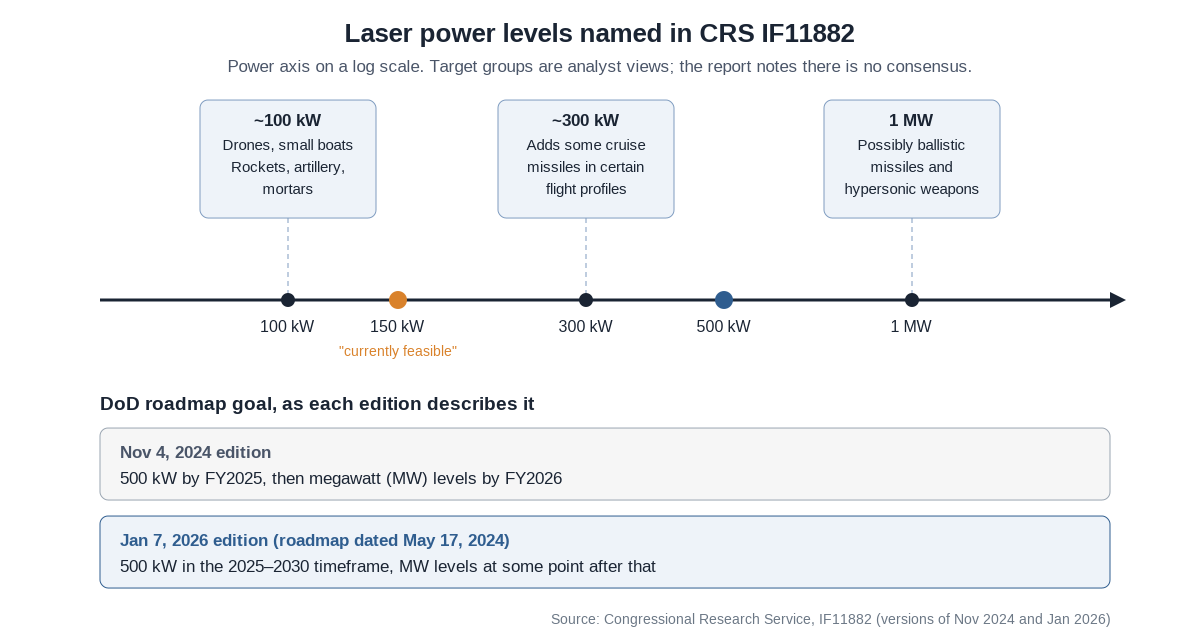
- Compared with the November 2024 edition, the deadline for the Pentagon's power goal moved from "500 kW by FY2025" to "500 kW in the 2025–2030 timeframe."
- The Pentagon has not released a FY2026 directed-energy budget total, and no program of record is known to exist.
What was announced
CRS is an agency of Congress. It writes reports that members use when they handle bills and budgets, and it makes some of them public. An "In Focus" is its shortest format: one topic on two pages.
IF11882 covers directed-energy weapons (DEW). In the Pentagon's definition, these weapons use focused electromagnetic energy instead of kinetic energy to disable or destroy an opponent's equipment, facilities or people. The primer covers only high-energy lasers (HEL) and high-power microwaves (HPM). Particle beam weapons are left out.
Three countries appear: the United States, China and Russia. Only a selection of unclassified programs is covered. The January 2026 edition also adds a new note to its first paragraph. Under Executive Order 14347 of September 5, 2025, the Pentagon uses "Department of War" as a second name.
What is publicly known
The table lists what the primer states, item by item.
| Item | What the primer says |
|---|---|
| Budget (unclassified programs) | FY2025 request of about $789.7 million. For FY2024, a request of $962.4 million and an appropriation of $1.1 billion |
| FY2026 | The Pentagon has not released a total for its directed-energy request |
| Program of record | None is known to exist |
| Coordination | The Principal Director for Directed Energy, under the Under Secretary of Defense for Research and Engineering, coordinates the work and develops and oversees the roadmap |
| Power roadmap | Roadmap dated May 17, 2024: from about 150 kW, which is feasible today, to 500 kW with less size and weight in 2025–2030. Megawatt levels at some later point |
| Power scaling effort | High Energy Laser Scaling Initiative (HELSI): show higher output while keeping or improving beam quality and efficiency, and give companies prototyping work |
| Lethality analysis | A department-wide review of laser lethality analysis is complete, and a searchable database of these analyses is being tested |
| Further reading | R44175 for Navy shipboard lasers, R45098 for Army directed energy |
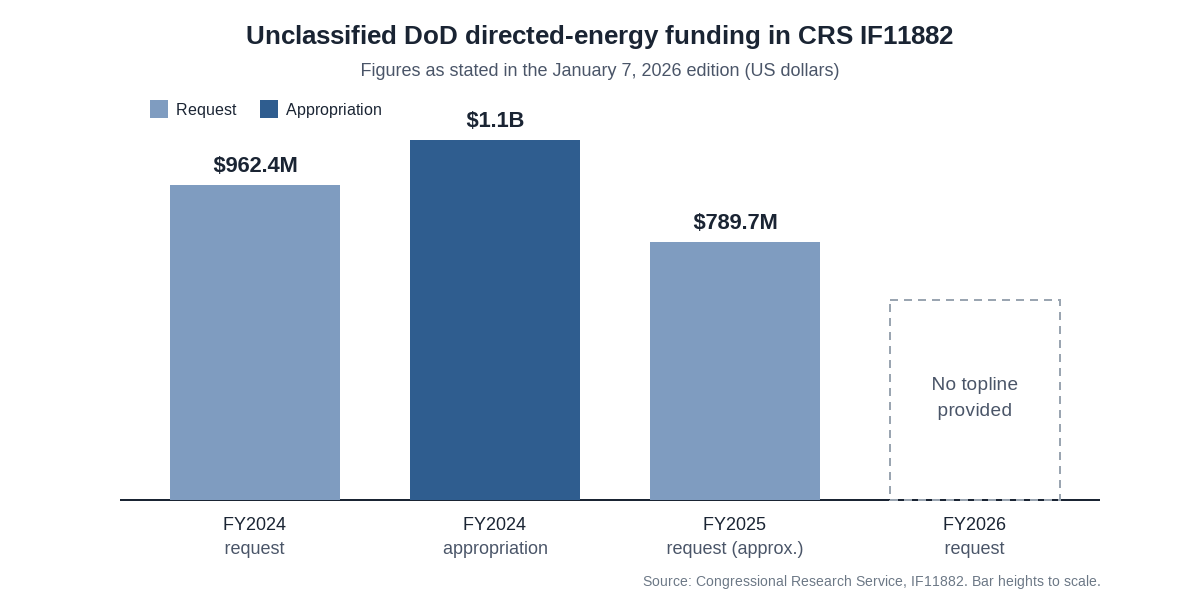
On these numbers alone, the FY2025 request is smaller than the FY2024 request. Keep in mind that the totals add up unclassified programs only. The primer puts that condition right in front of the dollar figures. How to read budget documents is covered in How to Read a Defense Budget: The Lines Behind the Totals.
The technology, explained: power numbers and targets
The primer links a few power levels to target types. Some analysts think a laser of about 100 kW could handle drones, small boats, rockets, artillery shells and mortar rounds. At about 300 kW, they add cruise missiles in some flight profiles. At 1 MW, ballistic missiles and hypersonic weapons might become possible.
One condition matters more than the numbers. Before giving them, the primer says there is "no consensus" on the power each target needs. A single power figure does not decide what a laser can stop.
The same output can give very different results depending on how small the beam spot is and how long it stays on the target. See Power, energy and intensity: W, J and W/cm² and Why a laser weapon does not finish "the instant it fires".
Cost per shot also comes up. Most current US programs are solid-state lasers that run on electricity. For that reason, the primer treats the cost of a shot as the cost of the electricity used to fire it. If the power supply is large enough, the "magazine" can be deeper than with conventional munitions.
High-power microwaves behave differently. A laser sends a narrow beam, while a microwave weapon can act on a wider area. Some analysts therefore think microwaves could be better for area defense against missile salvos or drone swarms. The two approaches are compared in Lasers and high-power microwaves: two kinds of directed energy.
Six questions the primer puts to Congress
The second half of the primer is questions. They are things members could ask the Pentagon in hearings or budget reviews, grouped into six areas.
- Technical maturity: Can beam quality and control reach a militarily useful level? Can size, weight, and power (SWaP) and cooling needs be met? Some systems fit on vehicles, but many need larger or fixed sites.
- Weapon traits: Rain, fog, smoke and similar conditions, along with SWaP and cooling limits, cut range and beam quality. The primer contrasts this with conventional weapons, which these factors do not affect.
- Mission value: The Pentagon is running several utility studies. What is the right share for directed-energy weapons next to conventional munitions?
- Industrial base: In the past, analysts worried about uneven funding and too few openings for the workforce. How much has HELSI eased that?
- Intelligence needs: Does the Pentagon know enough about rival directed-energy weapons to set its own requirements?
- Coordination inside the Pentagon: Section 219 of the FY2017 National Defense Authorization Act gave coordination to the Principal Director. Do the services and agencies follow the roadmap?
Read together, the six questions restate the hard parts of laser weapons in the words of a government document. Beam quality and heat are explained from the basics in Beam quality: M², divergence and brightness and Cooling and thermal management: where the heat that did not become light goes.
What is new
Reading the November 4, 2024 edition next to the January 7, 2026 edition shows a few changed lines.
| Place | November 2024 edition | January 2026 edition |
|---|---|---|
| Basis of the first sentence | The 2022 National Defense Strategy and a House Armed Services Committee task force report | "Senior U.S. defense officials" |
| Roadmap deadline | 500 kW by FY2025, megawatt levels by FY2026 | Per the roadmap dated May 17, 2024: 500 kW in 2025–2030, megawatt levels later |
| FY2026 budget | Not mentioned | States that no total was released |
| Program of record | "Does not currently have" one | "Not known to have" one |
| Title of Navy report R44175 | "Navy Lasers, Railgun, and Gun-Launched Guided Projectile" | "Navy Shipboard Lasers" |
The roadmap deadline is the clearest change. The older edition named fixed years: 500 kW in FY2025 and megawatt levels in FY2026. The new edition gives 500 kW a wide 2025–2030 window and puts megawatt levels at "some point" after that. The target power stays the same, and the deadline has widened and moved later.
The new title of R44175 is a small signal too. The railgun and the gun-launched projectile have dropped out of the title, and only shipboard lasers remain.
Limits and open questions
The primer covers unclassified programs only. Its budget figures are totals within that scope, so they should not be read as everything the Pentagon spends on directed energy. For FY2026, it says only that no total was released. Later budget documents are not part of this primer.
The power-to-target figures are analyst views. Since the primer first says there is no consensus, quoting 100 kW or 300 kW as a performance promise reads more into it than the text allows.
The timing of the edition also matters. This edition came out in January 2026. The news that the US Army signed a laser weapon production contract came later, in September. The contractor described it as the first US contract to produce high-energy laser weapons.
The details are in The US Army E-HEL laser contract and the directed-energy pilot at US bases. How the next edition will treat this contract in its program-of-record line is not yet known.
The China and Russia sections are short. China's 30 kW road-mobile laser LW-30 and Russia's Peresvet appear with a "reportedly" qualifier. The primer notes that little is public about Peresvet, even its power level. For space, the US Defense Intelligence Agency report from October is newer, and it is covered in November letter No. 3.
What to read next
- Laser weapon programs that have been made public: to see programs in other countries that the primer does not name, from public sources.
- US Army laser weapon names explained: DE M-SHORAD, IFPC-HEL, E-HEL: to see the order in which Army program names appeared.
- How to Read a Defense Budget: The Lines Behind the Totals: to see how a request differs from an appropriation.
- How to read laser weapon news: "kW-class", "range" and "cost per shot": to judge how far to trust power figures and test reports.