Follow US Army laser news year by year and the names keep changing. A 2018 congressional report talks about HEL TVD and MMHEL. A 2022 Army article is about DE M-SHORAD, a 2024 report about IFPC-HEL, and a 2026 announcement about E-HEL. Are these new names for one weapon, or different weapons?
The answer is a bit of both. Some names officially took over from an earlier one. Others belong to a branch with a different job. Below, each name is checked against Army articles and Congressional Research Service (CRS) reports.
Three things matter for each one: what it refers to, when it first shows up in an official document, and what power class sits next to it.
A name joins a weapon type to a job
Army laser program names usually have two parts. One part says what kind of weapon it is. The other says where the weapon fits, or which larger program it belongs to. The high-energy laser (HEL) and the DE in directed-energy weapon belong to the first part.
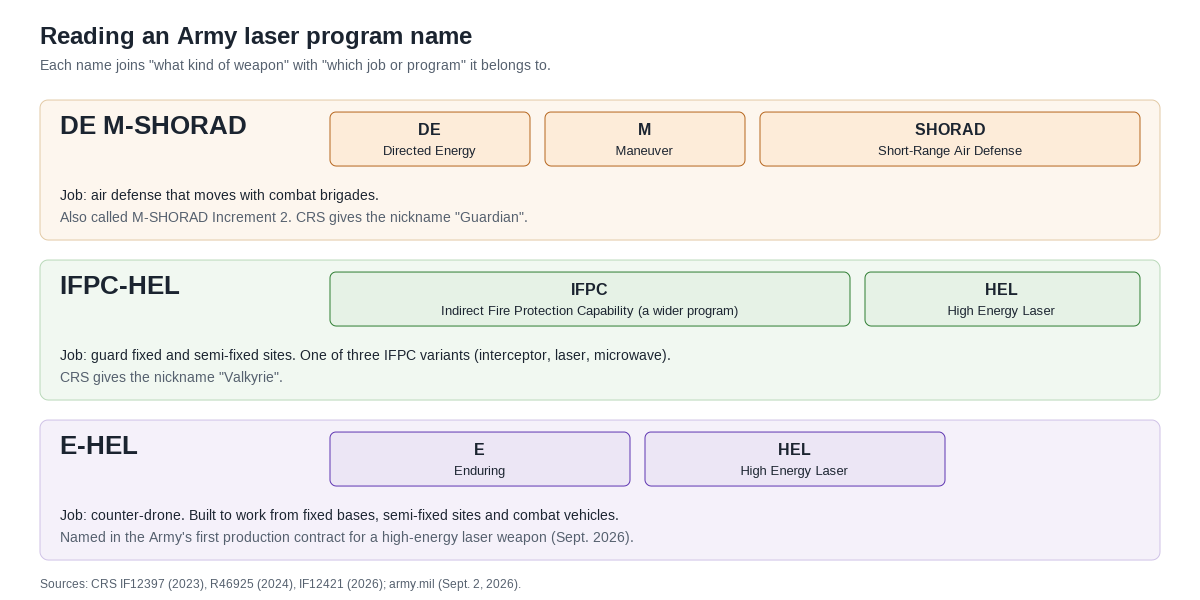
DE M-SHORAD joins "directed energy" to "maneuver short-range air defense." It is the laser branch of M-SHORAD, the program that protects combat brigades from the air while they move. IFPC-HEL is the "high energy laser" branch inside a larger program, the Indirect Fire Protection Capability (IFPC). The back half of a name already hints at the job: following units on the move, or guarding a site that stays in one place.
The 2010s: test vehicles on trucks and Strykers
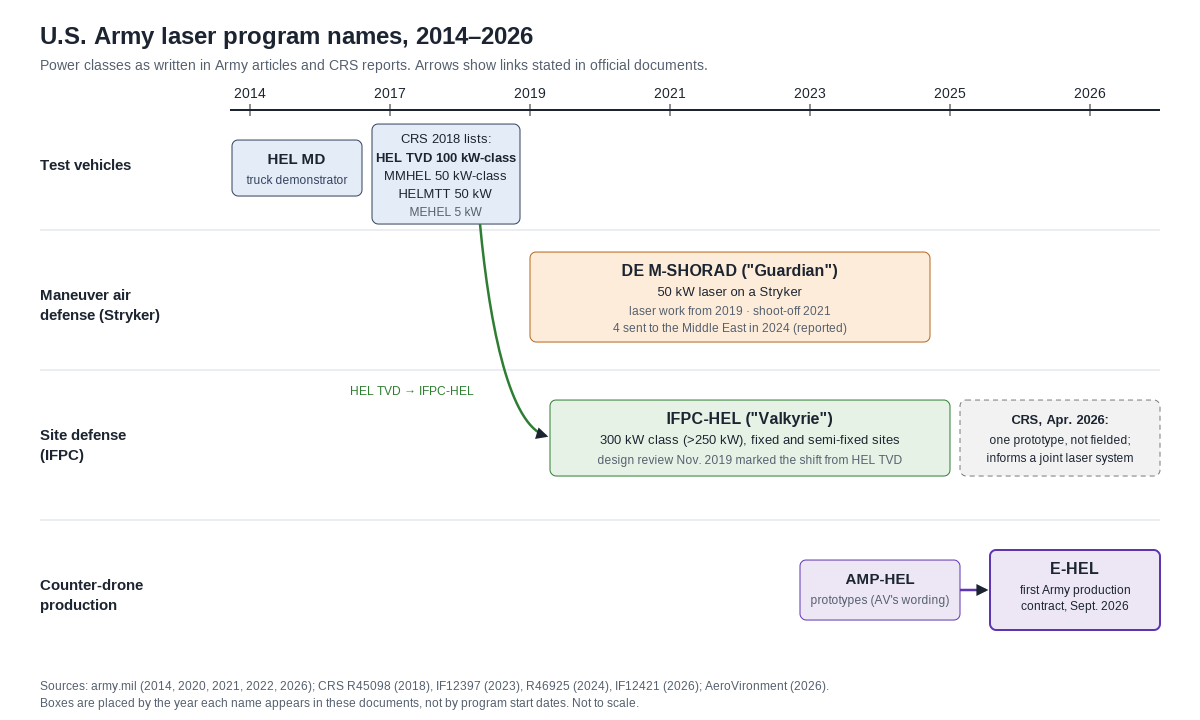
The High Energy Laser Mobile Demonstrator (HEL MD) was, in a September 2014 Army article, the high point of the Army's laser technology development and demonstration work. The whole laser weapon demonstrator sat on one Army truck. It had a record of hitting and destroying mortar rounds. As the name says, it was a demonstrator.
A February 2018 CRS report lists more names. The Army Space and Missile Defense Command was then growing laser technology along two paths. One was the High Energy Laser Tactical Vehicle Demonstrator (HEL TVD), a 100 kilowatt (kW)-class laser on a medium tactical truck. Its goal was a C-RAM (counter rocket, artillery and mortar) capability to protect fixed sites.
The other path was the Multi-Mission High Energy Laser (MMHEL), a 50 kW-class laser mounted on Stryker vehicles. Its purpose was to add short-range air defense for maneuver brigades.
The same report also lists two names used for testing and training. MEHEL put a 5 kW laser on a Stryker and was used in 2017 exercises. HELMTT carried a 50 kW laser on a heavy tactical truck to gather test data.
50 kW on a Stryker: DE M-SHORAD
From 2019, a program putting a 50 kW laser on Strykers appears under the name DE M-SHORAD. M-SHORAD Increment 2, a 2023 CRS paper explains, is also called DE M-SHORAD and uses a 50 kW laser as its main weapon.
Development of that laser started in 2019. The vehicle and power class match the 2018 MMHEL. Even so, no official document calls the two names one program.
In the summer of 2021, Strykers carrying this laser competed in a shoot-off at Fort Sill, Oklahoma. The Army Rapid Capabilities and Critical Technologies Office (RCCTO) called it the Army's "first laser weapon" in the title of an August article. The same article set out a plan to deliver a platoon of four laser Strykers by fiscal year 2022. After this shoot-off, Raytheon won a $123 million development contract.
Results depended on the target. The laser did well against drones, but Army program officials said "challenges remain" for rockets, artillery and mortars.
A 2024 CRS report, citing press reports, said four prototypes went to the Middle East that February for soldiers to try. Early feedback was described as "not overwhelmingly positive." The same report gives DE M-SHORAD the nickname Guardian.
300 kW class for fixed sites: IFPC-HEL
The truck-based HEL TVD carried on under another name. According to a March 2020 Army article, finishing the HEL TVD critical design review on November 7, 2019, marked the official move to IFPC-HEL. The power goal also rose from the 100 kW class to the 300 kW class.
The plan was to first demonstrate the 300 kW class in fiscal year 2022. By fiscal year 2024, four prototypes on tactical vehicles were to go to one platoon.
The 2024 CRS report gives IFPC-HEL the nickname Valkyrie. Its task is protecting sites, both fixed and semi-fixed, from cruise missiles, unmanned aerial systems (UAS), and rockets, artillery and mortars. Where the report quotes Army budget papers, the power is written as "300 kW class [>250 kW]."
The IFPC program also had a sibling that is not a laser. The Army first planned three IFPC variants meant to work together: an interceptor missile, a high-energy laser and a high-power microwave (HPM). The April 2026 picture is different.
Lockheed Martin's July 2023 contract for two prototypes was cut to one, with delivery expected around September–October 2026, according to a CRS paper. The prototype will not go to units. It will instead help inform the Joint Laser Warfighting System.
The name on a production contract: E-HEL
On September 2, 2026, the Army announced a production contract with AeroVironment under the Enduring-High Energy Laser (E-HEL) program. No earlier Army high-energy laser weapon had reached a production contract.
The job is defeating drones and other unmanned aircraft. The design uses 11 major interfaces, so it is not tied to one vehicle. It is meant to run from a permanent base, a temporary field site, or a moving combat vehicle.
The name just before E-HEL comes from the company, not the Army. AeroVironment said E-HEL builds on the Army Multi-Purpose High Energy Laser (AMP-HEL) prototypes. The company describes its LOCUST X3 as a 30 kW-class system, but the Army announcement gives no power figure. The contract itself is covered in the E-HEL contract article, and the later fielding schedule for 2028 in November letter No. 2.
The names and power classes at a glance
| Name | Full name | Year seen in official documents | Power as written | Carried on | Basis |
|---|---|---|---|---|---|
| HEL MD | High Energy Laser Mobile Demonstrator | 2014 | no figure | Army truck | Army article 2014 |
| HEL TVD | High Energy Laser Tactical Vehicle Demonstrator | 2018 | 100 kW class | medium tactical truck | CRS 2018 |
| MMHEL | Multi-Mission High Energy Laser | 2018 | 50 kW class | Stryker | CRS 2018 |
| MEHEL | Mobile Experimental High Energy Laser | 2018 | 5 kW | Stryker | CRS 2018 |
| HELMTT | High Energy Laser Mobile Test Truck | 2018 | 50 kW | heavy tactical truck | CRS 2018 |
| DE M-SHORAD (Guardian) | Directed Energy Maneuver-Short Range Air Defense | 2021 | 50 kW class | Stryker | Army articles 2021, 2022; CRS 2023, 2024 |
| IFPC-HEL (Valkyrie) | Indirect Fire Protection Capability-High Energy Laser | 2020 | 300 kW class (over 250 kW) | tactical vehicle | Army article 2020; CRS 2024, 2026 |
| AMP-HEL | Army Multi-Purpose High Energy Laser | 2026 | no figure | not confirmed | AeroVironment 2026 (company statement) |
| E-HEL | Enduring-High Energy Laser | 2026 | not in the Army release | fixed, semi-fixed, vehicles | Army article 2026 |
"Year seen in official documents" is the year of the document in the last column. It can differ from the year a program started. Take DE M-SHORAD: laser work began in 2019, and the name shows up in an Army article in 2021.
Words that trip readers up
The first is "program of record." The 2018 CRS report quotes the Defense Acquisition University: a program funded across the whole multiyear defense plan, so that it becomes a line item in the defense budget. Both MMHEL and IFPC-HEL were written up as planned to become programs of record.
Yet the January 2026 CRS primer says no directed-energy program of record is known to exist in the department. A planned transition and an actual one are not the same thing.
The second is "prototype" versus "production." Everything from HEL MD to IFPC-HEL was a demonstrator or a prototype. Only in September 2026, after that primer came out, did the Army put E-HEL on a production contract, calling it a first. A production contract does not mean units have the weapon yet, as explained in how to read laser weapon news.
The third is the "kW class" tag. Labels like 50 kW class or 300 kW class give a rough power grade, and the name does not tell you what the weapon can stop, or from how far.
According to the same primer, there is no agreement on what power each target needs. Some analysts think about 100 kW could handle drones and rockets, artillery and mortars, and about 300 kW could also handle cruise missiles flying certain paths.
Money helps with scale too. In a 2023 report, the Government Accountability Office (GAO) said the Defense Department spends about $1 billion a year on directed-energy weapons. That sum covers directed-energy weapons across the whole department, not only the Army.
What to read next
- Laser weapon programs that have been made public: to see laser program names from other countries in one table.
- Public High-Energy Laser Tests, 1975–2026: A Timeline: to see Navy and Air Force tests next to the Army's in date order.
- How to read laser weapon news: "kW-class", "range" and "cost per shot": to weigh power figures and words like "fielded" in news stories.
- The US Army E-HEL laser contract and the directed-energy pilot at US bases: to read what the E-HEL contract says.