In December 2025, Korea's Ministry of National Defense announced a final 2026 defense budget of 65.8642 trillion won. That is 7.5% more than the year before. Headlines usually carry only this one number.
A total, though, does not say where the money goes. One trillion won means something different if it pays soldiers, buys new equipment or funds research. This article opens up public budget documents from Korea and the United States. It shows how a total splits into lines, which budget stage a news figure comes from, and what to watch when comparing countries.
Splitting one total in two: Korea
The budget page of the Ministry of National Defense splits the 2026 defense budget (general account) into two large lines. Force operation costs are 45.8989 trillion won, and defense capability improvement costs are 19.9653 trillion won. Added together, they give exactly the total of 65.8642 trillion won.
Force operation costs split again into personnel operation, 26.3 trillion won, and force maintenance, 19.6 trillion won. Defense capability improvement is 30.3% of the total, or about three won in every ten.
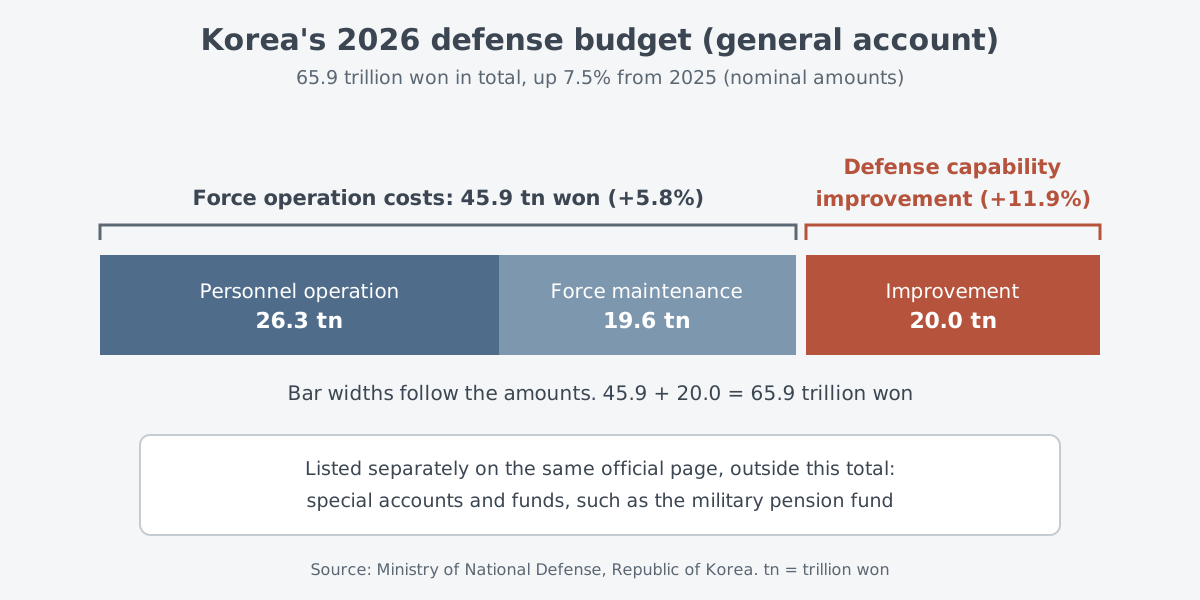
The lines also grew at different rates. The total rose 7.5%, but defense capability improvement rose 11.9% and force operation rose 5.8%. One headline about a 7.5% increase holds two different speeds.
Splitting by the titles of a bill: the United States
The United States splits its budget another way. The defense appropriations act that Congress passes each year is divided into titles, and the money is grouped by those titles. The Congressional Research Service (CRS) compiled the enacted FY2026 amounts. They are $294.4 billion for operation and maintenance (O&M), $193.3 billion for military personnel, $167.5 billion for procurement and $145.9 billion for research, development, test and evaluation (RDT&E).
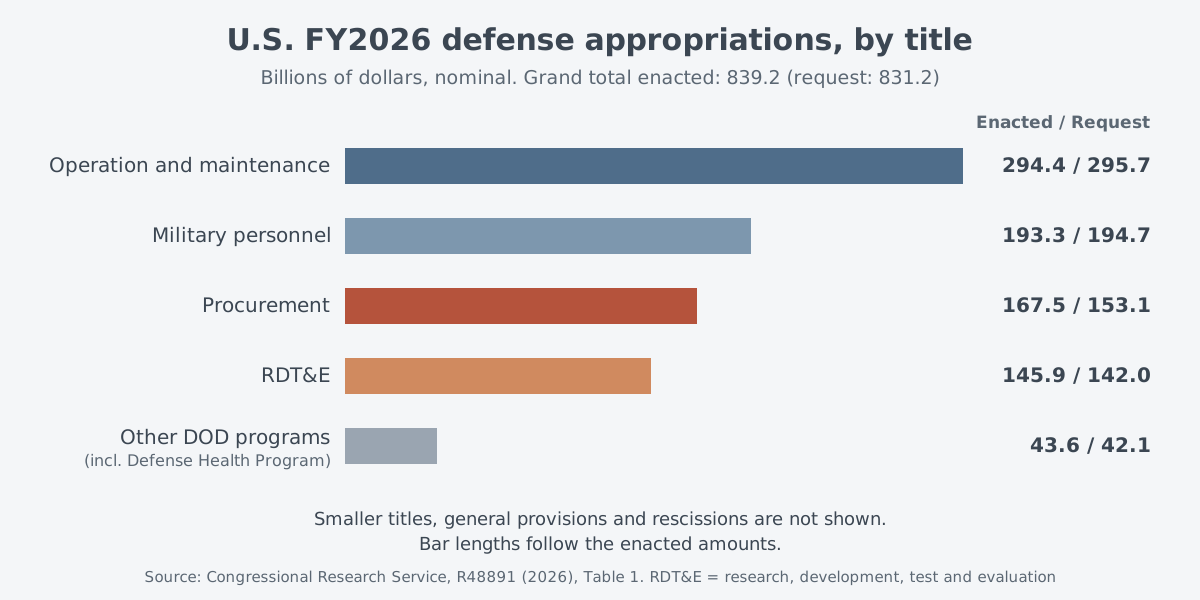
Set against the request, the titles move in different directions. Procurement ended up at $167.5 billion, above the $153.1 billion requested. Military personnel and O&M ended up a little below their requests. The grand total was $831.2 billion requested and $839.2 billion enacted.
Even the O&M line can look different from one document to the next. Some documents count the Defense Health Program inside O&M, while the congressional appropriations act puts it in a separate title. The chart above follows the table that keeps it apart, under "other DOD programs" ($43.6 billion in FY2026).
Korea's two lines and the U.S. titles differ in both names and grouping. Rather than pairing them up directly, it is safer to first read the size and change of each line within one country's own documents.
The numbers inside the research line
U.S. research money splits once more, into eight categories by the kind of work. Each category has a code from 6.1 to 6.8. Codes 6.1 basic research, 6.2 applied research and 6.3 advanced technology development together form the defense science and technology (S&T) budget, seen as the knowledge base for future military systems.
Next come 6.4 advanced component development and prototypes, 6.5 system development and demonstration, 6.6 management support, 6.7 operational system development, and 6.8 software and digital technology pilot programs. Codes 6.4, 6.5 and 6.7 focus on applying existing knowledge to current or near-term needs. Code 6.7 supports upgrades to systems that are already fielded or approved for full-rate production.
In FY2025, RDT&E funding totaled $143.7 billion, and 98% of it, $141.2 billion, sat in the RDT&E title of the appropriations act. Within that title the largest category was 6.7, at $51.8 billion (37%), while S&T in 6.1–6.3 came to $18.9 billion (13%). When a story says research spending went up, it is worth checking which code went up.
Each program in the budget documents is tracked by a program element (PE) number. The example CRS gives is night vision technology, PE0602709A. The leading 06 marks the research and development group, and the next 02 marks applied research within it. Then 709 is the program's own number, and the final A names the Army as the responsible component.
Request, authorization, appropriation and spending are different numbers
A defense budget figure in the news can come from any of several steps. The U.S. President must send next year's budget request to Congress by the first Monday in February. Within five days after that, the Department of Defense (DOD) submits its Future Years Defense Program (FYDP), a five-year plan. The figure at this point is the request.
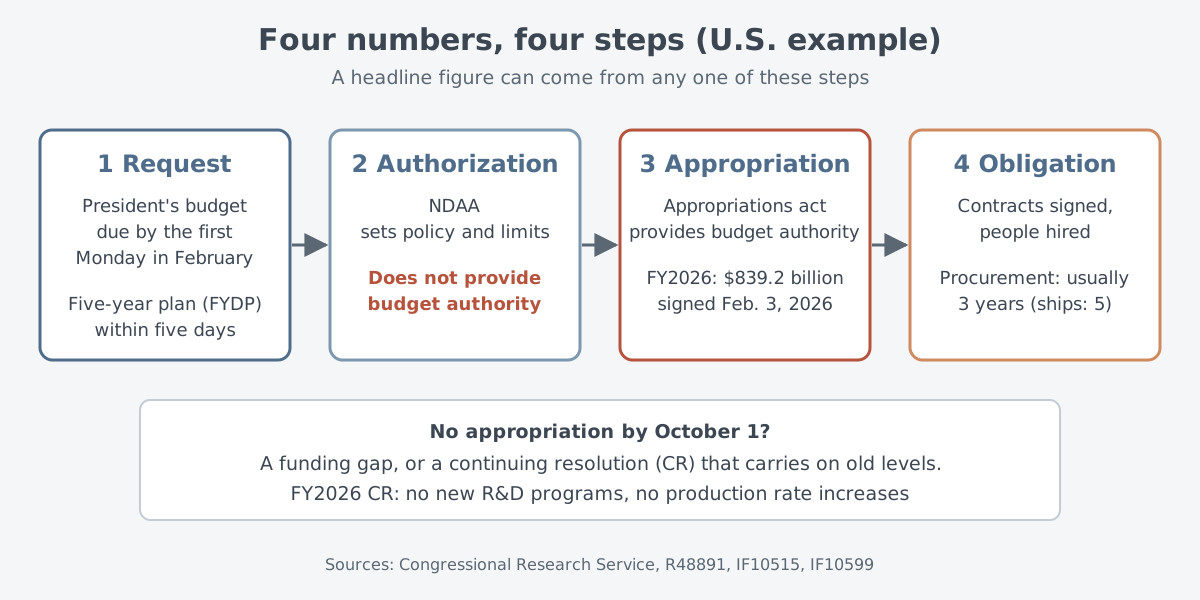
Two kinds of law then move through Congress. The National Defense Authorization Act (NDAA) sets policy and limits and authorizes spending, but unlike an appropriations act it does not provide budget authority. The power to actually spend comes from the appropriations act. Even so, the NDAA has been enacted for 64 years in a row through FY2025, and it has been a fairly reliable sign of how Congress will later fund programs.
The appropriations act changes along the way too. The FY2026 grand total started as a $831.2 billion request. It was $832.0 billion in the House-passed bill and $852.5 billion in the Senate committee bill, and it ended at $839.2 billion enacted. Depending on which figure a story quotes, two articles about the same year can differ by more than $20 billion.
Dates do not line up either. The U.S. fiscal year starts on October 1, but FY2026 began with no appropriations act, and a funding gap lasted 42 days until November 12.
A continuing resolution (CR) then kept DOD running broadly at FY2025 levels. Under it, FY2026 money could not go to new research and development programs or to faster production in existing procurement programs. The final appropriations act was signed on February 3, 2026.
Money in an appropriations act is not all spent that year. Committing to spend, by signing contracts or hiring people, is called obligation. Procurement money can usually be obligated over three years, and Navy shipbuilding money over five. Procurement also follows a full funding policy: the whole cost of a usable end item is approved in one fiscal year, even when the work takes many years.
Money outside the total, or out of sight
Korea's 65.8642 trillion won is the general account. The ministry's budget page lists other items apart from it. They are two special accounts, for relocating defense and military facilities and for relocating U.S. Forces Korea bases, plus the military welfare fund and the military pension fund. The pension fund's 2026 budget, for example, is 5.0997 trillion won, and it is not part of the 65.8642 trillion won total.
In the United States, a large sum arrived outside the appropriations act. The 2025 reconciliation law (P.L. 119-21) set aside $156.2 billion of mandatory money for defense, usable until September 30, 2029, of which $152.3 billion went to DOD.
DOD counted $113.3 billion of it in the grand total of its FY2026 request. In its December 2025 financial report, though, DOD said this was FY2025 money available over several years, not FY2026 money. Which year's total the same money goes into changes how large "the defense budget" looks.
Some lines are out of sight. Counting from public budget documents, CRS found that DOD's FY2025 request for "classified programs" came to $89.9 billion, or 10.6% of its $849.8 billion discretionary request. Classified amounts not labeled as such may be missing from that figure, and most classified money is requested inside the Department of the Air Force budget. The FYDP, the five-year plan, has a public structure, but its actual data are classified.
Comparing countries
Countries count different things as defense spending. The Stockholm International Peace Research Institute (SIPRI) uses a broad definition. Where possible, it covers the armed forces and the defense ministry, and also paramilitary forces judged to be trained, armed and ready for use in military operations. It also takes in military pensions, military research and development, and military aid given to other countries.
So a government's own defense budget and SIPRI's figure can differ. It pays to check how money listed outside the total, such as Korea's military pension fund, was handled.
The unit of money is another issue. Each country's raw data are in its own currency at nominal prices, with no adjustment for inflation.
Converting at each year's average exchange rate gives "current dollars," which work for comparing countries in the same year. They are a poor guide to one country's change over time, because exchange rates can swing in ways that do not match buying power at home. To follow change over time, inflation-adjusted constant prices are needed.
Years are counted differently as well. SIPRI's figures use calendar years, and only the United States is shown by fiscal year. The latest years' figures are adopted budgets or estimates, and they are often revised later.
Comparing the shares of lines runs into definitions too. In the United States, procurement plus research and development have usually made up about 30% of national defense outlays since 2005. That looks close to the 30.3% share of Korea's defense capability improvement costs, but the two lines are defined differently, so they cannot be compared as they stand.
The biggest trap is reading a budget as military strength. Military spending measures a flow of resources in one year, so it does not capture the equipment, knowledge, infrastructure and organization a country has already built up. SIPRI says attempts to judge a country's military capability from its spending level deserve considerable skepticism.
Where this meets lasers: reading the stage from the budget line
Budget figures show up often in laser weapon news. Whether the money sits in the research line or the procurement line gives a clue to how far a program has come. In the United States, a program before procurement is treated as being in development and is generally funded with RDT&E money. A major program usually moves into procurement after Milestone C approval.
A clue is not an answer. Some programs receive procurement money before Milestone C approval. Inside the research line, 6.2 applied research and 6.4 prototypes are different kinds of work, so checking the code gives a sharper reading. Other numbers in such stories, like power, range and cost per shot, are unpacked the same way in How to read laser weapon news.
What to read next
- How to read laser weapon news: "kW-class", "range" and "cost per shot": the numbers that show up in stories after the budget.
- Finding open sources: where to look for government reports, papers and standards: where to find original documents like the congressional reports used here.
- A map of Korean defense technology: the agencies and steps that Korean weapon programs go through.