Aiming a laser at a satellite is not a new idea. Lasers that briefly dazzle a satellite's camera with bright light are still named as the most common directed energy threat. A report released by the US Defense Intelligence Agency (DIA) on October 26 goes a step further. Weapons like these, in its judgment, could go up into space rather than stay on the ground.
The report's directed energy lines here come from two US outlets that quoted it directly, The War Zone and Air & Space Forces Magazine. A Chinese Foreign Ministry paper from three days earlier and a Chinese state media rebuttal from the next day sit alongside them.
This letter in brief
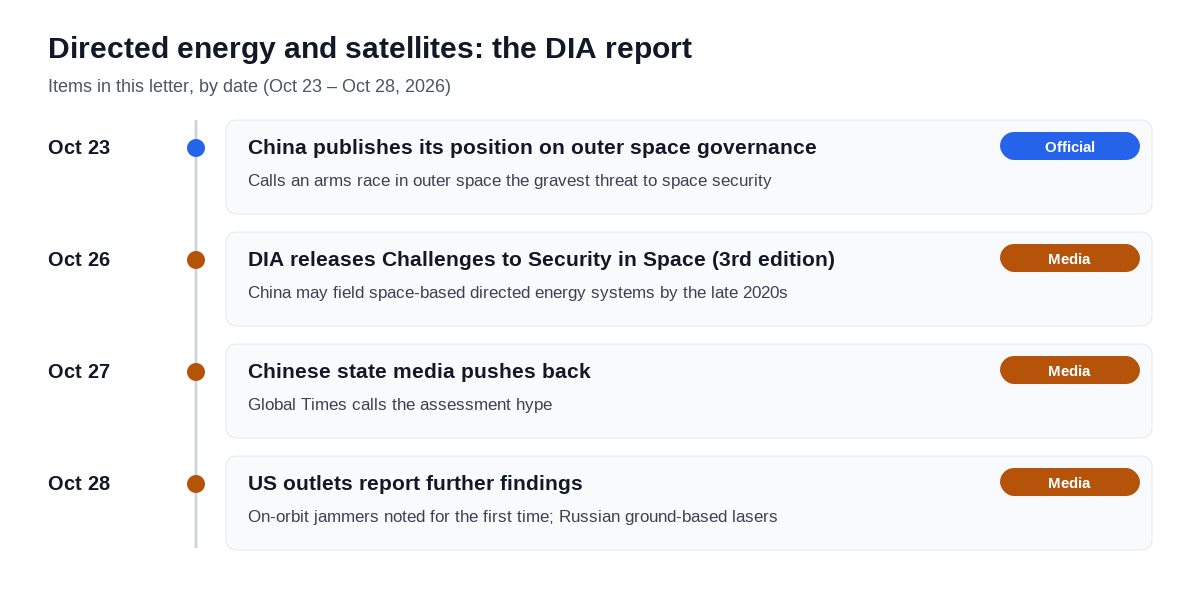
- The DIA released the third edition of Challenges to Security in Space on October 26. According to report lines quoted by outlets, it judged that China may field space-based directed energy systems by the late 2020s.
- The report repeated an earlier warning that Chinese ground-based lasers can disrupt, degrade or destroy low-orbit satellites, and it mentioned on-orbit jammers for the first time. Three days earlier, China's Foreign Ministry had issued a position paper calling an arms race in outer space the gravest threat, and state media called the report hype.
- Whether the directed energy China is said to be developing is laser or microwave, and what power or test evidence lies behind the judgment, was not disclosed.
What came out: the third edition
The third edition of Challenges to Security in Space came out on October 26, after earlier editions in 2019 and 2022. It is unclassified, relies mostly on open-source information and has a July cutoff. Two outlets, Air & Space Forces Magazine and The War Zone (TWZ), quoted it at length.
The directed energy passages quoted by the two outlets come in two layers. The first is a current judgment, repeated from earlier editions. Lasers on the ground in China can already "disrupt, degrade, or destroy" low-orbit satellites.
The second is new. One quoted line reads: "By the late 2020s, China may field space-based directed energy systems and higher-powered ground-based directed energy systems capable of threatening satellites in higher orbits." The verb is "may field," not "has fielded."
Why directed energy: effects that can be undone
China's People's Liberation Army, in the report's view, probably considers directed energy weapons "ideal counterspace systems." The reason given is that such weapons can do harm that wears off as well as harm that lasts. Reversible attacks include jamming satellite signals or temporarily blinding their optics.
The family runs from microwaves up to powerful lasers. The most common today are lasers that "dazzle" satellites carrying electro-optical sensors. It is a bit like shining a strong light into a camera until the picture washes out white. In practice, the satellite is far away and moving fast, with air in between, so hitting its sensor from the ground means following it very precisely.
What the report did not say matters too. It does not say which kind China is working on, whether laser, microwave, particle beam or some mix. No power levels or test evidence appear in the articles either.
Other new judgments
Several points are new in this edition. It is the first time the DIA has noted on-orbit jammers. Chinese satellites have come within 10 km of other nations' satellites in geosynchronous orbit. Such approaches are largely inconsistent with the satellites' stated missions, in the report's judgment.
Russia gets a line as well. It also has ground-based laser systems that can affect US and allied satellites. Russian plans for space-based directed energy weapons are not addressed.
TWZ added that directed energy attacks from one satellite on another could happen over long distances in the vacuum of space. That could make them very hard to attribute. This is the outlet's own analysis.
The Chinese documents: a position paper and state media
In time order, the Chinese document came first. On October 23, China's Foreign Ministry issued a position paper on outer space governance, three days before the DIA report. It is a general position, not a reply to the report.
The paper names two dangers: a space arms race, and a drift toward making space a new arena of conflict. Together they have become "the gravest threat and challenge to space security." Opposition to the weaponization of outer space is stated as well.
The day after the report came out, the Chinese state outlet Global Times ran a rebuttal. Its headline says US intelligence "hypes" Chinese and Russian space threats. The findings appear there as claims, next to a reminder that the US itself has acknowledged deploying weapons in orbit. A Chinese military commentator quoted in the article called it a case of "thief crying stop the thief."
The words each document uses
The DIA report's verb is "may field," and the key phrase in the Chinese Foreign Ministry paper is opposition to "the weaponization of outer space." One warns about the other side's capabilities. The other names the drift toward turning space into a theater of conflict as the biggest threat in itself.
On the technical side, one question stands out. Briefly dazzling a satellite sensor with a laser and damaging a satellite take very different amounts of energy. The words "reversible" and "nonreversible" mark that difference. How power, energy and intensity differ is covered in power, energy and intensity.
Another problem is that what happens in space is hard to see from the ground. Watching the space around satellites is covered in space situational awareness, and the debris left by tests that destroy satellites is in anti-satellite tests and space debris.
What to read next
- Anti-Satellite Tests and Space Debris: for why nonreversible attacks on satellites are a problem for everyone.
- Space situational awareness: what passes near satellites: for who watches close approaches to satellites, and how.
- What is a laser weapon? Film versus reality: for the difference between dazzling and destroying, from the basics of laser weapons.