A news report calls a laser "kW-class", and it sounds powerful. But powerful in what way? Power, energy and intensity (irradiance) all seem to say "how strong", yet each measures something different.
Power says how much per second, energy says how much in total, and intensity says how much on a small area. Their units are the watt (W), the joule (J) and the watt per square centimeter (W/cm²).
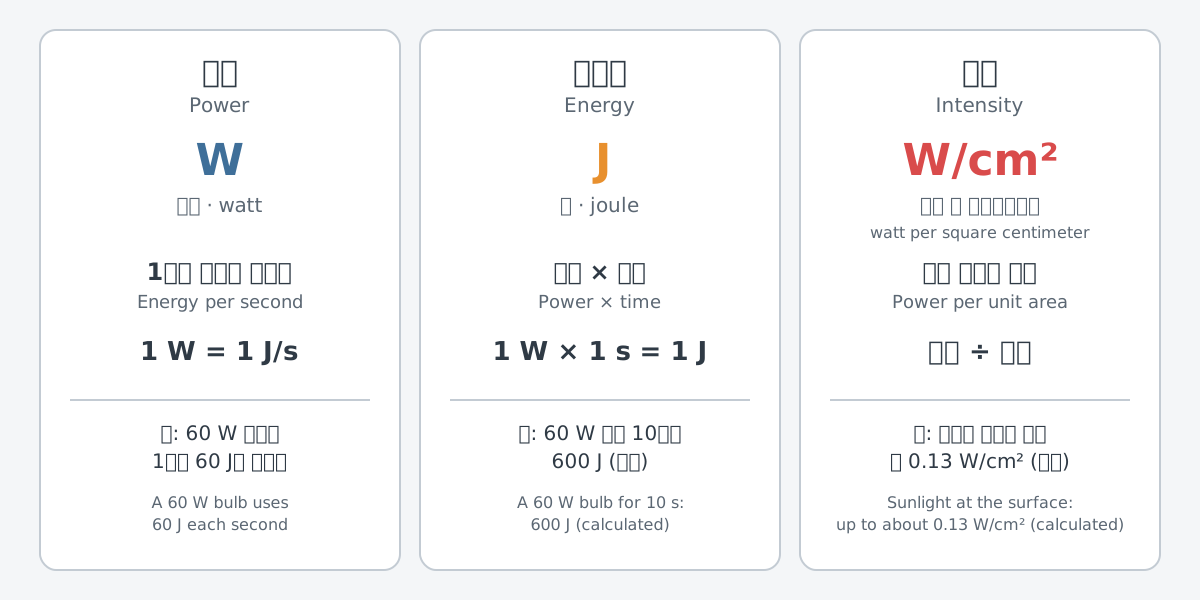
Power (W): energy per second
Power is how much energy moves each second. The OpenStax physics textbook (College Physics 2e) defines it as "the rate at which work is done". Work is energy transfer, so power is also the rate at which energy is expended.
The unit of power is the watt, and 1 watt equals 1 joule per second. So 1 W is a power that uses 1 J every second.
A light bulb is a good everyday example. In the same textbook, a 60 W bulb uses 60 J of energy per second.
But a 60 W incandescent bulb converts only 5 W to light, and the other 55 W is dissipated as heat. Even one bulb has a power it uses and a power that becomes light. That difference matters again in the "kW-class" section below.
Energy (J): power multiplied by time
If the power is constant, energy (J) is power (W) multiplied by time (s). Using 1 W for 1 s gives 1 W × 1 s = 1 J/s × 1 s = 1 J. A 60 W bulb left on for 10 s uses 60 W × 10 s = 600 J (calculated).
A power of 600 W delivers the same 600 J in one second: 600 W × 1 s = 600 J (calculated). The same energy can come at different powers.
Think of energy as the water collected in a bucket and power as the water leaving the tap each second. In practice, water stays in the bucket, while the energy a bulb uses changes form into light and heat.
Intensity (W/cm²): the same power on a smaller spot
Intensity is power divided by area. For an electromagnetic wave, OpenStax (University Physics Volume 2) calls it "the power per unit area" and gives it in W/m². This article uses W/cm². Since 1 cm² = 10⁻⁴ m², 1 W/cm² = 10⁴ W/m² (calculated).
I = P ÷ A
I is the intensity (W/cm²), P is the power (W) and A is the area the beam covers (cm²).
The same 1 W gives a low intensity when spread over a wide spot and a high intensity when gathered onto a small one. Putting 1 W on 1 cm² gives 1 W ÷ 1 cm² = 1 W/cm². On 0.1 cm² it gives 1 W ÷ 0.1 cm² = 10 W/cm² (calculated, assuming a uniform beam).
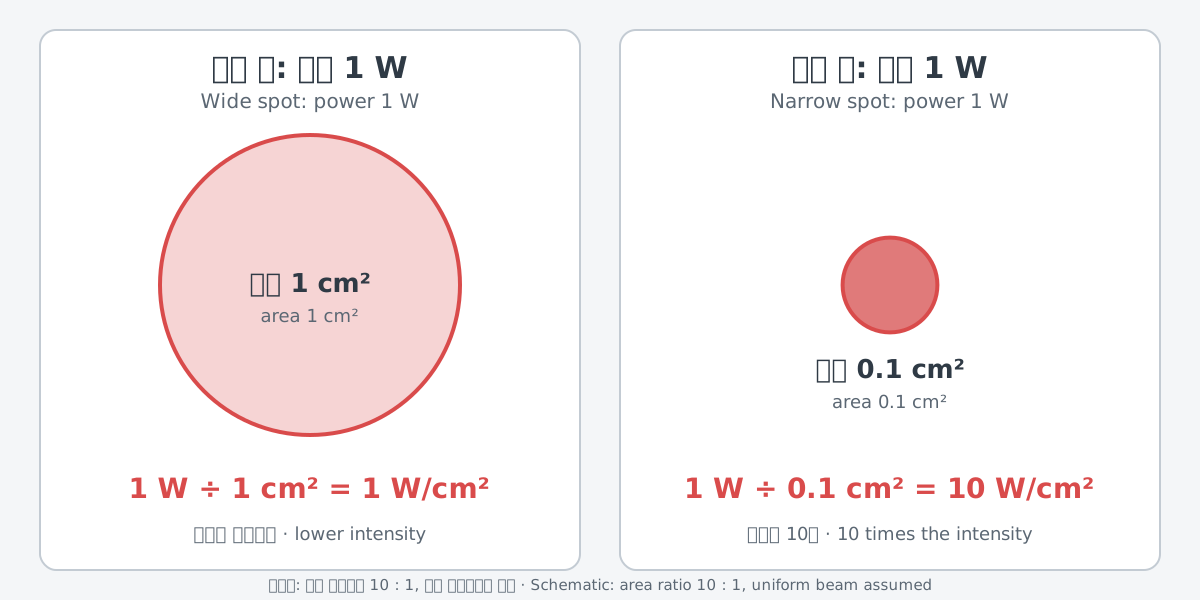
Picture pressing with the same force using your palm and then your fingertip. The more you concentrate it, the harder it feels. Intensity, though, is power divided by area, not force.
For a sense of scale, College Physics 2e says sunlight reaching Earth's surface carries a maximum power of about 1.3 kilowatts per square meter. Calculated, 1.3 kW/m² = 1,300 W/m² = 0.13 W/cm².
This quantity has two names. OpenStax calls it "intensity". The unit table of the International System of Units (SI), however, lists power per area (W/m²) as "irradiance" and power per solid angle (W/sr) as "radiant intensity".
A solid angle measures how widely directions spread out. W/sr is not a value per area, so the two are different quantities. This article writes "intensity" and gives irradiance beside it at first use.
Average power and peak power
When a laser emits light without a break, one power value is enough. When it emits short pulses, the word "power" splits in two. The article "Continuous-wave and pulsed lasers" covers that in detail.
Average power is the energy delivered during a period of time divided by that time. Because work is energy transfer, this matches the OpenStax definition (University Physics Volume 1): the work done during a time interval, divided by that interval.
Peak power is the maximum optical power of a pulse, and pulse energy is the total optical energy in one pulse. According to the RP Photonics encyclopedia, short pulses can give a very high peak power even when the pulse energy is moderate.
Reading the phrase "kW-class"
Start with the unit. In the BIPM prefix table, k (kilo) means 10³, M (mega) means 10⁶ and m (milli) means 10⁻³. The US Congressional Research Service (CRS) report R46925 spells it out in a footnote: "1 kilowatt is equal to 1,000 watts, and 1 megawatt is equal to 1 million watts."
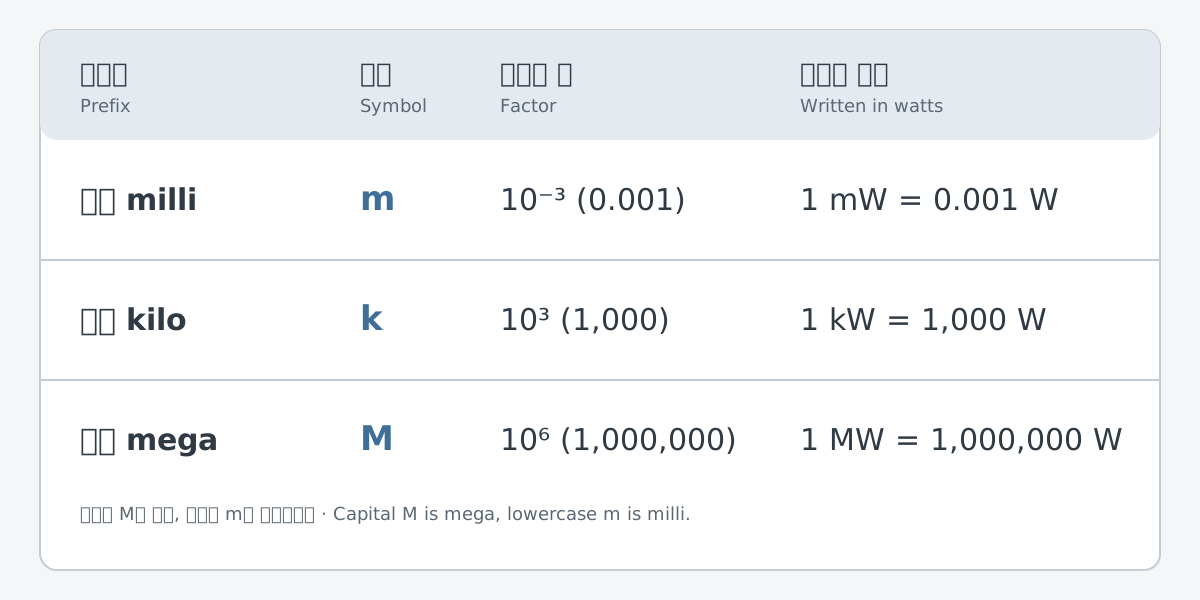
The same report discusses lasers whose beam powers are measured in kilowatts (kW) rather than megawatts (MW), and says solid-state lasers are "fueled by electrical power". Like the bulb above, a laser has a power going in as electricity and a power coming out as a beam. The two need not be equal.
The report, however, has no sentence that fixes which of the two "kW-class" refers to. When you see "kW-class" in a news report, do not assume optical output or electrical input. Check first what the article says was measured.
"kW-class" gives you only one thing: energy per second. By the two relations above (energy = power × time, intensity = power ÷ area), that number alone cannot tell you two things.
- How many seconds the light lasts: you need that to get the energy (J).
- How tightly the beam is focused: you need that to get the intensity (W/cm²).
What to read next
Three articles follow. "Continuous-wave and pulsed lasers" continues with average power and peak power.
"Units and dB notes: reading W, dBm and ratios" covers converting between the units that different sources use. "How to read laser weapon news: “kW-class”, “range” and “cost per shot”" covers what the words in a news report mean.