The U.S. fiscal year 2027 began on October 1. Yet there is still no FY2027 defense appropriations act. The Pentagon runs on a continuing resolution (CR), signed in September, until December 11, and that money is based largely on the amounts in the FY2026 appropriations acts.
So where is the money for laser weapons in the meantime? The most detailed official numbers available now are the President's request and the reports of two House committees that went through it line by line. This letter pulls out only the lines for high-energy lasers (HEL) and directed-energy weapons (DEW).
This letter in brief
- The FY2027 Pentagon RDT&E request has four Defense-Wide lines with "high energy laser" in the name ($313.685 million in all), plus directed energy lines for the Navy and the Air Force.
- The House Armed Services Committee added items for ultra-short pulsed laser weapons and containerized ship lasers. The House Appropriations Committee added laser research items to Air Force and Army lines.
- No full-year appropriations act exists yet. The two reports do not give a directed energy total, or the directed energy share of Golden Dome.
What was announced
A budget is not settled in one step. The President's request comes first. Then Congress passes the National Defense Authorization Act (NDAA) and the appropriations act separately. How to Read a Defense Budget maps this path in a diagram.
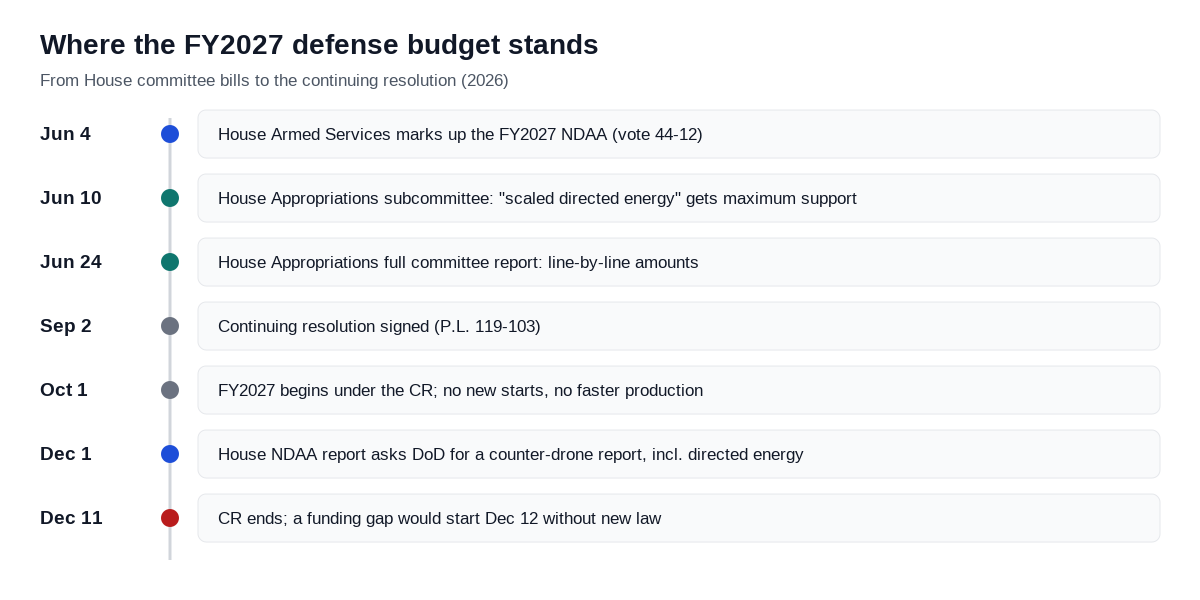
For FY2027, two House documents put numbers on each line. The House Armed Services Committee marked up the NDAA, H.R. 8800, on June 4 and approved it 44-12. The funding tables at the back of its report list the request and each committee change.
The House Appropriations Committee issued its defense appropriations report on June 24. The President's request for the activities in that act totals $1,072,210,299,000. The appropriations subcommittee summary of June 10 named six critical technology areas for maximum support. One of them is "Scaled directed energy."
Then, on September 2, the stopgap law (P.L. 119-103) was signed. According to the Congressional Research Service (CRS), it funds the agencies covered by the 12 appropriations bills for 72 days, from October 1 through December 11.
What is publicly known
Every value below appears in the two reports, in the same unit: thousands of dollars.
| PE number | Name | RDT&E category | FY2027 request | House NDAA | House appropriations |
|---|---|---|---|---|---|
| 0601108D8Z | High Energy Laser Research Initiatives | 6.1 basic research | 17,667 | 17,667 | 17,667 |
| 0602890D8Z | High Energy Laser Research | 6.2 applied research | 50,408 | 50,408 | 50,408 |
| 0603924D8Z | High Energy Laser Advanced Technology Program | 6.3 advanced technology development | 201,125 | 206,125 | 201,125 |
| 0604924D8Z | High Energy Laser Advanced Component Development & Prototype | 6.4 advanced component development and prototypes | 44,485 | 44,485 | 44,485 |
| 0603925N | Navy Directed Energy and Electric Weapon Systems | 6.3 advanced technology development | 94,825 | 97,325 | 94,825 |
| 0602605F | Air Force Directed Energy Technology | 6.2 applied research | 91,798 | 91,798 | 91,798 |
| 0603605F | Air Force Advanced Weapons Technology | 6.3 advanced technology development | 13,744 | 13,744 | 71,044 |
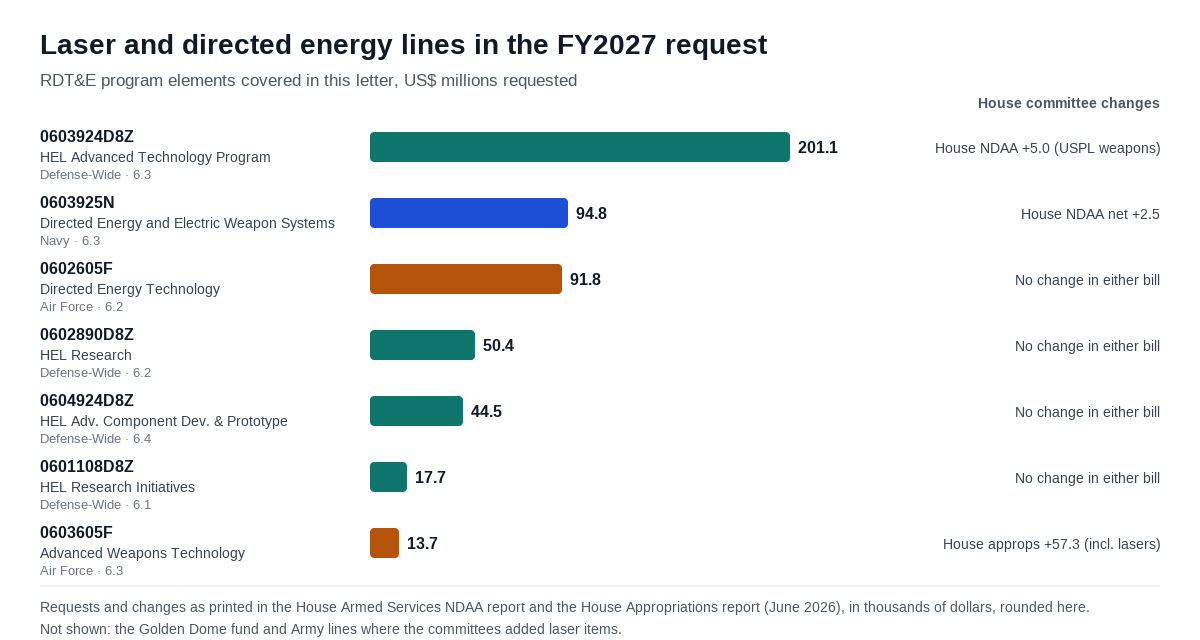
The largest line is the Defense-Wide High Energy Laser Advanced Technology Program, with a request of $201.125 million. The four Defense-Wide lines add up to $313.685 million. The Navy line asks for $94.825 million, and Air Force Directed Energy Technology asks for $91.798 million.
The two committees changed little. The Armed Services Committee added $5 million to the advanced technology program, under an item named Ultra-Short Pulsed Laser (USPL) Weapons.
On the Navy line it added $5 million for a containerized HELIOS and $2.5 million for a containerized maritime high energy laser weapon system. It also cut $5 million as "unjustified growth." The Navy line therefore rises by $2.5 million, to $97.325 million.
HELIOS is the first increment of SNLWS, the Navy's shipboard laser program. CRS spells it out as "the high-energy laser with integrated optical dazzler and surveillance." The committee's item name is that same phrase with "containerized" in front.
The Appropriations Committee moved the other way on the Air Force Advanced Weapons Technology line, raising it from $13.744 million to $71.044 million. The added $57.3 million includes $10 million for high power solid state laser technology and $5 million for airborne high power electromagnetic directed energy against drones.
Army lines also carry increases with laser in the name. One is $15 million for atmospheric study and prototype HEL systems against drones and cruise missiles. The others are $8 million for a modular HEL power system, $15 million for a low SWaP-C next generation HEL system, and $4 million for a solid state laser testbed.
The Armed Services Committee also assigned homework. The Secretary of Defense must deliver a report on counter-drone defense of U.S. bases by December 1. It must cover the development of directed energy counter-drone systems, whether they can be deployed at home, and the safety precautions needed when they are.
The technology, explained
PE in the first column stands for program element, the number given to each item in the budget books. The first two digits, 06, mark the research and development group. The next two give the category inside it: 01 is basic research, 02 is applied research, 03 is advanced technology development, and 04 is advanced component development and prototypes.
The last letter names the responsible component: N for the Navy and F for the Air Force. The four ending in D8Z sit in the Defense-Wide section of the appropriations tables.
Read this way, all seven lines above fall in categories 6.1–6.4. Categories 6.1–6.3 form what is called the defense science and technology (S&T) budget, and 6.4 is the prototype category. In other words, "laser budget" can mean lab research, prototypes or purchases, and those are different stages. How Weapons Are Bought explains the stages.
No kW figures appear in either report. A CRS primer sums up the most recent public Pentagon directed energy roadmap, dated May 17, 2024. It plans to go from about 150 kW, which is feasible today, to 500 kW with less size and weight in the 2025–2030 timeframe.
The same primer notes that some analysts think about 300 kW could also handle cruise missiles flying certain paths, across the laser rather than at it. It adds that there is no consensus on the power needed. What "power" measures is covered in Power, energy and intensity: W, J and W/cm².
An ultra-short pulsed laser cuts its light into very short pulses. Only the item name and amount are listed, with no word on what the weapon is meant to do. The high power electromagnetic item, judging by its name, is directed energy on the radio-wave side rather than a laser. For how lasers differ from their main counterpart, high-power microwave (HPM) weapons, see Lasers and high-power microwaves: two kinds of directed energy.
What is new
The official totals to compare against are in the CRS primer. The Pentagon requested $962.4 million for unclassified directed energy programs in FY2024 and received $1.1 billion. The FY2025 request fell to about $789.7 million. For FY2026, CRS says the Pentagon did not provide a directed energy topline.
FY2027 looks similar. The tables in the two committee reports have no line that totals directed energy alone. The seven lines above were picked by line names and committee item names, so they are not the whole picture.
Limits and open questions
The biggest gap is Golden Dome. The Appropriations Committee says the President requested $17,518,222,000 for the Golden Dome for America Fund, and that $17,120,151,000 of it was requested as mandatory funds. The committee's table shows only two Golden Dome fund lines, together $397.971 million. The report does not say how much of this is directed energy.
The committee raised the same point: it told the Pentagon to submit, starting in FY2028, a separate justification volume listing all Golden Dome activities by appropriation account and program element.
The two reports give line names, amounts and the names of items the committees added or cut. They do not give each program's power, test schedule or contractor.
House committee numbers are not law. They can change until a final law is agreed with the Senate. Under the CR, the Pentagon may not fund new starts that got no money in FY2026, or raise production rates above FY2026 levels. The laser items the committees added take effect only if they make it into a full-year appropriations act.
What to watch next
- December 1: due date for the counter-drone report on U.S. bases requested by the House Armed Services Committee, including directed energy development, domestic deployment and safety precautions.
- December 11: the CR ends. Without a full-year act or a new CR before then, a funding gap starts on December 12.
- The FY2028 budget request: whether the separate Golden Dome justification volume asked for by House appropriators comes with it.
Read next
- How to Read a Defense Budget: The Lines Behind the Totals: why request, authorization, appropriation and obligation are different numbers.
- How Weapons Are Bought: The Defense Acquisition Process: how R&D and procurement categories line up with program stages.
- US Army laser weapon names explained: DE M-SHORAD, IFPC-HEL, E-HEL: a guide to the Army program names that appear in the news.
- Laser weapon programs that have been made public: laser weapons that governments have announced outside the budget books.