In the spring of 1983, a Sidewinder air-to-air missile was flying over China Lake, California, when it fell out of the sky. Nothing fired at it: no missile, no gun. It was hit by a carbon dioxide laser aboard a nearby aircraft, a military relative of the Boeing 707.
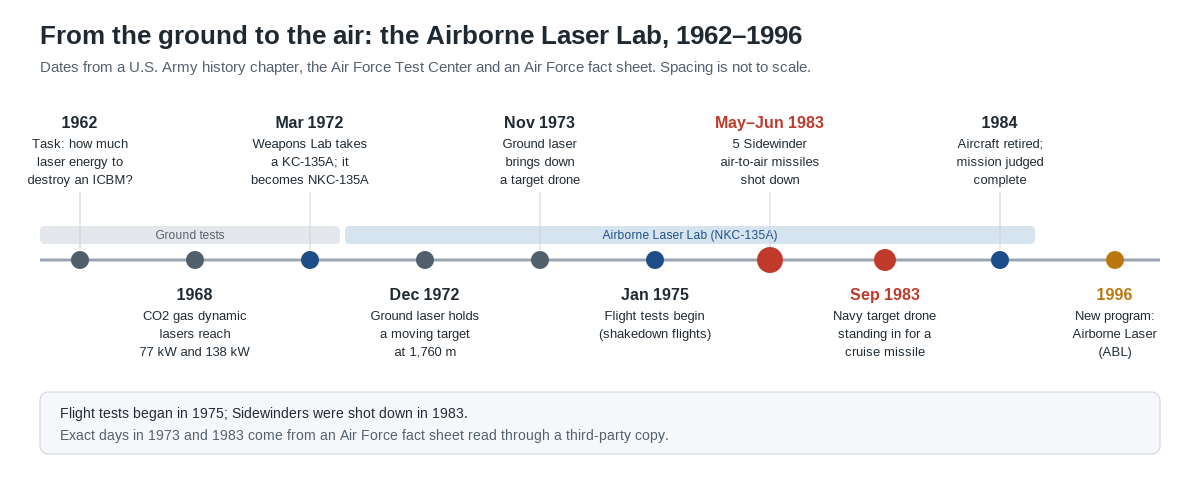
The aircraft was the Airborne Laser Laboratory (ALL). A U.S. Army Medical Department history records that it shot down five AIM-9B Sidewinders in 1983.
Yet the aircraft was retired the next year, and no weapon with the same laser followed. Why did a laser that could hit missiles not become a weapon?
A laser that fired on the ground first
The story starts on the ground, not in the air. In 1962, Air Force scientists at Kirtland were given a question: how much laser energy would it take to destroy an ICBM? At the time, no laser in existence could deliver that much energy.
Things changed within a few years. In early 1968, two carbon dioxide gas dynamic lasers (GDL) produced beams of 77 kW and 138 kW. A gas dynamic laser is one branch of the carbon dioxide laser family.
In December 1972, researchers at the Sandia Optical Range on Kirtland Air Force Base paired a 100–150 kW beam with a telescope. They kept it on a moving target 1,760 m away for several seconds. Eleven months later, the same setup brought down a target drone flying at 200 mph. An Air Force fact sheet calls this the first time a high-energy laser (HEL) destroyed an aerial target.
A lab inside a military 707
If it worked on the ground, would it work in the air? The next step was to put the laser on an airplane.
The Air Force Weapons Laboratory took over a Boeing NKC-135A in March 1972. The KC-135 is a military aircraft from the same family as the Boeing 707.
The aircraft carried a carbon dioxide gas dynamic laser with a wavelength of 10.6 μm. An optical pointing and tracking system turned the beam toward a target and followed it. An alignment system kept the optics lined up. Today this job belongs to the beam director.
Sources describe the power differently. The Army history calls it a 400 kW laser, while the Air Force fact sheet only says "kilowatt-class," in contrast with the megawatt-class laser that came later.
Testing in the air
An Air Force Test Center article records that the United States used the aircraft for its Airborne Laser Lab program from 1975 to 1984. According to the Air Force fact sheet, the early flights from January 1975 were shakedown runs. They checked how the aircraft flew with the laser aboard and whether the tracking and alignment gear worked in the air.
1983: five missiles over China Lake
The kills came in 1983. The Test Center mentions successful interceptions of small air-to-air missiles and drone aircraft, and the Army history counts five AIM-9B Sidewinders shot down that year.
The Sidewinder is a small air-to-air missile fired by fighter aircraft. Why a laser needs time to heat and damage a target is covered in Why a laser weapon does not finish "the instant it fires".
Only one source, the Air Force fact sheet, gives the exact days. By its account, Sidewinders went down on May 26 and soon after, then on May 31 and June 1. On September 26, a joint experiment with the Navy brought down a 23-foot drone standing in for a Russian cruise missile.
Why it never became a weapon
The ALL had been an experimental aircraft from the start. The Air Force Test Center notes that, despite its combat potential, the system was kept strictly experimental. The aircraft was retired in 1984.
The Air Force fact sheet says that, despite its success, weapons planners paid little attention to the ALL. The reason it gives: the flights were filed as "proof-of-concept" showings, not as proof of a weapon troops could use. It also names two problems with the equipment: the carbon dioxide laser took up too much room and lacked the power to work at long range.
Other test equipment of the period drew a similar verdict. Some U.S. high-energy lasers of that era could have been adapted as weapons, but none were developed that way. They were test beds, built to show what a technology could do and where its limits lay. The tests showed these lasers to be too big, too heavy, too costly, and too dangerous.
What the ALL left behind
The idea of an airborne laser did not end with the ALL. The Scud missile threat faced in the Gulf War revived interest in it. In 1996, the U.S. Air Force launched an acquisition program for the Airborne Laser (ABL), a laser weapon meant to defeat ballistic missiles in the boost phase.
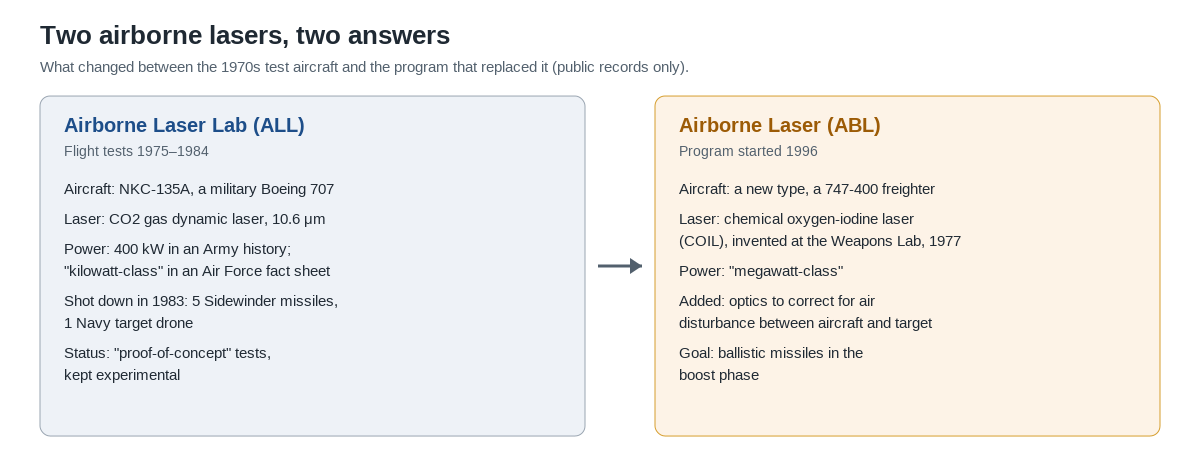
According to the Air Force fact sheet, the Air Force chose a fresh start over reviving the ALL: a new system with a different laser and a different aircraft. The new laser was a megawatt-class chemical oxygen-iodine laser (COIL), and the aircraft became a Boeing 747-400 freighter.
The ABL also gained something the ALL lacked: optics to correct for atmospheric disturbance between the aircraft and the target. Atmospheric turbulence, the shimmering of the air, blurs a beam. How that blur is undone is explained in Adaptive optics: restoring a blurred beam.
The ALL showed that a laser on an aircraft could hit a missile. The limits the records name were bulk and power, and the ABL changed both the laser and the aircraft and added atmospheric correction. How that turned out is the story of its 2010 test and the end of the program.
Further reading
- A history of laser weapons: from chemical to electric lasers: the chemical laser programs after the ALL and the shift to electric lasers
- 2010: YAL-1, the 747 Laser Intercept Test and the End of the Program: the ABL that followed the ALL, its test and its end
- CO2 Lasers: The Gas Laser That Ran Factories for Decades: how the ALL's laser works