The 2024 edition of Japan's defense white paper has a figure on the capabilities of Aegis system-equipped vessels. In its box for "Equipment planned to be installed after 2032," one line reads "High-power lasers, etc.," with the note that it deals with drone saturation attacks. A footnote under the figure says the details may change.
High-power lasers show up in Ministry of Defense papers long before that. This article lines up three kinds of official documents in date order. They are external evaluation reports from the Acquisition, Technology & Logistics Agency (ATLA), policy evaluations from the Ministry of Defense, and the white paper. It then separates what they state from what they leave blank.
2010–2016: air defense research with an iodine laser
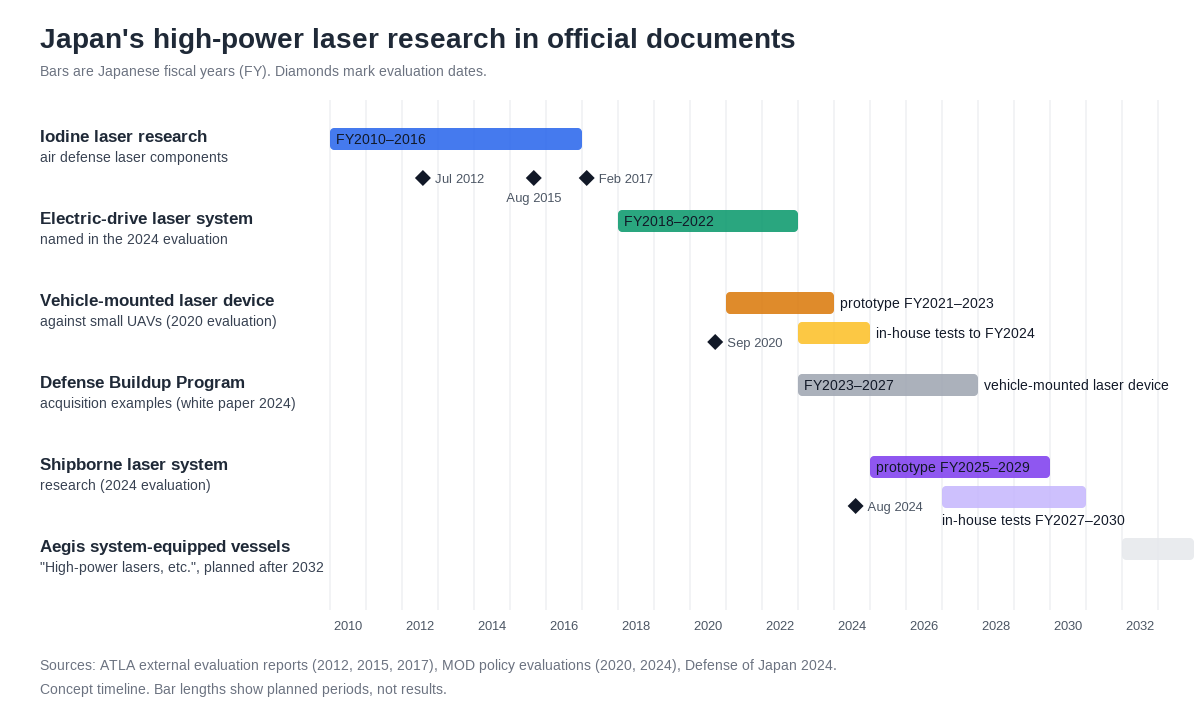
The earliest record this article found is an external evaluation report from a meeting on July 31, 2012. The subject was the basic design stage of "research on high-power laser weapons for air defense," and the technology under review was "small high-power iodine laser technology."
The aim was to gather technical data on parts of a high-power laser system. Such a system could serve close-in air defense for ships such as destroyers, or key ground facilities such as bases. The research schedule runs from FY2010 to FY2016.
On August 28, 2015, a mid-term review took place once the research prototypes were finished. The committee's discussion centered on laser output, tracking and aiming, and how the beam travels through the atmosphere. The committee wrote that the state of the air strongly affects laser propagation, so changes in the environment such as the weather need to be evaluated.
The third report covers a review held on February 15, 2017, after in-house testing ended. The 2015 mid-term report and this 2017 report carry the same prototype overview figure. It has the labels "research prototype (1): laser output 15 kW" and "research prototype (3): laser output 50 kW." Between them, "research prototype (2)" is labeled as adding a tracking function.
The 2017 report says the project measured the effect of thermal blooming with a high-power laser. That is the effect in which a laser heats the air it passes through, and the warmed air spoils the focus of the beam. The committee wrote that it understood the researchers' plan to choose a light source next, with solid-state lasers among the options.
2018–2022: an electric-drive high-power laser system
Research from these years appears by name in a later document. The 2024 policy evaluation says a project called "research on an electric-drive high-power laser system" ran from FY2018 to FY2022, and that the new project will build on its results.
The same evaluation says earlier research is in the process of establishing electric-drive high-power laser technology that can deal with small unmanned aircraft and mortar rounds. The output and test results of that research are not stated in the documents this article opened.
2020: the vehicle-mounted laser device project
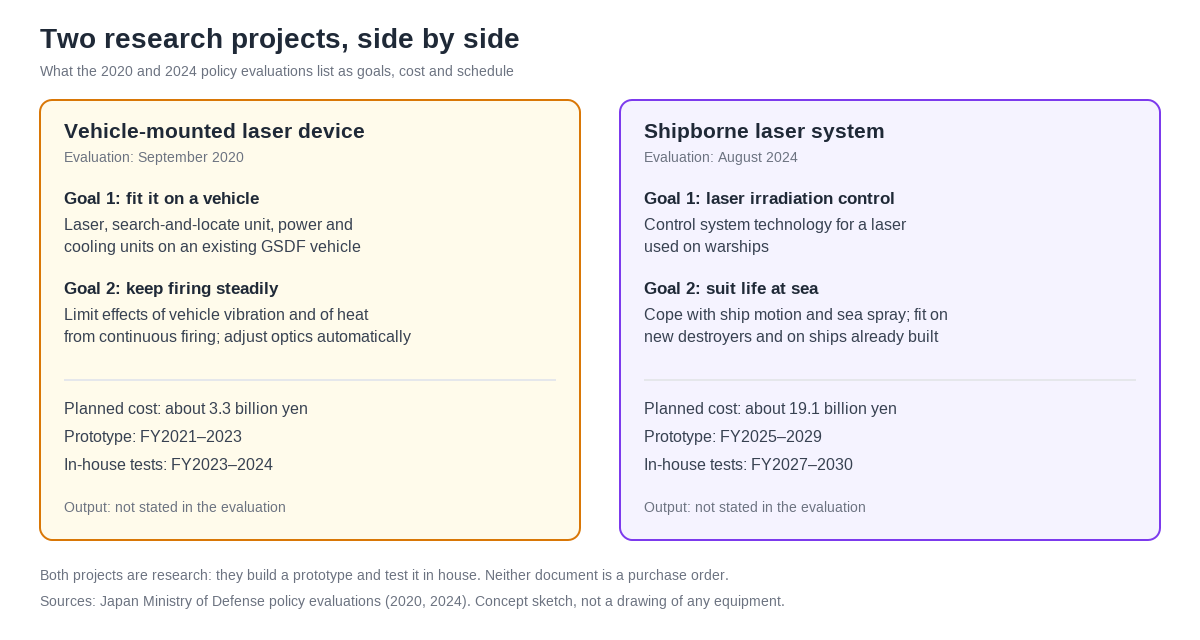
The policy evaluation of September 2020 was written ahead of a new project. Its title is "research on a vehicle-mounted laser device (for countering short-range UAVs)," and it falls under ATLA's technology strategy department. The plan is to build a prototype laser device on a vehicle that can move and deploy. With it, the project aims to establish technology to deal with attacks such as those by several small UAVs working together.
The planned total cost is about 3.3 billion yen in prototype research spending. The schedule has the prototype built in FY2021–2023, with in-house tests in FY2023–2024 to check the results.
The goals come in two parts. One is the technology to put the laser device, a search-and-locate unit, power and cooling units and other parts onto a vehicle the Ground Self-Defense Force already uses. The other is the technology to limit the effects of vehicle vibration on the move and of temperature changes from continuous firing. It also covers adjusting the optics automatically so the laser fires steadily and continuously.
2024: the shipborne laser system project
The ship-side policy evaluation came out in August 2024. The project is titled "research on a shipborne laser system." Building on earlier results, it will study a high-power laser system for ships that suits the sea environment and can handle large numbers of incoming small unmanned aircraft.
The planned total cost is about 19.1 billion yen in prototype research spending. The prototype is due in FY2025–2029, and in-house tests, including test preparation, in FY2027–2030.
One goal is to acquire laser irradiation control system technology. The other is shipboard fit. That means coping with ship motion, sea spray and similar conditions, and being able to go on both new destroyers and ships already built.
The evaluation also quotes the Defense Buildup Program adopted by the Cabinet on December 16, 2022. It says Japan will widen the ways it uses the electromagnetic spectrum, including countering small unmanned aircraft (UAVs) with lasers and similar means. It also says research on high-power lasers that intercept air threats such as small UAVs will continue.
Plans in Defense of Japan 2024
The plans this article looked at in the English edition of the 2024 white paper sit in two figures. The first lays out spending needed over the next five years. Among examples of equipment to be acquired under the Defense Buildup Program (FY2023–2027) is "Acquiring a vehicle-mounted laser device." It is an example of a planned purchase, not a statement that the device has been acquired.
The second is the figure on vessels equipped with the Aegis combat system that opened this article. Its equipment planned for after 2032 (scalable) includes high-power lasers and similar systems to deal with drone saturation attacks. As the footnote says, the details may change.
What is public and what is not
| Item | What the documents state | Document |
|---|---|---|
| 2010s research | Air defense high-power laser, small high-power iodine laser technology, FY2010–2016 | External evaluations 2012, 2015, 2017 |
| Output of the 2010s prototypes | Figure labels "laser output 15 kW" and "laser output 50 kW" | External evaluations 2015, 2017 |
| 2010s testing | Thermal blooming effect measured | External evaluation 2017 |
| Electric-drive research | Name and period (FY2018–2022) | Policy evaluation 2024 |
| Vehicle-mounted project | Goals, about 3.3 billion yen, prototype FY2021–2023, in-house tests FY2023–2024 | Policy evaluation 2020 |
| Shipborne project | Goals, about 19.1 billion yen, prototype FY2025–2029, in-house tests FY2027–2030 | Policy evaluation 2024 |
| Plans | Vehicle-mounted device acquisition (example for FY2023–2027), high-power lasers etc. on Aegis system-equipped vessels after 2032 | White paper 2024 |
| Output of the vehicle and ship systems | Not stated | Policy evaluations 2020, 2024 |
| Results of the vehicle-mounted in-house tests | Not in the documents this article opened | |
| Engagement range | Not stated |
The top of the table holds names, money and dates. The bottom holds the blanks. The only output figures in these documents are the two labels in the figure shared by the 2015 and 2017 reports. That figure also appears in the 2015 report, which evaluated iodine laser technology, so the labels cannot be read as the output of the vehicle-mounted or shipborne systems.
The documents also differ in kind. An external evaluation report reviews research that is under way or finished. A policy evaluation is a plan written before a project starts, and the white paper's two figures are plans for the future. The same word "laser" carries a different weight depending on whether it sits in a review record, a plan written before a project starts, or a plan for years ahead.
What to read next
- Laser weapon programs that have been made public: official statements from several governments and militaries in one table.
- A history of laser weapons: from chemical to electric lasers: how the light sources of laser weapons have changed.
- Light through air: absorption, scattering, turbulence, thermal blooming: the physics behind the atmospheric propagation and thermal blooming in the 2015 and 2017 reports.
- How to read laser weapon news: how to pick out stages and numbers in official wording.