Look at a cutaway of a tank's ammunition and the rounds fall into two groups. One is a thin metal rod with fins. The other is a blunt round with a pointed spike on its nose. Both are built to get through armor, so why do they look so different?
The answer lies in where the penetrating power comes from. One pushes in with the mass and speed it brings. The other detonates in front of the target and forms a metal jet. Speed is what separates them, and that difference is why one tank carries both.
The job is to get through
The armor and anti-armor monograph from DSIAC, an information center under the Defense Technical Information Center, starts from one point. Most anti-armor munitions defeat a target by perforating it. So round design comes down to what you send through to the far side of the armor.
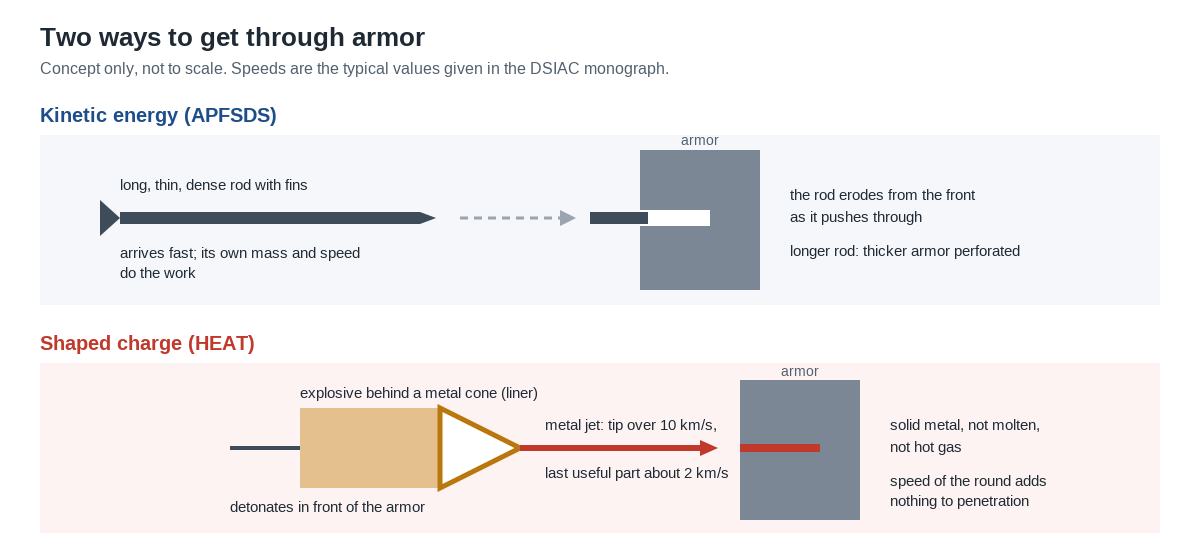
Here the two families split. Kinetic energy (KE) rounds throw heavy metal in at high speed. Shaped-charge (SC) rounds use explosive to squeeze metal into a thin line without melting it.
Kinetic energy rounds: pushing in with mass and speed
Kinetic energy is half of mass times the square of speed. Double the speed and the energy goes up four times. A KE round focuses that energy on a small area and shoves the armor aside.
The first armor-piercing (AP) shot was a full-bore lump of hard tool steel. By today's standards it struck very slowly, so it opened a hole and moved through without eroding, much like punching in a machine shop. The next step, hypervelocity AP (HVAP), placed a small, dense core such as tungsten carbide inside a light body. A denser core means higher impact pressure at the same speed, so it goes deeper.
Today's armor-piercing fin-stabilized discarding sabot (APFSDS) round stretches the penetrator even longer and thinner. Fins give it stability, so it can be fired from a smoothbore gun. It strikes so fast that the rod erodes from the front as it pushes in, which is why a longer rod gets through thicker armor. The full story of the long shape is in Kinetic Energy Penetrators: Why Fin-Stabilized Darts Are So Long.
Shaped-charge rounds: squeezing a metal jet in front of the target
A shaped-charge warhead puts explosive behind a cone-like metal liner. When it fires, the liner folds inward and a very fast, thin, stretching jet shoots forward. Because it is mainly an anti-tank weapon, the round is called high-explosive anti-tank (HEAT). As Lawrence Livermore National Laboratory puts it, a shaped charge is built to focus all of its energy on a single line.
The jet is faster than you might think, and cooler too. The tip typically moves faster than 10 km/s, and the last useful part about 2 km/s. Yet a military jet is solid metal far below its melting point. The big blast, the scorched-looking hole and the HEAT acronym spread a belief that hot gas burns through the armor, but that is not what happens.
This round has been strong for a long time. The DSIAC monograph ranks the shaped charge, by the end of World War II, as the most effective anti-tank weapon after the atomic bomb. The history of the principle is in The Shaped Charge: What Is the Munroe Effect?.
Speed means different things
The biggest difference is how each round treats speed. For a KE round, speed is penetrating power. Shaped-charge penetration, by contrast, hardly depends on speed.
It depends on the density ratio of jet and armor and, for a given pair of materials, on jet length. The kinetic energy the round carries in flight adds nothing to its penetration.
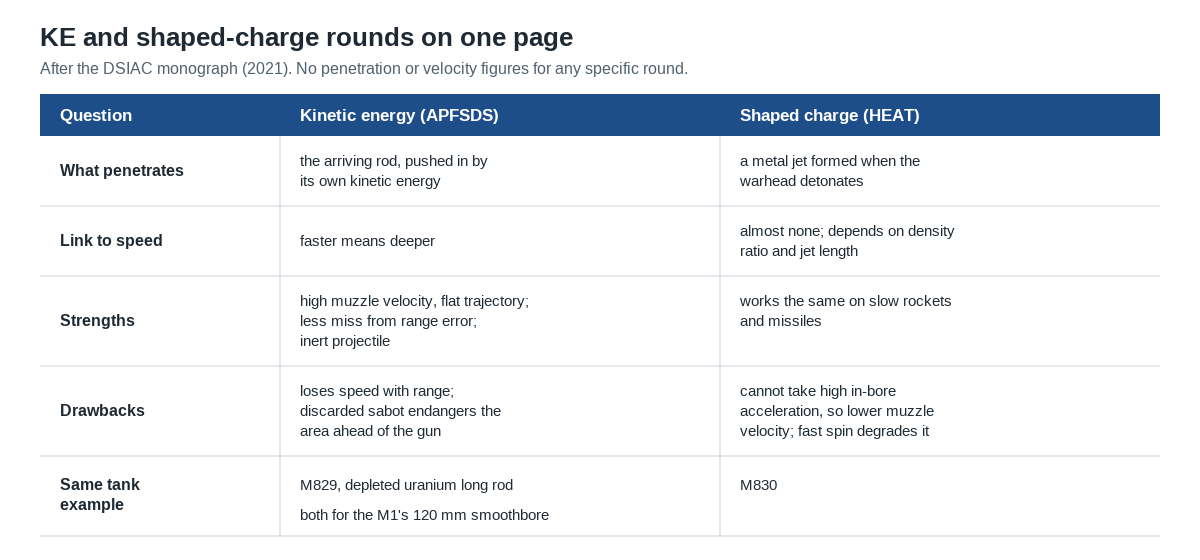
So a shaped charge does not need to be fast. Rockets had matured by World War II and offered another way to send it a long way. On a slow rocket or missile, the way it penetrates stays the same. A KE round cannot do that, so it always needs a large gun and a high muzzle velocity.
Strengths and drawbacks
An explosive-filled round cannot take high acceleration inside the barrel. Push it too hard and it risks detonating in the bore, so its muzzle velocity stays below that of a KE round. A KE round flies a flatter path, so a small error in range estimate causes less of a miss. With no explosive inside, it also helps reduce vehicle vulnerability if the ammunition stores are hit.
KE rounds have weak points too. They lose speed in flight, so they work less well at longer range. The sabot pieces that fall away at the muzzle endanger a wide area in front of the gun. No single round does every job well, so a tank carries two rounds with different characters.
Two rounds from one gun
The U.S. M1 tank is a good example. The M830 shaped-charge round and the M829 long-rod round are both designed for the M1's Rheinmetall-designed 120 mm smoothbore. The M829 is a depleted uranium KE long-rod round. The material story continues in Penetrator Materials: Tungsten, Depleted Uranium and the Health and Environment Debate.
It is worth noticing that both rounds share one smoothbore gun. Spinning a round fast badly degrades shaped-charge performance. That problem ties into why tank guns moved from rifled to smoothbore.
Where lasers come in
Livermore's phrase for a shaped charge, focusing all of its energy on a single line, is an idea that also comes up often with laser weapons. The difference is that a laser sends no metal; it builds up heat on a surface with light. How different weapons concentrate energy on a small spot continues in the laser section of Kinetic Energy Penetrators: Why Fin-Stabilized Darts Are So Long.
What to read next
- Kinetic Energy Penetrators: Why Fin-Stabilized Darts Are So Long: the long rod and the discarding sabot
- The Shaped Charge: What Is the Munroe Effect?: why a hollow charge digs deeper
- Tank Guns from Rifled to Smoothbore: spin and fins, two ways to stabilize
- Penetrator Materials: Tungsten, Depleted Uranium and the Health and Environment Debate: why heavy metals are used