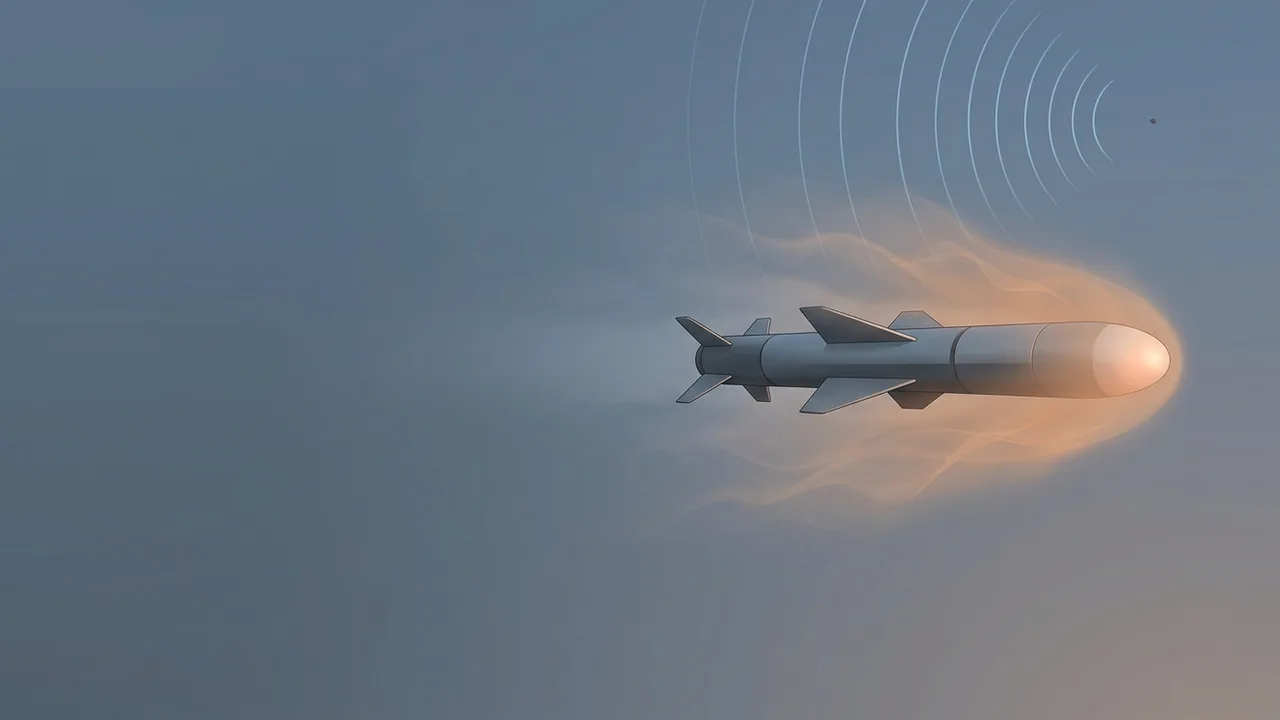
Picture a missile hanging under a fighter's wing. Once it is fired, the other aircraft does not hold still. It turns, climbs or dives, and changes speed. So how does the missile know where the target is while it flies?
The answer is the "eye" carried at the front of the missile. Air-to-air missiles see their targets in two broad ways. One looks for the heat the target gives off, which is infrared light. The other sends out radio waves and reads the reflection, the way radar does.
The radar side splits again, depending on who sends the radio waves. And is the eye open from the moment of launch, or does it open somewhere along the way?
A weapon that corrects its path in flight
An unguided rocket flies in the direction it was first pointed. A guided missile is different.
A technical journal from the Johns Hopkins University Applied Physics Laboratory (APL) gives a definition. Such a missile carries some way to alter its course once it has left the launcher, so that it can reach and intercept a target. The decision to change course can be made by the missile itself, or from afar by an operator or a fire control system.
Correcting the path takes extra parts on board: inertial sensors, sensors that look for the target, radio receivers, a guidance computer and an autopilot. A Congressional Research Service (CRS) primer on precision-guided munitions explains that such weapons can bend their path to make up for aiming mistakes, weather and other problems. By its account, the story of guided weapons reaches as far back as the First World War.
The targets of air-to-air missiles are among the hardest. An aircraft in the sky does not wait at a fixed set of coordinates. Inertial guidance can deliver a long-range ballistic missile precisely when the target is a known point on Earth. It is not suited to targets that move unpredictably, such as maneuvering aircraft.
The missile's eye: seekers and homing
To hit a moving target, the missile has to see the target as it flies. The device that does this is the seeker. When a sensor on the missile supplies the target data that guidance decisions are based on, the method is called homing guidance. Missiles that must catch targets with unpredictable motion, like hostile planes or cruise missiles aimed at ships, use this method.
A seeker does not look once and stop. After it acquires the target, it keeps tracking it and measures how the direction from the missile to the target changes. It stabilizes itself so that the shaking of the missile body does not throw it off. When it can, it also measures how fast the missile and target are closing.
This has a lot in common with how a laser weapon holds its beam on one spot. Gimbals, pointing and tracking: holding the beam on one spot makes a useful companion read.
A missile flying inside the atmosphere also needs a cover that protects the seeker from the elements. The cover on a radio-wave seeker is called a radome. The cover on an infrared seeker is called an irdome.
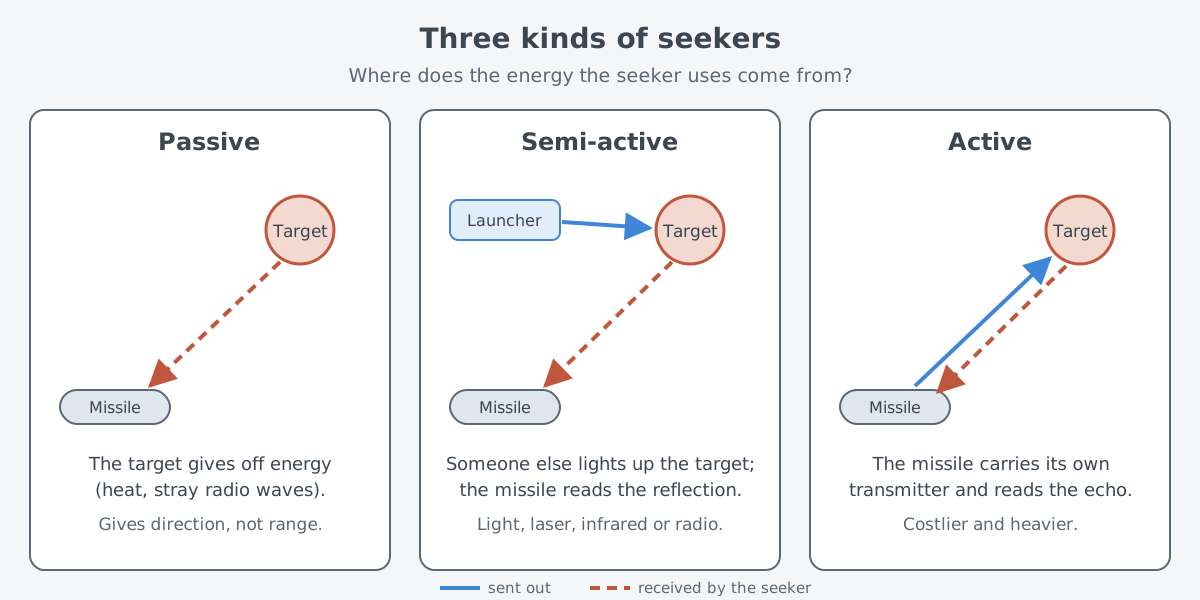
Seekers come in three kinds: passive, semi-active and active. One question separates them. Where does the energy the seeker uses come from?
Seeing in infrared: the heat a target gives off
A passive seeker does not light up the target. It only receives the energy that comes from it. Common examples are infrared (IR) seekers and radio frequency (RF) seekers.
An infrared seeker detects and follows the natural heat signature of the target. A passive RF seeker looks for radio energy that leaks from the target or bounces off it.
Infrared light is part of the electromagnetic spectrum, and its wavelength is longer than that of visible light. Our eyes miss it, though our skin feels it as warmth. Objects that are not very hot, such as people, give off infrared light and no visible light. Why wavelength matters: visible and invisible light explains, through wavelength, why some light is visible and some is not.
Sitting near a campfire, you can tell which side the fire is on even with your eyes closed. Your body feels where the heat comes from. A real seeker differs from your skin: it measures how the direction of the heat changes from moment to moment and uses that to steer the missile.
Passive seekers also have a clear limit. They measure which direction the target lies in, but they do not readily give the range to the target or the closing speed. Measuring closing speed can be done with radar designs, but it is hard with infrared ones.
The history of heat-following air-to-air missiles goes back to the early 1950s. The Office of Naval Research (ONR) describes an inexpensive missile that homed on heat, built in that period at a Navy weapons test site, the Naval Ordnance Test Station. It needed no outside guidance, and the project became Sidewinder. ONR calls Sidewinder the first infrared-guided missile and says it could follow the heat from the engines of hostile aircraft.
Seeing with radio waves: who lights up the target
A seeker that uses radio waves faces one more question. Who sends the radio waves that light up the target? How radar measures distance and motion from the waves that come back is covered in Radar: measuring distance and motion with radio waves. Here the focus is only on how the missile receives that reflection.
In a semi-active system, something outside the missile lights up the target. The beam is sent from whatever fired the missile, or from a spot nearby. The missile carries a passive seeker, which follows the target by catching the energy that bounces back.
This beam can be light or laser energy, or it can be infrared or RF energy. The use is different from that of a high-energy laser (HEL) weapon, but it is worth remembering that a laser can also serve as the light that marks a target.
Depending on the design, a semi-active RF seeker can give the closing speed as well as the target's direction. The Doppler frequency of the returning signal gives a good estimate of that closing speed. Because the illuminator sits outside the missile, much more power can be put on the target without making the missile bigger or heavier.
An active system puts the illuminator, a transmitter, inside the missile. The missile lights up the target itself and reads the echo. Adding a transmitter raises the cost and the weight. In return, once the missile has locked on to the target, it can carry on by itself.
Depending on the design, an active seeker can give range and range rate as well as direction. Even so, power and weight limits usually keep active homing to the final phase, after another kind of guidance has already carried the missile near the target.
| Kind | Energy the seeker receives | Main information |
|---|---|---|
| Passive | What the target gives off (heat, leaking radio waves) | Direction of the target |
| Semi-active | Reflection of a beam sent from outside the missile | Direction, and in some designs closing speed |
| Active | Reflection of what the missile's own transmitter sends | Direction, and in some designs range and range rate |
When the eye opens: phases of flight
A seeker does not always see the target from the moment of launch. A guided missile's flight is usually divided into three guidance phases: boost, midcourse and terminal. Not every missile uses all three, but every precision-guided missile has a terminal phase.
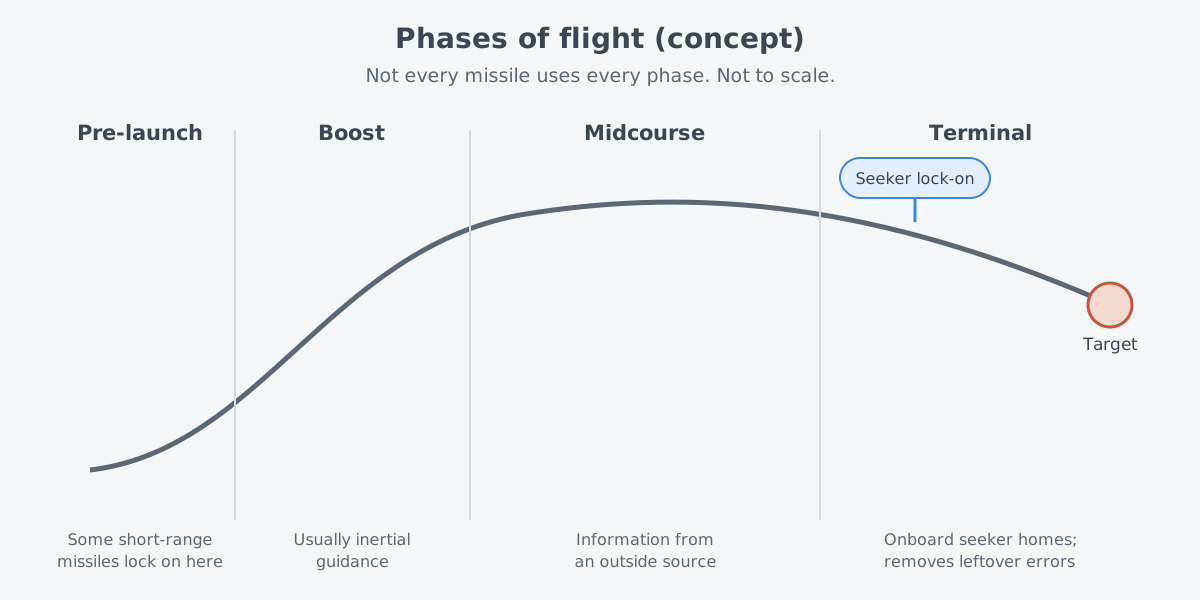
The boost phase usually uses inertial guidance. During midcourse, data reaches the missile from a source outside it. The last phase, the terminal phase, is generally the most critical one, and its purpose is to remove the errors left over from the earlier phases. The power and weight limits seen above are also why active seekers mostly work in this phase.
Some shorter-range missiles home all the way, from launch to the end. Such a missile acquires the target with its own seeker before it is fired. It leaves the launcher with its eye already open.
Air-to-air missiles in public records
The Sidewinder from the infrared section lives on in name. The CRS primer on precision-guided munitions, in its July 2025 version, presents the AIM-9X Sidewinder as a short-range missile for fighting other aircraft. It grew out of changes to the original AIM-9, under a program the Navy leads and the Air Force joins. Its newest version, the AIM-9X Block II, entered production in 2011, and ONR notes that Sidewinder is still in active service more than 70 years later.
The same primer also notes that the AIM-9X has been evaluated by the Army as a missile fired from the ground at air targets. An eye that watches targets in the sky solves the same problem whether the missile leaves an aircraft or the ground.
The other air-to-air missile the primer names is the AIM-120 AMRAAM, which serves with both the Air Force and the Navy. Its newest variant is the AIM-120D3, and both services are working on a successor, the JATM, also called the AIM-260.
Seekers are not one fixed kind either. The guidance parts CRS lists for precision-guided munitions include inertial measurement units and GPS receivers, and next to them seekers that use lasers or millimeter-wave radar. What a weapon looks with is chosen to fit the target and the job.
What to read next
- Why wavelength matters: visible and invisible light: explains through wavelength how infrared light differs from visible light.
- Radar: measuring distance and motion with radio waves: covers what the reflected radio waves read by semi-active and active seekers can tell you.
- Missile seekers: the eye at the front: looks deeper inside the seeker that this article only sorted into kinds.
- Surface-to-air missiles: ground systems that guard the sky: covers systems that turn the same eye from the ground toward the sky.