News of a North Korean ballistic missile launch almost always comes with two numbers. One is how far the missile flew. The other is how high it climbed. A launch on February 27, 2022, recorded in the Japan Ministry of Defense white paper, is a typical case.
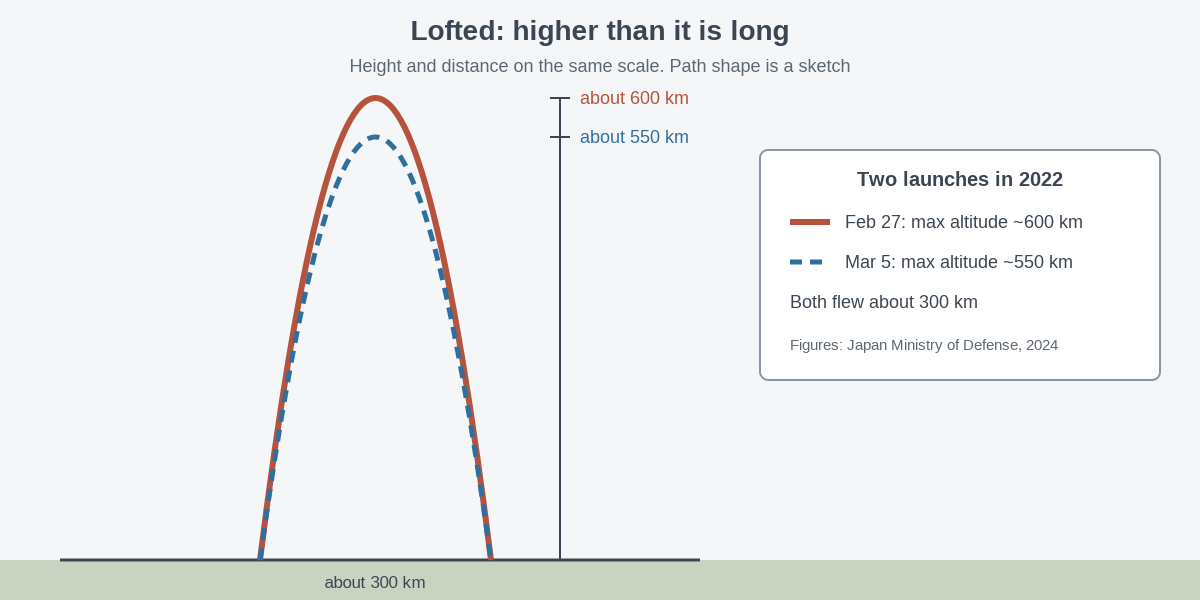
The missile flew about 300 km and reached a maximum altitude of about 600 km. It climbed about twice as high as it traveled. The ministry assessed that it was launched on a lofted trajectory.
How can a missile fly a path like that? And what is the name for the opposite, a low and flat path? Starting with a thrown ball, this article walks through the three names used for missile trajectories.
Same distance, two paths
Imagine throwing a ball twice with the same effort. Once you throw it steeply toward the sky, and once you throw it low and close to the ground. With no air resistance and flat ground, the two balls can land in the same spot.
A physics textbook puts this in terms of angles. At the same starting speed, two launch angles that add up to 90° give the same range. 15° and 75° are such a pair.
The difference is height. A throw at the shallower angle peaks lower, and a throw at the steeper angle peaks higher.
The angle that goes farthest is 45°. That is true only when air resistance is ignored; with air resistance, the best angle is somewhat smaller.
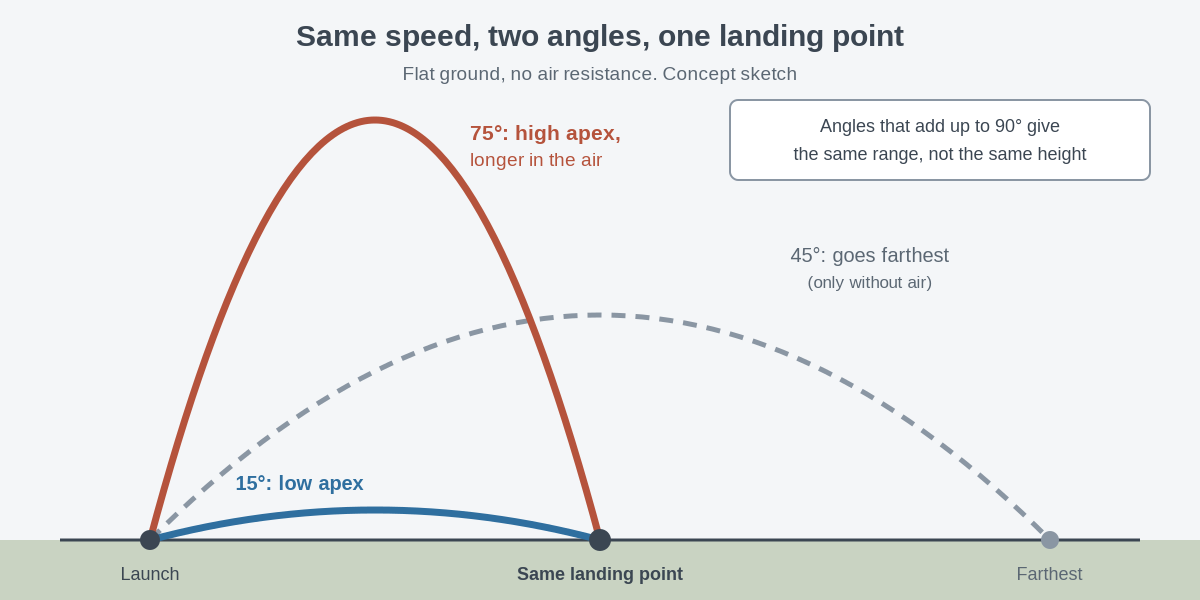
A ball that climbs higher also stays in the air longer. How high it goes is set only by the upward part of its starting velocity, and how long it stays up is set by the up-and-down motion alone. A steeper throw has a larger vertical part, so it flies higher and longer.
The reference path: the minimum-energy trajectory
A missile is not a thrown ball. For the first few minutes its rocket engines burn and push it upward. After the engines shut off, gravity does most of the work. That story is told in Ballistic missiles: why they climb high and come down.
So a missile also faces the question of which path takes the least effort. A 1992 paper by Gronlund and Wright in the journal Science & Global Security gives the answer. Once the flight range and the altitude where the engines stop burning are fixed, there is exactly one most energy-efficient ballistic missile path. That path is the minimum-energy trajectory (MET).
This most efficient path is the yardstick for the other two names. A lofted trajectory stands the path up higher than this, and a depressed trajectory lays it down lower.
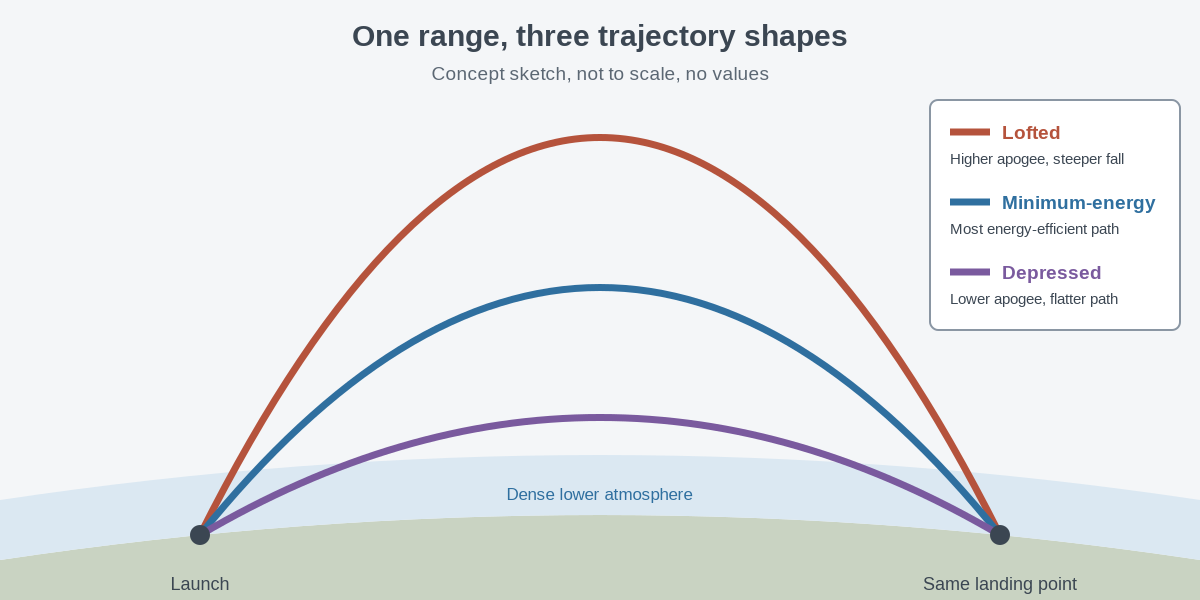
When, then, can a missile leave the reference path? For the submarine-launched ballistic missiles (SLBMs) that Gronlund and Wright studied, it can happen when the missile flies less than its maximum range. In that case the missile can use its spare fuel to fly a less efficient path, one with a lower or a higher apogee. Even in routine operations, trajectories may sit slightly above or below the minimum-energy path for various reasons.
Standing the path up: the lofted trajectory
A lofted trajectory climbs higher than the minimum-energy trajectory. The Japan Ministry of Defense describes it, compared with the minimum-energy path, as reaching a high altitude and falling at a steep angle. In ball terms, it is the 75° throw.
The ball comparison only goes so far. A real missile is not an object thrown at a fixed angle from the start. As the ministry's material notes, a missile can take several flight trajectories through control after launch. That is why the same missile can show very different maximum altitudes and flight distances depending on the path it takes.
Laying the path down: the depressed trajectory
A depressed trajectory is the opposite case. The name refers to paths pushed substantially below the minimum-energy trajectory. The Japan Ministry of Defense describes it, compared with the minimum-energy path, as flying fast at a low altitude.
How flat is it? Gronlund and Wright use a range of 1,850 km as an example. Over that range, a depressed trajectory comes back into the atmosphere at a shallow angle of roughly 5–10°, while a minimum-energy trajectory of similar range comes in at roughly 40°. Even for the same range, a depressed trajectory does not have just one shape or one apogee.
Coming in low also changes how the missile meets the air. The part that reenters the atmosphere with the warhead is called the reentry vehicle. Air drag slows it down, and its kinetic energy turns into heat in the surrounding air, wrapping it in very hot air. A shallow path is one that slants through the atmosphere on the way down.
Reading "lofted launch" in the news
When a news report says a missile was fired on a lofted trajectory, picture the path that stands up high.
Back to the 2022 example. According to the ministry's white paper, North Korea fired one ballistic missile on February 27 and one on March 5, and both are assessed to have flown lofted trajectories. Each traveled about 300 km, and the maximum altitudes were about 600 km and 550 km. Drawn with height and distance on the same scale, the path is a tall, narrow arch rather than a wide, flat one.
There is also a record of the same type of missile flying different paths. The white paper says North Korea fired the missile it calls "Hwasong-12" once on May 14, 2017, and once on January 31, 2022. Judging from the flight patterns, the ministry assessed that both were lofted. The white paper assesses that on a nominal trajectory the maximum range would be close to about 5,000 km.
The same type was also fired once on August 29 and once on September 15, 2017, and both missiles passed over Hokkaido, Japan. The ministry's material gives flight distances of about 2,700 km and 3,700 km. So the same type logged a few hundred kilometers on lofted launches and a few thousand on the flights over Japan.
That means the "flight distance" in a lofted-launch report is not the same thing as how far the missile can go. The white paper itself lists the lofted-launch record separately from its range assessment for a nominal trajectory. When the maximum altitude is close to or larger than the flight distance, picture a path stood up high, like the ball thrown at 75°.
Where this meets lasers: the shape is set during boost
The three paths split while the engines are burning. On a minimum-energy trajectory, the missile rises straight up and then tilts by a small angle early in flight. After that, the thrust stays along the body of the missile while gravity alone bends its path. Once the engines stop, gravity carries on along the path set up to that point.
This powered flight is short. According to a National Research Council (NRC) report, it usually lasts 60–300 seconds. The exact time varies with the missile's range and the kind of propellant it burns.
There was a laser program aimed at exactly this short boost phase. According to the U.S. Government Accountability Office (GAO), the Air Force started an acquisition program for the Airborne Laser (ABL) in 1996. The ABL was a laser weapon system meant to defeat ballistic missiles while their engines were still burning, in the boost phase. What that laser did in its 2010 tests, and how the program ended, is covered in 2010: YAL-1, the 747 Laser Intercept Test and the End of the Program.
What to read next
- Ballistic missiles: why they climb high and come down: the three phases of flight and the names based on range
- 2010: YAL-1, the 747 Laser Intercept Test and the End of the Program: the tests and end of a laser aimed at the boost phase
- Hypersonic glide vehicles: a different flight path: weapons that leave the ballistic path
- What circular error probable (CEP) means