On August 24, 2025, India's Press Information Bureau (PIB) put out a short release. Off the coast of Odisha, two kinds of missiles and one laser weapon had together brought down three targets. So which part did the laser play? Read the release to the end, and the answer is not there.
This article follows the laser weapons of India's Defence Research and Development Organisation (DRDO) through documents the government itself published. It lines them up by date, from one line in a 2014 laboratory table to the 2025 tests, and separates what the documents state from what they leave blank.
Who does the research: CHESS in Hyderabad
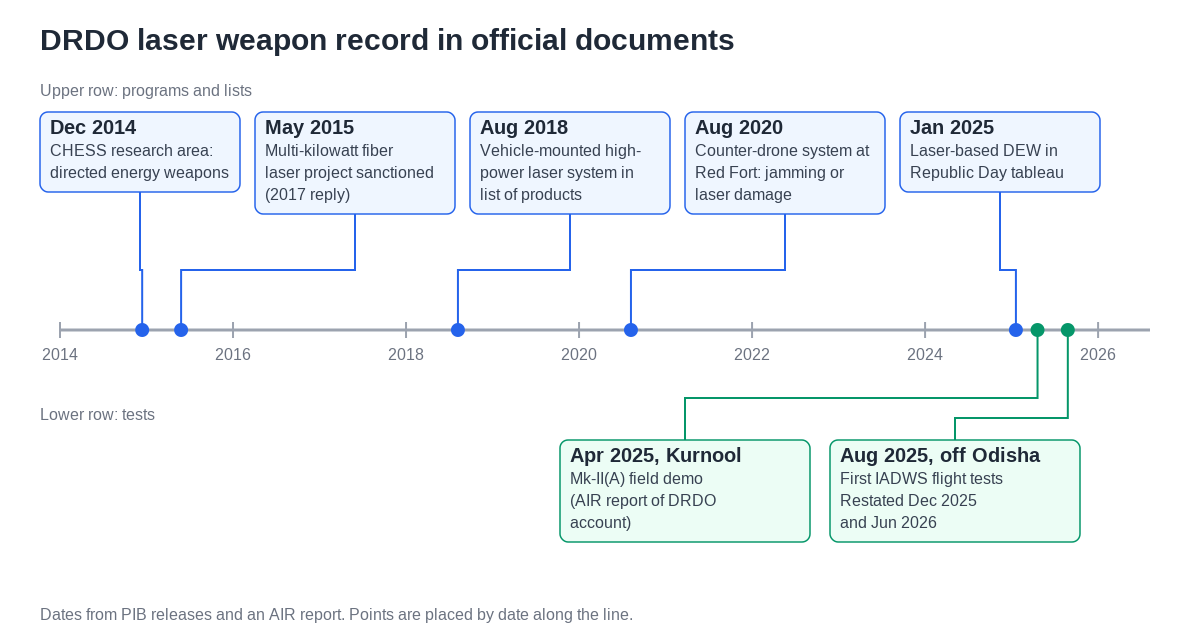
The story starts with one line in a table. In December 2014, India's defence minister attached a table of DRDO laboratories, their locations and research areas, to a written reply in the lower house of parliament. The entry for the Centre for High Energy Systems and Sciences (CHESS) in Hyderabad reads "Directed Energy Weapons."
A directed-energy weapon (DEW) acts on a target with concentrated electromagnetic energy instead of a projectile. Laser weapons belong to this group. CHESS also appears in both tests below. According to AIR, it carried out the Kurnool demonstration, and according to the PIB release, it developed the IADWS laser weapon.
2015 to 2018: a fiber laser project and a vehicle-mounted system
A written reply in February 2017 included a table of major projects sanctioned since 2014. The table lists only projects costing more than 100 crore rupees. One of them is "Development of Multi-kilowatt Fibre Laser," sanctioned in May 2015.
The next year, an August 2018 reply listed the products DRDO had developed over the previous three years. The list includes a "Vehicle Mounted High Power Laser Directed Energy System Against RPVs/UAVs/DRONES." The list gives only names, with no test dates or power levels.
2020 and January 2025: a counter-drone system and Republic Day
The defence ministry's year-end review for 2020 has a paragraph on a counter-drone system. It says that DRDO's anti-drone system was deployed at the Red Fort for the prime minister's security during his Independence Day address that year. The system can bring down micro drones either by jamming the links that steer them or by damaging them with a laser-based directed energy weapon.
Read closely, the laser is one of two methods in that sentence. The document does not say a laser was actually used at the Red Fort.
In January 2025, PIB announced the list for DRDO's tableau in the Republic Day parade. The theme was "Raksha Kavach – Multi-layer Protection against Multi-domain Threats," and a "Laser-Based Directed Energy Weapon" was among the systems on display.
April 2025 at Kurnool: the Mk-II(A) field demonstration
The earliest test report found for this article came on April 13, 2025. India's public broadcaster, All India Radio (AIR), reported a field demonstration by CHESS that day at Kurnool in Andhra Pradesh. The system was the land version of a vehicle-mounted laser directed weapon, the "DEW Mk-II(A)."
AIR relayed DRDO's account as follows. In the demonstration, the system defeated a fixed-wing drone and swarm drones, causing structural damage and disabling their surveillance sensors.
AIR also quoted DRDO chairman Samir V. Kamat, who said this was "just the beginning of the journey." He added that DRDO is also working on other high energy systems, such as high energy microwaves and electromagnetic pulse.
August 2025 off Odisha: the Integrated Air Defence Weapon System
Four months later, the next test came out as a PIB release. DRDO conducted the first flight tests of the Integrated Air Defence Weapon System (IADWS) off the coast of Odisha at around 12:30 on August 23, 2025. IADWS is a multi-layered air defence system with three parts, all made in India. They are Quick Reaction Surface to Air Missiles (QRSAM), Advanced Very Short Range Air Defence System (VSHORADS) missiles, and a high-power laser-based directed energy weapon.
The release describes who did what. A central command and control (C2) centre built by the Defence Research & Development Laboratory (DRDL) runs the three weapons together, and DRDL is the lead laboratory of the program. VSHORADS was developed by Research Centre Imarat (RCI), and the laser weapon by CHESS.
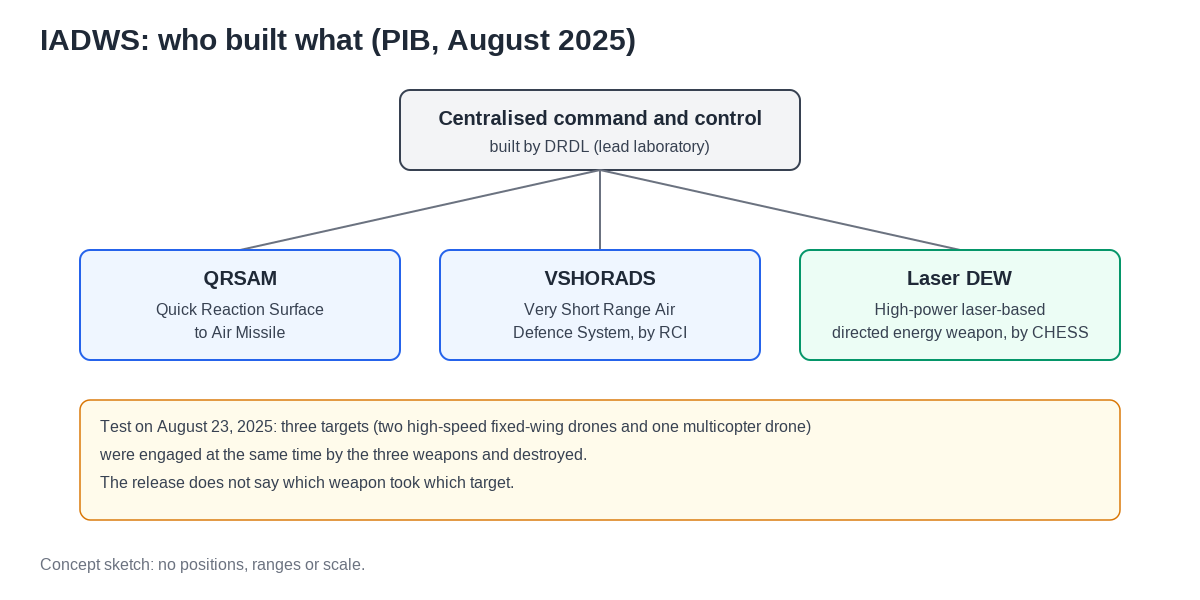
The result takes one sentence. There were three targets: two high-speed fixed-wing drones and one multicopter drone. The QRSAM, VSHORADS and high-energy laser (HEL) weapon system engaged them at the same time, at different ranges and altitudes, and destroyed them completely. Range instruments of the Integrated Test Range at Chandipur recorded the flight data and confirmed the outcome.
What later government documents repeated
The same test came back in later government documents several times. Three days after the release, the defence minister made special mention in a speech of the first IADWS test and of a high-powered directed energy weapon. The ministry's year-end review on December 31, 2025, carried the opening sentence of the August release almost word for word.
In "The Defence Decade," a booklet PIB published in June 2026, the wording got shorter. It says in one line that on August 23, 2025, DRDO tested an air defence system that brought together missile interceptors, short-range air defence systems, and laser-based technology.
What was made public and what was not
| Item | What the documents state | Document |
|---|---|---|
| Research lab | CHESS (Hyderabad), research area directed energy weapons | PIB 2014-12 |
| Fiber laser project | "Development of Multi-kilowatt Fibre Laser," sanctioned May 2015 | PIB 2017-02 |
| Vehicle-mounted system | Named in a list of developed products | PIB 2018-08 |
| April 2025 demonstration | Structural damage to a fixed-wing drone and swarm drones, surveillance sensors disabled (DRDO's account) | AIR report 2025-04 |
| August 2025 test | Three targets engaged at once and destroyed by three weapons, confirmed by range instruments | PIB 2025-08 |
| Developers | C2 by DRDL, VSHORADS by RCI, laser by CHESS | PIB 2025-08 |
| Power of the IADWS laser | Not stated | PIB 2025-08, 2025-12 |
| Targets taken by the laser | Not broken out | PIB 2025-08 |
| Engagement range | Only "different ranges and altitudes" | PIB 2025-08 |
The upper rows hold names and dates; the lower rows are the blanks. If an article gives a power or engagement range for the IADWS laser, that number does not come from the government documents in this table.
Questions to ask when reading the record
Where is the power level stated? Apart from "Multi-kilowatt" in the name of the 2015 project, none of the PIB documents traced here gives a power figure for the laser. Neither the August 2025 IADWS release nor the year-end review that followed has one.
The phrase "destroyed three targets" also needs a look at its subject. The subject of that sentence is the three systems together: two missiles and one laser weapon. How many targets the laser handled on its own cannot be read from it. How to read sentences like this is covered in How to read laser weapon news.
The documents are also of different kinds. The 2015 project and the 2018 product list come from tables in written replies to parliament, while the two 2025 tests come from a press release and a broadcast report. What happened between the year a name entered a table and the year a test was made public is not traced in official documents.
What to read next
- Laser weapon programs that have been made public: official announcements from several countries in one table.
- Lasers Against Drones: From Iron Beam to National Prototypes: how laser prototypes against drones have developed.
- What is a fiber laser? Growing light inside a thin glass fiber: the principle behind the fiber laser named in the 2015 project.
- The Counter-Drone Chain: Detect, Identify, Track, Defeat: where a laser fits in a counter-drone system.